

 These days deep emotions seem to burst forth at unexpected moments.
While in the car between visiting a pumpkin farm owned by friends and the local cider mill, I decided to pull out a crumpled paper with my brief presentation on the history of Crete. “Does anybody want to hear a story?” I asked my captive audience of one of my best friends and her three boys. “Yes!” As the fall foliage whirled by, I started reading, thinking that attention would wander soon, and I’d put it away. To my surprise the boys wanted me to keep reading and even asked that I continue the story when we returned to the car after a break to feed ducks.
When I finished, the youngest boy exclaimed “that was the best story I’ve ever heard!” I was thrilled I had related it in a way that he enjoyed so much and recognized in his giddy exclamation that mysterious emotional pull of the story of Crete that seemed to reach into his soul. Later he said to me as we watched the moon together, “you have to finish that story and add more about hope and the positive.” I told him, “The hope is in those who hear this story and others like it and strive to create a better world.”
So would you like to hear a story? Continue reading “A Story to Inspire Hope by Elizabeth Chloe Erdmann”
 We have nine justices usually but one of our most beloved, and notorious,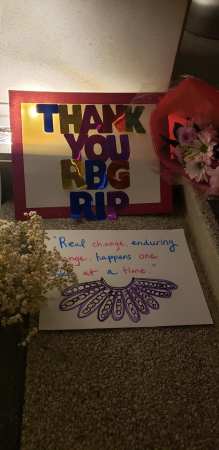
 Shortly after Kamala Harris was announced as Joe Biden’s choice for his Vice Presidential running mate, a panel of black women were asked, “How do you feel right now?” “I feel heard” was the simple yet profound response of one of them. As is well-known to those who follow the polls, black women voters are the backbone of the Democratic party. In the primary election, black women in South Carolina delivered the Presidential nomination to Joe Biden. Yet all too often black women have felt that their votes were taken for granted.
 Friends, it has been a few months since I’ve posted in this community. I’m amazed at how much our world has changed since then. Here in the northern hemisphere, spring came and went. It felt like a tide of turmoil rolled in, leaving debris all along the shore and now we are trying to clean it up while keeping our eyes on the sea for more dangerous waves that are coming.
 It’s July which means we have collectively endured 7 months of uncertainty, turmoil, darkness, and light. America, we are still battling all aspects of the virus: rising numbers of infected, those that deny its existence, those refusing to wear masks to help to stop the spread, and everyone else doing their duty by staying at home, washing their hands, and wearing masks. Yet, something else has added to the mix and the COVID19 pandemic; social media. Social media has taken on a whole new level for activism and resistance.
 I woke up this morning with a terrible itch in my mind. I want to sue the government. I’m not a lawyer, at least not yet, and I know that governments have sovereign immunity that typically prevents them from being sued. But, it didn’t and doesn’t seem right that I feel so lied to and unprotected during this pandemic. What is more, I know I am not deluded. Either it is bad or it isn’t. Either it is spreading and lethal, or it isn’t. Either precautions help, or they don’t. It can’t be that ambiguous from a viral-behavioral perspective. Government leadership refuses to speak or model a consistent, truthful, and accountable model for the social welfare, leading to such absurd reductions (in Ohio, for example) as that each individual school child can decide whether s/he wants to wear a face-covering this fall. So, what gives? Why all the half-, mixed, mis-, and disinformation?
 For the past four Sunday afternoons, I’ve walked along Monument Avenue in Richmond, Virginia, to observe firsthand the changes happening to the statues of Confederate generals placed there a century or so ago. I focus here on the Robert E. Lee statue. Robert E. Lee (1807-1870) “…was an American Confederate general best known as a commander of the Confederate States Army during the American Civil War” (Wikipedia). These days, Lee’s statue seems to be home base for activists who are working diligently to keep protests and demonstrations ongoing, yet peaceful.
 Sara is a naturalist, ethologist ( a person who studies animals in their natural habitats) (former) Jungian Pattern Analyst, and a writer. She publishes her work regularly in a number of different venues and is presently living in Maine.
 Regionalism
 Feminism and Religion