Charity Is Not Enough by Susan de Gaia

Gift giving is an important focus this time of year, along with reflection, reconciliation, and renewal. This spirit of charity is needed now more than ever. And yet, charity is not enough.

Thousands of women, maybe even millions, re-experienced the trauma of sexual assault when the American public heard and ignored Donald Trump’s admission of grabbing women “by the pussy” and the accusations of forced kissing by numerous women, electing him to office in 2016. This was followed by additional revelations of his immorality and corruption and, in a show of conscience by one political party, his impeachment by the U.S. House of Representatives.

Many have wondered how such a man could get elected and remain in office despite the many revelations of illegal activities, and complete lack of honesty, repentance, and conscience. The recent response by Trump and his allies to an editorial in Christianity Today favoring impeachment yields a clue: criticize Trump, and risk losing politically, financially, or worse. Today, one can’t even speak out. How many of Trump’s accusers received death threats? How many of his extramarital liaisons received a bribe to keep quiet?

The waters are muddy in the Trump era: politics divide us into winners and losers, and “our” administration sides with those who praise one man and against those who dare to disagree, aided by conservative religious leaders and institutions. This is a situation that our founders meant to prevent. But it is happening.

Also happening are racial and gender inequality on the rise. To many feminists this seems nightmarish and unexpected. Some of us saw it coming, but the extent of its public acceptance and open justification was something few could foresee.

At the same time, women and men are coming together; I have seen my networks and others expand more than ever. The increasing support and understanding for women’s issues by people of conscience, and the promotion of compassion and activism for all those who suffer, is a form of charity, one that is greatly needed now.

But such charity is not enough.  And charity from those who remain quiet about the corruption, immorality, and bullying in and outside of our government is not even welcome.

What we need is acknowledgement. This would be an important first step. And it is that which Trump and his allies push against the hardest, perhaps because they realize it can lead to the next steps, repentance and then change.

Trump’s perfect flawless existence is a thin veneer that most of us can see through. And yet, here we remain, at a standstill that is supported by willful ignoring of his true face by those with something to gain.

Acknowledgement, not charity, is needed now. No one is perfect, least of all one who claims that he is.


Susan de Gaia teaches Religion and Philosophy online for Central Michigan University and is General Editor of Encyclopedia of Women in World Religions: Faith and Culture across History (ABC-CLIO, 2018/2019). Susan lives in California and is active in social and environmental justice, peace, and women’s spirituality movements. She works locally to promote environmental sustainability, cultural diversity, and political action. She holds a Ph.D. in Religion-Social Ethics with a Graduate Certificate in the Study of Women and Men in Society (USC), and B.A. in Women’s Studies (UCSB).
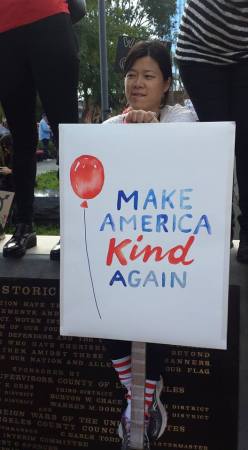
Poem: Make America Kind Again by Marie Cartier

Photo by Marie Cartier

Make America Kind Again was my favorite poster slogan of every Women’s March.

We’ve had three and will have a fourth soon, January 18. I’ll be there and hope I see this sign again.

It’s a sign that maybe it will happen –America will be kind again.

It will be a place where we don’t put kids in cages

Or gouge people’s health care

Or ban Muslims from entering our country

Or kick transgender people out of the military

Or threaten voting rights for Blacks

Or remove registered voters from the polls

Or… fill in the blank


Continue reading “Poem: Make America Kind Again by Marie Cartier”

The Holy of Holies and the Umbilical Cord: The Evolution of a Ritual Object by Jill Hammer

In the Jewish calendar, we’re just past the holiday season—the High Holidays, the harvest festival of Sukkot, and the concluding festival of Simchat Torah when the last verses of the Torah are read and the first verses are started again. The Torah readings for these holidays speak often of the offerings once made on the altar in the Tabernacle in celebration of these festivals.  Particularly on Yom Kippur, the readings mention the kodesh kodashim: the holy of holies. This enclosed sacred space contained, according to legend: the tablets of the Commandments inside an ark, topped by two cherubim that held up an empty space between them—an empty space understood to be the amplified presence of an invisible God.  As I think back over my powerful summer, which was largely spent with Jewish priestesses on various retreats and adventures (in Connecticut, Mississippi, California, Costa Rica, England and Scotland), I am thinking about a unique ritual object we use, and realizing that in its own way, it is a kind of Holy of Holies.

Continue reading “The Holy of Holies and the Umbilical Cord: The Evolution of a Ritual Object by Jill Hammer”

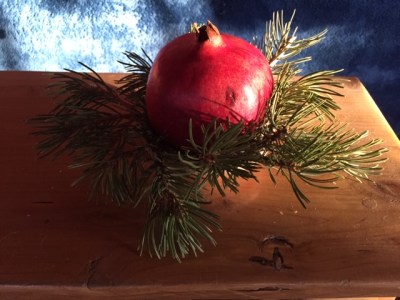
The Pomegranate by Sara Wright

It is mid November and shiny crimson Pomegranates catch the discerning eye in food markets; even Walmart carries them!

Why do these beautiful and very ancient fruits appear during this dark time of the year?

One answer to this question is that in the northern hemisphere the fruit of this deciduous shrub ripens anywhere from September to February. The reverse is true in the southern hemisphere when the fruits ripen during March, April and May. It is important to remember that in the southern hemisphere the seasons are reversed, so in both northern and southern parts of the globe these fruits appear in the fall, during the darkest months of the year.

Pomegranates are native from Iran to northern India and have been cultivated throughout the Middle East, Asia and the Mediterranean region for millennia. (Today they are also grown in California and Arizona, so they no longer need to be imported). The shrub was domesticated as early as the 5th millennium BC. Pomegranates were the first trees to be domesticated in the Mediterranean.

Continue reading “The Pomegranate by Sara Wright”

Susan B. Anthony’s Bargain with the Devil by Carol P. Christ

Matilda Joslyn Gage


[T]he most grievous wrong ever inflicted on woman has been in the Christian teaching that she was not created equal to man, and the consequent denial of her rightful place in Church and State. –Matilda Joslyn Gage, Woman, Church, and State, 1893, page 1

I do not approve of their [referring to Gage and Stanton] system of fighting the religious dogmas of people I am trying to convert to my doctrine of equal rights to women. –Susan B. Anthony to Olympia Brown, following the disputed merger of the radical National Women’s Suffrage Association with the conservative American Women’s Suffrage Association in 1889

Most readers of Feminism and Religion know that Susan B. Anthony and Elizabeth Cady Stanton were leaders in the nineteenth century struggle for women’s rights. Fewer will know that Matilda Joslyn Gage was widely understood to be Stanton’s equal as a theorist and Anthony’s equal as an organizer. The fact that Gage’s contributions have been lost to history can be attributed to Susan B. Anthony’s bargain with the devil.

If Anthony’s bargain had affected only the reputation of Matilda Joslyn Gage, that would be bad enough. But Anthony’s decision to merge the NWSA with the AWSA signaled that the women’s rights movement would cease and desist from its policy of naming and indicting Christian dogma as the source and cause of women’s subordination in the law in Christian countries. This decision meant that feminists would no longer have a clear understanding of the forces they were reckoning with. Continue reading “Susan B. Anthony’s Bargain with the Devil by Carol P. Christ”

Poem: She Works Hard for the Money and a Working Class Dream by Marie Cartier

My neighbor gets up at 2 a.m. and is at work by 3:30 a.m.
Six days a week.
She works hard for the money*

She works at a grocery store. She has two dogs and I have two dogs.
Our dogs like each other and we talk about going to the dog beach
together, but who can plan that? We’re lucky to run into each other in our own neighborhood.
“Hey, how are you?” “Tired. You know.”
So hard for the money

I do know. I teach six classes at two universities. My wife works freelance for an overseas company
in artificial Intelligence designing for humans to be obsolescent.
In the meantime, she has no time to sleep.
My neighborhood is all plumbing trucks, gardening trucks and vehicles that go to work.
People leave in the morning to make the world turn. And they come home late at night.

So hard for it honey. Continue reading “Poem: She Works Hard for the Money and a Working Class Dream by Marie Cartier”

ERA—Equal Rights for Women—in the US: Has Our Time Finally Come? by Carol P. Christ

On August 26, 1970, I borrowed an old VW bug from my mentor and summer employer Michael Novak to drive from Oyster Bay, Long Island to New York City to take part in the Women’s Strike for Equality march down Fifth Avenue. Some 50,000 women attended the march and another 50,000 took part in sister actions around the United States. The march celebrated the 50th anniversary of the passage of the Women’s Suffrage Amendment that gave women the right to vote. The ERA was on our minds, but it was not the only issue on the feminist agenda. We believed that all the walls created by patriachy would come tumbling down, and soon! Continue reading “ERA—Equal Rights for Women—in the US: Has Our Time Finally Come? by Carol P. Christ”
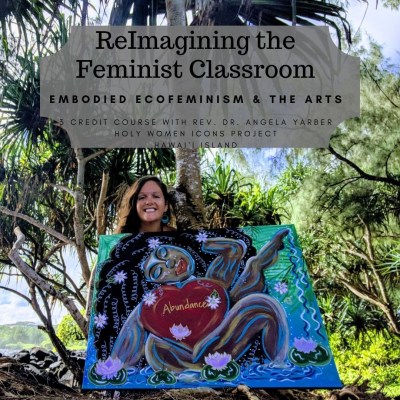
Reimagining the Classroom: Embodied Ecofeminism and the Arts Course on Hawai’i Island by Angela Yarber

“The classroom remains the most radical space of possibility in the academy.”-bell hooks

Like many academics, my “in the box” dream was to be a professor. The full-time, tenured kind. Like many queer feminist academics, I know that such dreams are rarely reality. When you’re also an artist and activist with a strong penchant for wanderlust, these dreams are simply unattainable fairytales. Never one for “in the box” living, I left the traditional academy and traditional church years ago, wandering over the garden’s walls with Lilith as my intrepid guide. I’ve told the story before. My wife and I left our jobs, sold our home, traveled full-time with our toddler, and turned the Holy Women Icons Project into a non-profit while building an off-grid tiny house on the television show Tiny House Nation in Hawai’i. It’s become old news. But since we’ve been doing this for several years now, those faraway dreams are finally starting to become reality. The academic classroom, the activist’s platform, the artist’s studio, the feminist’s megaphone, and the farmer’s orchard are fusing into one creative, life-giving, empowering space for teaching. The Holy Women Icons Project’s first academic course, “Embodied Ecofeminism and the Arts,” is actually happening. Seminarians and doctoral students from Berkeley join us in January. They’re soon followed by undergraduates from New York and seminarians from Atlanta. And I’m reaching out to more and more schools interested in creatively, subversively, and sustainably decolonizing the classroom with us for one week on the Big Island.

Continue reading “Reimagining the Classroom: Embodied Ecofeminism and the Arts Course on Hawai’i Island by Angela Yarber”

Metamorphosis and a Press Conference: A Kafkaesque and Shakespearean Fantasy about an Unreal Individual by Barbara Ardinger

Donald wakes up too early. Feeling confused and disoriented, he looks around the room. His bed has disappeared! He seems to be lying on the floor. Why? he asks himself, how’d I fall off my king-size bed? The floor (uncarpeted??) seems to go on around him forever, sans furniture, sans TVs, sans his solid gold toilet, sans even the doors and windows. It’s all a great big blank. All around him. Where am I? he asks himself.

He had disturbing dreams all night, and not just last night, but for…well, awhile. Since the subpoenas. He keeps seeing big, strong, silent men wearing jackets with initials on the back carrying big boxes out of his various offices. All of them. All over the world. In one repeating dream, a man dropped a box. It fell open, scattering papers filled with names and numbers. The men picked everything up, put the papers back in chronological order, and resealed the box. They kept carrying the boxes out to black vans that didn’t have names painted on them.

Continue reading “Metamorphosis and a Press Conference: A Kafkaesque and Shakespearean Fantasy about an Unreal Individual by Barbara Ardinger”

From the Biblical ‘Woman on Fire’ to Female Kurdish Fighters: The Women Who Mama Up by Tallessyn Zawn Grenfell-Lee

I was one of millions inspired by Greta Thunberg’s speech to the United Nations. In her usual courageous fashion, she spoke plain truths all adults need to hear about our failure to assure a future for generations of all creatures. Yet you all come to us young people for hope? How dare you? she rebuked us. How dare you?

The beginning of her speech actually struck me the most. This is all wrong, she said. I shouldn’t be up here. I should be back in school, on the other side of the ocean. Her words echoed the words of the small, simple hobbit Samwise in Lord of the Rings, as he and Frodo journey into the terrifying, almost certain death of Mordor. In the film, Sam says: It’s all wrong. By rights we shouldn’t even be here. Continue reading “From the Biblical ‘Woman on Fire’ to Female Kurdish Fighters: The Women Who Mama Up by Tallessyn Zawn Grenfell-Lee”