

 It’s July which means we have collectively endured 7 months of uncertainty, turmoil, darkness, and light. America, we are still battling all aspects of the virus: rising numbers of infected, those that deny its existence, those refusing to wear masks to help to stop the spread, and everyone else doing their duty by staying at home, washing their hands, and wearing masks. Yet, something else has added to the mix and the COVID19 pandemic; social media. Social media has taken on a whole new level for activism and resistance.
Category: Activism
On This Fourth of July by Natalie Weaver
 I woke up this morning with a terrible itch in my mind. I want to sue the government. I’m not a lawyer, at least not yet, and I know that governments have sovereign immunity that typically prevents them from being sued. But, it didn’t and doesn’t seem right that I feel so lied to and unprotected during this pandemic. What is more, I know I am not deluded. Either it is bad or it isn’t. Either it is spreading and lethal, or it isn’t. Either precautions help, or they don’t. It can’t be that ambiguous from a viral-behavioral perspective. Government leadership refuses to speak or model a consistent, truthful, and accountable model for the social welfare, leading to such absurd reductions (in Ohio, for example) as that each individual school child can decide whether s/he wants to wear a face-covering this fall. So, what gives? Why all the half-, mixed, mis-, and disinformation?
Robert E. Lee Gets a Makeover by Esther Nelson
 For the past four Sunday afternoons, I’ve walked along Monument Avenue in Richmond, Virginia, to observe firsthand the changes happening to the statues of Confederate generals placed there a century or so ago. I focus here on the Robert E. Lee statue. Robert E. Lee (1807-1870) “…was an American Confederate general best known as a commander of the Confederate States Army during the American Civil War” (Wikipedia). These days, Lee’s statue seems to be home base for activists who are working diligently to keep protests and demonstrations ongoing, yet peaceful.
Most of what I see and hear from those visiting the statue reflects a longing for marginalized people—especially African-Americans—to be fully included in our country, much of which was built by means of their enslaved labor. Some people are angry about the destruction of property. “What good does that do?” Or, “This [graffiti] is ridiculous.” Once I heard, “I’m a fourth generation Richmonder and they have no right to do this to my city.” Continue reading “Robert E. Lee Gets a Makeover by Esther Nelson”
The Song of the Forest by Sara Wright

When He comes
I forget who I am.
My story vanishes.
Boundaries dissolve.
Emerald green,
leaf filtered light,
clear mountain streams,
trees, lichens, moss –
become ‘all there is’.
In the still dawning
animals speak.
Nature’s ultimate gift is that given the chance S/he dissolves the artificial socially constructed boundaries that humans have erected to separate themselves from the Earth who is burning in the Fire, unable to breath, as many of us are beginning to do now.
We have a choice to re-establish interconnection – to become part of the original family that birthed us into life 500 million years ago… regardless of outcome.
Developing an intimate connection with Nature allows us to disappear into the whole. Ironically, dissolution of self is where peace is found.
 Sara is a naturalist, ethologist ( a person who studies animals in their natural habitats) (former) Jungian Pattern Analyst, and a writer. She publishes her work regularly in a number of different venues and is presently living in Maine.
Matriarchal Politics The Vision of an Egalitarian Society (Part 2): Macrostructures by Heide Goettner-Abendroth
 Regionalism
In a new matriarchal society, “bigger” is not necessarily “better.” The smaller units of society, responsible for engendering person-to-person and transparent politics, are given preference. They must not become so big that people cannot see through them, and cannot participate in their decisions, as is the case in so many of today’s national states and super-powers. But they must be big enough to safeguard their self-sufficiency by a subsistence economy, and the diversity of their handiwork, technologies and arts. The ideal dimension is that of the region.
The borders of a region are not random, like national borders are; rather they have developed out of the conditions of the landscape and out of cultural traditions. Regional borders are formed by the decisions of the people themselves who want to live together on the basis of common cultural and spiritual traditions; this avoids any war of culture or of religion. Often the landscape corresponds to these cultural borders, because natural borders can be formed by mountain ranges, rivers, big lakes, or the sea which bind and bound people into their regional places. Continue reading “Matriarchal Politics The Vision of an Egalitarian Society (Part 2): Macrostructures by Heide Goettner-Abendroth”
Gardening Through the Storm by Tallessyn Zawn Grenfell-Lee
 I spend a lot of time thinking about gardens. I think there might be something to them.
It seems strange to talk about gardens during such an intense time. The crucible of injustice, laid so bare during the pandemic, is overflowing all around us in a volcanic eruption of protests and retaliation. And more and more, we understand how it’s all connected – poverty, violence, choking black men, choking women, a choking planet. All connected in a huge, toxic river of greed, fear, destruction, and death.
Continue reading “Gardening Through the Storm by Tallessyn Zawn Grenfell-Lee”Coming Out of Quarantine by Angela Yarber
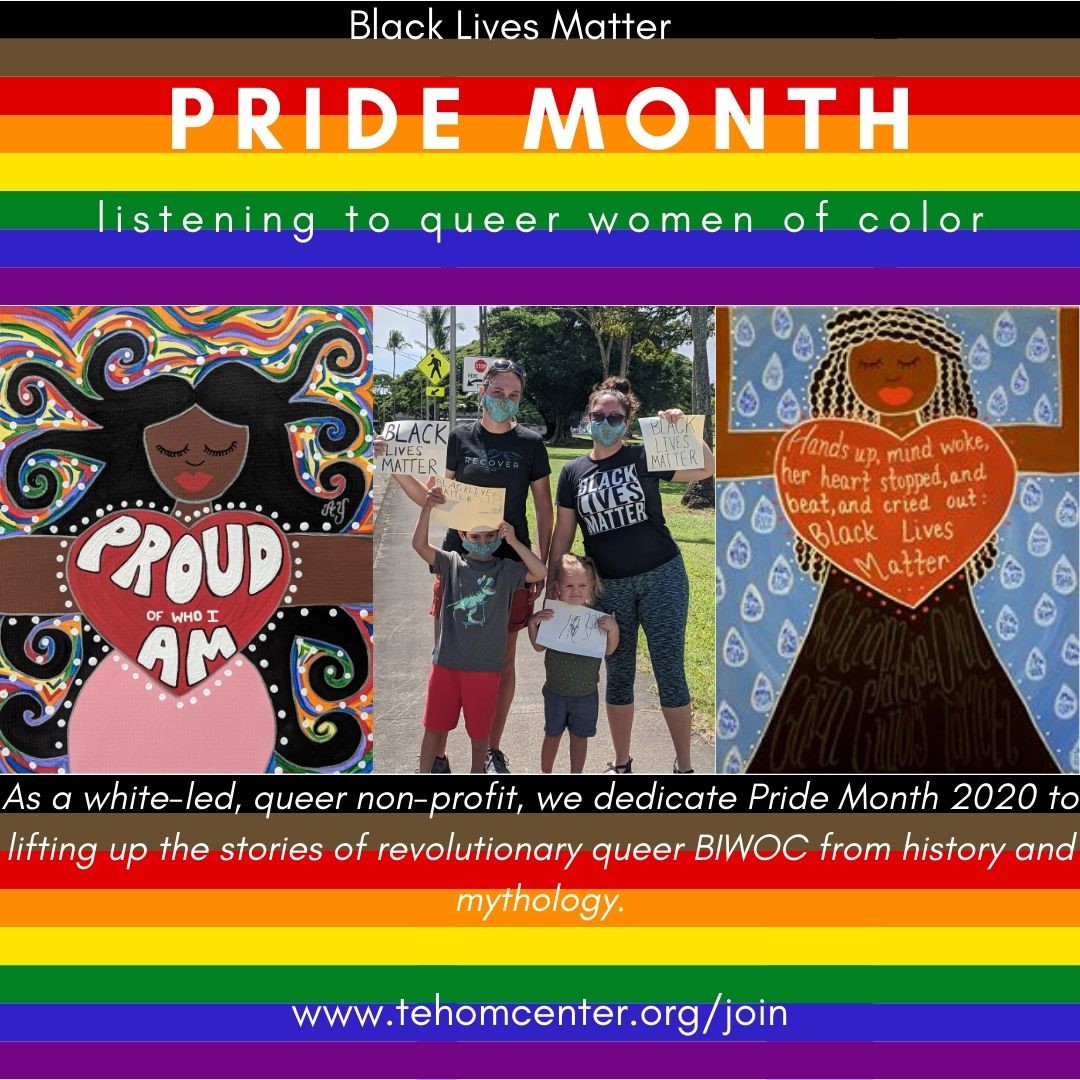 As Pride Month and Black Lives Matter protests co-exist, the spirituality of queer women of color teaches white allies how to listen.
After nearly eighty days of sheltering in place, I feel like I’ve stepped out and found the world on fire. June isn’t supposed to be this way. It’s Pride Month, after all, and I’m queer, eager to dance alongside my favorite drag queens, albeit reticent to embrace capitalism’s commodification of our beloved rainbows.
Most of our annual Pride events have been cancelled due to concerns of social distancing amid a global pandemic. I support these cancellations, though my first family outing since quarantine was a Black Lives Matter protest in Hilo, Hawai’i; we all stood six-plus feet apart, wore masks, and waved our signs beneath the King Kamehameha statue. As my six-year-old was complimented on how he wrote his own sign, I adjusted my three-year-old daughter’s face mask and thought about how queer BIPOC started the Stonewall riots only 51 years ago. I thought about how we queers would have every right to demand our Pride celebrations, storming capitals with glitter bombs, and demanding our civil liberties, not completely dissimilar to the myriad gun clad white dudes demanding haircuts only weeks ago. But we don’t. Continue reading “Coming Out of Quarantine by Angela Yarber”
This is a Wake Up Call by Mary Sharratt
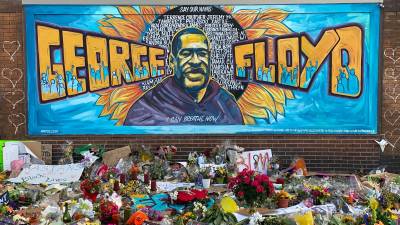 George Floyd Memorial, Minneapolis
This month I had originally intended to blog on the injustice of UK landowners using Covid19 as a ruse to illegally block public footpaths during lockdown when country walks are one of the few pleasures remaining to many people. However, recent events have completely blown that essay out of the water. In my hometown of Minneapolis, police officer Derek Chauvin suffocated beneath his knee George Floyd, an unarmed black man accused of a minor offense, while three other Minneapolis police officers stood by and did nothing. Outrage for this brutal and senseless killing literally ignited protests across the Twin Cities and across the globe. Thus, it would seem a travesty not to devote my monthly blog to George Floyd and the protesters around the world who are calling for an end to systemic police brutality against black communities. Continue reading “This is a Wake Up Call by Mary Sharratt”
A Beary Peaceful Day by Sara Wright
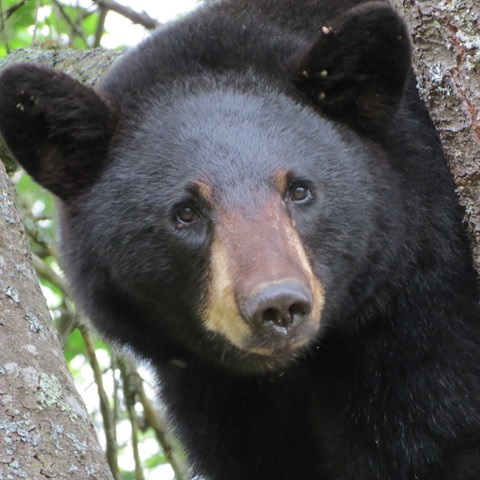
It is overcast and a few drops of rain are falling. I have been out talking to Tree Bear (TB), a yearling who has brightened my life in these dark soul days. Tree Bear comes up the mossy pine strewn path to the clearing and peeks at me from behind his white pine intermittently as he snacks.
There are so many old felled trees full of tasty grubs and ants now that the spring grasses have matured and gone by; soon the berries will ripen and Tree Bear will begin to put on weight. Acorns will be the choice of food for fall. Few people know that Black Bears are 93 percent vegetarian.
The other night I watched TB in the cherry tree, sitting in the branches like a monkey calmly combing out his thick under fur as he munched on cherry leaves and hard green cherries. He is a healthy looking and very beautiful yearling with brown eyebrows and a bump in his nose that is only visible from some angles. He probably weighs 50 – 60 lbs and has some brownish fur in places.
The Sacred Love We Can Share through Kindness and Patience by Elisabeth Schilling
 “Love is patient, love is kind.” – 1 Cor 13:4.
I think it was either Simone de Beauvoir or Betty Friedan who mentioned we live in a “sea of hostility.” Mainly it is the comment section of almost any post of photo or text where this can be evidenced. Since much of humanity spends a solid amount of time on social media these days, such negativity, judgment, criticism, canceling, and general snarky reactivity and pushing of opinion starts to leak into our veins. I was thinking about the human predicament the other day and what might be a central issue for many: the avoidance of pain.
We think we avoid suffering, discomfort when we project it on to another person. When we decide to play the game and live life for ourselves, acquiring more and more wealth, we forget there is a cost to the earth and often our near and far global neighbors. We try to avoid suffering when we demand our freedoms, trying to fashion a world according to our preference even as it means imposing our personal moralities onto others. Continue reading “The Sacred Love We Can Share through Kindness and Patience by Elisabeth Schilling”

