ERA—Equal Rights for Women—in the US: Has Our Time Finally Come? by Carol P. Christ

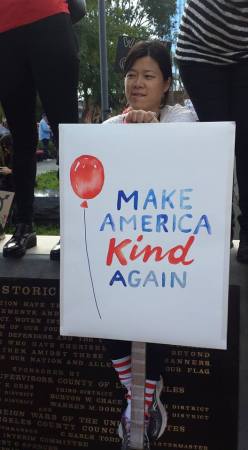
On August 26, 1970, I borrowed an old VW bug from my mentor and summer employer Michael Novak to drive from Oyster Bay, Long Island to New York City to take part in the Women’s Strike for Equality march down Fifth Avenue. Some 50,000 women attended the march and another 50,000 took part in sister actions around the United States. The march celebrated the 50th anniversary of the passage of the Women’s Suffrage Amendment that gave women the right to vote. The ERA was on our minds, but it was not the only issue on the feminist agenda. We believed that all the walls created by patriachy would come tumbling down, and soon! Continue reading “ERA—Equal Rights for Women—in the US: Has Our Time Finally Come? by Carol P. Christ”

Reimagining the Classroom: Embodied Ecofeminism and the Arts Course on Hawai’i Island by Angela Yarber

“The classroom remains the most radical space of possibility in the academy.”-bell hooks

Like many academics, my “in the box” dream was to be a professor. The full-time, tenured kind. Like many queer feminist academics, I know that such dreams are rarely reality. When you’re also an artist and activist with a strong penchant for wanderlust, these dreams are simply unattainable fairytales. Never one for “in the box” living, I left the traditional academy and traditional church years ago, wandering over the garden’s walls with Lilith as my intrepid guide. I’ve told the story before. My wife and I left our jobs, sold our home, traveled full-time with our toddler, and turned the Holy Women Icons Project into a non-profit while building an off-grid tiny house on the television show Tiny House Nation in Hawai’i. It’s become old news. But since we’ve been doing this for several years now, those faraway dreams are finally starting to become reality. The academic classroom, the activist’s platform, the artist’s studio, the feminist’s megaphone, and the farmer’s orchard are fusing into one creative, life-giving, empowering space for teaching. The Holy Women Icons Project’s first academic course, “Embodied Ecofeminism and the Arts,” is actually happening. Seminarians and doctoral students from Berkeley join us in January. They’re soon followed by undergraduates from New York and seminarians from Atlanta. And I’m reaching out to more and more schools interested in creatively, subversively, and sustainably decolonizing the classroom with us for one week on the Big Island.

Continue reading “Reimagining the Classroom: Embodied Ecofeminism and the Arts Course on Hawai’i Island by Angela Yarber”

Metamorphosis and a Press Conference: A Kafkaesque and Shakespearean Fantasy about an Unreal Individual by Barbara Ardinger

Donald wakes up too early. Feeling confused and disoriented, he looks around the room. His bed has disappeared! He seems to be lying on the floor. Why? he asks himself, how’d I fall off my king-size bed? The floor (uncarpeted??) seems to go on around him forever, sans furniture, sans TVs, sans his solid gold toilet, sans even the doors and windows. It’s all a great big blank. All around him. Where am I? he asks himself.

He had disturbing dreams all night, and not just last night, but for…well, awhile. Since the subpoenas. He keeps seeing big, strong, silent men wearing jackets with initials on the back carrying big boxes out of his various offices. All of them. All over the world. In one repeating dream, a man dropped a box. It fell open, scattering papers filled with names and numbers. The men picked everything up, put the papers back in chronological order, and resealed the box. They kept carrying the boxes out to black vans that didn’t have names painted on them.

Continue reading “Metamorphosis and a Press Conference: A Kafkaesque and Shakespearean Fantasy about an Unreal Individual by Barbara Ardinger”

From the Biblical ‘Woman on Fire’ to Female Kurdish Fighters: The Women Who Mama Up by Tallessyn Zawn Grenfell-Lee

I was one of millions inspired by Greta Thunberg’s speech to the United Nations. In her usual courageous fashion, she spoke plain truths all adults need to hear about our failure to assure a future for generations of all creatures. Yet you all come to us young people for hope? How dare you? she rebuked us. How dare you?

The beginning of her speech actually struck me the most. This is all wrong, she said. I shouldn’t be up here. I should be back in school, on the other side of the ocean. Her words echoed the words of the small, simple hobbit Samwise in Lord of the Rings, as he and Frodo journey into the terrifying, almost certain death of Mordor. In the film, Sam says: It’s all wrong. By rights we shouldn’t even be here. Continue reading “From the Biblical ‘Woman on Fire’ to Female Kurdish Fighters: The Women Who Mama Up by Tallessyn Zawn Grenfell-Lee”

Untapped Communal Potential and Yom Kippur by Ivy Helman

imageYom Kippur, the Day of Atonement, was the 9th of October 2019.  On this day, Jews typically attend shul, offer various prayers, and participate in some form of fasting.  The day is meant to be a reflection on the ways in which we, as individuals and as a community, have not been our best selves.  In this reflection, we speak aloud our objectionable behavior and ask for the Divine’s forgiveness.

In some Jewish communities, the ashamnu prayer, which we use to acknowledge our harmful and destructive behavior, has been the same for centuries.  Its particular form and composition is a stylized, alphabetized list of misdeeds. For example, one can find on the list stealing, lying, being rude, disobeying the Torah, participating in abominations, turning away from G-d and so on.  

That being said, many communities have rewritten the prayer to speak to modern-day failings.  For example, one can find concern for racism and anti-Semitism.  Another ashamnu highlights the need to end war.  I even found an ashmanu that was considerably more personal in its reflection.  It problematized self-doubt and supported self-care. Continue reading “Untapped Communal Potential and Yom Kippur by Ivy Helman”

Ant Hill by Sara Wright

Yesterday I gave a poetry reading at a local library beginning and ending with thoughts about how Climate Change is affecting all living things. I am a naturalist who holds the radical belief that all living things are sentient. I also argue that we must not equate animal intelligence with that of humans.

Almost every poem I read was about my intimate relationship with some aspect of the natural world, for example, the changing seasons, my friendship with sagebrush lizards, steadfast trees, Sandhill cranes, beloved Black bears. Intimacy and inter –relationship are part of every experience I have with nature and by sharing these poems I hoped might draw others in to new ways of perceiving the earth and her creatures.

The whole point of my focusing on non – human species was to raise awareness that these animals and plants desperately need our help. Perhaps I wasn’t clear enough about how critical it is to bring animals, plants, trees, mushrooms into the picture in this age of the Anthropocene, that is, the period in which we live where a few men with power rule. Today, it is not an exaggeration to say that humans control every aspect of our fragile planet.

I repeat: Perhaps I wasn’t clear enough or perhaps almost no one was capable of listening? Maybe both. As soon as I concluded my reading one woman did actually bring up an incident involving a very difficult child who became attached to a lizard, so she at least, was on the track I hoped I had laid….

Continue reading “Ant Hill by Sara Wright”

Call Out Culture vs. Mentor Culture: Which one will save us from the apocalypse? by Trelawney Grenfell-Muir

Have you felt the satisfaction of putting someone in their place? Have you ever felt the rush of power that comes with delivering a cutting set-down? Have you ever felt a glow of pride after making fun of a horrible person or group, and having the people around you laugh appreciatively?

I sure have. In high school, the bully-types in my classes learned not to pick on me to my face, and not to pick on my sister when I was in the room. I got damned good at snide, witty comebacks, and so people stopped messing with me. That kind of success was incredibly rewarding. It was a useful skill I honed over the years, so I could trot it out whenever needed. Rare these days, but my sister still occasionally says, “I’m just glad Trelawney’s in my corner.”

Oh, it feels good to WIN, to experience verbal conquest, and to know I’m justified in using my tongue as a sword, because that person SO deserved it! Ah, the adrenaline, the afterglow, the notch in my belt!

Continue reading “Call Out Culture vs. Mentor Culture: Which one will save us from the apocalypse? by Trelawney Grenfell-Muir”

Climate Change, the Generations and Religion’s Bad Rap by Susan de Gaia

As I reflect on my experience at the climate strike on September 20, 2019, I see a connection between climate change and the bad rap that religion has today. When asked what they think about religion, many are quick to point out how history has shown that it has been at the center of numerous wars. Even today we find conflicts between groups grounded in religious difference. There are other differences in these conflicts, such as ethnic differences, differences of social organization, and disagreements over territory, but religion is a clear element. Colonialism, misogyny, and priest sexual abuse are some other ways that religions have earned reputations for being too strict, too old fashioned, and too corrupt, among other things.

The climate strike was called Youth Climate Strike and had as one of its leaders a very special young woman, Greta Thunberg. It isn’t often that the youth are given a platform for their complaints and even rarer that a teenaged person – and a female at that – is seen as a world leader on one of the most important issues facing civilization. Not only does this young woman have the wisdom to see the problem from a global, even a cosmic, perspective, but she also stands before us as the face of the only group on the planet that is more impacted by climate change than any other – the youth.

Continue reading “Climate Change, the Generations and Religion’s Bad Rap by Susan de Gaia”

The Prophetess: Greta Thunberg, Global Warming, and the Legacy of Prophecy in Our Own Day by Jill Hammer

My community and many others have been watching in awe as Greta Thunberg makes waves around the world—her lone climate change protest in Sweden growing in a single year into a climate strike with millions of demonstrators around the world.  Of course, Greta isn’t asking us to listen to her.  She is asking us to listen to the science that will save us.  And Greta is not alone: there are young indigenous female protesters like performance poet and peace activist Lyla June Johnston of the Dine (Navajo) and Tsetsehestahese (Cheyenne) peoples and water protector Autumn Peltier of the Anishnaabe people, who are speaking before the UN and in other public settings about global warming, and revitalizing our spiritual relationship with Mother Earth. Yet Greta knows that her fame (and her youth) gives her a platform. She is conscientiously using that platform to testify before Congress and the UN, Tweet, post on Facebook, and do whatever else she can do to make an impact.  Recently, I’ve noticed that some people in my home Jewish community, when they post about Greta on social media, have given her a nickname: they call her “the prophetess.”

This appellation has deep history.  The Hebrew word for prophet is navi, and the word for prophetess is neviah. These words come from the root nun-bet-alef which means to announce or proclaim.  At one event I attended, a woman enacting the role of a prophetess announced: “I am God’s microphone,” and that is what a navi or neviah does: amplify the voice of the sacred. Continue reading “The Prophetess: Greta Thunberg, Global Warming, and the Legacy of Prophecy in Our Own Day by Jill Hammer”

A Blinding Light? by Sara Wright

Nature is a Living Being. Animals and plants have souls, and a spirit. Each species is unique, and yet we are all interconnected, human and non – human species alike. This is more than a both and perspective; its multi-dimensional.

Many books are written about using nature to heal humanity of its ills. ‘Recreate’. Climbing a mountain, or taking a walk are common examples of using nature to help ourselves, but how many of us are asking the question of how we can give back?

This is a question I was obsessed with for about thirty years and may be the reason I gained entrance into this seemingly secret world that we call Nature.* When I experienced unconditional love from both animals and plants I needed to reciprocate in kind. This idea of reciprocity between humans and the rest of Nature is probably similar to what Indigenous peoples experienced because they loved (or feared) and learned directly from animals, plants and trees. They respected animals, for example, for their unique qualities. Indigenous people never psychologized Nature the way westerners routinely do.

I rarely read books about Nature anymore because I am so troubled by this psychologizing. From my point of view psycho-babble is just another way of dismissing the reality of Nature as a living feeling, sensing, sentient Being.

Continue reading “A Blinding Light? by Sara Wright”