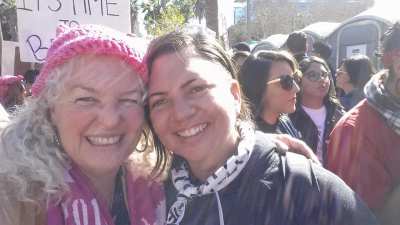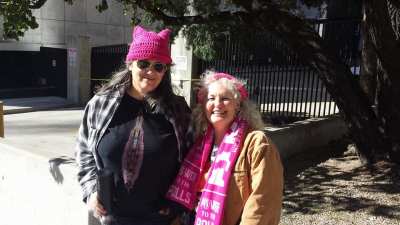
Photo Report from the 2nd Women’s March, January 20, 2018 by Marie Cartier

You can see my photo report from the last Women’s March 2017 here.

And you can see more of my photos from this 2018 march here, hereand here.

Please enjoy these radical feminist images from 2018! Yours in the struggle FAR family!

All photos by Marie Cartier

Continue reading “Photo Report from the 2nd Women’s March, January 20, 2018 by Marie Cartier”

Happy Anniversary, Women’s March, with love from Madge by Elizabeth Cunningham

Like many in the FAR community, I participated in the world-wide 2017 Women’s March.  So did Madge, the bodacious cartoon character who took me by surprise in 1990 and went on to become the narrative character of The Maeve Chronicles. Her life in print, as the first century Celtic Magdalen, satisfied her until….November 8th, 2016 when Madge returned, mouthy as ever, to rejoin us in our own times.


On the first anniversary of the historic march, I’d like to share a little of Madge’s millennia-spanning story and a few images from her two books of cartoons, now published in one volume.

Madge first appeared to me in 1990 as a line drawing of an ample woman sitting naked at a kitchen table drinking coffee. I had recently finished writing a novel, The Return of the Goddess, A Divine Comedy, and felt I had nothing more to say. I decided to play with magic markers for a while. Madge, as the naked woman introduced herself, was far from done with words. Fleshed out with peach magic marker, Madge told me she wanted “fiery neon orange” for her hair color. She also required speech balloons for her theological queries. (For example: If we are all members of the body of Christ, who is the twelve-year molar, the kneecap, the colon?) Enchanted with her sass, I invited her to be in my next novel. I pitched ideas to her. She rejected them all as too dull and said, “I want my own book of cartoons first.” Continue reading “Happy Anniversary, Women’s March, with love from Madge by Elizabeth Cunningham”

“Oh For a Pair of Clean Dry Warm Socks” by Carol P. Christ

Stories about refugees in the island of Lesbos (where I live) are no longer front page news. Yet according the United Nations Refugee Agency, 12, 742 refugees arrived here in 2017. This number is equivalent to 15% of the year-around population of the island. Though this number is huge, it does not compare to the estimated 91,506 arrivals in Lesbos in 2016. In January 2018, 7572 refugees are estimated to be stranded in the island waiting for their applications for asylum to be processed. The government-controlled reception center has a capacity of 2000, but up to three times that number are being housed there at any one time, in conditions that must be described as inhumane. It is suspected that “someone” in Greece or the European Union is slowing the asylum process in order to discourage refugees from attempting to enter the EU via Lesbos.

Recently I have begun to work with the Starfish Foundation, a local non-profit helping refugees on the island, using my skills as a writer to help with outreach. Today I share with the FAR community a blog I wrote to contextualize the desperation of the situation the refugees find themselves in.

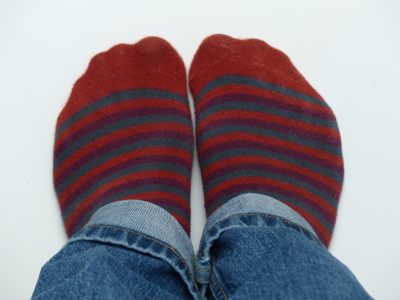
Think about it. Before you go out walking in town or countryside, you put on a pair of clean socks and then a pair of athletic shoes or boots. Your socks, which you take for granted—except when they get wet—protect your feet from blisters, callouses, and foot infections. Now imagine yourself as a refugee or migrant who has come across the wine dark sea, fleeing war. Your socks and shoes are soaking wet when you arrive. If you are lucky you will be given new shoes and socks, but then what happens?

You are taken to a refugee camp to wait for your asylum papers to be processed. While you are waiting, and it could be months or even a year, what happens to your socks? For sure they will get dirty, for you often have to walk on muddy and even sewerage infected paths in the camp. The toilets are filthy and when you have to use them, you try not to step in the muck, but sometimes you do.

You keep on wearing your socks, because you do not have a second pair. One day you decide to wash them and on that day blisters appear on your feet and become infected. You have always been a clean person, washing socks and underwear and all sorts of clothing for yourself and your family every day. But now you are facing the unknown, without even a clean pair of socks to put on your feet.  You bind up your wounds and pray that your one pair of socks will not be stolen from the wire fence where you hung them out to dry.

There is an urgent need for socks in the refugee camps of Lesvos where thousands of refugees wait to learn if they will be granted asylum.  It is hard for us who take our socks for granted to understand the difference a pair of clean dry socks could make in the life of a refugee.  A pair of clean dry socks could make all the difference in the world.

A plea for 300 pairs of socks for men and women from Euro Relief was one of the first postings on Starfish Foundation’s web page Needs Hub,  established  to connect organizations helping refugees on the island of Lesvos with donors. The request for 300 pairs of socks may soon be answered, but the need for socks in the refugee camps is on-going and immense. And socks are only one of the many things—from baby strollers and wheelchairs to shampoo and toothpaste–that the refugees need. Your gift, whether large or small, really could make all the difference in the world to a vulnerable person who needs your help.

Starfish Foundation is a Greek non-profit organization. Founded at the height of the refugee migration to the Aegean islands, which was called the greatest humanitarian crisis since the Second World War, Starfish Foundation works in co-operation with other organizations dedicated to helping refugees and migrants in the island of Lesbos. Please visit Stafish’s web page Needs Hub to learn what you can do. Donate to Starfish Foundation here.

 

Carol P. Christ is an internationally known writer and educator living in Molivos, Lesbos, who volunteers with Starfish Foundation to assist with writing and outreach. Carol’s new book written with Judith Plaskow, is  Goddess and God in the World: Conversations in Embodied Theology. FAR Press recently released A Serpentine Path: Mysteries of the Goddess. Join Carol  on the life-transforming Goddess Pilgrimage to Crete. Carol’s photo by Michael Honegger

Considering Our Spaces in the Pursuit of Justice by Elise M. Edwards

This past summer, my friend and I were perusing the exhibits at the National Museum of African-American History and Culture when she urgently called for my attention.  “Psst… Isn’t this where you are from?” she asked, pointing at a placard titled African American Life in Montgomery County.  Yes!  I grew up, I was educated, and I was churched in Montgomery County, Maryland.  So I eagerly read the exhibit’s description:
By 1900 there were at least eight African American communities in Montgomery County, Maryland. Unlike many rural African Americans, the residents were not tenant farmers—they owned their property and homes.  This gave them greater control over the land and the crops they produced.  They also directly benefited from improvements to their homes, which was an incentive to make additions and to stay in place.  Descendants of these early settlers still live in these communities today. Continue reading “Considering Our Spaces in the Pursuit of Justice by Elise M. Edwards”

30 Years of Activism by Vanessa Rivera de la Fuente

Diseño sin título

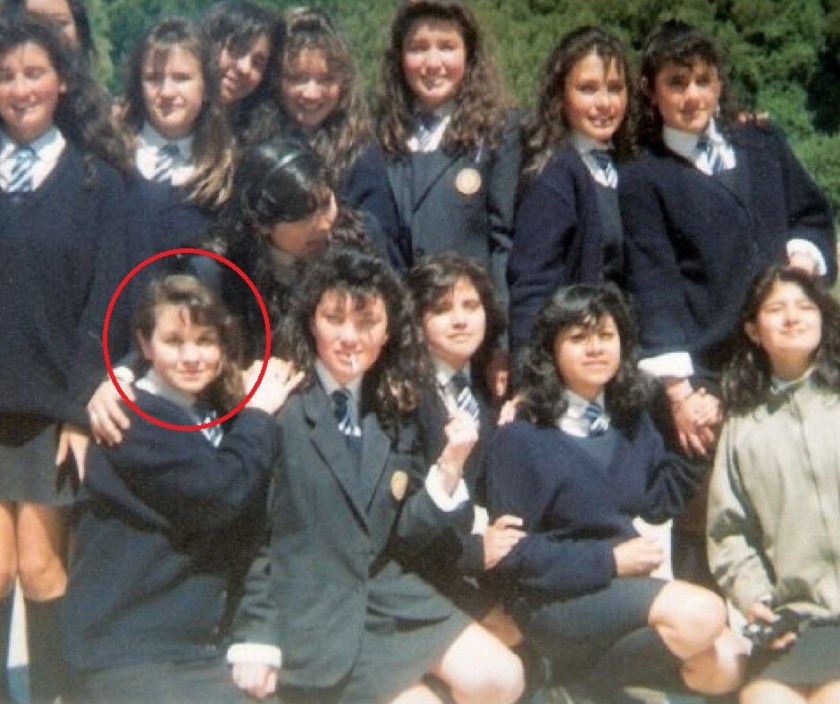
My first memory as an activist is of attending my first political public meeting to listen leaders of the resistance talking against the  Dictatorship, marching holding a sign that read “Democracy Now,” and taking my first dose of tear gas. It was 1988. I was 13 years old. My first menstrual period had come six weeks before. At that time, I didn’t know what feminism was; there were many books forbidden. Social Sciences such as Anthropology, Philosophy, and Sociology were banned in most universities.

But lack of theories could never prevent experience from happening and leaving its imprint. In 1990, at 15, I was gender conscious without recognizing my actions as feminism.

Continue reading “30 Years of Activism by Vanessa Rivera de la Fuente”

Women Religion Revolution and its Political Theological Orientation by Xochitl Alvizo

I introduced the volume  Women Religion Revolution,  the collected works that Gina Messina and I co-edited, in a previous post. I now write about the political theological orientation with which we entered the project of the book.

The very first thing to note is that this work was, from beginning to end, a collaborative effort at multiple levels. First is the personal, relational. The idea for the book was Gina’s, but she invited me to join her in the project very early on. We brainstormed contributors and hit the ground running. Next, with the help of Kate Ott, we partnered with Feminist Studies in Religion, Inc. and its newly launched FSR Book Series. We were excited for the opportunity to have our book be among the first ones published. Organizationally, FSR Inc. partners with the Carter Center and its Mobilizing Action for Women and Girls Initiative. The Carter Center helped support the launch of the FSR Books series out of its concern to support works that make a difference to women and girls. And so, by way of FSR, this project was also made possible by the Carter Center (more on that in a bit). Continue reading “Women Religion Revolution and its Political Theological Orientation by Xochitl Alvizo”

Difficult Dialogues by John Erickson

Let’s have a conversation about men and feminism and how we can continue to abolish the patriarchy together rather than writing mean, hurtful comments online.

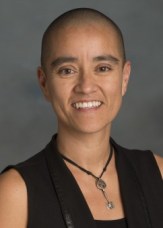
logo-CCWA few months ago Governor Jerry Brown appointed me to be the first man on the prestigious California Commission on the Status of Women and Girls. I am so excited and honored by this amazing opportunity to continue the great work that California is doing to tackle issues such as pay equality, advancing more girls in the STEM field, creating more opportunities for women in leadership positions across California, and a host of other hot topic issues.

From the moment I started telling people, the responses were extremely positive. People were very excited that we could have a conversation about how men can be included in creating change to better impact the lives of women and girls from all walks of life.  It felt great to see such a positive response from so many people that I love, trust, and admire. However, while much positivity still remains, it has come to my attention that some people are not so thrilled about my appointment. However, what these people and groups online do not realize is that I fully expected and am happy to see such conversations occurring about men in feminism.

Continue reading “Difficult Dialogues by John Erickson”

The Making of Women Religion Revolution by Xochitl Alvizo

Last month in Boston during the American Academy of Religion (AAR) Annual Meeting I presented on Women Religion Revolution, a volume of collaborative work with fifteen other women that Gina Messina and I co-edited. The book is the third one published with FRS Books, the new book series of Feminist Studies in Religion, Inc. (FSR, Inc.) – a project with which we are very proud to partner.

FSR Books organized a panel featuring these first books. Serving as a backdrop of the whole panel was Elisabeth Schüssler Fiorenza’s own book, Congress of Wo/men: Religion, Gender, and Kyriarchal Power, which was FSR Books’ first publication. In this book, Schüssler Fiorenza introduces the concept and vision of the ekklēsia of wo/men as kosmopolis. Defining the ekklēsia of wo/men as “the decision-making assembly of the kosmopolis,[1] she explains the kosmopolis as the polis/city-state “governed by the egalitarian values and visions of justice and well-bring for everyone without exception” (106). She calls feminists in religion to “build a global, transcultural, cosmopolitan organizations for articulating a wisdom spirituality of cosmic world citizenship and for securing the welfare of everyone in the kosmos/world and of the kosmos itself” (111-112). In other words, Schüssler Fiorenza’s volume is a renewed call for feminists to think big and think together beyond the binary of secular/religious so as to more effectively counter the neoliberal domination of our current global context. Continue reading “The Making of Women Religion Revolution by Xochitl Alvizo”

Black People Elect Jones, White People Vote for Moore: And What That Means by Carol P. Christ

By now the exit poll statistics from the recent election in the state of Alabama are well known: 98% of black women and 92% of black men voted for Democrat Doug Jones, while 74% of white men and 65% of white women voted for Republican pedophile and child-molester Roy Moore.

These statistics raise two important questions. The first is why white women would vote—some would say against their own interests—for a man whose abusive behavior toward women and girls is a matter of public record. The second, and related question, is whether the Democratic strategy of trying to appeal to racist and sexist white people by downplaying racism and sexism is a winning strategy. Continue reading “Black People Elect Jones, White People Vote for Moore: And What That Means by Carol P. Christ”

Grieving through the Holidays: Painting Holy Women Icons of Grief by Angela Yarber

The holiday season is a particularly difficult time for grief. Whether it is grieving someone who died earlier in the year as you celebrate your first holiday season without them, or the lasting memories of loved ones who are no longer present at family gatherings, this time of year makes grief bubble to the surface. Since this is my first holiday season without my little brother, who died in March, I’ve planned ahead with coping strategies that I’d like to share with other feminists struggling to grieve through the holidays.

Upon the death of a loved one, most people in the West are offered commodified grief, costly funerals, and stifled feelings pre-packaged as dignified tradition. When deathcare became a commercial enterprise at the turn of the twentieth century, there was what mortician and author Caitlin Doughty calls a seismic shift in who was responsible for the dead. “Caring for the corpse went from visceral, primeval work performed by women to a ‘profession,’ an ‘art,’ and even a ‘science,’ performed by well-paid men. The corpse, with all its physical and emotional messiness, was taken from women. It was made neat and clean, and placed in its casket on a pedestal, always just out of our grasp (Caitlin Doughty, From Here to Eternity: Traveling the World to Find the Good Death, 136).”

Continue reading “Grieving through the Holidays: Painting Holy Women Icons of Grief by Angela Yarber”