This past week, I have discussed with college students the time I was wrongly arrested and harassed by an Islamophobic Sheriff Deputy several years ago, which led to a successful court case against my county spearheaded by the ACLU. I opened up the discussion with the following religiously feminist spoken word piece I wrote:
Mr. Big Man
You told me what to write, word for word for word for word in my statement,
To get me caught up in your trickery is what you meant,
Acting like you were my friend,
Just so that you could win,
Many of the young women I meet tell me that they think feminism is not what they are about, that they prefer to work for the good of all. I understand that and certainly we can all choose where we wish to place our focus. However, it does make me wonder how effective we can be with our focus placed on so broad a scope. Certainly, we want equal rights for all and some call that “feminism” these days but is it?
In my 73 years, I have lived through quite a few years of women working for equal rights. I have seen many successes as well as the failures. I am incredibly proud of those successes. When I was in the early stages of my career and had just entered management, I was able to implement leadership methods, which now have become models for employers such as team building and servant leadership. Then however, there were no names for them. I led my teams based simply on how I wished my employers to treat me. Continue reading “It is a Matter of Focus by Deanne Quarrie”
In my dance workshop last Sunday in Somerset, England, we lit candles to the exquisite voice of the great Armenian soprano Lusine Zakarian, and danced beautiful Armenian dances in a ritual of solidarity with this occasion.
I have been encouraging all my students to dance Armenian dances with their groups this week, most especially on Friday, to align with the commemorations happening around the world. Even if you do not dance, you could simply light a candle and listen to some Armenian music (see my list of recommendations at the end of this post). I feel that every act of compassionate witnessing, however small, helps heal the wounds of history.
Consider a gay woman (myself) being asked by a straight attempting to understand the “right” for gay marriage, “What does it matter if I know you’re ‘gay’ if I’m not attracted to you?”[1]
Then consider that another right of “marriage” –or being known as “gay”—is the right to be admitted into the hospital room of a loved one, who is considered one’s primary partner, or “spouse.” Yes, one wants to say to the questioning woman in the above scenario, the rights for marriage include the crucial family relationships which allow one person to be able to take sick leave to care for a partner, or a partner’s child; being able to make critical medical decisions, and the right to be together in crisis situations (such as a hospital emergency room).[2]
Last year a friend of mine who is also a professor, a professor of Philosophy, initiated an email conversation with me to casually dialogue and ask some questions about feminism, a topic about which he had only limited knowledge. During this conversation, he asked a particularly pointed question which I will paraphrase here:
“Sara, do you think that ‘popular feminism’ or the kind of feminism we see in social media, particular political organizations or popular culture ends up getting to define feminism for larger society (and isn’t this representation a bit limited or behind what feminism has actually become)?”
His question stayed with me for quite some time and was echoed by members of the Women’s Caucus at the 2014 meeting of the American Academy of Religion, Western Religion (AAR/WR). Who defines feminism for society today? Who is defining what feminism is becoming? Who wants to be a feminist? Who ‘gets’ to be a feminist now?
Reflecting on these questions personally last year, I found myself a little lost… My daily exposure to feminism via social media sometimes felt like I was watching a constant battle between those who identified as feminists and those who found feminism wanting, inadequate, harmful or even hateful. Yet, much of my professional experience working with feminism, at the same time, also involved the opposite: purposeful coalition building, training and discussions about allied relationships, and efforts to create inclusive, if agonistic community.
Teaming up to address this issue of representation, power, naming and justice-making, the Queer Caucus and the Women’s Caucus of the AAR/WR co-hosted a panel and groups discussion at the 2015 regional conference this year in March. We asked the panelists to consider the question: “Who ‘gets’ to be a feminist,” encouraging each panelist to directly engage her, his or their own social location, institution and activism when addressing the workshop theme.
Does Islam need a reformation? The ever-controversial Ayaan Hirsi Ali’s new book Heretic: Why Islam Needs a Reformation Now argues that it does. Do you agree with her? Or do you find problems with the way Ayaan Ali frames the discussion?
By now most, if not all, readers of FAR have read or watched the disturbing YouTube video of University of Oklahoma Sigma Alpha Epsilon (SAE) Fraternity sing their racist chant. The two male SAE members who led the “song” were swiftly expelled by President David Boren, with the National Chapter of SAE shutting down the OU chapter of SAE. Student outcry denouncing the racist behavior ranged from hurt and anger from white students to how are you surprised by black students. At the very minimum the incident was and is occasion for important race dialogue on all college campuses.
The level of comfort and familiarity with the lyrics sung by those on the bus horrified me. The students, both male and female, were dressed in formal attire on their way to an unspecified date function. I flipped between MSNBC and CNN commentaries as the video replayed and the subsequent fallouts unfolded. Yet what I missed was commentary on the complicit nature of acceptance by the other students on that bus; and for the purpose of this post, the young women who gleefully followed along.
I immediately reflected on the writings of Mary Daly and her seminal work, Gyn-Ecology: The MetaEthics of Radical Feminism in which Daly challenges the multiple manifestations of patriarchy’s far-reach on the lives of women as well as female complicity in patriarchy. Daly identifies the practice of Indian Suttee or female foot-binding as one of many examples of Sado-Ritual Syndrome in which she argues, “The history of the footbound women of China provides us with a vivid and accurate image of the way in which women have been coerced into ‘participating’ in the phallocratic processions. The footbound daughter was bound to repeat the same procedure of mutilation upon her own daughter, and the daughter upon her daughter” (41-42). While the literal practice of food-binding has been erased, Daly reminds us patriarchy continues with “insidious forms of mindbinding and spiritbinding in every nation of this colonized planet”(42).
The culpability of the young women (and men) and their Sin of Silence brought swift judgment from me. How I thought, could they so easily participate in something so wrong? Then the related YouTube surfaced of University of Oklahoma SAE House Mom rapping the N-word in the same unconscionable manner as the SAE fraternity’s use of the N-word. I basked in my indignation until I recalled a not-so-distant time when I remained silent in the face of what Daly might call the phallocratic mutilation of women.
The occasion was the appearance of comedian Bill Maher on the campus of Loyola Marymount University during the presidential campaign of the 2008 election. As a political pundit I expected Maher’s material to cover the upcoming election as well as the candidates, one of which was Hilary Clinton. From the start Maher used abusive verbiage associated with female genitalia as a means of contesting her politics. When speaking of the male candidates, his insults/jokes were framed around the substance of their platform and not their bodies. The distinction was not lost on me, or the roar of laughter from the predominately student body.
I recall turning to my female co-workers repeating, “This is wrong, this is not funny! We need to walk-out right now!” “What?” they responded, “Walk out on Maher, you know he’ll make a mockery of us and our bodies if we do such a thing.” They were right. I sat in complete fear trying to find the courage to match my moral outrage with the action of walking out. I recall imagining what horrible names related to the female anatomy he would hurl at me, affirming my deepest body-image sensitivities. So like so many other women when confronted with the repercussions of ugly misogyny I remained silent and in my seat, seething with shame and disappointment by my in-action.
At the time I did not have Daly’s language of female complicity in patriarchy, although this is exactly what occurred. While I self-identified as a feminist, I did not understand the repercussions and reach of a patriarchal system that so easily silences women to their own demise. The seductive nature of this complicity takes form whenever I/we remain silent to its deceptive and phallocratic ways. But speaking up is risky and dare I say, exhausting when you are the lone voice who objects to the tentacles of misogyny, especially when the pushback comes from other women. I have discovered once you leave the safety of your feminist tribe and speak out against misogyny or speak in favor of women from a feminist stance, you are open game for all kinds of insults–with many coming from other women. During these encounters I find my voice softening to a safe whisper. I know my silence can be complicity in and with patriarchy, but the alternative engagement outside of academia leaves me with battle fatigue.
While I continue to hold those on the University of Oklahoma SAE bus accountable for participating in the racist rant, I wonder how the binding of the daughters by the bound mothers facilitated the participation in the phallocratic processions.
Cynthia Garrity-Bond is a feminist theologian and social ethicist, is completing her doctorate at Claremont Graduate University in women studies in religion with a secondary focus in theology, ethics and culture. For the past six years Cynthia has been teaching in the department of theological studies at Loyola Marymount University where she completed both her BA and MA in Theology. Her research interests includes feminist sexual theology, historical theology with particular emphasis on religious movements of women, agency and resistance to ecclesial authority, embodiment, Mariology and transnational feminisms. Having recently returned from Southern Africa, Cynthia is researching the decriminalization of prostitution from a theological perspective.
What is the shifting conception of religious liberty as religious groups carve out exemptions in complying with laws on LGBTQI rights, particularly as they relate to marriage? As gay marriage becomes “normative” how does it change the structure and study of religion? How did the anti-gay rights movement in California, regarding Proposition 8, funded largely through religious organizations such as the Church of Latter Day Saints and the Catholic Knights of Columbus, have a direct impact on state decisions, and animate new conversations about the juncture of religion and politics?
Let’s start with this information:
Sociologist Brian Powell posed the question of why people were opposed to gay marriage. Do what people say match the legal arguments that justify the opposition to gay marriage? Since legal arguments are based on public policy, what public policy was shaping the legal arguments? The findings, published recently in Social Currents, show that the most common reason for gay marriage opposition was given as: “Because I don’t believe God intended them to be that way.” Running a close second was: “Well, they’re sinners.”
If public opinion drives public policy, then the motivation for banning same-sex marriage is moral disapproval. Or as stated in Powell’s findings—religious disapproval—and the belief that God is not “on the side” of the homosexuals; casting homosexuals as sinners in the faith choice of the person formulating the public policy critique. With these formulations, Powell suggested that public discourse —based on religious formulations such as “sinner” and what “God intended” are the primary agents erecting state laws that ban access to civil rights- such as marriage- for the LGBTQI population. Continue reading “Spouse for Life & the Fight for Gay Marriage by Marie Cartier”
Last week, Supreme Court Justice Ruth Bader Ginsburg was in the news again, but not for reasons you would expect. She, along with Rabbi Lauren Holtzblatt, penned a feminist essay about the Exodus title “The Heroic and Visionary Women of Passover.” Finding this story was exciting, especially because I am so drawn to the Exodus story (the intrigue and curiosity of which caused me to return to school and study, as one of my main areas of focus, Hebrew Scriptures – along with Archaeology and Ancient Near Eastern History). Now women’s roles in this story are being elevated thanks to Justice Ruth Bader Ginsburg and Rabbi Holtzblatt.
Before I discuss the message and the importance this message brings, I think it is important to know an important fact about Justice Ginsburg. Ginsburg is not observant, but does embrace her Jewish identity. When her mother died, she was excluded from the mourner’s minyan because she was a woman; an event in Judaism that is meant to comfort the mourner, brings a sense of community, and is considered obligatory – a means of honoring our mother/father. This important event left an impression and sent a loud message that inspired and influenced her career path – she did not count – she had no voice – she had no authority to speak. No wonder her life and career focuses so much on women’s rights and equality.
As many of us know, the story of Exodus is focused on two things 1) Moses and 2) liberation from the bonds of servitude and enslavement; women are rarely discussed. In the essay co-authored by Ginsberg, women are described as playing a crucial role in defying the orders of Pharaoh and helping to bring light to a world in darkness. In the Exodus event, God had partners – five brave women are the first among them, according to Ginsburg and Holtzblatt. These women are: Continue reading “Passover and the Exodus: A Feminist Reflection on Action, Hope, and Legacy by Michele Stopera Freyhauf”
We find our versions of home in these communities and it is within these spaces where our home not only begins to define who we are but we, as a reflection of that space, begin to outwardly redefine the spaces we exist in. If we slowly begin, through our experiences to shape our homes based on privilege and power without self-reflection and acknowledgment of others, then we are no better than those oppressive forces we say we’re against.
This post is a response to a recent blog entry titled “Who is Gender Queer?” on this site from Carol Christ. The post can be read by clicking here.I want to thank my friend, advocate, and upcoming scholar Martha Ovadia for reasons only she knows! Stay brave, speak up, be heard! _________________________________________
It is terrifying to know that something is wrong but not be able to speak truth to power.
It is even more terrifying to know something is wrong, be able to speak to it, and then silence those voices that do not have that same privilege, power, or position.
The struggle that many of us in positions of privilege and power face is not just that of being ostracizing and essentializing forces—it is that we, as allies, members of communities, or even those dedicated to a cause, can ourselves participate in the oppression we are fighting against and can do harm.
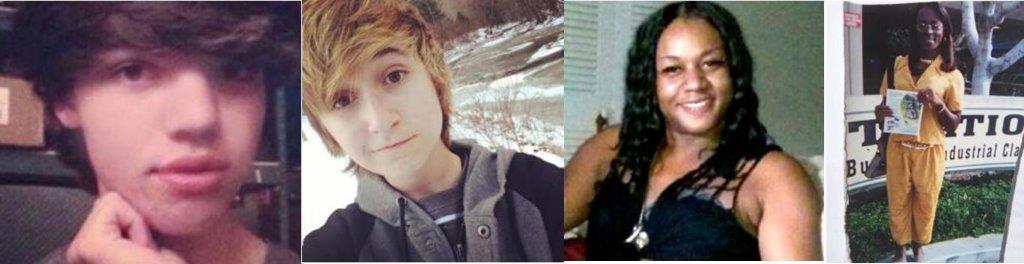
It’s taken me a long time to not only be comfortable with who I identify as, but also how I go about fighting and defining my life based on said identity and experience. However, the one thing that I have the ability to do is choose that identity more freely than others. Unlike Leelah Alcorn, Ash Haffner, Aniya Knee Parker, or Yaz’min Shancez pictured above, I did not have to face the types of oppressions they did, to which they sadly lost their lives, as a result of the fact that we exist in a society that can’t deal with the inability to leave things undefined or to allow people to define who they are on their own terms.
It is vital that although my lived experiences could never meet nor match the same types of oppression that these brave individuals had to face, I, as a white, cisgendered gay male, do not become part of their oppression through my own position and privilege.
As a man who exists in the world of feminism and within various women’s communities, I walk a daily tightrope of privilege and power to insure that I do not silence those that I consider allies, friends, mentors, or colleagues. As a man who exists in the world of the LGBTQ community, I walk an additional tightrope to additionally not take away from or diminish the experiences of those members of our community that do not have the same type of lived experiences as myself. Even within minority communities, there are positions of hierarchy and within these hierarchies of knowledge, identity, or power, comes a responsibility to insure that the oppressed do not become the oppressors.
We find our versions of home in these communities and it is within these spaces where our home not only begins to define who we are but we, as a reflection of that space, begin to outwardly redefine the spaces we exist in. If we slowly begin to shape our homes based on privilege and power without self-reflection and acknowledgment of others, then we are no better than those oppressive forces we say we’re against.
I can’t speak for what identity feels like –I can only speak for what essentializing does, and what it does is reflected in the deaths of Lelah, Ash, and the many others who die nameless. It is our responsibility, as allies, members of communities, and those fighting to end sexist, patriarchal, and, even now, homonormative oppression, to make sure that no more deaths occur on our watch or that truth is spoken to power even when power is masquerading around as truth.
John Erickson is a Ph.D. Candidate in American Religious History at Claremont Graduate University. He holds a MA in Women’s Studies in Religion; an MA in Applied Women’s Studies; and a BA in Women’s Literature and Women’s Studies. He is a Non-Fiction Reviewer for Lambda Literary, the leader in LGBT reviews, author interviews, opinions and news since 1989 and the Co-Chair of the Queer Studies in Religion section of the American Academy of Religion’s Western Region, the only regional section of the American Academy of Religion that is dedicated to the exploration of queer studies in religion and other relevant fields in the nation and the President of the University of Wisconsin Oshkosh’s LGBTQA+ Alumni Association. When he is not working on his dissertation, he can be found at West Hollywood City Hall where he is the Community Events Technician and works on policies and special events relating to women, gender, sexuality, and human rights issues that are sponsored or co-sponsored by the City of West Hollywood. He is the author of the blog From Wisconsin, with Love and can be followed on Twitter @JErickson85



 Does Islam need a reformation? The ever-controversial Ayaan Hirsi Ali’s new book
  By now most, if not all, readers of FAR have read or watched the disturbing
 Last week, Supreme Court
 ![Ruth_Bader_Ginsburg_official_portrait[1]](https://feminismandreligion.com/wp-content/uploads/2015/03/ruth_bader_ginsburg_official_portrait1.jpg?w=181&h=235) from the
from the