Painting Guanyin by Angela Yarber

As hundreds of thousands of people are dying in Syria and myriad individuals suffer from political unrest in Egypt, as we continue to debate the sexuality of young women (yes, we’re still talking about Miley Cyrus) in the face of America’s rape culture and as countless nameless victims are ravaged by war, poverty, racism, and violence, I sometimes find myself overwhelmed, as though my two hands are never enough to reach out, help, rage, change.  And I find myself—and our world—in need of mercy and compassion.  Since I always focus on one of my Holy Woman Icons with a folk feminist twist, I am drawn this month to the Goddess of Mercy.  So, Guanyin joins this great cloud of witnesses who inspire, embolden, and surround us: Virginia Woolf , the Shulamite, Mary Daly, Baby Suggs, Pachamama and Gaia, Frida Kahlo, Salome, Guadalupe and Mary, Fatima, Sojourner Truth, Saraswati, Jarena Lee, Isadora Duncan, Miriam, Lilith, and Georgia O’Keeffe.

In English we know Guanyin as the Goddess of Mercy and Compassion.  Generally regarded among East Asian devotees as originating from Avalokitesvara, her name is shortened from Guanshiyin, which means “One who hears the sounds/cries of the world.”  In the Lotus Sutra, Avalokitesvara is a bodhisattva who is androgynous and can take on the form of any female, male, adult, child, human, or non-human sentient being in order to teach the Dharma.  Typically she is depicted in female form and she is widely venerated by East Asian Buddhists.  Though she is particularly poignant for Buddhists, Guanyin is present in almost every facet of Chinese religion, from Buddhism to Taoism to shrines for local fishermen. Continue reading “Painting Guanyin by Angela Yarber”

A New Glossary for Crete: The Power of Naming and the Study of History by Carol P. Christ

carol-christThe words we use affect our thinking. In the case of ancient Crete the repetition of the terms “Palace,” “Palace of Knossos,” “King Minos,” “Minoan,” “Priest-King,” and “Prince of the Lilies” shape the way we understand history–even when we ourselves know these terms are incorrect. We must engage in “new naming.”

Ariadne. May have been a name of the Goddess of pre-patriarchal Crete. The ending “ne” signifies that Ariadne is not of Greek or Indo-European origin and thus predates the later Greek myths.

Ariadnian. The name I have given to the Old European pre-patriarchal culture of Crete, from arrival of the Neolithic settlers from Anatolia c.7000 BCE to the Mycenaean invasion c.1450 BCE. Arthur Evans named the Bronze Age (c.3000-1450 BCE) culture of Crete “Minoan” after King Minos of Greek mythology, son of Zeus and Europa, husband of Pasiphae, father of Ariadne, whose gift of the secret of the labyrinth to Theseus led to the downfall of her culture. Evans assumed that Minoan Crete was ruled by a King.

This image I call “Ariadne Dancing” could become the new “icon” of Ariadnian Crete.

minoan woman dancing

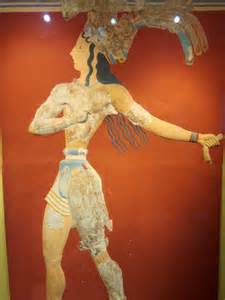
It could and should replace the “icon” of  the “Priest-King” Arthur Evans’ “imaginatively” reconstructed and named the “Prince of the Lilies.”

 prince of the lilies

Once we remove the crown which probably belonged to a Sphinx, the figure’s white color and athletic body suggests it was intended to portray a young female bull-leaper leading a bull. Continue reading “A New Glossary for Crete: The Power of Naming and the Study of History by Carol P. Christ”

Earth Connection & Healing the Bees by Jassy Watson

Jassy_Agora1-150x150

I’m an avid gardener. I must, need, long to have my hands in the soil. The sweet smell and feel of the earth connects me to something greater, to a sense of ‘other’; a source divine. I am interwoven, connected, at one and in reverence of a greater mystery.  When I think about my connection to the earth and its origins, I find it is a connection I have had my entire life. As a young girl I spent many hours, days, in fact years, exploring the Australian bush – it was my backyard. Some of my most prominent memories are the smell of Eucalypt and the crescendo of cicada song that would permeate my entire surroundings throughout summer. As a teen, time and time again, I bushwalked our families property that backed onto mountainous National forest. I often sensed the indigenous ancestral spirits of our land watching attentively.

It is this deep connection that I have to the earth that not only leaves me feeling exultant, it leaves me troubled. I am troubled by the continuing problems caused to the environment. I admit to feeling quite disturbed recently when I read a number of reports about the persisting problems with the Fukushima Nuclear plant – radiated water still leaking into the ocean. Birdlife and ocean animals found suffering from radiation burns. Should we even be eating fish from the pacific? I can’t begin to fathom the enormity of the repercussions from this disaster that will be seen for many generations to come. My inner activist wants to be out there on the frontline, riding the waves on the Rainbow Warrior, tied to an ancient tree in protest of lopping; but I know my place is here, nurturing my little ones. So what can I do with these troubled feelings, with the frustration and with the love I have for Mother earth and all her beings? Action starts from home. So I let it fuel my fire and I get creative. I paint, I write, I garden; with intention. My intention is to play a role, no matter how small, that aids in the healing of the planet. I hold hope that it inspires other to do the same. Continue reading “Earth Connection & Healing the Bees by Jassy Watson”

Rescuing Martha from the Dishes: A Challenge of Retrieval and Proclamation by Mary Grey – Part III

Rescuing Martha – A Hermeneutic of Retrieval
This is the last part of a three part post. Read Part I here and Part II here

Discovering another tradition means being open not only to artistic witnesses but to myth, legend, and to feminist theory. But to begin with what is uncontested: both sisters, Mary and Martha, were friends of Jesus who loved them and their brother Lazarus. Martha seems to be the householder. We are told nothing about the parents of the three – perhaps they had been caught up and killed in one of the Zealot uprisings. The Church that sprang up at the site of Bethany was one of the earliest Christian pilgrimage places.  The legends that grew up held Lazarus and his 2 sisters in great respect. And this is a sharp contrast with the tradition I began with.

Secondly, to disparage responsibility for housework as a lowly role is an anachronistic viewpoint. It is likely, as in most poor agricultural communities today that domestic work goes alongside income- generating work either inside or outside the house. Many rural women in India and Africa cope with domestic work, child care and a full day’s work in the fields. In the life-time of Jesus, women would be involved in cleaning fish and mending nets – though the Gospels do not tell us this.  Nor was this the work of the sisters at Bethany who did not live near Lake Galilee. The public/ private split between unseen work in the household and public work belongs to a much later date. Thirdly, it is diakonia or service that is at stake here, and this was part of a creative tension in the early communities. Continue reading “Rescuing Martha from the Dishes: A Challenge of Retrieval and Proclamation by Mary Grey – Part III”

Rescuing Martha from the Dishes: A Challenge of Retrieval and Proclamation by Mary Grey – Part II

What do the Gospels of Luke and John tell us?
This is the second part of a three part post. Part I is here and Part III is to follow tomorrow. 

I now return to the story of Mary and Martha in the gospel of Luke: what was its purpose for the evangelist and his community? The text itself has been a subject of multiple interpretations. An abstract interpretation sees the sisters as representing two different principles, one as justification by works and one by faith. Augustine (d.430) saw them as symbolising either the labours of this world and the bliss of the world to come. Origen (185-254), famous for his allegorising interpretation of Scripture, understood them as life according to the flesh or according to the Spirit. So, as Elisabeth Schüssler-Fiorenza points out in But She Said: Feminist Practices of Biblical Interpretation (1992:58), this typologising contrast was already established by the end of the 2nd century.  In a contemporary context Martha and Mary continue to exemplify the two vocations that the church offers to women, contemplative love of God (Mary), or social activism through service of neighbour (Martha). Continue reading “Rescuing Martha from the Dishes: A Challenge of Retrieval and Proclamation by Mary Grey – Part II”

Rescuing Martha from the Dishes: A Challenge of Retrieval and Proclamation by Mary Grey – Part I

Introduction and Martha – Patron Saint of Housewives

Here I explore a troubling issue for feminist biblical interpretation, namely the interpretations of Luke 10, 38-42, with specific reference to the figure of Martha, and the questions that arise when we compare John’s story, the Raising of Lazarus (John 11.1-44).  At first sight Luke seems clear: Martha is troubled with the domestic task of preparing food, while Mary has gone to the heart of the matter, listening to the word of God at the feet of the Lord. Mary is always depicted at the feet of the Christ, while Martha is the active one and this is often interpreted negatively. (One interesting exception is Giotto’s fresco of the raising of Lazarus, where both sisters are prostrate at Jesus’ feet). A clear message seems given for Christian discipleship and this text has had an evocative power through history. But on reading John’s story, are the roles reversed? Martha runs to greet Jesus, Mary remains at home. From Martha comes the confession of faith in Jesus:

Yes, Lord; I believe that you are the Christ, the Son of God, he who is coming into the world. (John 11.27)

What we are given is a full confession of faith on Jesus as Son of God, the confession which is on the lips of Peter in the 3 Synoptic Gospels, (Luke 9.20, Mark 8.29, Matthew 16.15-17).

Why is it, then, that Christian Tradition has largely ignored the Johannine text and followed Luke, even a negative interpretation of Luke? Continue reading “Rescuing Martha from the Dishes: A Challenge of Retrieval and Proclamation by Mary Grey – Part I”

Painting Georgia O’Keeffe by Angela Yarber

Hailed as the Mother of American Modernism, her seemingly vaginal flowers lauded by feminists and artists alike, Georgia O’Keeffe stands as a sentinel for strong, creative women who balk at tradition and embrace a faraway freedom.  Though she adamantly denied any association with female genitalia embedded in her sensuously up-close-and-personal flowers—even from feminist artists as famed as Judy Chicago—she remained a female force unbound, painting, living, loving, and creating on her own terms.  So, it’s no wonder that she joins my Holy Woman Icons with a folk feminist twist: Virginia Woolf , the Shulamite, Mary Daly, Baby Suggs, Pachamama and Gaia, Frida Kahlo, Salome, Guadalupe and Mary, Fatima, Sojourner Truth, Saraswati, Jarena Lee, Isadora Duncan, Miriam, and Lilith.

Born in November 1887, O’Keeffe knew she would be an artist from the young age of seven.  Whether you’re familiar with her intricate flowers, soaring skyscrapers, or desert skulls depends largely on the period of her life that interests you.  Whether it was the rural Wisconsin farm of her childhood, the bustling city of New York where she began her relationship with famed photographer Alfred Stieglitz, the peaceful lake in the Adirondack Mountains where they summered, or the harsh desert landscapes of New Mexico where she devoted her later years, she found inspiration and captured beauty wherever she lived, camped, traveled, hiked, or drove in her Ford Model A.  Continue reading “Painting Georgia O’Keeffe by Angela Yarber”

GODDESS AND SACRED COW: A RE-EXAMINATION OF THE MYTHOLOGY OF THE SACRED BULL by Carol P. Christ

carol-christStatue_of_Egyptian_Goddess_Hathor_from_Luxur_Museum_EgyptMost archaeologists and visitors to museums assume that when they see a horned bovine, they are faced with the image of the male God or the image of the bull sacrifice.  In the minds of many, these two are one, as we have been taught that the male God who was the consort or son-lover of the Goddess was sacrificed. Yet horned Goddesses are not infrequent in the history of religions and Hindus still revere the sacred cow.  

Cattle have played an important role in human life from the beginning of agriculture.  Cows provide milk which is also turned into butter, cheese, and yogurt.  Most of the young males and some of the females are killed for meat or leather, while a few males are kept to impregnate the females.  Though the “raging bull” is the lens through which most of us think about mature male bovines, I have been told by a friend who raised cattle that in fact bulls are for the most part gentle and even sweet–though of course they are also potentially dangerous.

Before the industrial revolution, there was also a third category of bovines, the castrated males, known as oxen, who were used as “beasts of burden”–to pull plows, litters, and after the invention of the wheel, wheeled vehicles. Many people assume that only bulls have horns. This is not the case.  Recently a friend who was raised on a dairy farm described to me the pain experienced by young female cows when their horns are burned out. So let us think again about the images of the horned bovines found in museums.  Given that cows and oxen were long-term companions of early “man” and early “woman,” why should we assume that all horned bovines are bulls?  Continue reading “GODDESS AND SACRED COW: A RE-EXAMINATION OF THE MYTHOLOGY OF THE SACRED BULL by Carol P. Christ”

Aine, Summer Goddess of Love, Light and Fertility by Judith Shaw

judith Shaw photoAine, (pronounced AW-neh), was originally worshipped as a Sun Goddess. Like so many goddesses and gods, Aine has assumed many other roles over the years, being seen as a Moon Goddess, a Goddess of Love, a Fertility Goddess, a Healing Goddess, and a Sovereignty Goddess. Aine is also known as a Faery Queen. She is often called Aine, Goddess of Love, Light, and Fertility.  Her name means “brightness, glow, joy, radiance; splendor, glory, fame” and she is associated with the abundance of summer.

Continue reading “Aine, Summer Goddess of Love, Light and Fertility by Judith Shaw”

THE LABRYS: A RIVER OF BIRDS IN MIGRATION by Carol P. Christ

carol-christ“There’s a river of birds in migration, a nation of women with wings.” Goddess chant, Libanalabrys seal ring

On the Goddess Pilgrimage to Crete, I explain that many of the names given to “Minoan” (c. 3000-1450 BCE) Cretan artifacts and architecture are products of patriarchal and Eurocentric imaginations, and as such, are misleading.  For example the name “Minoan” was given to the culture of Bronze Age Crete in honor of “King Minos,” who was said to have ruled in Crete a few generations before the Trojan War–several hundred years after the end of the culture to which his name was attached.  In fact, despite his eagerness to find evidence that King Minos ruled at Knossos, the excavator Sir Arthur Evans finally had to concede that the best he could do was to produce a fresco of a “Prince of the Lilies” which he identifed as the image of the male ruler of the culture he called “Minoan.”  Evans’ Prince had white skin, a fact that Evans conveniently overlooked–because according to his own interpretation of “Minoan” iconography, white skin would mark the figure as female.  Mark Cameron, who reviewed Evans’ reconstruction of the fresco, suggested that the Prince is more likely to be a young woman who is perhaps leading a bull to take part in the bull-leaping games.  He also stated that the “crown” belonged to another fresco altogether.

Evans’ failure to find evidence of a King or for that matter a Queen at the complex of buildings he called “The Palace of Knossos” calls into question his idea that these structures were palaces.  Nanno Marinatos argued that the “palace” was instead a ritual center for the surrounding village, as well as a community gathering place, a place for storing grain, wine, and oil in a sacred way, and a place where ritual objects were fashioned of clay, bronze, stone, and gold.  Following her lead, I renamed the “Palaces” “Sacred Centers.” In this blog I will experiment with renaming the “Minoan” culture “Ariadnian,” after the pre-Greek name Ariadne, which may be one of the names of the Goddess of Bronze Age Crete.

One of the most pervasive–and many would say–most enigmatic symbols of the Ariadnian culture is the labrys.  Continue reading “THE LABRYS: A RIVER OF BIRDS IN MIGRATION by Carol P. Christ”