Painting the Shulamite By Angela Yarber

Calling the Shulamite holy is my way of affirming female sexuality, the beautiful variety of the body’s shapes and sizes, and including the LGBT community in the canon of saints.

Several years ago, after experiencing the innate maleness and straightness of most traditional icons, I decided to give iconography a folk and feminist twist.  Biblical women, mythological figures, poets, artists, dancers, scholars, literary figures, and personal loved-ones graced my canvases and with a brush-stroke they were canonized.  Miriam, Sappho, Gaia, Jephthah’s daughter, Virginia Woolf, Tiamat, Mary, Baby Suggs, Isadora Duncan, Fatima, the Shulamite, Dorothy Day, Mother Teresa, Mary Daly, Sophia, Sojourner Truth, and many of my friends and colleagues became “Holy Women Icons.”  It is these icons—these holy women—that will be the focus of my monthly articles in Feminism and Religion.

This month, the Shulamite is the center of our attention.  She is a dancer made famous by the erotic love poetry dedicated to her sensuous curves in Song of Songs:

Return, return, the Shulamite.

Return, return, and let us gaze on you.

How will you gaze on Shulamite in the dance of the two camps?

How beautiful are your sandaled feet, O prince’s daughter.

The curves of your (quivering) thighs like jewels crafted by artist hands.

Your vulva a rounded bowl; may it never lack wine.

Your belly a mound of wheat hedged by lotuses.

Your breasts like two fawns…

(Song of Songs 7:1-4 translation mine) Continue reading “Painting the Shulamite By Angela Yarber”

Art – A Bridge Between the Physical and Spiritual Worlds by Judith Shaw

judith shaw photoBrushing yellow gold on top of deep crimson, I sense the paints coming alive, even as I feel myself moving outside of ego, outside of time, and inside to my deepest source.

At least forty thousand years ago the human family began to make art; drawing, painting, sculpting and playing music. For much of human history, art has served a dual purpose. Some art has been purely decorative, while much art has expressed a spiritual understanding of our physical existence.

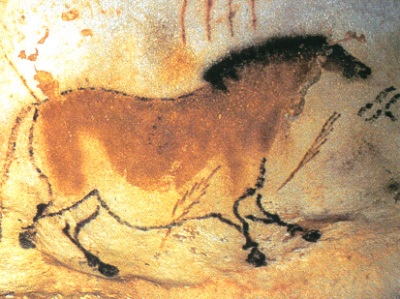
During the Paleolithic period, c.15–18,000 B.C. on the walls of a sacred cave, Lascaux, in southern France, our ancestors created beautiful paintings, often interpreted as a ritual that invoked sympathetic hunting magic. They are a reminder of the bond between the spirit world and the human world. This was a magical time in which humans lived immersed in the connection between the physical and spiritual worlds. Art was a means to both express and facilitate that connection.

Neolithic Goddess Figure

The seasons turned and the art and mythical imagery of the Paleolithic era was transmitted to the Neolithic era in Old Europe. Worship of the Goddess, as giver of all life, continued as did the art which honored Her and our connection to Her. The artists from these ancient days expressed their communal worship through the creation of cult idols and objects, shrines, painted pottery, and religious ceremonialism. The artists, though anonymous, were the hands and eyes of the creator, deepening and transforming the consciousness of their community.

As the human community in the western world developed and grew, art remained firmly grounded in the spiritual. From the megalithic stones of the Celtic era, to the illuminated manuscripts, mosaics and fresco paintings in the churches of the Middle Ages, right up to the work of painters like Van Gogh, Kandinsky, Malevich and Mondrian in the more modern era of late 19th and early 20th century – art expressed our human connection to the divine.

Continue reading “Art – A Bridge Between the Physical and Spiritual Worlds by Judith Shaw”

Ways of Being in the World by Barbara Ardinger

I was in college in the sixties before The Sixties really set in. We talked a lot about existentialism in those innocent days, especially in my theater classes. Those were the days when the theater of the absurd was the big thing. We theater majors walked around asking each other, “How do I be in the world? What is the meaning of my existence?”

When I’m in One Of Those Moods, I have fun telling people I was in college while Shakespeare was still writing his plays. Then I watch their lips move as they try to figure out if I’m really 400 years old, and if I’m not that old, then what am I on?  Continue reading “Ways of Being in the World by Barbara Ardinger”

My Feminist Perspective of Authority – Part 2 by Elise M. Edwards

My understanding of authority differs from that of the academy in that I have defined for myself a sense of ultimate purpose that those in power in the institution do not have authority to deny. It also differs because I believe my authority is conditioned in particular ways. Yet I think that ultimately my conception of authority fits the paradigm of mentorship that the academy establishes, even though I may be more guarded about my work and my choice of mentors. My “her-story” gives me the courage to proceed, even as I protect myself and my work.

In a previous post, I discussed insights on power and authority from a student’s perspective that I shared at a workshop on Living Texts: Celebrating Feminist Perspective and Theo/alogy, Authority, and the Sacred in the Academy. The workshop was a gathering where women scholars in religion discussed the challenges and promises of our voices in the academy. The dialogue was so inspiring to me that I decided tocontinue it here. Today, I reflect on these two questions:

  • Does my understanding of authority differ from that of the academy?
  • How do you situate my “her-story” in light of a largely patriarchal perception of authority in the academy?

Previously, I asserted that there is a critical distinction between power and authority. Authority is a personal characteristic based on a relationship of trust between me and a text, a person, or their work. Power, on the other hand, is operative with or without trust. Therefore, the people who have authority in my academic work are those whose supportive words provide direction and assistance, and whose criticism I take seriously.

My understanding of authority differs from that of the academy in that I have defined for myself a sense of ultimate purpose that those in power in the institution do not have authority to deny. Continue reading “My Feminist Perspective of Authority – Part 2 by Elise M. Edwards”

Son of Man: An Updated Gospel Story of Jesus Set in South Africa by Michele Stopera Freyhauf

January 12, 2012

Son of Man is an updated story of the life of Jesus set in the fictional State of Judea that is modern day South Africa – complete with warlords and child soldiers.    It could easily be mistaken for modern day Rwanda or Darfur with its modern issues and political overtonesRoger Ebert stated, “The secret of the movie is that it doesn’t strain to draw parallels with current world events – because it doesn’t have to.”  The director draws parallels between the gospels and 21st century Africa.  According to Dartford-May, “we wanted to look at the Gospels as if they were written by spin doctors and to strip that away and look at the truth.”  The director “captures the rhythms of African life in both rural settings and sprawling townships.”  “Feather-clad young angels offer an eerie echo and reminder of Africa’s lost generations.”

The movie also sticks with what Eric Snider calls “Traditional African trial music, dance, and costumes” as a type of worship or or allusion to Jesus’ godhood.  Judea is in flux; warlords and corruption take center stage.  Poverty, violence, and oppression affect the all of the people.  The key idea is that Jesus is a freedom fighter – one that fights injustice and oppression.  The director does not emphasize “Jesus’ divinity so much as his leadership, good sense and compassion.”  Jesus is not violent and his followers, most of whom were former child soldiers, are encouraged to respond non-violently, which goes against their upbringing and training. Continue reading “Son of Man: An Updated Gospel Story of Jesus Set in South Africa by Michele Stopera Freyhauf”

The Reclamation of Culture in Reality TV By Elise Edwards

In my academic life, I spend a lot of time thinking about issues of race, gender, religion and cultural production.  In my free time, I watch a lot of tv.  At times, the two interests converge, and I’m fortunate to have this community and forum to share the thoughts that come from it.  A couple months ago, I started revising a paper I’d written a few years ago about the issue of cultural imperialism and in that process, I recognized that there had been a subtle shift in television programming that features black women.  In the wide and ever-expanding reality tv genre, there are many shows that cast a black woman as a villain (the black bitch) or sexual object.  But there are other shows that present alternative, positive images of black women as caring, capable, professional, and talented.[i]   I’ve also noticed that several shows seemed to be overtly designed to combat the lack of positive images by celebrating the passions, skills, and abilities of women of color.  I am encouraged to see black people claiming an active role in their own cultural production. The act of creating is self-affirming, and when used by marginalized peoples, it can be a source of empowerment to counter their mistreatment.   In Art on My Mind: Visual Politics, bell hooks states, “It occurred to me then that if one could make a people lose touch with their capacity to create, lose sight of their will and their power to make art, then the work of subjugation, of colonization, is complete.  Such work can only be undone by acts of concrete reclamation.” [ii] Continue reading “The Reclamation of Culture in Reality TV By Elise Edwards”

Advent 2011 By Barbara Marian

We know that the whole creation has been groaning as in the pains of childbirth right up to the present time.

Romans 8:22   (NIV)

Advent 2011

Ancestral midwives kneel in shadows

bringing aid and comfort

witness giving

to the pains and crying out and pushing,

Sister-mothers,

prepare the way,

For birthing

in a gushing

mess with cries of gratitude and joy,

As water holy turned

to blood in breaking open paths and sacks

that spill out life

and milk and bread

from deepest springs of hope ferocious. Continue reading “Advent 2011 By Barbara Marian”

A Spirit of Competition By Elise M. Edwards

Elise M. Edwards is a Ph.D. candidate in Theology, Ethics, and Culture at Claremont Graduate University and registered architect in the State of Florida.  She does interdisciplinary work in the fields of theology, ethics, and aesthetics, examining how they inform and shape each other and express the commitments of their communities.

“You should watch this.  It’s inspiring,” my sister said to me about Born to Dance: Laurieann Gibson, the dance competition show on BET.  So I watched. And I loved it.  I can’t remember watching any other reality show–especially a competition-based one- that left me with such a sense of the spirituality of its star.

Laurieann Gibson fulfills many roles on Born to Dance: host, mentor, judge, and executive producer.  Laurieann is a respected dancer and choreographer.  TV viewers may remember her from MTV’s Making the Band franchise, in which she trained members of Dannity Kane in dance and sometimes clashed with P. Diddy, the star and producer of that show.  In this show that features her name, we learn more about her approach to dance and to life.  On Born to Dance, we see the same drive and demanding ethic that she displayed in other shows, but we also see her spirituality.  She says grace before eating dinner with the contestants.  She speaks of God and gifts.  And most surprisingly, she prays in Jesus’ name before very elimination.   These prayers are for the contestants that will be eliminated, that they may continue to grow in confidence and belief in their dreams to become dancers, and that they may have many opportunities and paths in the future to do so.     Continue reading “A Spirit of Competition By Elise M. Edwards”

Artemisia Gentileschi: Baroque artist and rape survivor painted strong Biblical women, By Kittredge Cherry

Kittredge Cherry

The following is a guest post written by Rev. Kittredge Cherry, lesbian Christian author and art historian who blogs about LGBT spirituality and the arts at the Jesus in Love Blog.  Her books include “Equal Rites” and “Art That Dares: Gay Jesus, Woman Christ, and More“.

Originally posted at Jesus in Love.

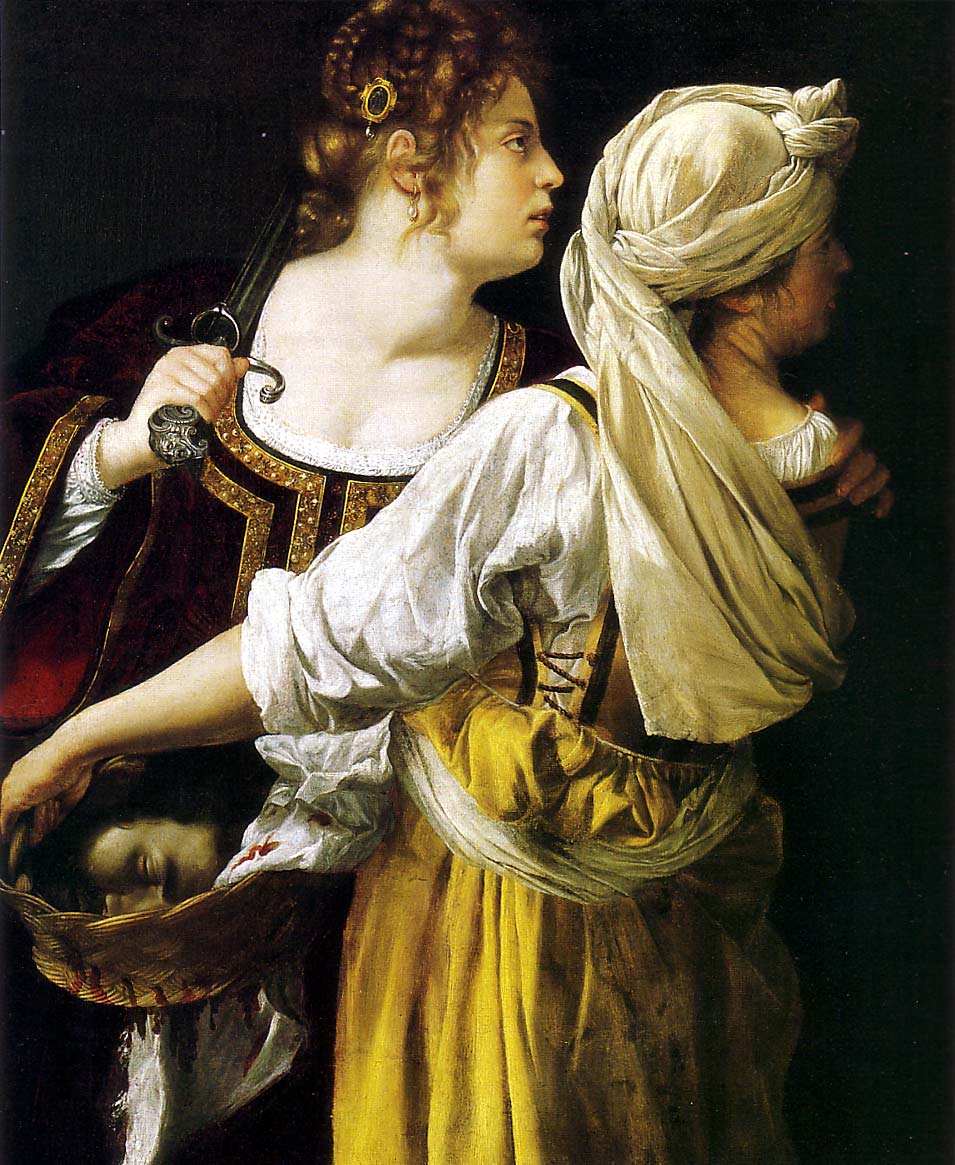
Baroque artist Artemisia Gentileschi inspires many with her paintings of strong Biblical women — created despite the discrimination and sexual violence that she faced as a woman in 17th-century Italy.

Gentileschi (1593–1652) was successful in her own day, but was mostly written out of art history until the 1970s, when feminist scholars rediscovered her work. Now she is celebrated in many books, films and plays, and her work is widely reproduced. Her greatest paintings include “Judith Beheading Holofernes” and “Susanna and the Elders.”

Many women and queer people can relate to her battles against prejudice and sexual violence, documented in her rape trial in 1612. She could be considered the patron saint of women artists.

"Judith and Her Maidservant" by Artemisia Gentileschi

Although Gentileschi was apparently heterosexual, lesbians have drawn energy from her life and art.

Lesbians who have created tributes to Gentileschi include painter Becki Jayne Harrelson and playwright Carolyn Gage. In the play “Artemisia and Hildegard,” Gage has two of history’s great women artists debate their contrasting survival strategies: Gentileschi battled to achieve in the male-dominated art world while Hildegard of Bingen found support for her art in the women-only community of a medieval German nunnery.

The daughter of a painter, Gentileschi was born in Rome and trained as a painter in her father’s workshop there. She was refused admission to the art academy because she was a woman, so her father arranged for her to have a private painting teacher — who raped her when she was about 19. Gentileschi herself was tortured by thumbscrews during the seven-month rape trial, but she stuck to her testimony. The teacher was convicted, but received a suspended sentence. Continue reading “Artemisia Gentileschi: Baroque artist and rape survivor painted strong Biblical women, By Kittredge Cherry”