Let’s Try Creativity This Year by Barbara Ardinger

As usual, I’m writing my post a couple weeks before you’ll be able to read it. I bet we’re all wondering in mid-December if 2020 is really gonna happen. Will we still be living in a civilization? Will there still be wild animals (outside of zoos)? Will trees and other plants still be growing? Well, my friends, if we all woke up last Wednesday and opened our eyes and it’s all still here……hooray!

Way back in 1998 I wrote a book called Goddess Meditations. It was the first-ever book devoted to guided meditations centered only on goddesses. No gods. No empty minds or asanas. Goddesses, some well known, others obscure, from many pantheons. One chapter in the book is “Chakra Goddesses,” in which I assigned a goddess to each of the seven major chakras. The goddess of the throat chakra—which rules clear communication, self-expression, and creativity—is Sarasvati. Here (with comments that pop out of my mind and into my fingers as I type) is part of what I wrote about communication.

Continue reading “Let’s Try Creativity This Year by Barbara Ardinger”

A Sword Will Pierce Your Own Soul by Mary Jane Miller

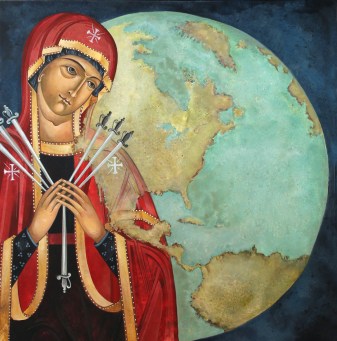
On Holy Ground is a collection of icons for this age of climate change. The collection of iconography opens with an image of Mary of Swords inspired by the number seven. This sacred number is associated with intuition, mysticism, inner wisdom, and a deep inward knowing. The ancient church speaks of seven deadly sins and seven holy attributes, and seven sacraments. The composition places the planet Earth beside Mary as she bows her head having been told, “ a sword will pierce Your own Soul ”
Mary of Sorrows or in this case, Mary the softener of Evil Hearts tilts her head lovingly towards our planet Earth. Seven swords pierce her heart; indicating the fullness and boundless sorrow, pain and “sickness of heart” that would have been experienced by Mary the Mother of Jesus at His crucifixion.
Muslims pilgrims circle the Kaaba in Mecca sevens times, and Egyptians had seven gods.

Continue reading “A Sword Will Pierce Your Own Soul by Mary Jane Miller”

The Cuisine Cards by Laurie Goodhart

Suit of Tomatoes

With every wonderful, heart-wrenching, deeply researched, and inspiring  post I read on F.A.R., I feel less inclined to share my own somewhat out-of-step contributions to this world. Nevertheless, I keep reminding myself that they are the things that I do, and I do them because I feel compelled, and have consistently been compelled in those two specific directions — art and agriculture/wildcrafting — since childhood. Also, the paintings and prints are a product of my always thinking about and feeling into both feminism and spirituality, and the fruits of the intersection of the two. So here is another offering.

I’ve always had a fondness for the visual aspect of playing cards, and collect books on them. One image of an uncut sheet of cards printed in 1585 in Frankfurt, where the black and white cards were jammed in every which way on large sheets of paper, inspired the look of these four prints, The Cuisine Cards.

They are conceived as celebrating food and cultures from various parts of the world. The face cards are non-hierarchical in terms of rank and gender. The 10 is a Table of the suit’s food, then there are the Shaper, Mover, and Taster, who, although usually carrying on in a certain sequential order, each contribute equal value to the whole experience of eating food. Two suits have all female face cards and two all male.

Continue reading “The Cuisine Cards by Laurie Goodhart”

Week 2 – Goddess Birthing Liberation: A Feminist Advent Daily Devotional by Trelawney Grenfell-Muir

If you have not yet realized that the Christmas story is a story of liberation from oppression, it is time to realize that. I like to dust off the patriarchy and mysogyny of scriptural writers to find the beautiful wisdom within the stories. Here is my daily devotional for the second week of Advent, the week of Peace. May our ever-birthing Goddess guide you to recognize and birth Peace, with all Creation. As the sky turns dark, may our candles shine ever brighter, together.


Feminist Advent Daily Devotional, Day 8:


The Peaceful Kin-dom

New shoots shall grow out from the stumps of old trees,

and branches shall grow out of their roots.

The spirit of Eternal Becoming rests on young prophets of Goddess,

the spirit of wisdom and understanding,

the spirit of counsel and might,

the spirit of knowledge and the reverence of Gaia.

Their delight shall be in the reverence of Gaia.

They shall not judge by the diseased eyes of their culture,

or decide by the distorted ears of falseness or deceit;

but with righteousness they shall proclaim justice for the poor,

and bring abundance to the meek of the earth;

they shall heal the earth with the birth canals of their mouths,

and with the breath of their lips they shall redeem the wicked.

Righteousness shall be the belt around their waists,

and faithfulness the belt around their wombs.

The wolf shall live with the lamb,

the leopard shall lie down with the kid,

the calf and the lion and the fatling together,

and a little girl shall lead them.

The cow and the bear shall graze,

their young shall lie down together;

and the lion shall eat straw like the ox.

The nursing child shall play over the hole of the asp,

and the weaned child shall put her hand on the adder’s den.

They will not hurt or destroy

on all my holy mountain;

for the earth will be full of the knowledge of the Eternal Womb

as her waters cover the sea.

Continue reading “Week 2 – Goddess Birthing Liberation: A Feminist Advent Daily Devotional by Trelawney Grenfell-Muir”

Week 1 Goddess Birthing Liberation: A Feminist Advent Daily Devotional by Trelawney Grenfell-Muir

If you have not yet realized that the Christmas story is a story of liberation from oppression, it is time to realize that. I like to dust off the patriarchy and mysogyny of scriptural writers to find the beautiful wisdom within the stories. Here is my daily devotional for the first week of Advent, the week of Hope. May our ever-birthing Goddess guide you to recognize and birth Hope, with all Creation. As the sky turns dark, may our candles shine ever brighter, together.

Feminist Advent Devotional, Day 1:

Isaiah 2:1-5, revised

The word that Isaiah, daughter of Amoz, saw concerning the kindred of faithful seekers.

In days to come the mountain of Peace shall be established as the highest of the mountains, and shall be raised above the hills; all Creation shall stream to it.

Many peoples shall come and say, “Come, let us go up to the mountain of Peace, to the house of Love and Justice; that we may learn her Wisdom and that we may walk in her paths.” For out of Gaia shall go forth instruction, and the Wisdom of the Eternal Womb from the Earth Mother.

She shall guide all Creation, and shall reconcile all the Earth; they shall beat their swords into plowshares, and their spears into pruning hooks; nation shall not lift up sword against nation, neither shall they learn war any more.

O kindred of faithful seekers, come, let us walk in the light of Hope!

Continue reading “Week 1 Goddess Birthing Liberation: A Feminist Advent Daily Devotional by Trelawney Grenfell-Muir”

Archy and Mehitabel by Barbara Ardinger

Archy the Cockroach and Mehitabel the Cat were introduced to the world in 1916 by Don Marquis, a columnist for the New York Evening Sun. Marquis was more than a mere columnist; he was a social commentator and satirist admired by nearly every famous writer of the first quarter of the 20th century. Franklin P. Adams, for example, said Marquis was “far closer to Mark Twain than anybody I know” (see note).

As the story goes, Marquis said he came into his office one morning to find a big cockroach jumping about on his typewriter keys. The cockroach kept climbing up the metal frame and hurling itself headfirst onto a key, one slow letter after another. He couldn’t use the shift lock (except one time when he hit it accidentally and produced an entire uppercase column), so his writing is lowercase. After about an hour, Marquis reported, the cockroach fell to the floor, exhausted after typing just one page. He never could manage punctuation, and he also had trouble with the carriage return—how many of us remember how those old typewriters worked?—but he somehow hit it every time. (My grandfather had an old typewriter like this. The keys were very stiff. I felt like my little fingers were gonna break when I tried to type.)


In his previous life, Archy was a free verse poet. As he explains to Marquis,

expression is the need of my soul

i was once a vers libre bard

but i died and my soul went into the body of a cockroach

it has given me a new outlook upon life

i see things from the under side now

Continue reading “Archy and Mehitabel by Barbara Ardinger”

The Holy of Holies and the Umbilical Cord: The Evolution of a Ritual Object by Jill Hammer

In the Jewish calendar, we’re just past the holiday season—the High Holidays, the harvest festival of Sukkot, and the concluding festival of Simchat Torah when the last verses of the Torah are read and the first verses are started again. The Torah readings for these holidays speak often of the offerings once made on the altar in the Tabernacle in celebration of these festivals.  Particularly on Yom Kippur, the readings mention the kodesh kodashim: the holy of holies. This enclosed sacred space contained, according to legend: the tablets of the Commandments inside an ark, topped by two cherubim that held up an empty space between them—an empty space understood to be the amplified presence of an invisible God.  As I think back over my powerful summer, which was largely spent with Jewish priestesses on various retreats and adventures (in Connecticut, Mississippi, California, Costa Rica, England and Scotland), I am thinking about a unique ritual object we use, and realizing that in its own way, it is a kind of Holy of Holies.

Continue reading “The Holy of Holies and the Umbilical Cord: The Evolution of a Ritual Object by Jill Hammer”

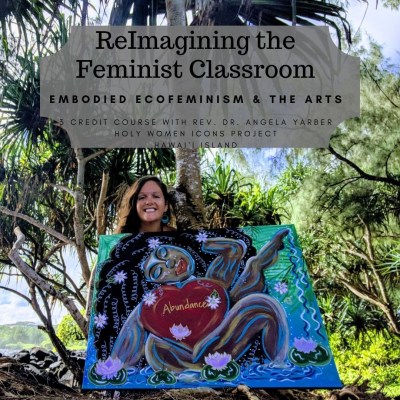
Reimagining the Classroom: Embodied Ecofeminism and the Arts Course on Hawai’i Island by Angela Yarber

“The classroom remains the most radical space of possibility in the academy.”-bell hooks

Like many academics, my “in the box” dream was to be a professor. The full-time, tenured kind. Like many queer feminist academics, I know that such dreams are rarely reality. When you’re also an artist and activist with a strong penchant for wanderlust, these dreams are simply unattainable fairytales. Never one for “in the box” living, I left the traditional academy and traditional church years ago, wandering over the garden’s walls with Lilith as my intrepid guide. I’ve told the story before. My wife and I left our jobs, sold our home, traveled full-time with our toddler, and turned the Holy Women Icons Project into a non-profit while building an off-grid tiny house on the television show Tiny House Nation in Hawai’i. It’s become old news. But since we’ve been doing this for several years now, those faraway dreams are finally starting to become reality. The academic classroom, the activist’s platform, the artist’s studio, the feminist’s megaphone, and the farmer’s orchard are fusing into one creative, life-giving, empowering space for teaching. The Holy Women Icons Project’s first academic course, “Embodied Ecofeminism and the Arts,” is actually happening. Seminarians and doctoral students from Berkeley join us in January. They’re soon followed by undergraduates from New York and seminarians from Atlanta. And I’m reaching out to more and more schools interested in creatively, subversively, and sustainably decolonizing the classroom with us for one week on the Big Island.

Continue reading “Reimagining the Classroom: Embodied Ecofeminism and the Arts Course on Hawai’i Island by Angela Yarber”

Metamorphosis and a Press Conference: A Kafkaesque and Shakespearean Fantasy about an Unreal Individual by Barbara Ardinger

Donald wakes up too early. Feeling confused and disoriented, he looks around the room. His bed has disappeared! He seems to be lying on the floor. Why? he asks himself, how’d I fall off my king-size bed? The floor (uncarpeted??) seems to go on around him forever, sans furniture, sans TVs, sans his solid gold toilet, sans even the doors and windows. It’s all a great big blank. All around him. Where am I? he asks himself.

He had disturbing dreams all night, and not just last night, but for…well, awhile. Since the subpoenas. He keeps seeing big, strong, silent men wearing jackets with initials on the back carrying big boxes out of his various offices. All of them. All over the world. In one repeating dream, a man dropped a box. It fell open, scattering papers filled with names and numbers. The men picked everything up, put the papers back in chronological order, and resealed the box. They kept carrying the boxes out to black vans that didn’t have names painted on them.

Continue reading “Metamorphosis and a Press Conference: A Kafkaesque and Shakespearean Fantasy about an Unreal Individual by Barbara Ardinger”

What I Learn from Women in Southern Morocco by Laura Shannon

I feel deeply fortunate to be able to travel regularly to southern Morocco. In Taroudant in the Souss Valley, and further south in the Anti-Atlas Mountains, my groups of students have the chance to discover women’s cultural traditions including music and dance, weaving and embroidery, household and healing rituals. In the seven years I have been leading these tours, women have joined me from a dozen different countries and as many different faiths, and most of them end up feeling at home here just the way I do.
What makes southern Morocco so special? Many threads come together to create the extraordinary ambience which permeates this part of the country. First of all, there is the Berber influence: a large percentage of Moroccans in the South are Berbers, and many elements of ancient North African Berber culture, with roots in Neolithic times, remain percepible beneath the relatively recent overlays of Arabic culture and Islam.

Continue reading “What I Learn from Women in Southern Morocco by Laura Shannon”