I feel deeply fortunate to be able to travel regularly to southern Morocco. In Taroudant in the Souss Valley, and further south in the Anti-Atlas Mountains, my groups of students have the chance to discover women’s cultural traditions including music and dance, weaving and embroidery, household and healing rituals. In the seven years I have been leading these tours, women have joined me from a dozen different countries and as many different faiths, and most of them end up feeling at home here just the way I do.
What makes southern Morocco so special? Many threads come together to create the extraordinary ambience which permeates this part of the country. First of all, there is the Berber influence: a large percentage of Moroccans in the South are Berbers, and many elements of ancient North African Berber culture, with roots in Neolithic times, remain percepible beneath the relatively recent overlays of Arabic culture and Islam.
I never considered myself one of those people who gets really “into” Halloween. But, as one might expect having an eight year old, especially an eight year old who celebrates her birthday shortly before the holiday, has made me much more in tune with the excitement and preparation which surrounds Halloween.
One of the traditions that I do very much enjoy is watching Halloween movies like Hocus Pocus and Double, Double, Toil and Trouble and, new to us last year, drinking warm mulled wine after coming home from a chilly (and this year possibly snowy!) night of Trick or Treating.
In my work as a church musician Halloween is book-ended by the celebration of Reformation and All Saints Day, so it tends to be a fairly busy time for my work schedule. As a result this is often the time of year that I reconsider my self-care and centering routines in the hopes of somehow preparing myself for the coming holiday season and the end of the year. This year, as I checked in on my current practices I realized that I haven’t been reading as much poetry as I used to when I was in grad school. As a result I have been trying to get back in the habit of reading some poetry a few times each week to help center myself. As luck would have it the last few weeks have found me stumbling upon poetry with connections to the Halloween season. I want to share with you a portion of two seasonal poems that I have encountered and are sticking with me.
Artwork and sustainable agriculture are the two threads of my professional life. They mingle fruitfully beneath the surface as I sift through remaining evidence of ancient worlds, trying to sense how people of lost cultures met basic survival needs and also how they responded to the very human hunger for beauty, meaning, and story.
In revisiting the remnants with empathy and wonder, scavenging for resonant clues and forks in the road that we didn’t take, some subtle but significant things continually resurface. For one, various ancient Greek writers (males, e.g., Plato, Strabo, Euripides) noted that it is “the women” who keep things sacred and maintain spiritually oriented rituals; that without the impetus of women, men would not bother to honor the sacred in everyday life, carrying on without much concern beyond themselves. Continue reading “Wealth In Imagination by Laurie Goodhart”
“I’m not afraid. I was born to do this.” -Joan of Arc
Women are inherently valiant. In extreme situations we armor up and lead others through whatever we are battling at the time.
Joan of Arc was a human woman with otherworldly faith who, as a young teenager, listened to Divine voices and lead an army that eventually ended the 100 Years War. “The real Joan of Arc is an uncomfortable fit as an icon of female solidarity or democratic rights. She achieved what should have been impossible for someone of her gender and class in 15th-century France.” wrote Helen Castor in her book Joan of Arc: A History. She was so respected and revered that 20 years AFTER Her death, 115 people testified on behalf of Joan of Arc (Jeanne d’Arc) and overturned the ruling.
Enbodying the Divine Feminine on Earth, women look to Joan as an inspiring example of a brave and active woman. Joan inspired the Suffragettes, they held her banner and wore white (as Joan chose to wear white for purity when She was taken to the stake to be burned for the crime of cross-dressing) as they marched for women’s right to vote. Just as, a few months ago our newly elected Congresswomen all wore white in solidarity.
The day before the 2019 Nevertheless She Preached conference at First Baptist Church of Austin, TX my own Catholic church’s young adult ministry hosted Eucharistic Adoration. Although I’ve enjoyed Adoration dozens of times, several factors made this evening different. I was preparing for cervical surgery for one. My Hebrew Bible class at Austin Presbyterian Theological Seminary was grappling with Rebekah, Rachel, Leah, and the voiceless Dinah. The call to write the history of 20th century Catholic women theologians had been at my ear all day. The catalyst was when two men at the Adoration began leading a song about God the Father.
Maybe it was just the incense but I swear I saw something. An image of the baby crowning from the womb, God gasping in labor, as the Eucharist wore the gold of the monstrance as a crown before the tabernacle. God was pushing the Body of Christ into creation while I prayed for my own sick body. God was crying out with the voices of these thousands of unheard women. We were all there. I snuck out my phone and took a picture, determined to put the scene to paper.
At the end of Anita Diamant’s novel, THE RED TENT, Dinah—the same young woman who is only briefly mentioned in the biblical account (Genesis 34)—dies after a long and full life. The biblical text tells us that Dinah “went out to visit the women of the region” and that “Schechem son of Hamor the Hivite, prince of the region, saw her…seized her and lay with her by force” (vss. 1-2). The passage is often titled “The Rape of Dinah.”
In Diamant’s version of the story, Dinah and King Hamor’s son engage in consensual sex. In keeping with the biblical account, the king then attempts to negotiate a bride price with Jacob (Dinah’s father), but Jacob and his sons are reluctant to agree to the marriage. They demand soon thereafter that all the men in Hamor’s kingdom undergo circumcision as a bride price. On the third day after surgery, the sons steal into the city and kill the men.
After just a mere mention of Dinah’s “rape” in Genesis 34, she disappears from the story. In THE RED TENT, Diamant not only gives Dinah a powerful voice, she also weaves a wonderful tale of mothers, daughters, heartache, betrayal, loss, love, and joy. Dinah gives birth to her lover’s son in Egypt, develops a strong bond and working relationship with the midwife, Meryt, and eventually falls in love with Benia, a master carpenter.
September 17 marks the feast day of 12th century Benedictine abbess and powerfrau, Hildegard von Bingen.
Born in the Rhineland in present day Germany, Hildegard (1098–1179) was a visionary and polymath. She founded two monasteries, went on four preaching tours, and wrote nine books addressing both scientific and religious subjects, an unprecedented accomplishment for a 12th-century woman. Her prophecies earned her the title Sybil of the Rhine.
Over eight centuries after her death, Hildegard was finally canonized in May 2012 and in October 2012 was elevated to Doctor of the Church, a rare and solemn title reserved for the most distinguished theologians.
But most people today know Hildegard best for her soaring ethereal music.
The first composer for whom we have a biography, she composed seventy-seven sacred songs, as well as Ordo Virtutum, a liturgical drama set to music.
Her melodies are completely unlike the plainchant of her era—or anything that has come before or since. Likewise her lyrics are highly original and feel fresh to us even today. She was the only 12th century writer to compose in free verse.
Hildegard and her nuns sang the Divine Office eight times a day. She believed that song was the highest form of prayer—the mystical power of music reunited humankind to the ecstasy and beauty of paradise before the fall, connecting the singer directly with the divine, and joining heaven and earth in celestial harmony.
I’ve spent years researching Hildegard. I’ve visited the sites of her abbeys along the Nahe and Rhine, studied her writings, and written a novel about her, Illuminations: A Novel of Hildegard von Bingen, published in 2012. I’ve had the privilege of discussing Hildegard’s life and work with scholars, musicians, and people of faith from around the world. But not until last month did I have the opportunity to experience firsthand what it would be like to sing Hildegard’s wondrous music.
In August I took part in a retreat entitled “Connecting Heaven and Earth: The Chant of Hildegard” at Hawkwood College in Stroud, southern England, led by renowned soprano Dame Emma Kirkby and by author, spirituality teacher, and musician Caitlin Matthews. I’ve been reading Caitlin’s sublime books from the moment she started publishing in the 1980s. Caitlin’s Sophia: Goddess of Wisdom, Bride of God is a spiritual classic I highly recommend. I also own and adore Emma’s iconic 1985 album, Feather on the Breath of God, which first introduced Hildegard’s music to a wide mainstream audience.
This course was open to singers of all abilities. I would describe myself as an enthusiastic amateur, better suited for folk songs than Hildegard’s soaring octave leaps, but as a lover of Hildegard, how could I not at least give it a try? I’ll confess I was somewhat intimidated to learn that many of the participants were professional or semi-professional singers who were quite adept at sight-reading and that some of the scores we worked with were not in modern notation but in the medieval neume pattern. I found our singing classes quite daunting, even grueling, for we were experiencing a heat wave and our classrooms were all south facing with huge glass windows and radiators we could not shut off!
Hildegard’s music is challenging, especially for amateurs like me. It requires a huge range of voice, from ascendant scales that even the experienced sopranos sometimes struggled with, to deeper, profounder notes. But as the weekend went on, I began to slowly grow in confidence, following the stronger voices around me, and enjoying the sheer beauty of the music.
Caitlin helped balance the retreat by sending us on outdoor walking meditations through the beautiful gardens and woodlands where we could meditate on Hildegard’s vision of Viriditas–the sacred as manifest in the green, growing world.
On our last evening, we performed a recital with an audience of one, a friend of one of the participants. Some of the more accomplished singers sang solos while the rest of us joined in the chorus and in other songs. Listening to the soloists, I nearly wept, it was so beautiful and transformative. Listening to Hildegard’s music, particularly when performed live, moves the spirit within. These sacred songs are literally uplifting, just like the dramatic leaps in scales. After our recital, our single audience member told us that she felt the music lifting her heart energy toward heaven.
Our evening recital at Hawkwood. Caitlin and Emma are front and center. I am the short one with the long hair in the back, on the right.
While writing Illuminations: A Novel of Hildegard von Bingen, I listened nonstop to CDs of Hildegard’s music, creating a wall of sacred sound that helped inspire and empower my writing. But singing her music live as an amateur was a completely different and possibly more authentic experience than listening to polished and digitally mastered CDs. Hildegard composed her music to be sung by her sister nuns, not all of whom would be accomplished vocalists. She might have had sisters who were tone deaf or had a very limited vocal range. In sacred song what matters most is the spiritual intention behind it, rather than talent or technique or polish. Each song is a prayer offered to the divine. Sacred song is all about the mystery of devotion rather than the mastery of notes or neumes. Singing in a group of like-minded women, even with such a broad range of ability as we had, we reached a sublime place, our voices joining, so that we could hear the Voice behind our individual voices.
“There is the music of heaven in all things,” Hildegard wrote. “But we have forgotten to hear it until we sing.”
If god is the wild, passionate, loud, sexual, sizzling, dancing fires of creation.
And should I ever forget my fiery, heavenly vision, the sun comes out every day to remind me.
And I ask myself, which is more miraculous? Our local star feeding earthly life?
Or me, reflecting the sun, feeling the passion, sizzling in response?
Jacob Dreams and So Do We
(inspired by Genesis 28:12)
As darkness slips into light,
dawn,
with its unique melody,
grows brighter.
As light slips into darkness,
dusk,
with its mysterious possibilities,
settles softly upon the land.
Creation is oneness, but we need duality to experience sex, symphonies, hot fudge sundaes.
Creation is pure love, but it is to the passions of the human heart that we owe our earthwalk
Dawn and dusk hold open the thresholds of mystery inviting our human hearts to experience . . .
The sacred dance where one becomes two becomes three.
The sacred song where three becomes two becomes one.
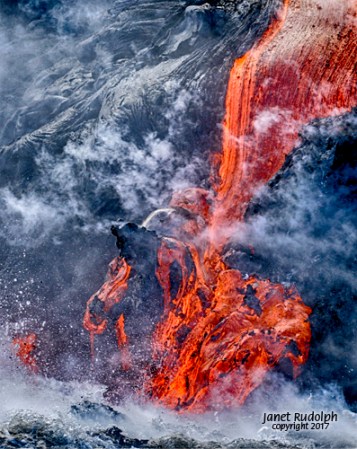
Pele’s Birth Dance
Twinkling stars ignite waves of fire that explode into a tumultuous, joyful noise:
“EH YEH, EH YEH, EH YEH.”
And Mother Earth awakens.
Matter bathed in Pele’s cauldron flares up, erupting into waves of baby earth while roaring:
“EH YEH, I AM, EH YEH.”
As seeds rise from great watery oceans of fire, my heart swells, breathing air into newly forged matter and causing my breath to become song:
“I AM, EH YEH, I AM.”
Fire,
that reflects flame-drenched stars,
that reflects Pele’s dance,
that reflects the passionate seed,
echoes within my belly until I glow with waves of love which burst forth to sing:
“I AM, I AM, I AM.”
And then . . .
Riding a watery wave that gushes forth new life, my newborn erupts from my body, then twinkles, then cries tumultuous joyful noise:
“EH YEH, EH YEH, WAHHHHhhhhhh.”
(Note: “Eh yeh” is God’s name in phonetic Hebrew as given to Moses in Genesis 3:14. “I am” is its traditional translation into English)
Janet Rudolph has written three books on the subject of ancient Biblical Teachings. One Gods: The Mystic Pagan’s Guide to the Bible,When Eve Was a Goddess: A Shamanic Look at the Bible, and the just recently released book,When Moses Was a Shaman. For more information visit her website at /www.mysticpagan.com/
“She’s doing it again,” Mrs. Cockroach is saying to her friend Old Mrs. Spider. “You know? The giant? She’s been blowing on me and telling me to live somewhere else. Like, I’d leave a good home?”
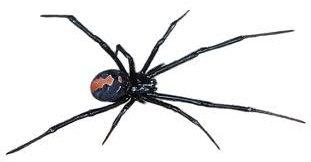
Old Mrs. Spider looks up from her weaving. “Yes,” she says in a weary voice. “But you know she’s not a giant. She’s just a normal human being, well, overweight, as I understand humans measure their bodies. And if she’s going to blow on us and ask us to live somewhere else, well…..I think she needs to brush her teeth.”
Mrs. Cockroach chuckles. “Indeed. We insects, maybe with the exceptions of fleas and termites, we don’t have bad breath. Blood-breath and wood-breath are sour! I was sitting on the wall in her bathroom, keeping an eye on things and telling the termites to get away from the window, and she just walks up. Doesn’t she know we insects and arachnids are protecting her house?”
I’ve always been an artist-painter, with an innate drive to explore the mystic and ethereal. Concurrent with artwork I minored in Philosophy as an undergrad, then farmed (certified-organically) with animals and plants for thirty years, all the while accumulating a fine archaeology reference library. The farming grounded the other endeavors in a way that probably nothing else can. Scraping by in the best of years, and always subject to the vagaries and perils of natural forces, one learns that there is no other way forward than to surrender, constantly alert to the complex nuances of Earth and Life.
Even though no longer farming, I still carry on in this way. A couple of weeks ago I participated in a three-day regional Artist’s Open Studio Tour, hosting the general public during some of the most sweltering days on record in our area. Bringing people into the un-air-conditioned studio to suffer was an awful prospect, so I hung forty large paintings and twenty tiny ones in a large shady area that I’ve thought of as The Sacred Grove, since acquiring this property five years ago.
A sacred grove because it is bordered on its long side by a small stream that emerges from a spring at the uphill end. Further uphill from this area is a columned platform that the previous owners erected and dubbed, The Parthenon. These wonderful features dovetail exquisitely with the fact that for the past twenty years my artwork has focused on what I call Remnants And Residents Of A Lost Sanctuary Of Aphrodite.Continue reading “In A Sacred Grove by Laurie Goodhart”



 Artwork and sustainable agriculture are the two threads of my professional life. They mingle fruitfully beneath the surface as I sift through remaining evidence of ancient worlds, trying to sense how people of lost cultures met basic survival needs and also how they responded to the very human hunger for beauty, meaning, and story.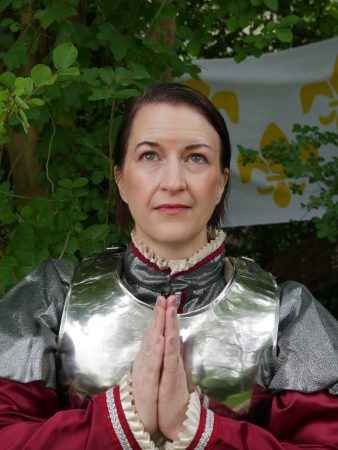





 Feminism and Religion