Soulful Art in New York City by Judith Shaw

judith shaw photoThough temperatures outside were sizzling during the July heatwave in New York, I was cool inside the Frick Museum. Nearing the end of my visit I was standing by a rope that blocked entry to a curved stone staircase – I looked to my right, a stunning Renoir; I looked to my left, a resplendent Vermeer. Each expresses the essence, the sublime – one with misty intensity – the other with focused clarity. 

Continue reading “Soulful Art in New York City by Judith Shaw”

Poem:  “How to Survive a Four Letter Word” by Marie Cartier

What is taken from a woman?

When someone breaks her open and fills her with nothing of herself,

and then leaves?

She has to find all the pieces of herself.

That’s why they call it—recovery.


You have to recover.

It doesn’t always happen. You’re not put back together

exactly the same. The pieces were broken.

Still are, just glued back together.

It’s a four letter word:  rape.

Continue reading “Poem:  “How to Survive a Four Letter Word” by Marie Cartier”

Happy Birthday Isis: Isis Isis…Ra! Ra! Ra! by Karen Tate

I wanted to pull myself away from the ugliness out there and take time to honor the Egyptian Goddess, Isis, as Her birthday is recognized to be in the latter part of July.  My husband, Roy, and I formed the Isis Ancient Cultures Society and the Iseum of Isis Navigatum, in Los Angeles, sometime ago and for more than a decade, in Her name, we sponsored Moon Circles to promote diversity, Salons to teach, and we put out a quarterly newsletter when you still had to fold and mail them – remember that?  But the premier events every  year were the Isis Birthday Tea and the Isis Navigatum or Festival of Isis, every March.    Our aim was to reconstruct Isis rituals in a modern context and make them relevant  for today.

We put on the Isis Tea in prestigious locations like aboard the Queen Mary and the Isis Navigatum in various public locations including The Japanese Gardens, in the San Fernando Valley, and on the beach on Point Dume, in Malibu, California.  So detailed were our events, sometimes the public joined us thinking we were a movie crew and our organization was written about by a anthropologist/folklorist citing the detail and depth of the material culture of contemporary Isian devotees.

Continue reading “Happy Birthday Isis: Isis Isis…Ra! Ra! Ra! by Karen Tate”

Sappho’s Poems as an Ethos for Women’s Ritual by Jill Hammer

Photo by: Zac Jaffe

For by my side you put on

many wreaths of roses

and garlands of flowers

around your soft neck


and with precious and royal perfume

you anointed yourself.


On soft beds you satisfied your passion.


And there was no dance

no holy place

from which we were absent.


–Sappho (trans. Julia Dubnoff)


Sappho, the poet from Lesbos (630-570 BCE), was considered one of the greatest poets of her time—one of her epithets was “the tenth Muse.” I discovered the poems of Sappho in my thirties and was utterly captivated.  I had newly embarked on a relationship with a woman and Sappho’s love poetry (though by no means exclusively lesbian) supported the expression of eros between women.  Yet even more than that, Sappho’s poems supported an erotic relationship between self and world—a relationship that included ritual as a form of intimacy.  I’m not a Greek scholar—I experience Sappho’s poems in translation. Yet the translations I read back then were a revelation: a world in which women lived in circle with one another.

Continue reading “Sappho’s Poems as an Ethos for Women’s Ritual by Jill Hammer”

Temple Magdalen by Elizabeth Cunningham

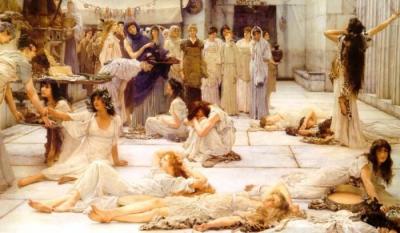
The Women of Amphissa, 1887, by Lawrence Alma-Tadema

Since I began writing for FAR in July 2012, I have written about Mary Magdalen, or excerpted a passage from one of my novels, near or on her July 22 Feast Day. For why I made the controversial choice to depict her as a prostitute, see last year’s post. The below excerpt is from The Passion of Mary Magdalen. I made this selection in remembrance of all the refugees in the world today. In this passage, Judith, a Jewish widow whose family was driven from the land by tax collectors, returns to the place where Maeve (my fictional Celtic Magdalen) and her friends have recently founded a Temple to Isis on the outskirts of Magdala. Maeve has just invited Judith to join them. (Edited for brevity.)

She stared at me, her eyes full of anger and longing.

“I will not be a slave and a whore where I was once a wife, the one who made the challah bread, who said the Sabbath prayers over it. This was our place, my husband’s and mine. We brought the best we had to the temple, the finest oil and wine, the unblemished kid—”

“Goats? You kept goats? You know how to make cheese?”

She sat quietly for a moment before she answered. “How can I live here with you?” she wondered. “I don’t understand.”

Continue reading “Temple Magdalen by Elizabeth Cunningham”

Finding God in Music by Gina Messina

We cannot force a connection with God through a faulty conduit. What is important is that we affirm ourselves when we find it — when we feel it. Embrace those experiences, name them for what they are and recognize that you are sacred and the divine – whatever that means to you – is present.

When I’m in a funk, I generally feed into it and make it worse. Once we are in a rut it is easy to continue the spiral downward. I’m good at admonishing myself for lacking gratitude when I feel this way. It might be a Catholic guilt thing.
A few days ago, I was in a dark place; but this time I tried to own my sadness, acknowledge it, and let it go. The only thing I could think to do in hopes of shifting my emotions was to put on music – something up beat that would allow me to transcend the moment.  

I listened to a live version of “Stay” by The Dave Matthews Band, a song about embracing the beauty of our lives and the idea that those moments where it feels like we are just wasting time are often our most precious; the ones that allow us to connect with each other and ourselves. It was the sermon I needed — and an important lesson my uncle taught me — but more on that shortly.

I often say that I think music is the sound of my spirit — our spirits. As I started writing this, I struggled with finding the words to articulate the feeling music provokes within me. There is little else that creates such an indescribable experience and that is why I think that music is where I find my connection to the divine. 

Traditional religious services have always felt challenging to me.  I don’t connect to much of anything and generally find myself feeling angry and rejected by the Church and the community where I am supposed to find God. My grappling with Catholicism aside, we are told that our spiritual lives must take place within particular dimensions, and for many of us God is not there. Continue reading “Finding God in Music by Gina Messina”

All Are Our Teachers by Elisabeth Schilling

Art by doanminh0205

What can we learn from each other? Some people teach us that we need help with boundaries. Some remind us that we are easy to love. We can observe the way some lovers make us want to escape, simmering a queasy feeling in our stomach that we practice patience and non-attachment with so that we are not harmed too much whilst in their presence and other lovers are always ready with a supportive word, assuring us that what we desire is valid, that we do not need to justify our path.

The people who we react to the most intensely, most of the time negatively, are these people our lessons? That sounds rather crass when thought to apply to anyone in an extremely oppressive and/or abusive situation. I would not suggest we apply this to anyone but ourselves, if indeed, it works for us. This is not the fatalistic idea of people belonging in a certain state or being punished for something. This is more a strategic curiosity of looking at our own agency from a back door. For example, my body might contort in frustration and sadness with someone, which could indicate I need to not be in relationship with their energies, but until I can create another path (maybe due to work commitments, relational obligations, financial situations, etc.), I feel more empowered reflecting so that I can learn about myself and others so as to perhaps not invite the same energies in during the future or to not have them affect me so harshly so that it doesn’t matter.

Continue reading “All Are Our Teachers by Elisabeth Schilling”

The Berlin Wall—what did the US learn? by Marie Cartier

I am writing this from Berlin. I am here for two weeks for the ALMS conference entitled, “Queering Memory.” Berlin is a city of such memory. You walk the streets and there are small brass plaques in the sidewalk in front of you memorializing Jews that were deported who lived in the residence. Everywhere there is memory of war, and hope.
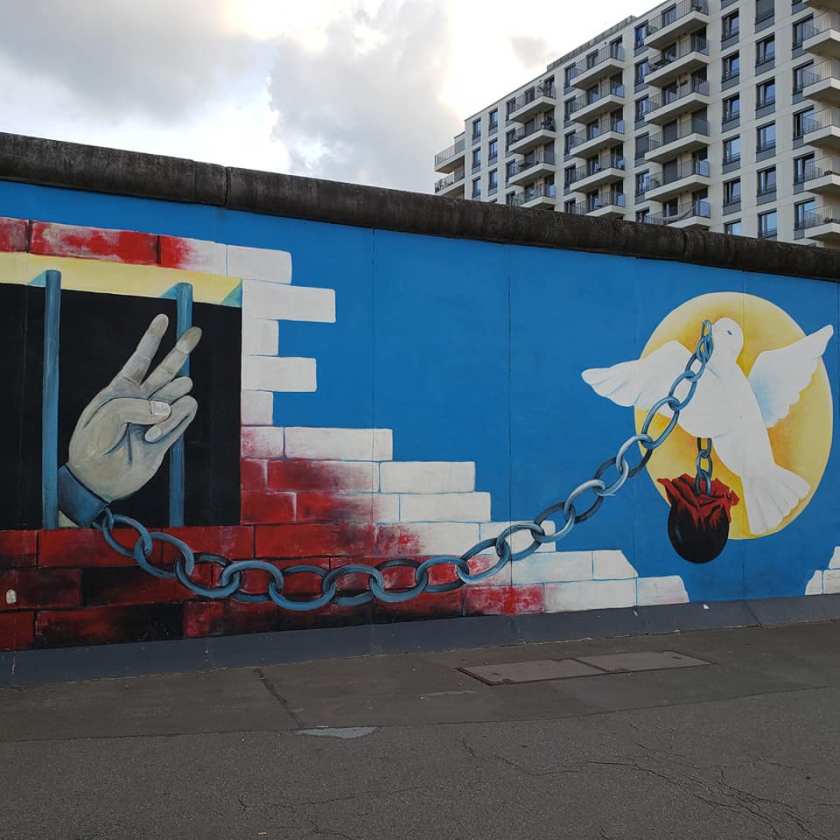
For me, perhaps the most visible symbol is the wall. The Berlin wall was in place from 1961-1989. When it fell, the East Side which had been closed off for decades, burst into freedom, as evidenced by the images on the east side of the wall, at the East Side Gallery – an open air mural gallery painted directly on that side of the wall.

Continue reading “The Berlin Wall—what did the US learn? by Marie Cartier”

If Holly Near’s Simply Love Album Were a Musical by Elisabeth Schilling

For many of us, listening to women-loving-women songs is a spiritual experience. That is because somehow it makes us feel seen, puts a sense of hope into our world as well as daydreams of romance. We can understand the challenges and the regret or guilt that comes with disappointing others and ourselves, them for not being who they wanted us to be and for us, not being who we are for far too long. Holly Near’s Simply Love album narrates a story that I might envision as a musical theatre production, and I really wish someone would ask me to write it and then hold the casting call (yeah, I’d want to be in it too, so save me a part). I offer some of my thoughts on two central songs in the would-be musical in hopes of sacred liturgy on a potential stage.

Simply Love has 28 songs and was released (according to Spotify) in 2000. I think the synopsis would be surrounding Cassandra, in a loving relationship with her partner, reflecting on her journey to this place of authenticity. I can imagine how it might be living one’s live in an exploratory way and coming to new revelations later in life.

Continue reading “If Holly Near’s Simply Love Album Were a Musical by Elisabeth Schilling”

Musings on the Triune God by Natalie Weaver

This past term I had the opportunity to teach courses on the Christian doctrines of Christology and Trinity.  My first inclination was to approach these doctrines from the perspective of their historical development. For, I find the historical study of doctrinal development to be a fascinating and liberating approach to theology because it delivers the searcher from the illusions of ubiquity and universality, even in matters of the most central tenets of faith.  When people can see doctrine in its political, polemical, and posited guises, we can be free from absolutization of belief in past expressions as well as in present permutations.

Yet, as much as I enjoy tours through the historical development of faith formulations, I found myself unable to really commit to this approach this year.  I was more concerned with allowing students space to think about Christ and to think about God.  I wanted to introduce the problems and tensions that have dogged Christian logic and practice for millennia, but I wasn’t interested in arriving at conclusions or teaching modern experts’ answers.  I wanted to create occasion for my students to answer for themselves questions of justice and mercy; theodicy; particularity; scandal; and more. Continue reading “Musings on the Triune God by Natalie Weaver”