By Song, All Was Created by Janet Maika’i Rudolph

This blogpost is part of an on-going collaborative project between myself and my dear friend Ecuadorian elder and medicine woman, Susana Tapia Leon. The purpose of the project is to illuminate in word and images the underlying pagan meanings of biblical verses. There are many rich verses that got hidden within translations. This has had the effect of erasing their original meanings or at least making them very difficult to uncover. I have come to call these hidden gems because they were not erased completely. In this post, I am offering alternative translations of 3 verses that focus on song.  

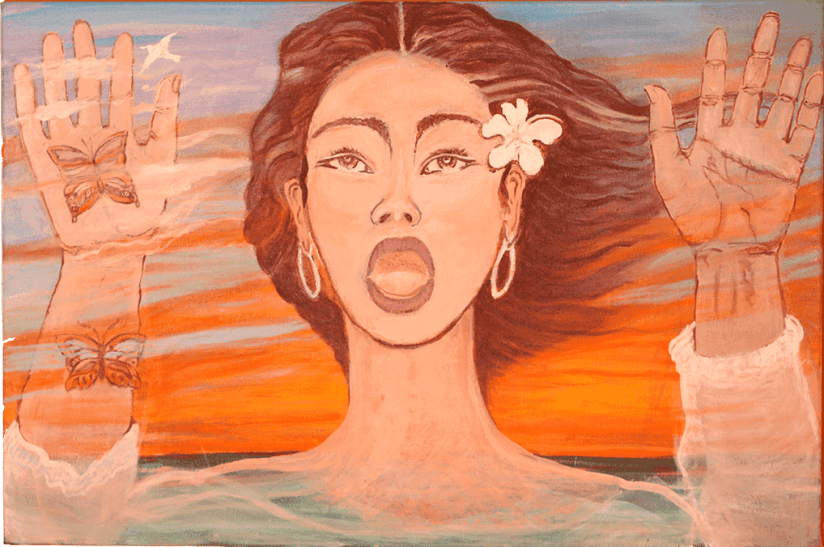
Susana Tapia Léon, Cantadora 1
“She came alive after a month of work
She was always inside waiting to be revealed.”
Continue reading “By Song, All Was Created by Janet Maika’i Rudolph”

The Place of All Possibility: Cultivating Creativity Through Ancient Jewish Wisdom by Rabbi Adina Allen

In her book Pentimento, author and playwright Lillian Hellman describes a phenomenon that often occurs when we return to a piece of art we once worked on after much time has passed: “Old paint on a canvas, as it ages, sometimes becomes transparent. When that happens it is possible, in some pictures, to see the original lines: a tree will show through a woman’s dress, a child makes way for a dog, a large boat is no longer on an open sea.” Hellman speaks of the way the aging paint allows for older layers to show through, offering an opportunity to see, in her words, “what was there for me once, what is there for me now.”

Like the painting Hellman describes, Torah, too, is a work in process. Layers and layers of interpretation have been added to it over time, according to the needs, desires, fears, and longings of those who devoted their lives to making meaning out of these sacred words. Some layers add to the beauty and power of the overall piece, strokes and shapes that bring the picture more clearly and compellingly into focus. And some accrue like varnish, making the painting hard and impenetrable. Each one of us is invited into this process of excavation, of peeling back layers of what we have been taught or what we think we know, and seeing, as Hellman writes, what is there for us now. And each of us is called to our creativity — to bring our brush back to the canvas anew, reencountering and reworking the stories, ideas, and images that lie at the very foundation of who we are and who we could be.

Continue reading “The Place of All Possibility: Cultivating Creativity Through Ancient Jewish Wisdom by Rabbi Adina Allen”

What an Outdoor Movie Taught me about Biblical Women By Alicia Jo Rabins

Once I went to a free outdoor movie in Miami Beach. The film was projected on the side of the giant concert hall. There was a grassy park with palm trees stretching out from the wall; families brought picnic dinners and cans of beer and stretched out to watch the movie once the sky darkened.

The movie was Star Wars, but as Princess Leah appeared, I was thinking about a different mythic canon. For over twenty years I’ve been studying and teaching stories of Biblical women from a feminist Jewish perspective, and after all this time, I was surprised to find that the way I feel while interacting with these stories was oddly, powerfully similar to the feeling of watching Star Wars projected on the side of a building on this Miami night.

Continue reading “What an Outdoor Movie Taught me about Biblical Women By Alicia Jo Rabins”

TRUMP AS MESSIAH by Esther Nelson

Once upon a time long, long ago, I identified as an evangelical Christian. The term “evangelical” has evolved over time, however, evangelicals can probably be found in every branch of Protestant Christianity. Wherever you find them, they emphasize the authority/ inerrancy of the Bible, a “born-again” experience into the Kingdom of God, and a personal relationship with Jesus Christ. Generally, evangelicals are socially conservative and rarely does their thinking go beyond the borders of their insulated theology.

It comes as no surprise to me that many (most?) evangelicals embrace Trump with a fervor akin to their enthusiasm for Jesus. Trump supporters, especially those who identify with the Religious Right may love Jesus, but Jesus is not the Messiah they yearn for.

Continue reading “TRUMP AS MESSIAH by Esther Nelson”

Miriam Speaks by Janet Maika’i Rudolph

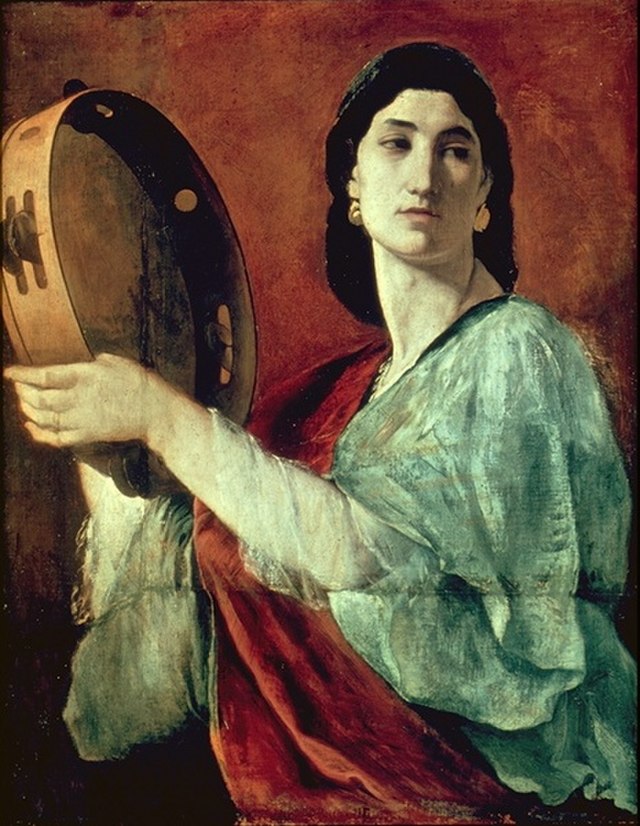
Wikimedia Commons: Anselm Feuerbach

Intro:  I have been working on a project inspired by Charlene Spretnak and her book Lost Goddesses of Early Greece. I am writing biblical stories through the eyes and words of the women. The scribes who wrote down the tales of the bible, wrote mostly from men’s point of view. And they had their own which was to destroy evidence of the Goddesses. I tell Noah’s story through Naamah, his wife. Abram and Sarai’s journey to Egypt through the eyes of Sarah. Exodus in Miriam’s voice. In my telling, Miriam went to Midian with Moses and, while there, experienced the Burning Bush and worked with Moses’ wife Zipporah to protect knowledge of the Goddesses. Below is an abridged version of this section of Miriam’s tale.  

I look around at your world today. You, yes you, are my descendants. My beloveds. I mourn for what you’ve lost. No, I am angry, how could things have gotten this bad? I dare you, I dare any of you to challenge my work. We did everything we could. It should not have taken this long to find our clues. But then I see the job the scribes did. It was better and more thorough than even we, who saw so much, could have imagined. I look around at this precious earth we bequeathed to you and see how damaged it is.

Continue reading “Miriam Speaks by Janet Maika’i Rudolph”

Jacob’s Ladder, A Feminist Perspective by Janet Maika’i Rudolph

Today, I embark on my retelling of the biblical story of Jacob, the section usually referred to Jacob’s ladder or Jacob’s pillow. The entire story-arc of Jacob is filled with mystery and a sense of shamanic-style questing. What is the goal of a shamanic quest? There are many but the foundation is to open gateways to travel amidst thresholds. It is through these passages that we can gain knowledge of ourselves, have ecstatic experiences, do healing work, divination . . 

I believe this is a feminist issue because when we look at Jacob’s story more holistically, we can strip away the patriarchal assumptions inherent in the tale as it’s come down to us. For example, in my retelling, there is no male grand deity standing above, judging and dictating human actions and interactions. 

Continue reading “Jacob’s Ladder, A Feminist Perspective by Janet Maika’i Rudolph”

A Serving of Vegetables with Love: Plastic, Poison, and the Simple Salad Solution

Years ago, I remember looking around one day and realizing that I was surrounded by plastic bottles. Of course I already knew it on some level; I had bought them, after all. But it was one of those epiphanal moments – you know, where you kind of freeze, and time seems to slow down, and everything goes a little out of focus. And I realized – yet again – that I had been hoodwinked. That we all have.

Because I felt like I needed every single one of them. Yet somehow – and not that long ago, either – everyone used to get along fine without all these plastic bottles in their lives. Yes, it probably involved more domestic labor; but it also just stemmed from a local, circular economy based on common sense.

Continue reading “A Serving of Vegetables with Love: Plastic, Poison, and the Simple Salad Solution”

From the Archives: Aren’t We All Divine Children? by Janet Maika’i Rudolph

This was originally posted March 18, 2021
Note from Janet: Thank you all who supported the launch of my book Desperately Seeking Persephone on May 19. Due to a printer’s error, the original books sent out were deeply damaged without formatting, editing and with uncertain content. If you received one of these books you are entitled to a free replacement. I have put instructions at the bottom of the post for anyone affected to receive their copy.

Consider the following four birth stories:

Continue reading “From the Archives: Aren’t We All Divine Children? by Janet Maika’i Rudolph”

The Daughter, the Alliance-Maker (Women in the Book of Daniel, part 2) by Liz Cooledge Jenkins

Note: This is the second in a two-part series reflecting on women in the biblical book of Daniel. For part 1, see here.

The second female character I noticed while taking a deep dive into the book of Daniel appears even more briefly. Daniel 11:6-7 includes her story: “The daughter of the king of the South will go to the king of the North to make an alliance, but she will not retain her power, and he and his power will not last. In those days she will be betrayed, together with her royal escort and her father and the one who supported her. One from her family line will arise to take her place” (NIV). It is a brief story—and not a happy one, in the end. But I think it’s worth reflecting on.

In this chapter of Daniel, an unnamed supernatural messenger gives Daniel a detailed account of a long series of violent power struggles between various kings. Empires accumulate and then are broken up (vv. 3-4). One king is strong, but his commander proves stronger and overtakes him (v. 5). Attacks are victorious, and valuables are seized and carried off (vv. 7-8). Retreats are made (v. 9). Great armies are assembled (v. 10). Kings “march out in a rage” toward battle (v. 11). Armies are carried off, and thousands are slaughtered (v. 12). You get the idea. Everything is violent. Everything is bloody. Everything is one brutal war after another, one brutal kingdom after another, one brutal ruler after another. It all starts to blur together.

Continue reading “The Daughter, the Alliance-Maker (Women in the Book of Daniel, part 2) by Liz Cooledge Jenkins”

The Queen, the Memory-Keeper (Women in the Book of Daniel, part 1) by Liz Cooledge Jenkins

Note: This is the first in a two-part series reflecting on women in the biblical book of Daniel.

I recently had the chance to take a deep dive into the biblical book of Daniel. I think it’s the first time I’ve read the whole book of Daniel since I’ve started intentionally attending to the questions of feminist biblical interpretation: Where are women present? Where are women absent? What are they doing or not doing—perhaps prohibited from doing? How does this passage move its readers toward—or away from—gender equity and women’s empowerment? How does it speak to—or deny—women’s full humanity?

            The absence of women in most of the book of Daniel feels glaringly obvious to me.[1] The main characters include the Hebrew exile Daniel, Daniel’s three (male) friends, King Nebuchadnezzar, King Belshazzar, and King Darius. The angels look like men. The divinely appointed eschatological authority figure is described as being like a “son of man.” The particularly oppressive king who desecrates the temple, abolishes the ritual sacrifices, and sets up an “abomination that causes desolation”[2] is definitely male.

Where are the women?

Continue reading “The Queen, the Memory-Keeper (Women in the Book of Daniel, part 1) by Liz Cooledge Jenkins”