Each month, I delight in writing about a revolutionary woman. Whether she is from history or mythology, sharing the stories of my Holy Women Icons with a folk feminist twist is one of my favorite things to do as a feminist, artist, scholar, and clergywoman. Yet, no matter how much research I’ve done, or how many times I’ve taught about an icon, new discoveries are made, revelations within my own heart and mind cracked open, so that there is sometimes the need to revisit a particular holy woman afresh. Such is the case this month with Guanyin. Though I wrote about her nearly two years ago, published a book including her story, and have taught a course with one session focused on her compassion and mercy, I realized that much about her has gone unsaid. Namely, she is an icon for queers, pacifists, and vegans. Before explaining why, let’s have a quick review…
Guanyin is the Buddhist Goddess of Mercy and Compassion. In the Lotus Sutras, she originates from a bodhisattva named Avalokitesyara. Avalokitesyara is identified as male in the Lotus Sutras. Overtime, however, Avalokitesyara transitions from being identified as a male to becoming Guanyin, most often portrayed in feminine terms and referred to as “she.” Many scholars assert that Guanyin is androgynous and can take on the form of any sentient being. And this is how I’ve always written about Guanyin, as the divinely androgynous one who is most often portrayed in feminine form. Continue reading “Guanyin Revisited: Queer, Pacifist, Vegan Icon by Angela Yarber”
For many years I been told of the beautiful Hymn of Kassiani, sung only on Easter Tuesday night, but I had never heard it until this week. For many this song is the high point of Easter week.
Kassiani, also known as St. Kassia, was a Greek woman born into a wealthy family in Constantinople (now Istanbul) about 805 to 810 AD. According to three historians of the time, she was intelligent and beautiful and selected as a potential bride for the Emperor Theophilos. The chroniclers state that the Theophilos approached her and said: “Through woman, the worst,” referring to the sin of Eve. Clever Kassiani responded, “Through woman, the best,” referring to the birth of the Savior through Mary.
Apparently unable to accept being put in his place by a woman, Theophilos chose another bride. Kassiani founded a monastery in Constantinople becoming its first abbess. She was an outspoken theological advocate of icons during the iconoclastic crisis (for which she was flogged). One of only two women to publish under her own name during the Byzantine Middle Ages, Kassiani wrote both poetry and hymns. Up to 50 of her hymns are known today, with 23 of them being part of the Greek Orthodox liturgy. Continue reading “Kassiani: Placing a Woman at the Center of the Easter Drama by Carol P. Christ”
Sophia was the first Holy Women Icon with a folk feminist twist I ever painted. A church gallery was hosting a Lenten triptych exhibition with the theme of “The Many Faces of Jesus.” I knew immediately that the face of Jesus I wanted to portray was Sophia wisdom. Sophia is the Greek feminine word for wisdom in the New Testament. Her characteristics are similar to the Hebrew hokhma, but expand in early Christian theology as she is understood as a divine attribute, or part of the trinity. In these ways, sophia is portrayed as a hypostasis of God’s wisdom, or a part of God’s substance. Accordingly, early Trinitarian formulas reference God the father, Jesus the son, and Sophia the spirit. A female spirit was undeniably an early part of the trinity.
It is worth noting that such an early understanding of the trinity, and of an unequivocally feminine spirit, was once normative. The Spirit was understood as and spoken of as a “she.” April DeConick highlights the difficulty of such an understanding today: “[W]hat must be realized is that Judaism and Christianity are the products of centuries of religious developments. So what might have been considered ‘orthodox’ at an early time, a few centuries later might be considered ‘heretical’ because the tradition and practices had drastically changed by then (April DeConick, Holy Misogyny, 7).” What was once orthodox—a female sophia spirit—has slowly, yet intentionally been overshadowed by patriarchal understandings of the trinity and the spirit. Continue reading “Painting Sophia by Angela Yarber”
My sister once said about me, “One thing you have to understand about Elise—she takes the ritual of whole thing very seriously.” My sister was right and her words helped me see this quality about myself. What ritual was she talking about me taking so seriously? Happy hour on Fridays.
It was a different season of my life when she said this. I don’t have Friday happy hours regularly anymore, although I did gather with my friends nearly every week for food and drinks for many years throughout my 20s and 30s. It was often on Fridays, but at one point it was Wednesdays and then, for about a year, it was Thursday nights after a late shift at work.
More recently, I would meet a friend for crepes at the farmers’ market on Saturday mornings. Although the day and the time and specifics of these gatherings would vary, the act of setting aside a weekly time to connect with people dear to me and relax as we indulged in good food or drink was a ritual to me.
Dawn Mandala, ink and watercolor on paper, by Judith Shaw
Can geometry open our hearts and minds to spirit? Throughout time people around the world have thought so. Mandalas and Sacred Geometry symbols are found in many cultures both ancient and modern.
Mandala is a Sanskrit word which means “sacred circle.” In Buddhism, Hinduism and other ancient wisdom traditions of the East, the mandala has been used as a tool to facilitate contemplation and meditation. Through the process of studying and/or creating a mandala one can reach one’s center, one’s connection to Source. The circle, the first closed shape of Sacred Geometry, thus becomes a doorway to Oneness.
Traditional Hindu mandalas follow a strict form. Every mandala is created following the precise design of that form. One sees a further development of other Sacred Geometries within these traditional forms. First there is the squaring of the circle also known as “The Marriage of Heaven and Earth”, with the circle representing Heaven and the square representing Earth.
In the Hindu tradition, each design within this “Marriage of Heaven and Earth” is called a yantra mandala and functions as a symbol which reveals cosmic truths. Thus yantra mandalas become sacred geometric symbols of a particular Hindu deity.
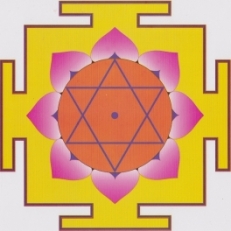
One of the most famous yantra mandalas is the Shri Yantra, a symbol of Tripurasundari, a supreme Hindu Tantric Goddess. It depicts a series of precisely interlocking triangles, half pointing downward and half pointing upward. It forms a state of perfect balance and harmony and represents the union of the female and male principles. Also known as the Yantra of Creation or the Cosmic Yantra it is the most honored of all the Hindu yantras. The Shri Yantra becomes a door which can lead to the experience of Oneness.
Another goddess whose divine truths are revealed through the mandala is Lakshmi, Hindu Goddess of fortune, light, luck, and beauty. Meditating on the Lakshmi Yantra encourages spiritual progress and helps to overcome internal blocks.
Christianity has also used the mandala to represent Divine Oneness and to teach the wisdom of its tradition. The magnificent rose windows of the Gothic cathedrals are luminous examples of western mandalas. Complex sacred geometries were used in the architectural designs of the buildings themselves and of the rose windows.
The rose windows are a western representation of our human aspiration towards wholeness and balance. The rose windows operate on various levels; spiritual, emotional and intellectual. The instructional aspect of the rose windows is clearly seen by the subject matter – biblical stories, lives of the saints, astrological calendars, and morality stories to name a few.
In much the same way that the Hindu yantras symbolize the aspects of a particular deity, the rose windows typically show Christ or the Virgin or some other combination in the central rosette of the window. The gates at the cardinal points of the yantras depict the many paths available to reach the divine. In a similar fashion, the saints shown in the petals of a rose window can be seen as paths to Christ.
More than likely, mandalas were reintroduced into western thought through the Carl Jung’s pioneering work on the unconscious. Jung wrote: “I sketched every morning in a notebook a small circular drawing,…which seemed to correspond to my inner situation at the time….Only gradually did I discover what the mandala really is:…the Self, the wholeness of the personality, which if all goes well is harmonious.”
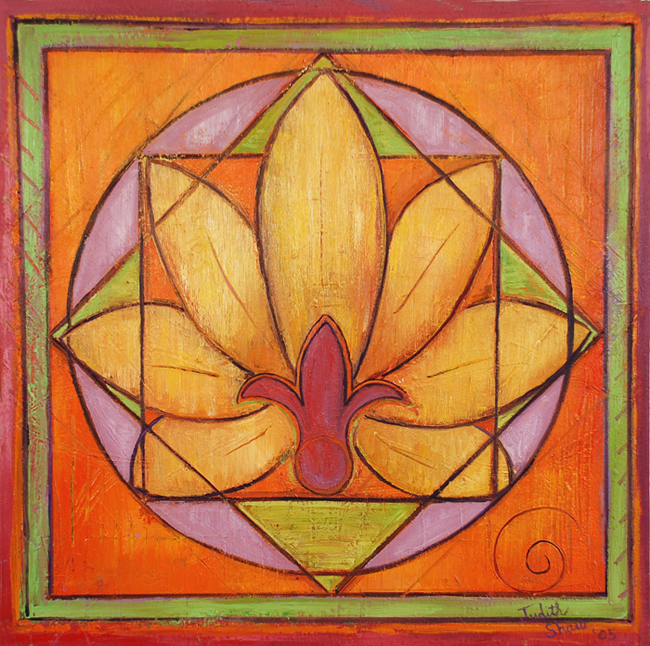
Lotus Mandala 1, oil on canvas, by Judith Shaw
Continuing in this tradition, artists and spiritual practitioners today have been exploring a more free-form style of the mandala. Within the basic foundation of the “squaring of the circle”, the artist then creates a personal, spontaneous design based on the concepts of balance, wholeness and oneness.
A quick google search reveals a multitude of mandala workshops being offered all around the world. Exploration of the mandala through these workshops offers a connection to your true self, an experience of sacred love, an opportunity to improve your life with intention, a deepening of your connection to nature, healing of emotional, mental, or physical pain, and a chance to be truly in the moment.
The mandala is a form that I have used in my own art since before I discovered the existence of Sacred Geometry. Even when not directly exploring the mandala, I find that often I want to draw a circle around the main image in my painting – seeking that experience of wholeness in the process of painting.
In future posts I will explore other elements of Sacred Geometry, all of which grow out of the mandala, the sacred circle.
Judith’s deck of Celtic Goddess Oracle Cards is available now. You can order your deck on Judith’s website. Experience the wisdom of the Celtic Goddesses!
Judith Shaw, a graduate of the San Francisco Art Institute, has been interested in myth, culture and mystical studies all her life. Not long after graduating from SFAI, while living in Greece, Judith began exploring the Goddess in her artwork. She continues to be inspired by the Divine Feminine in all of Her manifestations. Originally from New Orleans, Judith now makes her home in New Mexico where she paints and teaches part-time. She is currently hard at work on a deck of Goddess cards. Her work, which expresses her belief in the interconnectedness of all life, can be seen on her website.
When I first began to think about female language and images for God I imagined that changing God-He to God-She and speaking of God as Mother some of the time would be a widespread practice in churches and synagogues by now. I was more worried about whether or not images of God as a dominating Other would remain intact. Would God-She be imaged as a Queen or a Woman of War who at Her whim or will could wreak havoc on Her own people?
Forty years later, very little progress has been made on the question of female imagery for God. I suspect that most people in the pews today have never even had to confront prayers to Sophia, God the Mother, or God-She. Most people consider the issue of female language in the churches to have been resolved with inclusive language liturgies and translations of the Bible that use gender neutral rather than female inclusive language.
“I stood in the authenticity of my being: Black, preacher, Baptist, woman. For the same God who made me a preacher made me a woman, and I am convinced that God was not confused on either account.”
– Reverend Dr. Prathia Hall
These words came across my Facebook feed on Sunday in celebration of International Women’s Day. Reconciling Ministries Network put the statement on its Facebook page, along with a picture of Prathia Hall preaching from the pulpit, in remembrance and honor of women leaders who contributed to the US Civil Rights Movement. This past Sunday, March 8, when the quote was displayed, marked the 50th anniversary of Selma’s Bloody Sunday. Prathia Hall was a leader in the Student Non-Violent Coordinating Committee (SNCC) and one of the activists on the Edmund Pettus Bridge who were attacked as they began to march from Selma to Montgomery, Alabama. Later in her life, she became an ordained minister, professor, and womanist theologian.
For me, this past weekend was about remembrance through many forms. While there were many events commemorating Selma and the important events that unfolded there 50 years ago, my family and I were focused on a more intimate form of remembrance. On Saturday, we held a dinner and informal memorial service for my godfather who passed away last month. I got the news of his death on a day when I’d been doing some deep soul-searching and reflecting about the image I present to the world and its correspondence with who I am and desire to be. Just a few days prior, I’d spoken to my godfather about his health and subsequently, I had been questioning how I might be more connected to him. We lived several states apart, and I wondered how I could be a good goddaughter to him despite the distance. Those questions are left unanswered in the wake of his death. Continue reading “Role Play: In Search of the Authenticity of My Being by Elise Edwards”
Last year I got my ashes at the airport. As I sat in that airport chapel, I halfheartedly listened to a (mostly terrible) litany that was proclaimed in between announcements for gate changes. I was leaving for another campus interview after having been home for only 24 hours since the previous one. The Christian season of Lent came during a time of stress and chaos in my life. That year, when I contemplated what I might give up for Lent, I could think of nothing. So much had been taken away that I had nothing left to give.
The season of Lent is often linked with the idea of sacrifice. Some people fast, others give up a favorite vice or a favorite food. As a feminist theologian, I spend a great deal of time thinking about the idea of sacrifice. I wonder how women who consider themselves part of Christian churches can be asked to sacrifice when we have already given away too much. Too often, our labor is welcomed but our voices are silenced. As a Baptist theologian and ordained minister who has sojourned in Catholic universities, I’ve felt this in my own tradition and in traditions that are not my own. Continue reading “Ashes, Sacrifice, and Abundance by Melissa Browning”
Poppaea Sabina as portrayed on a Roman coin minted 62-65 CE.
As suggested in my first post on Poppaea it is likely she knew one or more of the women Paul refers to in Romans. Of particular interest is the woman Paul refers to as his ‘mother’ (Romans 16:13). If Poppaea knew her she surely knew about Paul. If that was the case, then it seems all but certain Poppaea was among those members of the imperial household to whom Paul refers at Philippians 4:22. Corroboration of that may have been in the source(s) of an anecdote Saint John Chrysostom tells, attributing Paul’s incarceration and execution to Nero’s anger at his interaction with a woman with whom Nero was erotically involved.
Though it is difficult to place much reliance on Chrysostom’s anecdote without more knowledge about his source(s), in the aggregate the evidence for Poppaea knowing about or even meeting with Paul is relatively strong, especially when compared to the sort of evidentiary problems with which ancient historians regularly grapple. Furthermore, it is easy to spot the issue Poppaea would have focused on (that precisely because it relates to sexuality could have led in antiquity to the sort of distortion or misunderstanding of her motivation in meeting with Paul) that may underlie Chrysostom’s anecdote: circumcision. The problem with understanding that issue today, however, ironically relates to modern perceptions of no relevance whatsoever to the ancient evidence. Continue reading “Poppaea & Paul: Was This About A Female Challenge To Male Privilege? by Stuart Dean”
Former Mayor of New York Rudy Giulaini recently questioned the American President’s patriotism when he asked if Obama had been “brought up the way you were brought up and I was brought up, through love of this country.” When Chris Hayes discussed the furor surrounding Guiliani’s statement on MSNBC with James Peterson of Lehigh University, I would say that they both missed the point. Their defense of the President was to insist that he is a dyed in the wool patriot. Should anyone be a dyed in the wool patriot these days? What does and should patriotism mean? These were questions not asked.
Asked to clarify his comments, Giulani opined that Obama speaks from the perspective of “socialism” and “perhaps anti-colonialism” rather than good old American patriotism. Again Hayes and Peterson dropped the ball. They were quick to agree that the American Colonialists should be considered anti-colonialist given that they rebelled against the colonial power of England. What they failed to say was that the American Colonialists were colonialists too. Though they threw England out, they had no compunction in asserting their right to take the land, the resources, and the very lives of earlier inhabitants of what became the American land.
I heard Giuliani’s statement in a different way. When Giuliani spoke of being brought up to love his country, I heard echoes of my own childhood. Like many Americans, Giuliani included, I was taught to love my country right or wrong. Indeed I was taught that my country was never wrong. From the perspective of my current understanding of the world, I now feel that the way I was brought up to love my country was itself wrong.
The American nation has been wrong on many things. First we must consider the idea our forebears held that the American land was theirs for the taking. No matter what degree of relation immigrant Americans had to the Native Americans, they all were taught that the Indians were barbarians who had no right to the land being claimed by civilized Europeans. Next we can ask why slavery was not outlawed and women were denied the vote at the time of the founding of the American nation. If we look at the truth of the matter, there are many reasons not to feel as proud of our country as “we” were taught to do.
And then of course there are the many wars—from the Pequot War to the Iraq and Afghanistan wars. How many, if any of them were just wars? And how many of them should rightly give us reason to temper any patriotism we have with the double eye that sees both the good and the bad that our nation has done?
If Chris Hayes had been interviewing me, I would not have been so quick to defend patriotism and the American nation. Rather I would have asked what patriotism means and whether anyone should defend any nation right or wrong. This would not have extricated Obama from Giuliani’s criticism, but it might have instigated deeper and more complex questioning of Giuliani’s premise.
In recent programs on MSNBC Lawrence O’Donnell opened a complex discussion of religion in general and Islam in particular, following Obama’s (now controversial) assertion that the terrorism of the Islamic State is not “the real” Islam and his statement that Christians were also guilty of atrocities during the crusades.
It was clear to me that the context of Obama’s statements is the feeling of many Americans that “Islam” is to blame for the terrorist activities of jihadists acting in its name, along with the conclusion they draw from this that “Islam” is a violent religion while “Christianity” is not. Obama was trying to make two related points: not all Muslims are violent jihadists; and Christianity is not all good and Islam is not all bad. Obama was immediately attacked for comparing Christianity and Islam for both having violent histories.
O’Donnell (unlike Hayes) resisted any knee-jerk temptation he might have had to defend Obama in any simple way from his critics. Rather O’Donnell (revealing the power of Roman Catholic theological education), began a more complex conversation about what constitutes “the real” Islam and “the real” Christianity.
This discussion of what is or is not “the real “Islam” and “the real” Christianity reminds me of debates feminists were having a few decades ago about whether or not “the real” Christianity or Judaism are sexist or not. Along with Mary Daly, Rosemary Radford Ruether, Judith Plaskow, and others, I engaged in this debate for a period of time.
In the end, I came to see that the question of what constitutes “the real” Judaism or Christianity is a moot point. Whatever good or bad exists in the past of any group is subject to interpretation by actors and groups of actors in the present: they are the ones who will determine which texts and which history they will consider normative and which parts they will transform or discard. From this perspective we can see that both jihadists and progressive Muslims are engaged in interpretation of Islam in the present, and that they are struggling with each other about which interpretation of Islam will be brought into the future.
It is not easy to initiate complex discussions of complex issues, but these are the very discussions we most need to have—about patriotism and about religion. It is clear that these discussions are related. Guiliani criticized Obama’s patriotism in part because Obama dared to criticize Christianity. Many people on both sides of the discussions about religion and politics are are convinced that their country is right because their God is on their country’s side.
I commend Lawrence O’Donnell and Asra Normani for showing us that complex discussions of religion are possible in public spaces, even when the political stakes are high. I hope this discussion will continue, and that a more complex discussion of patriotism and love of country can be initiated as well. No religion and no country is all good nor is any religion or country all bad. Blind faith in religion or country, on the other hand, is never a good thing.



 Sophia was the first
  My sister once said about me, “One thing you have to understand about Elise—she takes the ritual of whole thing very seriously.” My sister was right and her words helped me see this quality about myself. What ritual was she talking about me taking so seriously? Happy hour on Fridays.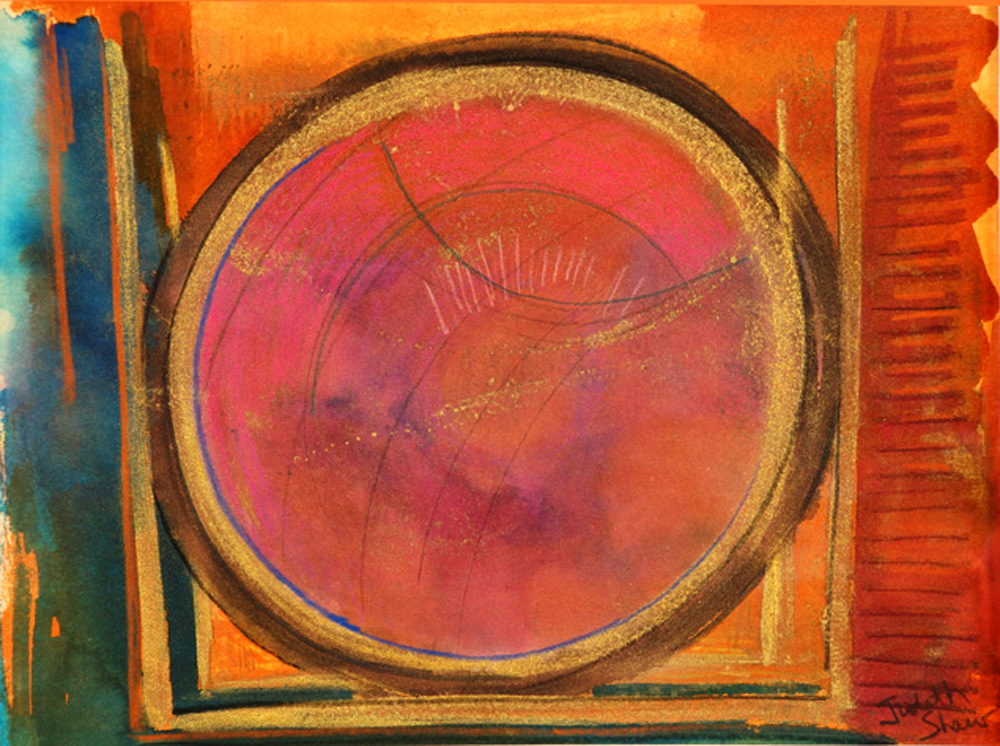






 Last year I got my ashes at the airport. As I sat in that airport chapel, I halfheartedly listened to a (mostly terrible) litany that was proclaimed in between announcements for gate changes. I was leaving for another campus interview after having been home for only 24 hours since the previous one. The Christian season of Lent came during a time of stress and chaos in my life. That year, when I contemplated what I might give up for Lent, I could think of nothing. So much had been taken away that I had nothing left to give.

 Feminism and Religion