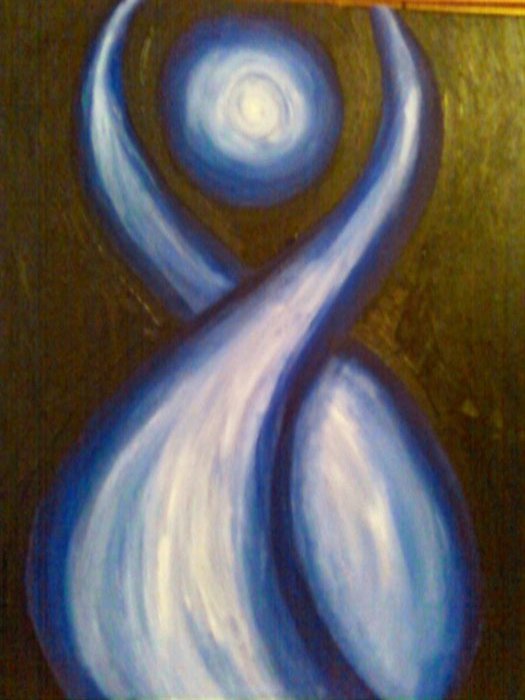
ADVENT: THE ACTIVE-WAIT, PART II, By Cynthia Garrity-Bond

On Nov. 14 I posted Part 1 of Advent: The Active-Wait. What follows (in Part II) is a rereading or exegesis of Mary’s encounter with her cousin Elizabeth as an Advent waiting with hope, anticipation and trust, but also with action.

The second form of waiting, illustrated in verse Luke 1: 39, reads: “In those days, Mary set out and went with haste to a Judean town in the hill country, where she entered the house of Zechariah and greeted Elizabeth.”  The verse before this has Mary in complete surrender,  “Here I am” Mary proclaims, “the servant of the Lord; let it be with me according to your Word.”  Continue reading “ADVENT: THE ACTIVE-WAIT, PART II, By Cynthia Garrity-Bond”

Birthing God at the Edges of Life, Death, and Beyond: Reflections on Mary, Motherhood, and Kali Part III By Tracy Sayuki Tiemeier

Tracy Sayuki Tiemeier, Ph.D., is Assistant Professor of Theological Studies at Loyola Marymount University in Los Angeles, CA. She teaches and researches in the areas of women and religion, interreligious dialogue, comparative theology, Asian and Asian American theology, and Hindu-Christian studies. Tracy also co-chairs the Los Angeles Hindu-Catholic Dialogue.

When I began my studies of Hinduism, I marveled in a dizzying array of gods and goddesses. While non-Hindus assume that Hinduism is polytheistic because of the multitude of gods and goddesses, the reality is far more interesting and complex. Hinduism really isn’t one religion, but a cluster of them. For some, there is one personal, divine God or Goddess, and all other gods and goddesses are either different forms of the ultimate divine or are lower, created beings (like angels). For others, there is one divine reality, but it isn’t a personal God or Goddess. For them, the different deities illustrate or symbolize different aspects of the divine, but are not themselves the one Ultimate Reality. What all Hindus recognize, however, is that there is one Ultimate, Divine Reality and that that divinity pervades all things. But that divine Oneness is so profound, so deep, so real, that no one image can capture the divine essence. Thus, even as Hindus are more monotheists than polytheists, they resolutely celebrate the multiplicity that inevitably comes when finite humans imagine the infinite divine. Continue reading “Birthing God at the Edges of Life, Death, and Beyond: Reflections on Mary, Motherhood, and Kali Part III By Tracy Sayuki Tiemeier”

Birthing God at the Edges of Life, Death, and Beyond: Reflections on Mary, Motherhood, and Kali Part II By Tracy Sayuki Tiemeier

Tracy Sayuki Tiemeier, Ph.D., is Assistant Professor of Theological Studies at Loyola Marymount University in Los Angeles, CA. She teaches and researches in the areas of women and religion, interreligious dialogue, comparative theology, Asian and Asian American theology, and Hindu-Christian studies. Tracy also co-chairs the Los Angeles Hindu-Catholic Dialogue.

Mary, her purity, and her role as Virgin Mother have become the primary language for talking about women and women’s place in the Church. The late Pope John Paul II held up Mary, both virgin and mother, as the perfect model for women. For the Pope, women’s sexuality and spirituality are united in a vision of woman’s personhood as that of nurturing self-gift. The calling of physical and spiritual motherhood is connected to women’s more receptive and nurturing nature. Men lead the Church, as Christ did, while women receive Christ and others in their homes and in the world, as Mary did. Mary’s receptive openness to God is manifest from the beginning in her consent to Jesus’ conception. Such receptivity is both biologically natural and spiritually essential. Mary as Virgin Mother shows both women and men the value and depth of the receptive, self-giving reality of womanhood. Continue reading “Birthing God at the Edges of Life, Death, and Beyond: Reflections on Mary, Motherhood, and Kali Part II By Tracy Sayuki Tiemeier”

Birthing God at the Edges of Life, Death, and Beyond: Reflections on Mary, Motherhood, and Kali Part I By Tracy Sayuki Tiemeier

Tracy Sayuki Tiemeier, Ph.D., is Assistant Professor of Theological Studies at Loyola Marymount University in Los Angeles, CA. She teaches and researches in the areas of women and religion, interreligious dialogue, comparative theology, Asian and Asian American theology, and Hindu-Christian studies. Tracy also co-chairs the Los Angeles Hindu-Catholic Dialogue.

I grew up in St. Louis, MO, in the decades following Vatican II. My parish, like many at the time, was an odd mash-up of old and new. Contemporary praise music co-existed with smells and bells, informal homilies by hip priests with solemn novenas. It was an exciting time to grow up Catholic. I was on fire for God, but the opportunities for ministry as a little girl were limited. Boys were taught to follow Christ and were groomed to be priests. They got to skip class to receive training as altar boys. We all knew that boys were special. Girls were taught to be like Mary.  While shut out of most ministries at the church, we were essential for the yearly May crowning. Every year, I prayed I would be chosen to crown Mary. I was never chosen; but I nevertheless became incredibly devoted to Mary, talking with her often and leaving little gifts outside my door for her to take to heaven. My favorite game was to pretend to be Mary.  Continue reading “Birthing God at the Edges of Life, Death, and Beyond: Reflections on Mary, Motherhood, and Kali Part I By Tracy Sayuki Tiemeier”

Consumption Rather than Production: The Modern Housewife?

Last year I went to an intriguing talk by organizational psychologist Carrie Miles, who spoke about changing gender norms in Mormon society.

One thing that caught my attention was how she traced the way gender roles functioned in pre-industrial society to the way they work now in modern society. According to Miles, in pre-industrial society, women were essential to the survival of the family because they spent the vast majority of their time engaged in production — gardening, sewing clothes, making butter etc. In these pre-industrial societies, if a kid needed socks, there was one way to get them — the mom knitted them. Purchasing such items was not economically feasible for most families, which generally lived in a subsistence mode. They produced the vast majority of what they consumed. Continue reading “Consumption Rather than Production: The Modern Housewife?”

Does My Faith Have Gender? By Brooke Nelson

The following is a guest post by Brooke Nelson, a  Ph.D student in Religion at Claremont Graduate University. She is interested in themes of feminine agency, authority, and textual representation in early Church texts, and how these themes intersect with the contemporary need to create a canon of legitimate examples. Her current research project is focusing on the ways that women were represented as taking control of their lives, their deaths, and their salvation through feminine martyr narratives.

For many people, the academic study of religion may provide an opportunity to pursue (or find) a theology in which women play a major role. I, however, hit the books for a very different reason. I grew up in a “Christmas and Easter” Catholic family that subscribed to the larger sense of the faith without worrying too much about the details. I went to Catholic schools, learned my catechism, memorized the ways to spot a heretic, and associated predominantly with my Roman Catholic schoolmates. I never, however, boldly flew the Papist flag. I often failed to identify with the larger Catholic community because I took a rather free, grab bag approach to the Latin Church, taking what I wanted and leaving behind the strictures that I thought were too backwards to apply to modern life. Continue reading “Does My Faith Have Gender? By Brooke Nelson”

KARAI KASANG: Rebirthing the Non-Patriarchal Image of God in Kachin Culture by Zau Sam

This  post is written in conjunction with the Feminist Ethics Course Dialogue project sponsored by Claremont School of Theology in the Claremont Lincoln University Consortium,  Claremont Graduate University, and directed by Grace Yia-Hei Kao.

Zau Sam is a first year MA student in Feminist Studies with interests in process theology, ecotheology, feminist and ecofeminist theologies.  He is ethnically Kachin (Jinghpaw) and from Myanmar (Burma). Zau is a minister at Yangon Kachin Baptist Church (in Myanmar) and Academic Dean of the Church-based Bible School there.  

Throughout our Feminist Ethics class, I have been thinking about Mary Daly’s concept of “Goddess” in her Gyn/Ecology: The Metaethics of Radical Feminism.  I don’t believe that there is any sound theological argument that the term “God” itself represents patriarchy. Theologically speaking, if we study the Bible systematically, particularly Genesis 1:27, it is unquestionable that God is associated with both feminine and masculine imagery.  God is imaged as both mother and father. In contrast to this nature, Mary Daly does not merely seek to erase masculine imagery from the term “God,” but the word “God” itself.  However, “Goddess” without the masculine imagery can no longer be the Perfect Goddess, just as “God” without the image of the feminine also remains imperfect.

Continue reading “KARAI KASANG: Rebirthing the Non-Patriarchal Image of God in Kachin Culture by Zau Sam”

Part I: Advent as the Active Wait By Cynthie Garrity-Bond

In the Advent reading of the Annunciation we are silent witnesses to the conversation between the Angel Gabriel and Mary  (Luke 1: 26- 40).

I would like to bring to the surface two ways of looking at the season of Advent though the scriptural story of the Annunciation.  Both require waiting, one in the stillness of surrender and the other in what I call the active wait. While we know that Advent is a season of waiting, it is also one of expectation and hope.  It is suggested we pullback from the busyness of our hectic lives, in the anticipation of renewing our connection to God and therefore ourselves in prayerful silence leading to interior excavation.  The 14th century mystic Meister Eckhart wrote, “We are celebrating the feast of the Eternal Birth which God the Father has borne and never ceases to bear in all eternity.  But if it takes place not in me, what avails it?”  And so like Mary, we wait for the Blessed Unknown to take shape within us. Continue reading “Part I: Advent as the Active Wait By Cynthie Garrity-Bond”

Christian Sexual Ethics and Just Love for a Mormon Marriage by Caroline Kline

Several months ago, my husband and I had a fascinating dinnertime discussion on whether or not we have a ‘just love’. I had been reading one of the foremost ethicists on the subject of Christian sexual ethics — a Catholic nun by the name of Margaret Farley who taught at the Yale Divinity School for over 30 years.  Her book is called Just Love.

The framework for sexual ethics that Farley comes up with highlights her commitment to the importance of justice in sexual relationships. For Farley, love is not enough. Love alone can be based on fantasy, it can be manipulative, it can look at the other only as a means to an end. Therefore, in her sexual ethical framework, love must coincide with justice.  Just love must contain these seven norms:

1. Do no unjust harm (don’t be physically, emotionally, spiritually destructive to the other) Continue reading “Christian Sexual Ethics and Just Love for a Mormon Marriage by Caroline Kline”

Halloween Matters: An Immigrant Family, Christian, and Feminist Parenting Perspective by Grace Yia-Hei Kao

“I had realized that my parents legitimately had more important things to do than to carve pumpkins or buy costumes. But as a young child, I equated participating in the cultural phenomenon that is Halloween with being an American. I, as a daughter of immigrants, just wanted to fit in and join the fun.”

Continue reading “Halloween Matters: An Immigrant Family, Christian, and Feminist Parenting Perspective by Grace Yia-Hei Kao”