The Gospel of “Jesus’ Wife” is certainly at the center of a battle that was last seen when questions of authenticity were raised about the James (Jesus’ brother) ossuary. In a New York Times article, September 30th, Judith Levitt states that this document adds weight to theological and historical flaws surrounding the issue of the ordination of women. The Vatican believes that their theology is still sound, calling the document a forgery.
The Gospel of “Jesus’ Wife.” [www.boston.com]Frankly we do not need this document to validate the existence of female deacons and disciples – we have the biblical text and writings of the early church to validate this position.
Nor do we need this document to show that the standing from the Vatican’s point of view of ordaining women is theologically and historically flawed.
“In 1976, experts of the Pontifical Biblical Commission determined that there were no scriptural reasons preventing women’s ordination. The Congregation for the Doctrine of Faith overturned the commission’s judgment and instead wrote its own statement (Inter Insigniores, 1976) stating that women do not image Jesus who was a man; and therefore only male priests can adequately represent Christ.” – Women’s Ordination Conference
I was reminded that the idea of eschatological reversal can be a powerful image in the promotion of justice if we believe that we already are, or that we should be moving towards the ultimate end that remedies current injustices.
I started teaching a course in Introduction to Christian Ethics a couple weeks ago for a class of graduate students who are pursuing their M.Div. and other Masters in religion degrees. We are spending some time talking about the use of Scripture in ethics, so I reviewed Richard Hays’ 1996 text The Moral Vision of the New Testament: A Contemporary Introduction to New Testament Ethics. It got me thinking a lot about the role of eschatology in ethics. (Eschatology is the area of theology concerned with “last things,” like the end of the world, heaven, hell, death and eternal judgment.)
Becoming a Godfather was more than just a reentry into the Catholic traditions I had long given up but rather a journey back in time that would grant me the ability to rewrite the wrongs I felt as a kid growing up in a tradition I not only didn’t understand but also didn’t feel like I belonged in.
I often wondered why I wasn’t asked to be the Godfather of my niece and nephew. It made perfect sense to me that I would be the best person to guide and provide spiritual care for either of them as I was the only member, in both my family and my brother-in-law’s, getting a PhD in Religion. I didn’t think there would be much to it. I would go, hold my nephew, and watch a priest pour water over his head, and then go and enjoy some very sugary cake in my sister’s backyard.
On August 18th, 2012 my wish came true and I became the Godfather to my sister’s second child, Drew. I had always believed that there was nothing to being a Godfather. That it was a title in name only and a tradition that many individuals bestowed upon members of their family as ritualistic habit rather than a sacred institution of spiritual care and upbringing. Boy, was I wrong. Continue reading “8 Simple Rules for Being a Queer Godfather by John Erickson”
As many feminists invest their life fighting for women’s rights to be the center of attention – no one could predict the occurrences of this election year. In my previous post “Rape is Not a Political Platform – Rape is a Violent Crime!” Carol P. Christ made a comment about women’s issues and politics:
“I have been waiting all my life for women’s issues to become central in an election campaign, but I guess I should have been more specific in my wish: this is not the format I imagined…”
Christ’s reaction is like so many others in the election; no one could have imagined such a bizarre and backwards slide being lobbied against women’s rights. Issues being bantered around continue to be rooted in a purported pro-life stance. This ranges from trans-vaginal ultrasounds, definitions of “legitimate” rape, and now using an Ob/Gyn’s “best guess” to define the gestational age of a baby from the time of a woman’s last period. This is not a game – this is semantics, this is politics, this rhetoric, and frankly, this needs to stop. Continue reading “Is the Republican Party Platform Truly Pro-Life? by Michele Stopera Freyhauf”
Just when you think you have heard it all, here we go again – another politician with “open mouth-insert foot” syndrome. Discussing his zero-tolerance policy for abortion, Missouri Representative Todd Akin made the following statement last Sunday about pregnancies that result from rape:
“from what I understand from doctors, that’s really rare. If it’s a legitimate rape, the female body has ways to try to shut that whole thing down. But let’s assume that maybe that didn’t work or something. I think there should be some punishment, but the punishment ought to be on the rapist and not attacking the child.”
In an inadequate attempt to apologize and clarify his words, Akin stated that he meant to say “forcible rape.” This clarification fares no better nor does the fact that he later acknowledges that women “do become pregnant” during a “forcible rape.” It is interesting to note what Akin considers to be “rare.” According to the Washington Post, approximately 5% of rape victims become pregnant. Akin reduced this to a statistic – 1 out of 32,000 women. This, for Akin, is a rare occurrence.
Stating that a woman’s body is capable of preventing pregnancy in the case of “legitimate rape” demonstrates how out of touch politicians are and further (re)affirms the bigotry that exists within our political system. The same politicians who have waived a “war against women” this year, try to promote policies that exercise control over what a woman can and cannot do with her body; policies that are based on ill-advised misinformation. Decisions politicians make for a woman – what she can and cannot do with her body – are rooted in personal faith beliefs, party-line agendas, and supporters (campaign financing dollars and lobbyists). This year, a woman’s body has become a platform for votes.
All of us have the same creative power as artists to contribute to the world in our own domains. When we do so, we re-create the world and participate in its ongoing creation.
For years, my friend Lisa Cole Smith has been working with artists and thinking about their important role in the world. She has been building a community to support artists and other creative people through a Christian church in the Northern Virginia/Washington DC area and at times, I’ve been fortunate enough to participate in that effort. My conversations with Lisa are always rewarding, whether we are simply catching up as friends, giving each other encouragement for our work, or discussing theological concepts. Although she works in a church and I work in an academic setting, we have similar pursuits. Continue reading “Re-creating the World by Elise Edwards”
Spiritual Power is arguably the most dangerous power of all. In the wrong hands, it gives the power to make judgments even about the eternal fate of another person. It needs a sign on it at all times saying, ‘Handle with extreme care.’ The greater the power a person exercises, the more need there is for checks and balances before it is used and accountability after it is used.” – – Bishop Geoffrey Robinson
May 6th, I addressed the issue of abuse of power in the Catholic Church and how we seem to be unraveling any kind of progress made since Vatican II. Since writing that article, the Leadership of the LCWR met with Vatican Officials and expressed their concerns openly. A dialogue occurred and left no resolution, just information that the leadership will discuss with the community at their August meeting. That meeting will reveal their next step in this controversy – concede and follow the conditions and rules sets forth by the CDF or disband and form a new religious community or maybe there will be another option revealed.
I have to ask though – Was this a meaningful meeting or was it meant to pacify the Sisters and their supporters? Will the Vatican change its stance? Certainly, the U. S. Catholic Sisters have not been
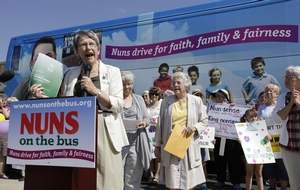
pacified, nor have their supporters. For example, there is a “Nuns on the Bus” tour traveling around the United States, prayer services for the Sisters, #nunjustice and #whatthesistersmeantome campaigns on Twitter. Even the Women’s Ordination Conference delivered a petition containing over 57,000 signatures to the Vatican in support of the Sisters. Certainly, the support for the sisters and their mission is not dwindling, but growing stronger every day.
As for the Vatican, a change in their position is doubtful, but we can continue to pray. I am, however, very discouraged by a statement attributed to Pope Benedict that indicates a desire to have a smaller more faithful Church of Catholics then a large Church of people who do not adhere to Church Teaching – seeking out a small, strong, holy community.
Obviously, it is my hope that this statement was taken out of context, but I have to be honest and say
Women’s Ordination Conference delivering Petition Picture reprinted from WOC’s page on Facebook
that my hope is filled with doubt. This is not the first time I have heard clergy make this statement. Priests have made this statement in my presence – wanting a more faithful flock and dismissing those that do not adhere to their interpretation of Church teaching. This stance does not bear fruit, but is rather a power play – a play that can be called many things – misogynist, arrogant, non-pastoral, cold-hearted, and frankly un-Christian. It also plays with a person’s spiritual fate and in many cases their soul. The psychological impact of something like this is dangerous for some. Some ordained will go so far as to withhold sacraments or even compromise the person’s status in the Church, including their role in ministry, for the sole purpose of inducing compliance – a tactic that dates to the medieval period.
I wasn’t reading it to find out about the origins of the earth in the way the big bang theory explains it. I was reading it to find out what an ancient people thought about the connection between God, the heavens and the earth, and all the creatures and creations in between.
For years, I’ve been fascinated by creation myths. Yet as a feminist, I was taught to be suspicious of the biblical creation myths in Genesis. The creation of man from dust and the subsequent creation of woman from his rib have often been interpreted to support claims about women’s inferiority to men. And obviously, the accounts of Eve and the serpent and her role in “tempting” Adam have been used to justify claims of women’s susceptibility to evil and their wanton natures which lead men astray.
So it was a bit of relief when in my first weeks of study in seminary, my Hebrew Bible professor pointed out that there are two creation myths in the opening chapters of Genesis. I was relieved because Chapter 1 and the first few verses of chapter 2 told a creation story I enjoyed reading. Continue reading “Back to Beginnings by Elise M. Edwards”
“Now the Vatican says that nuns are too interested in “the social Gospel” (which is the Gospel), when they should be more interested in Gospel teachings about abortion and contraception (which do not exist). Nuns were quick to respond to the AIDS crisis, and to the spiritual needs of gay people—which earned them an earlier rebuke from Rome. They were active in the civil rights movement. They ran soup kitchens.” — Roman Catholic Women Priests (via Facebook)
I once had a conversation with my New Testament Professor about the issue of women ordination. He was optimistic and thought there might be a possibility that change was in the air – that was six years ago. The basis for his statement had to do with language. Of the journals and articles read, he felt the language used was more inclusive and that once people adjust to this discrete change in gender inclusive language, change for women in the Church can come.
Statement from Ivone Gebara, writer, philosopher and theologian from Brazil on the Vatican action against U.S. religious women.
Translated from Portuguese. Reprinted with permission.
Once again, we watch dumbfounded as the Congregation for the Doctrine of the Faith directs a “doctrinal assessment of” or a “calling attention to” or the “punishment of” those who, according to the CDF, break away from the proper observance of Catholic doctrine. Only this time, the CDF is not pointing an accusatory finger at a person, but rather at an institution that brings together and represents more than 55,000 women religious in the United States- namely, the Leadership Conference of Women Religious, known by its acronym LCWR.
Throughout their long history, these women religious developed and continue to develop a broad educational mission which advances the dignity of many people and groups both within and beyond the United States. Most of these women belong to diverse national and international congregations.
In addition to their Christian and humanistic formation, they are intellectuals and professionals in various fields of knowledge. They are writers, philosophers, biologists, sociologists, lawyers and theologians. They have broad backgrounds and their expertise is recognized nationally and internationally. They also are educators, catechists and human rights activists. In many situations, they set their lives at the service of those affected by injustice or set themselves in opposition to the grave actions taken by the government of the United States. Continue reading “The Inquisition of Today and U.S. Women Religious by Ivone Gebara”


 The Gospel of “Jesus’ Wife” is certainly at the center of a battle that was last seen when questions of authenticity were raised about the James (Jesus’ brother) ossuary. In a New York Times article, September 30th, Judith Levitt states that this document adds weight to theological and historical flaws surrounding the issue of the ordination of women. The Vatican believes that their theology is still sound, calling the document a forgery.



 Feminism and Religion