Another way to put this: there is nothing inherently competitive about the study of mathematics. The classroom is competitive in order to create a particular kind of graduate—one who engages in a particular [dominant] culture. Liberative pedagogy challenges the ways that classrooms are run in order to challenge the dominant culture.
For those of you who don’t know, STEM educations refers to education in Science, Technology, Engineering and Mathematics; and within the United States, women are significantly underrepresented within these fields. I share these articles and my friend’s question in this blog because I believe there is a common misconception that feminist and other liberative educators are arguing that we need to make courses “easier” or “less intimidating” in order to create inclusion. The implication here, that somehow women and/or people of color need an easier course, can be understood as a sexist and racist assertion of inferiority. However, this common critique misses its own investment in kyriarchal codes. Conflating masculinist pedagogical practices with academic rigor, this circular logic redirects the responsibility for inclusion onto the oppressed themselves as though the supposedly “intimidated minority,” is deficient, not the exclusivist language and practices that reinscribe power for particular people and particular ways of being. Continue reading “STEM and Sexism: Pedagogical Responses to “Chilly Climates” by Sara Frykenberg”
Society has created this vortex of fear surrounding women aging. Yet, as I turn 30, I am only feeling awe. Awe over everything I accomplished in my twenties and awe in all the things yet to be realized in my thirties. The interesting thing is how other people are experiencing me turning thirty. Some are reminiscent of their twenties or how their experienced their thirties. Others start to bring up certain things which are apparently still lacking in my life. The biggest ones are a husband and children. They look at my eve of thirty-hood as the clock ticking away on me finding love and most definitely on my biological clock.
Last week the oldest Catholic liberal arts college for women in the United States announced it would admit men into its campus-based undergraduate programs for the first time since the institution was founded 175 years ago. As an alumna, I have lived the value and reaped the benefits of all-women’s liberal arts education at a Catholic institution. But throughout the past year, my work of recruiting young women to attend the College revealed in new ways the dissonance between Catholic higher education and women in this time and place. As is the case in most sacred struggles I have more questions than answers, but I will speak to what I have felt and observed.
In the 21st century it has become increasingly difficult for institutions and individuals to identity as both Catholic and pro-woman. As a constituent at a women’s institution, I celebrate the empowerment of women in leadership roles within their careers and families. But as a constituent of a Roman Catholic institution, I am aware of the Church’s patriarchal governance and inconsistent appropriation of power to lay and religious women. As a constituent of a women’s institution, I see women’s diverse expressions of sexuality and gender. But as a constituent of a Catholic institution, I am immersed in binary, sexist language and assumptions at every formal liturgy. Continue reading “A Decision To Exist: One Feminist’s Musings on the Transformation of a Catholic Women’s College by Cathleen F.”
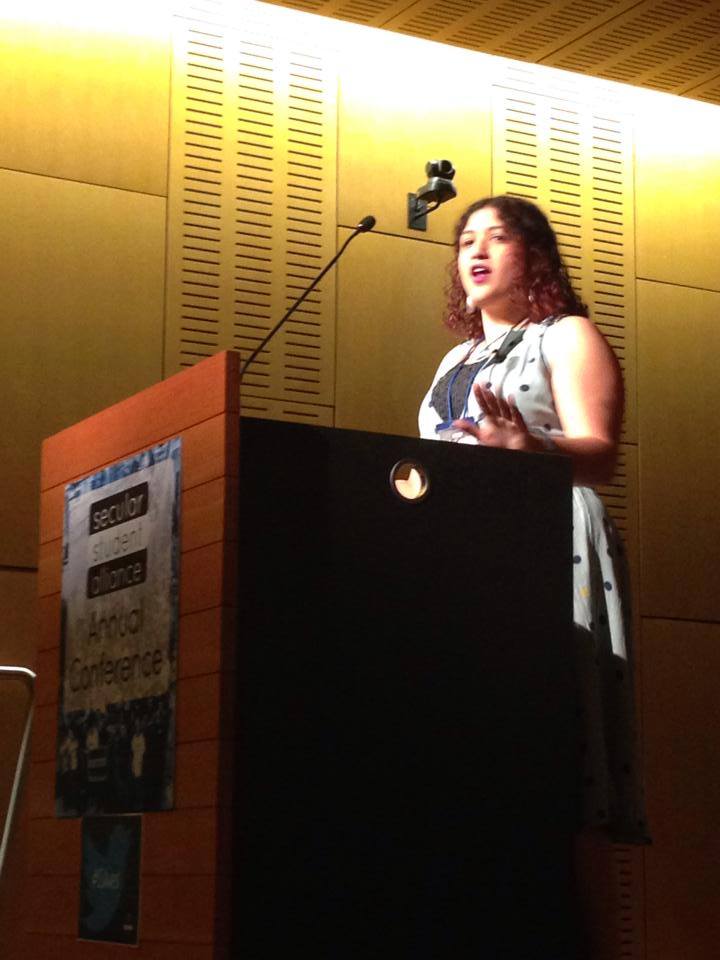
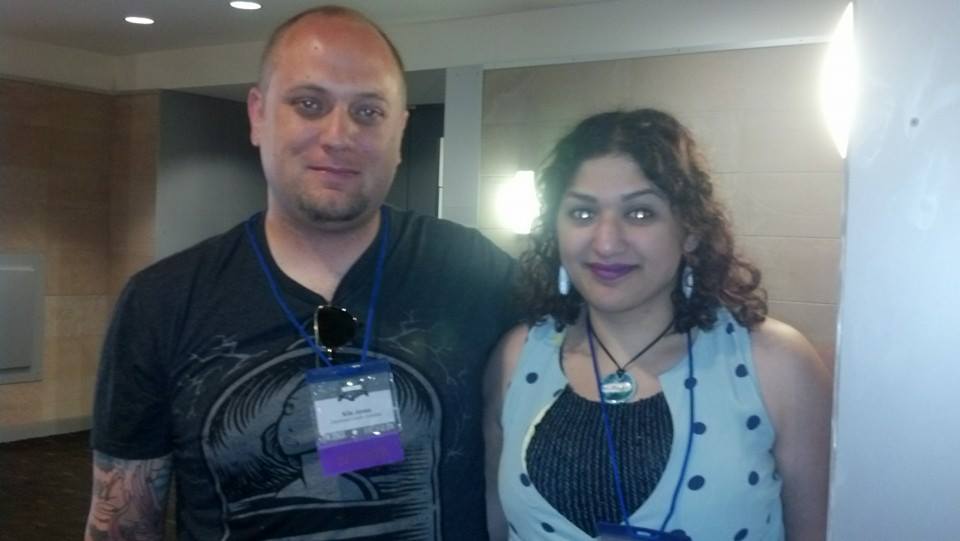
A few days ago I had the pleasure of giving a talk at the Secular Student Alliance Conference on how non-believing persons can work with Churches. Amidst the chaos of conferences–managing your time, deciding which talks to attend, and making sure you have enough water (it was a Burning Ring of Fire outside in Tempe, AZ)–I got to meet some pretty incredible secular women.
One of them was Heina Dadabhoy.
Heina speaking at SSA.
Former Muslim, blogger at Freethought Blogs, and overall bad-ass, Heina spoke about ways in which secular groups can create a more welcoming environment for ex-Muslims and Muslims beginning to doubt. Her talk, “Of Murtids and Muslims,” (a “murtid” is a public apostate) was not only about her experiences coming out as a secular humanist, but considered some of the absurd questions people ask her (and other ex-Muslims) about leaving Islam. “So did your parents try to honor kill you?” “Have you gone through FGM?” It was disturbingly humorous.
What I considered to be Heina’s main point, was that we should respect each others’ individual differences and not generalize and caricature all Muslims with the depictions of some. “Just because you read Ayaan Hirsi Ali’s book,” Heina notes, “does not make you an expert on Islam.” Heina made sure to emphasize the radical diversity that exists in Islam. She also spoke of the some of the issues that people go through when they leave Islam: How do I create a new identity when my old one was intricately tied up in my Muslim community, family, and culture? How do I navigate popular culture when I have missed a bunch of it? How do I find myself in this new secular world? Heina’s answers were refreshingly honest and insightful.
P.S. Aisha (one of Muhammed’s wives) should not simply be reduced to the young person Muhammed married; she was also a war leader, influential Muslim thinker, and someone who contributed greatly to early Islam. This is, of course, Heina’s insight.
Me and Heina at SSA
Another awesome secular woman I met, was Sarah Morehead.
Sarah. Photo from Apostacon.
Sarah is a former evangelical Southern Baptist, Executive Director of the “Recovering From Religion” project, and another overall bad-ass. She spoke on how to start up a Recovering From Religion group on your campus. Here is a blurb about Recovering From Religion,
“If you are one of the many people who have determined that religion no longer has a place in their life, but are still dealing with the after-effects in some way or another, Recovering From Religion (RR) may be just the right spot for you. Many people come to a point that they no longer accept the supernatural explanations for the world around them, or they realize just how much conflict religious belief creates. It can be difficult to leave religion because family and culture put so much pressure on us to stay and pretend to believe the unbelievable. If this is you, we want to help you find your way out. Don’t let people convince you that you just didn’t have ‘enough’ faith, or that you just haven’t found the “right” religion.”
Sarah and I chatted (and often laughed) about our old experiences as conservative Christians. We discussed some of the funny language (Christian-eze) we used to use, the various levels of guilt and shame that were cast upon us, and how science helps explain some of the interesting displays of piety often seen at Pentecostal services. Sarah’s jovial and welcoming demeanor was calming, and as an Executive Director for a project aimed at helping people “recover” from religion, I cannot think of a better person for the job.
Lyz. Photo by SSA.
The last woman I have in mind is Lyz Liddell.
Lyz is the Director of Campus Organizing for the Secular Student Alliance. I have an interview I did with her a while back, on this very blog! Besides running around with her headset on, standing on chairs for announcements, and generally keeping the world of SSA from not crumbling into oblivion, Lyz is a great motivation and example. If you are ever interested in starting a SSA group on your campus, talk to her.
To all those who attended this years SSA West, or who are involved with helping secular students: Unite!
Kile Jones holds a Bachelors of Theology (B.Th.) from Faith Seminary, a Masters of Theological Studies (M.T.S.) and a Masters of Sacred Theology (S.T.M.) from Boston University, and is a current Ph.D. in Religion student at Claremont Lincoln University. He also holds a Certificate in Science and Religion from the Boston Theological Institute. Mr. Jones has been published in Zygon: Journal of Religion and Science, Philosophy Now, Free Inquiry, World Futures, Human Affairs, and the Secular Web. He is the Founder/Editor-in-Chief of Claremont Journal of Religion (www.claremontjournal.com), and is the Founder/Director of Interview an Atheist at Church Day (interviewatheists.wordpress.com).
I am sitting on the patio in front of my apartment as I write this blog. It’s hot-ish and windy. Ventura is always windy. The jasmine vine in my garden (also known as my strip of dirt, or ‘the facilities’ for all neighborhood cats) is in full bloom and my potato bush is covered in purple flowers. When I planted this bush, that is now taller than my head, it was just a stick—a stick that can apparently become a tree-size monster; but, it is my favorite plant monster and it hosts the loudly buzzing, giant black bees that visit my home. No bees today though, just a badly needed change of scenery…
Many of the teachers and professors who read this blog can probably empathize with me when I say that I have been trapped in my office for weeks grading. The last day of classes this semester was Friday of the past week. I’m not quite sure how I managed to so fully and completely overestimate my ability to read, comment on and score hundreds of pages, but I did, and so, I am sentenced to ‘hard time’ at my desk. As the Arcade Fire song The Well and the Lighthouse goes, “I’m serving time all for a crime I did commit.”
My twin sister rubbed this in a bit. She called me as I sat in my office Monday morning after a long weekend of grading and asked me what I was doing. I told her, “grading,” and she promptly started laughing at me and bellowed, “You’re in purgatory!!” She continued to laugh for some time; and then proceeded to post references to purgatory on my Facebook page throughout the day. (Consequently, she later noted my lack of response to her posts. Of course, I had been too busy to reply—see above comments on overestimating, end of semester and grading.) Continue reading “Grading in Purgatory? How about a Change of Scenery? (A Little Levity and Thought for the End of the School Year) by Sara Frykenberg”
Every now and again, a budding systematic theologian comes to my office and wants to talk about how to avoid being pegged as a feminist, and therewith avoid not being taken seriously as a theologian. Sometimes the students are feminists, but don’t want that aspect of their work to dominate or perhaps even to be visible for a time; in other cases, the students aren’t feminist – or didn’t start out that way – but are having experiences as they enter the guild that are raising these concerns for them in a new way. Perhaps professors are assuming that they are feminist simply because they are female, or perhaps male students are dominating in class and the professor is doing nothing to rein them in.
These students seek me out knowing that I am an avowed feminist and an avowedly feminist theologian. But they are concerned about the effects being or appearing feminist might have on their future careers. After all, they want to join the theological conversation in order to shape it – and their ambitions are right and justified. Continue reading “A feminist closet? by Linn Marie Tonstad”
I have been doing a lot of thinking about gendered imagery and language for God over the past few months. Honestly, a lot of this reflection was provoked by hostile comments I got from my college students at the end of the fall semester because I require gender-neutral language for God and gender-inclusive language when referring to people. The policy in my syllabus is this:
For academic discourse, spoken and written, students are expected to use gender-inclusive language for human beings, and gender-neutral language for God. (e.g. “God” instead of “He;” “God’s” instead of “His;” etc.) This is to prepare students to communicate to the world beyond the Christian university setting. I want to equip you to succeed in graduate school, in the corporate world, and in public communication, all settings in which gender inclusive language for is increasingly expected.
I provide links to websites that discuss the issue, and we talk about it more when we discuss 20th century feminist issues in my course on the Christian Heritage and when we discuss prejudice and sexism in my ethics class. Some students have thanked me for the policy. But many students are perplexed by it, and I’m perplexed by their confusion. It shocks my system when I hear people refer to “man” for all people; I first became aware of the issue when I was in 2nd or 3rd grade and the Girl Scouts changed their pledge because it referred to “mankind.” That was over 30 years ago!
While I’m confused as to why replacing “man” with “people” is such a difficult task, I am more empathetic to the reorientation required to replace “He” with “God.” (And I also acknowledge that the term “God” is not completely genderless either.) I recognize that for many of my students, I might be the first one to challenge their gendered conceptions of God. So I am empathetic, but insistent.
The way discussions about the “gender” of God and Savior are often dismissed as irrelevant, unimportant, silly, or the remote concern of “those feminists” bothers me. Traditional Christian theology asserts that God is a different kind of being than humans are. Therefore, God (the first person of the Trinity) and the Holy Spirit do not have a sex or gender, as sex is a characteristic associated with physical creature-ness and gender is (to simplify) a social construction related to sex. The second person of the Trinity, Jesus, is thought to be male. In the Incarnation, the eternal God became human while also divine, and therefore has a sex and gender in the person of Jesus. But the Trinity as a whole is without sex and has characteristics that we would associate with femininity, masculinity, and genders in between. According to this logic, references to the maleness of God should only be understood metaphoricall,y not literally, and therefore replacing that language with genderless/sexless language should not be inherently problematic.
I’m not saying that the use of any language in reference to God is appropriate or acceptable within the bounds of traditional theology. We (traditionals and non-traditionals alike) should be concerned with how we refer to God, because as Sallie McFague and others remind us, these metaphors/models of God have consequences in the world beyond language. Maleness becomes deified or closer to godliness than femaleness, maleness becomes the model for the priesthood, maleness is the true form of authority, etc. I believe that many of the concerns about feminine imagery for God are based in this same concern: that by associating God with one sex or gender, we claim God’s preference for that sex or gender. In a patriarchal system, this correlation between God and the feminine simply will not do. Feminists who assert feminine qualities of God are merely making projections of themselves, critics claim.
How we conceptualize the being we worship matters. It matters to me, at least. While I acknowledge that there is a danger of simply projecting an image of myself as a deity that I worship, I also think there is great harm in loving and worshiping the divine imaged as those who are at times hostile to me, and historically have been so to my ancestors and kin. So although I know and have good relationships with older, white males, I see no reason why I should image and worship God “the Father” who looks like an old white man. How would that benefit my spiritual practice?
Thank you Carol Christ, for asking me to state my views about this in the comments to my last post. I look forward to more discussions with you and the members of this community. When I read your work years ago, I was convinced about the validity and rightness of affirming feminine forms of divinity. Although the Christian (patriarchal) tradition does not have much room for Goddess language, I am comfortable with it, at least for the first and third persons of the Trinity. In my next post, I’ll talk more about the ways I am considering the gender of the Christ.
Elise M. Edwards, PhD is a Lecturer in Christian Ethics at Baylor University and a graduate of Claremont Graduate University. She is also a registered architect in the State of Florida. Her interdisciplinary work examines issues of civic engagement and how beliefs and commitments are expressed publicly. As a black feminist, she primarily focuses on cultural expressions by, for, and about women and marginalized communities. Follow her on twitter, google+ or academia.edu.
I think classroom discussions can be a good forum for modeling the kinds of discussions students might have in their families, peer groups, faith communities, and political contexts. But sometimes I really wish I wasn’t the one responsible for leading the discussion.
I started a new position this year as a lecturer in Christian Ethics. This semester, the high moments of my week are my two 75-minute sessions of an Introduction to Christian Ethics class. I have less than 20 students and they are smart, kind, engaging, talkative, and respectful. They also come to class prepared and eager to participate in discussion. I love it. I count myself as blessed for having the opportunity to teach them. But there have been several days when I haven’t wanted to go to work and face them. Continue reading “A Reflection on Leading Discussions about Difficult Ethical Issues by Elise M. Edwards”
With the new school year in full swing, I thought this post from almost two years ago would be an appropriate reflection, encouragement, and outward support to those returning to school or nearing the completion of their degree. Remember – do not give up – the sweat, sacrifices, and struggles are worth it in the end AND You are not alone. Remember the strength and courage it took to return to school or take that next step to pursue your educational goals will become the tool to help you persevere and reach that finish line!!
Going back to school at 30-something to complete a B.A. in a completely different field (from accounting to Religious Studies and Theology) was an interesting endeavor. After many years of legal and business writing as well as crunching numbers, learning how to write academically, including formatting citations and using new technology was quite an undertaking that has proven to be rewarding. All the searchable databases in the library no longer included card catalogues and microfiche. This was amazing! No more correction ribbon and electric typewriters (am I showing my age yet?!) Going to college in 1985 is different then going back to college in 2006. Continue reading “Enduring the Trials of Graduate School: From Conception to Labor Pains and Birth (Revisited) By Michele Stopera Freyhauf”
Of the many reasons I am grateful for feminismandreligion.com, I have to say that I am most grateful for the time it requires of me to reflect about feminism’s impact in my life, faith, and work. I decided it was time to reflect on this question: What difference does feminism make for the way I structure and approach my classes?
I recently started a new position as a full-time lecturer in the Department of Religion at Baylor University. Earlier this week, I attended a gathering for the department, where I was introduced, along with a few others, as new faculty. At the end of the evening, the wife of a retired male professor introduced herself to me and remarked about how happy she was to see more women in the department. (Four full-time faculty members were hired this year, and three of us are women.) She had been looking forward to this kind of change for quite a while. I was appreciative of her remarks, just as I have been generally pleased with the warm reception I have received around the University.
Her excitement about the increase in the number of women faculty provoked me to reflect on what I add to my department, particularly for my undergraduate students. I have thought before about how, from a purely representative standpoint, I bring something different to the faculty. I have thought about how my students may not have previously had a professor–especially a religion professor–who looks like me. Even if they had, I’ve had different life experiences than many of my colleagues, and that this bears on my approach to theology and ethics. Therefore, the research I do and share is distinctive in its approach. Yet, I am slightly embarrassed to admit that I have not given much thought about how my being a black feminist woman might impact my students. I am tempted to blame it on the fact that I have just been trying to keep my head above water in a new position. Of the many reasons I am grateful for feminismandreligion.com, I have to say that I am most grateful for the time it requires of me to reflect about feminism’s impact in my life, faith, and work. So I decided to reflect on this question: What difference does feminism make for the way I structure and approach my classes? Continue reading “The Difference a Feminist Makes by Elise M. Edwards”


 Recently, a friend of mine sent me a journal article entitled, “Are STEM Syllabi Gendered? A Feminist Critical Discourse Analysis,” and a response to the research from a rather conservative publication, the National Review: “Female Researcher: We Must Make STEM Courses ‘Less Competitive’ to be more ‘Inclusive’ of Women.” Not a feminist or feminist scholar himself, his question to me was whether or not the author of the original research article, Laura Parson, was sexist and/or racist for suggesting that course syllabi needed to be, or rather sound, less “difficult,” less competitive, etc.
 Society has created this vortex of fear surrounding women aging. Yet, as I turn 30, I am only feeling awe. Awe over everything I accomplished in my twenties and awe in all the things yet to be realized in my thirties. The interesting thing is how other people are experiencing me turning thirty. Some are reminiscent of their twenties or how their experienced their thirties. Others start to bring up certain things which are apparently still lacking in my life. The biggest ones are a husband and children. They look at my eve of thirty-hood as the clock ticking away on me finding love and most definitely on my biological clock.




 Feminism and Religion