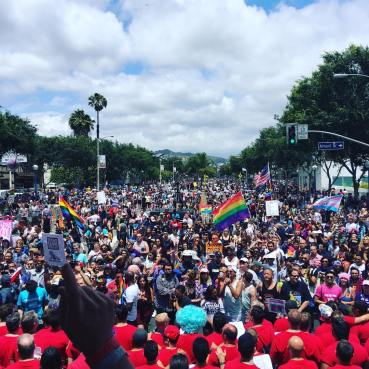
Pride by John Erickson

When we come together, we are the Divine.  I didn’t think I could experience that twice in one year; clearly, I was wrong. 

If you’re anything like me you not only hate opening up your Twitter feed each morning but also feel compelled to in order to make sure you didn’t miss whatever new atrocity to come out of 1600 Pennsylvania Ave. After the Women’s March, I felt charged. I felt that whatever this administration threw at the proverbial “us,” I knew we could and would overcome it. Although that charge kept me going for a few months, there came a time where I just couldn’t go on anymore and that I was completely drained; then walked in a man named Brian Pendleton.

After the Women’s March on January 21, I didn’t know what to expect. The event was truly so successful that many of the organizers and coordinators were on an activist high as a result of what was a truly magical and divine moment. A few months came and went and the 45th President of the United States continued (much to our surprise) to be as awful as we all knew and expected. However, while I am able to exist in a world, no matter how oppressive, as a cisgendered white male and the full on privilege and power that comes along with that territory, many of the individuals and communities being attacked did not have those same freedoms; and like with the Women’s March and how that all took shape, in walked Brian Pendleton to my life to talk to me about the #ResistMarch.

Cover PhotoAlthough my involvement during the 120 days or more that led up to the #ResistMarch happened in a flash, one thing is for certain: miracles exist not because of divine intervention but because G-d places people on this Earth to make positive impacts. The beauty of the #ResistMarch was not just the passion of the organizers but the beauty of the rainbow that came out in full force on June 11
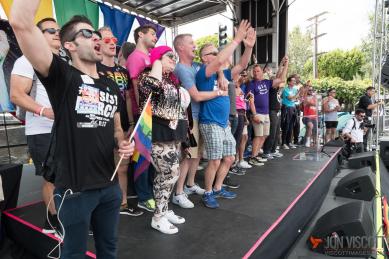


The strength shown by our community was one that, for all intensive purposes, proves that love does conquer all. RuPaul couldn’t have expressed the common and conquering theme better than when he said: “It’s all about love; giving love and being able to receive love. That’s our secret weapon; that’s the one thing they don’t have: our love and our music. That is our activism. That is what we use and what we always use to fight the ugliness.”

That is the one experience that I took most out of the #ResistMarch: the power of love and friendship; the beauty in the unexpected conversation that leads to changing the world, again.  Thank you, Brian. Thank you, for bringing us all together to resist, recharge, and love.

19055531_10158898620590385_6920780108892374453_o

When we come together, we are the Divine.  I didn’t think I could experience that twice in one year; clearly, I was wrong.

John Erickson is the President of the Hollywood Chapter of the National Organization for Women. John is a Ph.D. Candidate in American Religious History at Claremont Graduate University where he is finishing up his dissertation tentatively titled “Step Sons and Step Daughter”: Chosen Communities, Religion, and LGBT Liberation.” John holds a MA in Women’s Studies in Religion; an MA in Applied Women’s Studies; and a BA in English and Women’s Studies. He is the Founding and Past President of the University of Wisconsin Oshkosh’s LGBTQA+ Alumni Association and currently serves as the Chair of the Legislative Committee for the Stonewall Democratic Club, a Diversity and Inclusion Fellow at Claremont Graduate University. He is a permanent contributor to the blog Feminism and Religion, a Co-Founder of the blog The Engaged Gaze, and the Co-Chair of the Queer Studies in Religion Section of the American Academy of Religion’s Western Region, the only regional section of the American Academy of Religion that is dedicated to the exploration of queer studies in religion and other relevant fields in the nation. In April 2017, he was the first openly gay athlete to be inducted into the Wisconsin Volleyball Conference Hall of Fame. Most recently, John was one of the coordinators of the Women’s March Los Angeles, which brought together 750,000 people in downtown Los Angeles on January 21, 2017, and a Committee Member for the #ResistMarch, which brought together 100,000 people from Hollywood to West Hollywood in honor of LA Pride on June 11, 2017.


Mulling over Movies: Moana, Pt. 1 by Elise M. Edwards

elise-edwardsI love going to outdoor movie screenings.  Sitting outdoors on a summer evening with good company brings me joy.  Last week, I went to an screening of Moana, the Disney movie about a teenager who goes on a quest through the Pacific Ocean with the demi-god Maui.  Moana goes on this journey to help her people.  The movie came out last year, but I didn’t see it.  I have to admit that I wasn’t even interested in it until Simone Biles performed a dance to one of Moana’s songs on Dancing with the Stars. It was then that I realized that the movie has an empowering message.  I asked my friend Natalie, who is also a feminist religion scholar, about Moana.  She has three young daughters, so I trusted her to be more current than I am.  Her enthusiastic response sold me, as did her remark, “There’s not even a love story in it!”

Ah, Disney princesses and their love stories!  I’m old enough that I didn’t grow up with the Disney culture that children in the past few decades have, but I haven’t been immune to the Disney princess phenomenon.  I childhood pre-dated DVDs and digital downloads, but I still knew and cherished the Disney characterizations of Snow White, Cinderella, and Sleeping Beauty. These young women were kind and virtuous and beautiful (according to Eurocentric standards), but their stories culminate with marriage to a charming prince.  It’s also problematic that so often, the villains in these movies were older women—wicked stepmothers or evil witches—who were motivated by jealousy and hate.

Continue reading “Mulling over Movies: Moana, Pt. 1 by Elise M. Edwards”

When a Methodist Turns Baptist by Katey Zeh

simon-launay-236262

Nearly a year ago, almost to the day, I entered the sanctuary of an historic church in downtown Raleigh for the first time. Visiting a new faith community is nearly always at least a slightly uncomfortable social experience. In my case I’d grown quite accustomed to feeling like an outsider in these spaces as a significant portion of my work included traveling to congregations around the country. This particular Sunday, however, had me a more on edge than usual.

The church, as it turns out, was Baptist. I was Methodist. Sitting down in a Baptist Church for worship felt something akin to rooting for a rival sports team. It was simply not done.

I recall on several occasion the pastor of my hometown Methodist church, a soft-spoken and generally mild mannered man, would poke fun at Baptist preachers from the pulpit. If a worship service ran long as it often did on the Sundays we celebrated communion, my mother and I would half-jokingly lament that our favorite lunch spot would be filled with Baptists by the time we got there. One could argue it was all in good fun like any hometown rivalry. But even well-meaning jokes, if they are repeated enough, have a poisoning effect over time.

As I fidgeted in the pew that first Sunday waiting for the service to begin, a woman sporting black cat-eye glasses and fiery red lipstick leaned across the pew to greet my husband and me. “Is this your first time at Pullen?” she asked. I nodded my head and confessed quietly that I was struggling a bit with being in a Baptist church. “I’m Methodist,” I whispered to her. Without skipping a beat, she responded with a hint of a smile, “Well honey, I’m Jewish.”

Needless to say this Baptist Church was unlike the ones we’d joked about in my small town Georgia church. Pullen Memorial Baptist Church has been on the forefront of social justice movement for decades, much to the chagrin of certain other Baptist-identifying bodies. From affirming women and the LGBTQ community to standing against racism and Islamophobia, Pullen is committed to the work of dismantling oppressive systems.

Prior to my first Sunday at Pullen I’d tried desperately to find community in several local Methodist churches, but I could not in good conscience align myself with their theological values. Pullen, on the other hand, affirmed my spiritual sensibilities and challenged me to examine them critically. In the end I had to make a decision: what was more important to me, the ministry of the congregation or its label (and the stereotypes that came with it)? As you might guess, the choice was easy.

Last month my husband and I along with our two-year-old daughter stood before the congregation and pledged our commitment as official members of Pullen Memorial Baptist Church. Some have asked me if leaving the Methodist faith was terribly painful for me. In truth this decision felt very little like a departure at all; rather it felt grounded in the deep joy and affirmation of having found a community to make my spiritual home. No change is without some sense of loss, but what I mostly feel is an overwhelming sense of joy.

Joining a Baptist congregation has opened my heart to the possibility of unexpected becoming. We are never as sure of things as we might like to believe. I’m grateful for that.

RA82Katey Zeh, M.Div is a strategist, writer,  and educator who inspires communities to create a more just, compassionate world.  She has written for outlets including Huffington Post, Sojourners, Religion Dispatches, Response magazine, the Good Mother Project, the Journal for Feminist Studies in Religion, and the United Methodist News Service. Her book Women Rise Up will be published by the FAR Press in March of 2018.  Find her on Twitter at @kateyzeh or on her website kateyzeh.com
The Nature of Communal Pondering by Elise M. Edwards

elise-edwardsLast week, I listened to an episode of Krista Tippett’s series On Being that featured an interview with poet Marilyn Nelson.  I am not very knowledgeable about the world of modern poetry, but I am familiar with Nelson’s work.  A couple years ago, I wrote about Fortune’s Bones: The Manumission Requiem, Nelson’s poetic composition about Fortune, an enslaved man whose owner rendered his body into a skeleton for medical training.  Fortune’s identity and history had been erased across centuries as his remains were displayed.  Community concerns eventually led to a multi-disciplinary academic, artistic, and community effort to honor the man and, in 2013, put his bones to rest.  Isaye M. Barnwell, a musician formerly of Sweet Honey in the Rock, developed a cantata and choral work for Fortune’s Bones. These developed into a series of artistic performances and community events that demonstrate the power of art to speak through and for those who are marginalized—even in death.  Disparate communities joined together to ponder Fortune’s life, and it was powerful.

In the On Being interview, Nelson spoke about “communal pondering,” and I’ve been repeating this phrase to myself since then.  It identifies a form of creative activity and a spiritual way of being that I am deeply committed to, and have not been able to name.  Communal pondering occurs when a group of people are listening together and are opening up new paths for discourse and action by the engaged reflection that takes place within that listening.

Continue reading “The Nature of Communal Pondering by Elise M. Edwards”

Eros, Caritas, and Relationship by Chris Ash

Christy CroftIn 2011, the Anglican Theological Review published arguments for and against same-sex marriage. “A Theology of Marriage including Same-Sex Couples: A View from the Liberals,” co-written by Deirdre Good, Cynthia Kittredge, Eugene Rogers, and Willis Jenkins, presents a rationale for same-sex marriage that is surprisingly traditional, grounded in scripture and doctrine, understood and interpreted “in the company of patristic interpreters as well as in the company of readers long silenced by the tradition.” Part of the liberal view explores the relationship between eros and caritas, and how the marriage vows, which “mark marriage as an arduous form of training in virtue,” teach us to love and “offer a means by which God may turn eros into charity.”

As someone for whom eros is both a modality of intimate communion and manifest expression of divine love, the idea that it would need to be transformed into something less sensual, more socially acceptable, seems an arbitrary sanitization that positions eros as untamed and dangerous, in need of redemption by sexless ideals of Christian charity. Admittedly, my aversion to scrubbing eros of its rawness likely comes from my own understanding of the word, which might differ from that of traditional Christian theology, and which is inherently tied to the ways in which I’ve known the divine more deeply through expansive, mystical, erotic experiences that engaged my every sense in the coolness of rivers and grazing touch of mountain breezes.

We know through the body; we sense through our skin and parts and cells and perceive through nerves and fibers and tissue – seismic shocks of color and sound reverberating through our beings in the abstract, or the specific, deep, and warming awareness of divine love washing over our grief, fear, or loneliness. Each of these teaches us about the nature of the universe and of love, about bodies and subjectivity, and (by extension) about God and God’s action in the cosmos. My experience of eros – of the sensual explosion of erotic energy that makes me tremble, lays gooseflesh across every inch of me, and takes my breath as it rises inside my chest and belly – is not limited to sexuality, but comes through nature, art, song, movement, and touch. It is my primary way of experiencing divine love, and needs no purification. Continue reading “Eros, Caritas, and Relationship by Chris Ash”

Should I Stay or Should I Go? by Esther Nelson

On March 13, 2017, Carol Christ wrote on this “Feminism and Religion” blog:

“When I made the decision to leave Christianity rather than to work within it to transform it, I believed that rational judgments were primary. Now I am much more cognizant of the complex ways in which questions of identity, family history, ethnicity, class, community, and exclusion shape our decisions to leave or to stay. I think we need to talk more about this.”

I agree with Carol. This is an important subject to ponder as we think and write about the choices we make regarding the faith traditions we either inherited or belonged to at one point or another during our lives.

I just finished re-reading Joanna Brooks’ memoir, THE BOOK OF MORMON GIRL. Raised Mormon in an insular family in a “tract house on the edge of the orange groves” near San Diego, California, Joanna learned, and felt, early on that salvation meant “belonging,” tied to people who believed as her family and their Mormon ancestors did, “safe where no one would say your books of scripture are all made up.”

The stories that shaped Joanna early on in her life all “arrived at the same conclusions: the wayfarer restored, the sick healed, the lost keys found, a singular truth confirmed.” She wants to tell “orthodox Mormon stories,” yet “these are not the kinds of stories life has given me.” Continue reading “Should I Stay or Should I Go? by Esther Nelson”

Doctrine and Fidelity by Elise M. Edwards

elise-edwardsThis past week, I was listening to Krista Tippett’s podcast On Being as she spoke with Pádraig Ó Tuama.  He is a poet, theologian, and leader in the Corrymeela community of Northern Ireland. As he spoke about several things related to the challenges of belonging, reconciliation, and fractured communities, he said, ”The measure of Christian fidelity is more than the positions we take.”

I agree.  I interpreted his statement as a condemnation of the ways Christian doctrines and moral positions too often take priority over other matters of faith.

Continue reading “Doctrine and Fidelity by Elise M. Edwards”

You Can’t Debate Mutuality by Sara Frykenberg

I use words like “mutuality,” “listening,” and “love,” here as I discuss my understanding of feminist justice-making and eschew debate…I want to make it abundantly clear: I see these as powerful, often forceful and even angry tools. We listen to what oppressors say so that they cannot deceive with their “alternative facts.” We love forcefully…We counter violence—we do not debate it—with anger, humor, creativity and power, in order to redirect its energies into more mutual possibilities.

Sara FrykenbergParticipating in the Women’s March on Jan. 21st in Los Angeles fed my soul deeply. I didn’t realize how much I needed to protest in this way, how stuck I had been in grief and despair after the election, and the way that coming together as a community would help me to mourn. There’s nothing quite like standing together with hundreds of thousands of people who also care deeply with hope, humor, and real power. Marching helped me to find the energy to fight back. It refilled a reservoir, so depleted in 2016, much as the badly needed winter rain in my home state of California has helped to abate the severe drought. Continue reading “You Can’t Debate Mutuality by Sara Frykenberg”

It Takes a Village: Responding to the Needs of Rosemary Radford Ruether by Cynthia Garrity-Bond

Rosemary Radford RuetherAs many of you may already know, on August 24, 2016, feminist theologian and scholar Rosemary Radford Ruether suffered a significant stroke. There has been some speculation from those who know or have known Rosemary about her current condition.  Here is the short of it.  While Rosemary has made progress, her doctors and therefore Medicare feel it is insufficient to warrant continued physical and speech therapies. Those who interact with Rosemary on a daily or weekly basis disagree with this medical prognosis.  The stroke damaged the part of Rosemary’s brain that allows for communication, therefore she, at this time, is not able to speak.  That said, Rosemary recognizes individuals, is able to respond to some commands and engage in therapeutic exercises.  The more attention and care she receives the greater her capacity grows for a more meaningful life that includes a level of agency.  

The first year of a stroke demands ongoing therapies in order to truly assess a clear diagnosis.  To what degree Rosemary will recover from her stroke is uncertain, but at the minimum ongoing therapies will prove beneficial towards her overall quality of life.  Unfortunately, Rosemary does not have secondary health insurance that will cover the cost of these badly needed therapies.   For example, one month of Physical Therapy at 3x/week and Speech Therapy 2x/week amounts to $3,289.00.  Put another way, 15 minutes of physical or speech therapy costs $41.00.  To be effective, Rosemary should have, at the minimum, five hours of combined therapy per week.   Continue reading “It Takes a Village: Responding to the Needs of Rosemary Radford Ruether by Cynthia Garrity-Bond”

A Gift Offered in Faith and Love by Elise M. Edwards

elise-edwards“The day begins with the sun and ends with the moon and stars; what you do in between is your gift to the world.” – Reyna Craig

The new year has begun, and many of us take this marking of time as an occasion to set intentions, goals, plans, or resolutions for the year ahead.  For us feminists, the year ahead holds clear challenges.  We know that the bodies, spirits, minds, hearts, and souls of women, racial and ethnic “minorities,” and all sorts of vulnerable people will be attacked.  We know that the protections secured under the law for these bodies, spirits, minds, hearts, and souls have been eroded and continue to be dismantled in the name of… well, what exactly? Justice? Life? Religion?

We’ve seen voting rights eroded in the name of democratic ideals.  We’ve seen challenges to bodily autonomy in the name of life.  We’ve seen state-sanctioned murder in the name of law and order.  We’ve seen a rise in religious intolerance in the name of religious liberty.  Our work in this age must be to continue to expand our collective understandings of these ideals.  This is the gift we offer to the world.

Continue reading “A Gift Offered in Faith and Love by Elise M. Edwards”