“I wake up under a tropical dome that has been with us most of August. The thick air feels like it is smothering me, and with emphysema that may not be my imagination. I can no longer walk or hike in this weather. Migraines and other peculiar headaches come and go – dizziness too – the former probably due to changes in pressure; As yet I have no diagnosis for the latter. I am feeling old because I am getting old. I move into my 77th year trying to adjust to increasing physical limitations.”
On the first harvest moon that occurs in August, (according to ancient teaching by Northern Indigenous peoples) I harvested elderberries under a burning sun, sloshing through mud, thorny bushes and cattails to reach the clusters of ruby beads that would soon become a tincture that I knew would help me resist colds flu and perhaps also the Covid variants. The world health organization in Europe is presently researching elderberry because studies have indicated that it apparently block viruses from entering cells (it does with H1N1 virus), but I have been using this remedy for years and know that it mitigates the effects of colds and prevents flu, at least for me. While removing the berries from their tree – like stems my fingers were stained the most beautiful purple, reminding me of a story I had written when I turned 70 about becoming an old woman… In this tale, I imagined that an Elderberry woman came to guide me into the future.
The move to Portugal all but forced me to heal my relationship with time and productivity, to create a life that was sustainable and nurturing.
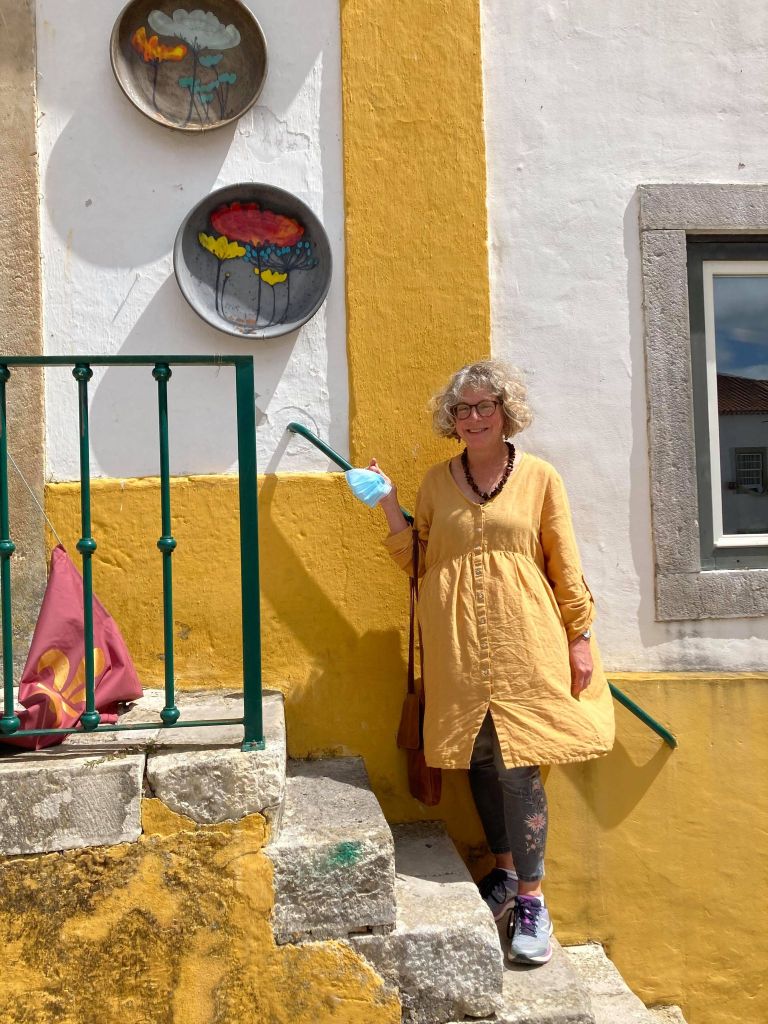
Hanging out in Obidos, the closest town to my village. Photo by Erika Mailman.
One year ago, I published my essay, The Grace of Letting Things End, about my bittersweet experience of leaving England in the wake of Brexit for a new life in Portugal.
One year later, my life in Portugal still feels radically new.
Time passes differently in Portugal. I set my intention, from the outset, to embrace this move as an opportunity to slow down and live a more authentic life.
My day-to-day life has irrevocably changed.
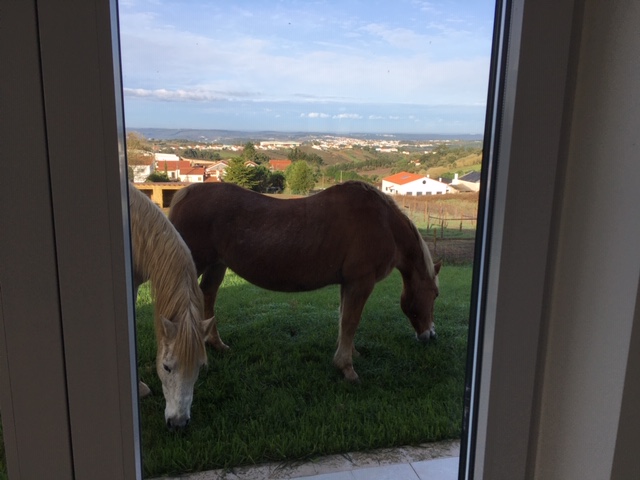
I’ve gone from being a livery yard customer in England, with all the drama and conflict this sometimes entailed, to becoming an independent small holder with two horses on my property to care for all by myself. Practically, this has translated into a lot more work, but also a lot more peace.
The ponies decided to help with the lawn mowing
I’ve also been devoting considerable time and energy into learning Portuguese. My husband and I have been taking classes once or twice a week for nearly a year now and are making slow but steady progress.
But the most deep-seated change has been to my whole relationship to work and life. In the UK, I led a very productivity-centered life, existing from deadline to deadline with barely any time to breathe in between. I often felt too busy and wrapped up in my projects to meet friends for lunch.
For years I have struggled to heal my dysfunctional relationship with time management, embracing lifehack after lifehack. I’ve all but abandoned social media. I’ve done my utmost to milk every single hour of the day in order to become more productive. This pattern led to disillusionment and epic burn out, something more and more women are facing, particularly those who balance the demands of their careers with childcare and other care-taking duties.
Even writers and artists can fall down the hole of the Cult of Productivity, taking the creative process, which is at its essence slow and organic, and trying to force it into an industrial process with regular, reliable yields that are judged on how well they can be monetized. Even the refuge of spirituality can be compromised if it’s just another task on a never-ending to-do list.
Thus, despite my official intention to slow down, I found myself trying doggedly to replicate my old hectic, tunnel-vision working schedule in Portugal only to discover that it just didn’t work here. I hit a brick wall. Because I couldn’t sustain the same level of busyness AND care for two horses AND learn a challenging new language AND keep my initial intention of slowing down and enjoying the life I moved here to experience.
Something had to give. The move to Portugal all but forced me to heal my relationship with time and productivity, to create a life that was sustainable and nurturing. No lifehack could help me anymore, because I’d already given up television. I don’t even watch Netflix.
We hear a lot about the Slow Living Movement, but actually slowing down involves so much more than decluttering your closet or posting pictures of photogenic hipsters in hammocks on Instagram.
Moving to Portugal forced me to slow down. Because life is slow here. It’s no accident that the Slow Food Movement had its birth in Italy, another slow country in southern Europe. Food is also big in Portugal. In fact, I like to joke that LUNCH is the national religion. No matter how busy or important you think you are, the whole world stops for lunch. Shops close. People pour out of offices and go to restaurants for beautiful, affordable meals. Proper, cooked meals, mind you. Not a sandwich or salad to be inhaled at speed. To say you are too busy to meet your friends for lunch in Portugal would be sacrilege. Even in the height of the pandemic when all the restaurants were closed, people went home for lunch and ate with their families.
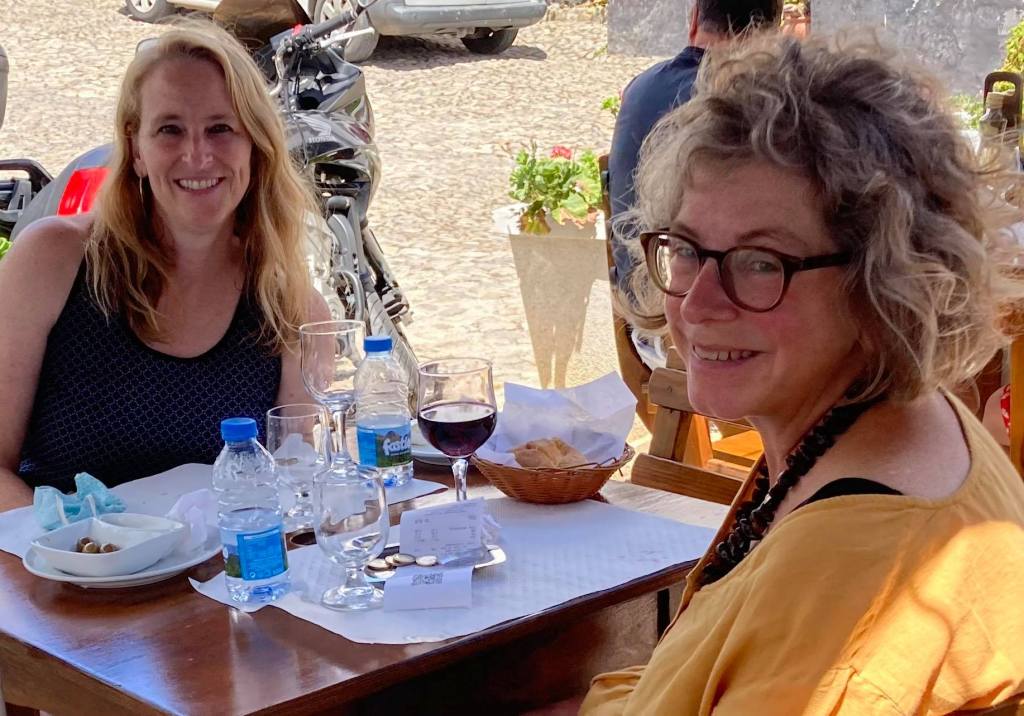
Converting my visiting writer friend Erika Mailman to the religion of LUNCH!
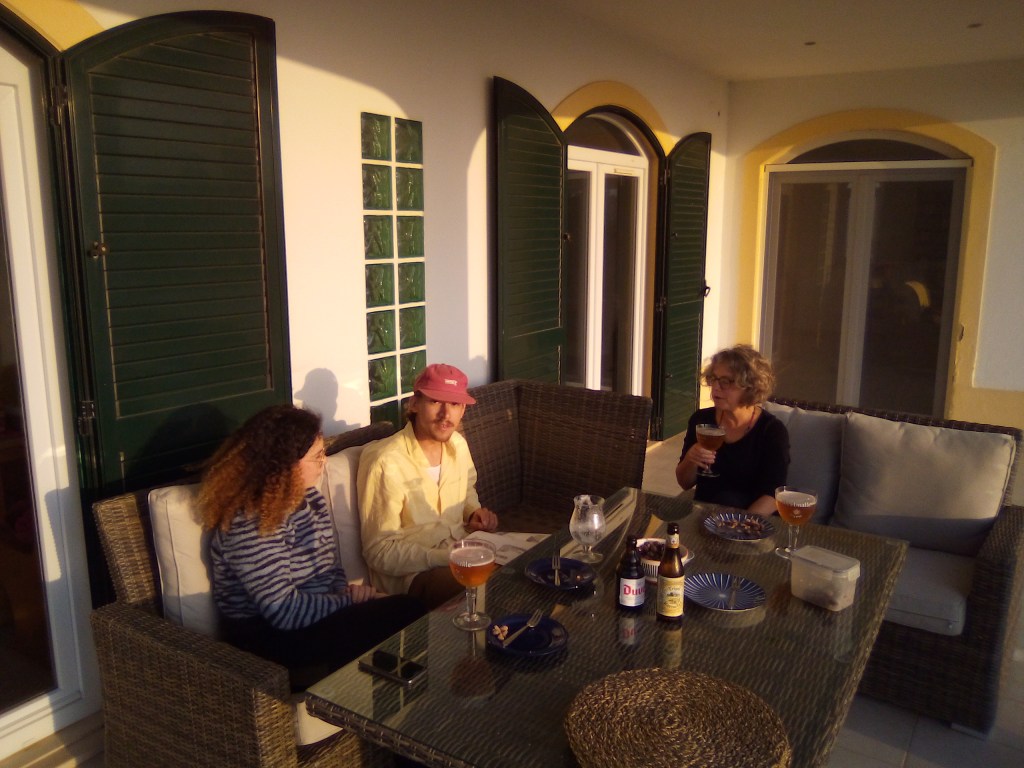
Any culture that prioritizes good food also prioritizes human relationships. My social life here is unlike anything I’ve experienced anywhere in the world. I’ve met wonderful Portuguese people, such as our local Priestess, Luiza Frazao, as well as new friends from the U.S., the U.K., Canada, Columbia, the Netherlands, Israel, Russia, Germany, Spain, Poland, Hong Kong, and Belgium. My husband and I have made so many friends in our village. We can walk to each other’s houses and invite each other for dinner or go on long walks together. The other foreigners who move to Portugal have made the conscious decision to make time for friendship, not just shove it into a twenty minute “let’s meet for coffee” slot. I haven’t had this much fun since I was a student.
Other things are slow here, too. The post office can be painfully slow. My New Yorker subscription has gone AWOL and I’ve resigned myself to reading the digital version. Plumbers and technicians come when they come. Just when you think they’ve forsaken you, they manifest at your door. But then again neighbors I’ve never met before also show up unexpectedly with gifts of apples for the horses. One day an old man pulled his tractor up in front of our house and presented me with two sapling banana trees.
What I’ve discovered is if I give up any notion of trying to control the clock or manage time, it becomes more expansive. When I’m with my horses or laughing with friends, time disappears and I’m living in an eternal now. The same is true when I’m deep in my writing flow or trying to speak my best Portuguese to thank my neighbor for the banana trees. In a rich and authentic life, there is time for everything.
Life Balance is a feminist issue, because too many women have been brainwashed by the Cult of Productivity for far too long and this has kept too many of us chained to a patriarchal machine that eats us up and spits us out when we’re too broken to go on doing anymore. Let’s rebel and meet our sisters for lunch!
Mary Sharratt is on a mission to write women back into history. Her acclaimed novel Illuminations, drawn from the dramatic life of Hildegard von Bingen, is published by Mariner.Her new novelRevelations, about the mystical pilgrim Margery Kempe and her friendship with Julian of Norwich, is now available wherever books and ebooks are sold. Visit her website.
Like many of you, I was anxious and angry during most of the Trump administration years. I watched MSNBC avidly, hoping against hope that a) he could be stopped or b) he would be impeached. Now that he is gone, it would be nice to be able to take a “breather” (I wasn’t breathing regularly during the Trump years), a break from thinking about US politics all the time, but sadly, the political situation in the United States continues to require attention.
President Biden has pleasantly surprised me with his progressive domestic agenda and his decision to remove troops from the heretofore endless war in Afghanistan. Nonetheless, he has proposed an increase in the military budget. Dwight David Eisenhower, who warned of the increasing power of “the military-industrial complex” as he left office, must be turning over in his grave.
Most worrying of all is the fact that so many Americans voted for Donald Trump, believe that the election was stolen from him, and support white supremacy, while the Republican party refuses to deviate from the Trumpian worldview.
As if it could not be any worse, police killings of innocent black men by white officers and mass killings by young white men with easy access to automatic weapons are proliferating. Moreover, Republican-inspired voting restriction legislation is once again threatening the foundations of our democracy. Continue reading “Feeling Weary about US Politics by Carol P. Christ”
Preface: I am submitting this story for publication because it occurred during the Christian Holy Week and because it involves me, a woman who follows her dreams… That I did so in this instance was important in ways that I cannot comprehend rationally. But I know that it involved creating space for some kind of passing over from one way of being to another. Every word is true.
Roy comes Home
In the dream I’m creating a ceremony to welcome Roy home – it’s very elaborate – yet fluid – it’s fine when I make mistakes – I am creating the space for his death but also welcoming him home. I am also asking for gifts that are expensive. Someone, I think it’s Roy, says humorously and with kindness, “You don’t want much do you?” I laugh. He is teasing me. I finish the ceremony, and I see Roy in an old dented truck pulling on his ears – he can’t hear me but we have made contact. There is such Joy in his heart that I know All Will Be Well….
For many years, I’ve had a Miriam’s Cup on my Passover seder table, next to the Cup of Elijah. Our cup of Elijah is a kiddush cup belonging to my great-grandfather Joseph Frankel and inscribed with his name. Our cup of Miriam was created by a ceramic artist and bears the word “Miriam” at its base. The Cup of Elijah, filled with wine, is an old tradition—a cup on the seder table for the prophet Elijah, who according to legend visits every Passover seder. The cup of Miriam, filled with water, is a custom only a few decades old, honoring the prophetess Miriam, who watched over the infant Moses, danced in celebration at the crossing of the Sea, and who according to a famous ancient tale had a well of water that followed her through the wilderness.
According to scholar Annette Boeckler, the custom of the Cup of Miriam began at a Shabbat table in Boston in 1989, made its way to the post-Sabbath Havdalah ceremony, and eventually found its way to the seder table. The custom was intended to honor the prophetess Miriam as well as the contributions of women to the Exodus and to Jewish life. Many of the heroes early in the book of Exodus are women, yet their stories are not part of the seder. The Miriam’s Cup at the seder is a way to give the participants an opportunity to include those stories. Continue reading “Reflections on Miriam’s Cup by Rabbi Jill Hammer”
Yesterday I learned (NPR) that a third of the oak trees in this country will be dead within 50 years; I also read that our sugary harbingers of spring, the Maples, are dying confirming my own observations. I try to imagine what fall will be like without fire on the mountain.
When I heard that pink dolphins, those denizens of the fresh waters of the Amazon are going extinct, I remembered their gift to me, grateful that I had been present as a receiver. On the last day of a three – year research journey (early 90’s) I was with my guide returning to a place on the river that I loved. It was absolutely calm; my guide and I drifted along a serpentine tributary curtained and dripping with scarlet passionflowers, when a circle of pink dolphins surrounded the dugout.
“I love you,” I repeated the words over and over in a trance-like state glued to the rippling brown water.
Round and round they came surfacing inches away from the side of the boat. Flippers splashing shades of pink and gray.
The Circle of Life was being inscribed in the water.
Now, many years later I am saying goodbye to an enduring friendship with a species I adored…
Around the world, and especially here in the ‘United’ (?) States the virus continues to spike and another strain has been identified, more contagious than the first. Two million people are dead…
It is Hanukah. I have discussed the reasons I have found observing it difficult in a past blog. Namely, as an ecofeminist, I will not celebrate the violence of war or the slaughter of animals at the temple. This year presents a new challenge: how to celebrate the miracle of the oil in the midst of a global pandemic. For inspiration, I have looked at this week’s Torah portion: Mikeitz. Its Joseph tale has helped me find a meaningful practice for my Hanukah observance this year: the power of a human community’s action to preserve life.
The parshah begins with pharaoh having bad dreams. He has called on every interpreter he can think of and no one could interpret them for him. That is until he hears tale of Joseph and summons him. After hearing his dreams, Joseph satisfactorily explains the dreams’ meaning. Joseph says that there will be seven years of abundant crops followed by seven years of famine. The pharaoh believes Joseph and begins to make preparations. He appoints Joseph to oversee them.
As we strive to create a better future, we can look to our rich heritage of global goddess and heroine tales for insight into peaceful, creative, and effective means to achieve our goals. Let me introduce you to the delightful ancient story of two young Chinese heroines, Gum Lin and Loy Yi Lung.
Summarized from Merlin Stone’s Ancient Mirrors of Womanhood: Gum Lin’s village was starving due to a drought. Even the bamboo she needed to make objects to sell had disappeared. Searching for bamboo on a nearby mountain, she found a lake, but a locked gate stopped its abundant waters from flowing down to the village. A dragon living in an underwater cave held the key. Gum Lin sang sweetly until the dragon’s daughter, Loy Yi Lung, arose from the depths and together they hatched a plan. They sang in unison to draw the dragon to the surface. While Loy Yi Lung continued her song and the dragon listened, Gum Lin swam to the cave where she encountered treasures she could easily steal for herself. She ignored them and found the key. She unlocked the gate and the waters gently flowed down the mountain in a newly-made river, nourishing the rice and bamboo. In time, Loy Yi Lung moved to the village where she and Gum Lin happily sang at the edge of the water.
On Friday, Nov. 6th, the day before the Biden/Harris race was called I spent a day in a deeply meditative state. I live in the NY City metropolitan area and it was a beautiful day. I mostly sat in my backyard in a patch of sunshine musing on the world and seeking a personal sense of balance. I didn’t do anything that day. Well not entirely true, I did a few things, for example I shifted positions a few times to stay in the sun. I grew up in the Puritan based school system which frowned on “doing nothing” as if spending a day not actively achieving anything was somehow wrong, perhaps sinful. For my kids, 30 years after me, it was far worse, codified in hours of homework following a complete school day. And today it’s even harder with afterschool activities (although I must say, to my great pleasure, I have never seen so many children playing on the street in my neighborhood than since this pandemic began.) No wonder Mama Nature is not generally honored. We don’t raise our children to have the time nor space for Her. Continue reading “Election Musings by Janet Maika’i Rudolph”
In Part One of this article, I described dancing Jewish, Romani, and Armenian dances for forgiveness and reconciliation with groups in Germany and all over the world. I also offered danced rituals of remembrance at former concentration camps and other places scarred by the atrocities of war.
I went to camps including Dachau and Auschwitz, to genocide memorials and sites of massacre throughout Eastern Europe, in Australia, and the Americas. At first, my prayers were private: I brought flowers, lit candles, danced my grief, and spent time in meditation. I tried to visualise the prisoners in those places, sending them my deep sorrow and regret back through time. I wanted to let them know that they are remembered and mourned by people from their future. My prayers contained a fervent apology as well as a soul commitment to do my part in this lifetime to overcome prejudice and stand for peace.
In time I invited others to dance with me for healing and peace. We danced at former camps in Germany, including Bad Gandersheim, a subcamp of Buchenwald, and on many occasions in Steyerberg, a former prison camp and forced-labour munitions factory which is now the site of an intentional community called Lebensgarten (‘Garden of Life’), a centre for permaculture, non-violent communication, and other ecologically and spiritually oriented ways of living.




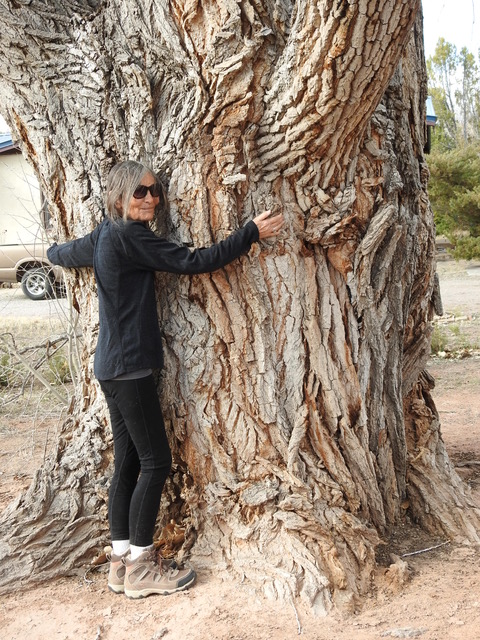 Yesterday I learned (NPR) that a third of the oak trees in this country will be dead within 50 years; I also read that our sugary harbingers of spring, the Maples, are dying confirming my own observations. I try to imagine what fall will be like without fire on the mountain.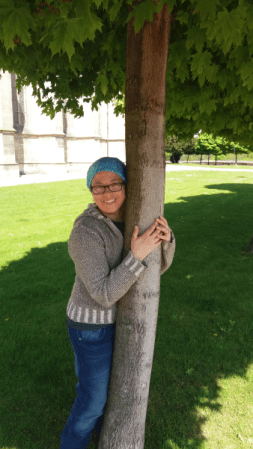

 On Friday, Nov. 6th, the day before the Biden/Harris race was called I spent a day in a deeply meditative state. I live in the NY City metropolitan area and it was a beautiful day. I mostly sat in my backyard in a patch of sunshine musing on the world and seeking a personal sense of balance. I didn’t do anything that day. Well not entirely true, I did a few things, for example I shifted positions a few times to stay in the sun. I grew up in the Puritan based school system which frowned on “doing nothing” as if spending a day not actively achieving anything was somehow wrong, perhaps sinful. For my kids, 30 years after me, it was far worse, codified in hours of homework following a complete school day. And today it’s even harder with afterschool activities (although I must say, to my great pleasure, I have never seen so many children playing on the street in my neighborhood than since this pandemic began.) No wonder Mama Nature is not generally honored. We don’t raise our children to have the time nor space for Her.
 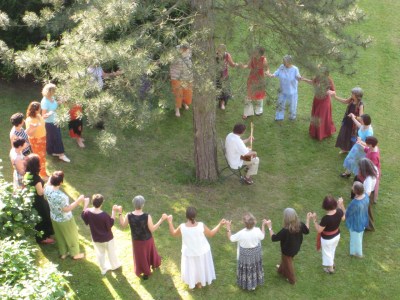 In Part One of this article, I described dancing Jewish, Romani, and Armenian dances for forgiveness and reconciliation with groups in Germany and all over the world. I also offered danced rituals of remembrance at former concentration camps and other places scarred by the atrocities of war.
 Feminism and Religion