In prisons in Canada and around the world, a large percentage of criminalized people, who are more often than not, victimized people, Indigenous people make up significant percentages. In a recent *talk I gave, accompanying Indigenous Elder and Artist Philip Cote, we addressed what happens when colonial narratives and patriarchal narratives collide. The result is that our worldviews are shattered. When our worldviews, which are our foundational way of meaning-making, are dismissed, denied, and in the case of
cultural genocide: decimated, our heart health fails. Our bodies, our minds, our souls become disconnected become dissociated. Become imprisoned. Imprisoned in the figurative sense and eventually over time, in the literal sense.
Category: Community
Poem: A Valentine’s Wish, 2023 by Marie Cartier

What if everyone said everyone was their Valentine?
I mean you are walking down the streets telling strangers:
You are adorable.
You are my love.
Kiss. Kiss.
Well, maybe not, I am thinking of those candy hearts, with the sayings, my favorite Valentine’s candy.
But what if everyone in the world on Valentine’s Day, February 14th,
decided that that the world, the Earth, was their lover?
Squishy hugs and smacking kisses,
and loving her with what she wants.
What if we all decided for twenty-four hours to love everyone
in the way they wanted, in the way they needed?
To respect women?
To say please and thank you and excuse me?
To honor difference and listen to all these voices
who have been silenced?
To give the sweet chocolate of understanding to those
who have been so misunderstood?
To take fifty Happy Meals to downtown L.A. and pass them out to the homeless,
yelling, “Happy Valentine’s Day!”?
On Mishpatim, Feminism and A Caring Community by Ivy Helman.
Mishpatim (Exodus 21:1 – 24:18 and 30:11-16) is the Torah portion for February 18, 2023. Its name, mishpatim, means laws or ordinances, and the portion is essentially just that – a list of laws to be followed. It is not the easiest parshah to follow as it jumps around, backtracks numerous times, and sometimes contradicts itself, particularly in the sections with Moses.
That being said, there are two main themes in Mishpatim; both of which I have discussed in past blogs. First is the death penalty. There is an overabundance of crimes that result in the death penalty in this parshah. Way, way too many. Another theme is idolatry. In many ways, that is a theme in the Torah itself. For more on these themes from my feminist perspective, see here: Sh’lach; Ki Tisa; Shofetim ; and on b’tzelem Elohim.
Continue reading “On Mishpatim, Feminism and A Caring Community by Ivy Helman.”Re-imagining the Ritual of Communion by Xochitl Alvizo
I remember the words so clearly: “I know what it’s like to have my body broken, I know what it’s like to have my blood spilt. I won’t celebrate anyone else’s broken body or spilt blood, and I don’t want anyone doing that on my behalf.” Sitting in the pew next to me, my friend spoke her truth in a soft and tentative, but somehow still firm, voice. She then slumped in her seat and folded up her legs, hugging them against her body. While everyone else got up to take communion, I stayed in place beside her.
There was a period of time in my life when I was not willing to participate in communion. My friend’s words stayed with me, transforming the communion table from one of hospitality to one of violence. “Celebrating” communion didn’t feel celebratory anymore. I chose not to take communion for several years. I let my friend’s words guide and deepen my reflection on the practice of communion—especially in light of the trauma suffered by all too many bodies.
Continue reading “Re-imagining the Ritual of Communion by Xochitl Alvizo”From the Archives: Christmastime for the Self by John Erickson
This was originally posted on December 25, 2018
We’ve all been there.
Sitting around the tree watching the kids open presents. Attempting to enjoy a holiday meal with extended and immediate family that you may or may not have traveled thousands of miles to see. Trying with every fiber of your being to not talk about the elephant, or red hat, in the room.
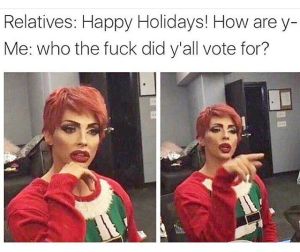
I get it. It is hard to not go home for the holidays. It’s also hard to sit at home and watch every one of your friends post online about their dinners, get-togethers, and other joyous events while you sit at home. I also understand that many of us, as a result of our sexual and/or gender identity, or maybe our political preference, don’t feel comfortable going home or, can’t go home. This is not ok and that is why it is so important that we all have our chosen families to be with during these times of communal gathering or more importantly, ways to cope while we are at home in these uncomfortable situations to make sure we take care of ourselves and make it out the other end.
Continue reading “From the Archives: Christmastime for the Self by John Erickson”Building Community: Starting a Local Sacred Circle K & Letting It Go by Caryn MacGrandle
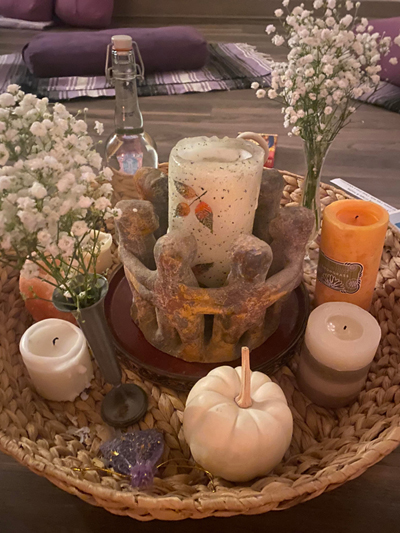
In January of this year, I put out the call for a Sacred Circle at a local Healing Arts Center. Over 150 people responded interested from a Facebook invite. Thirteen showed up.
From strangers, we have become friends and a community.
One was on the verge of checking herself in to a rehab.
She celebrated six months sobriety the other month in Circle.
We’ve had our share of potential drama. Egos and self-esteem issues and the potential pitfalls of being human. But we’ve made it through. Returning again and again to love to hope to dreams.
We’ve watched each other change and grow and open up.
Continue reading “Building Community: Starting a Local Sacred Circle K & Letting It Go by Caryn MacGrandle”Can I get an “Amen” up in here? by Laura Montoya

I am a great evangelist. I used to evangelize in Pentecostal settings until I was 22. Then, I left my church to evangelize about feminist issues to every woman that crossed my path. Rhetoric is a gift I received when I was a kid and that I inherited from my grandpa and my dad. But during the COVID lockdowns, it was hard to socialize, and my evangelization skills turned toward making my friends and family join the privileged fan base of Ru Paul’s Drag Race. One by one, I convinced my sister, cousins, neighbors, and best friends to watch the reality show, and they did with astonishing devotion. Every week, two or three of us gather in someone’s living room wearing masks to watch episode after episode after episode. Our debates about the queens in the show could last all night long. Who had the best performance? Did you like their lip-synching? “That elimination was so fair/unfair!”
Continue reading “Can I get an “Amen” up in here? by Laura Montoya “From the Archives: The Story of Juneteenth by Kelly Brown Douglas
This was originally posted June 18, 2013
Tomorrow is a special day for me. It is Juneteenth. On June 19, 1865, news finally reached Galveston, Texas that slavery had been abolished. This was of course two and a half years after Lincoln issued the Emancipation Proclamation. While the actual impact of the emancipation for the enslaved remains a source of historical discussion if not debate, the fact of the matter is that the proclamation of emancipation and the reality of freedom for black women and men did not necessarily coincide. To be sure, for a variety of reasons, the Emancipation Proclamation did not have an immediate impact on the daily lives of enslaved women, men and children. While the “official” historical records marks January 1, 1863 as a day of emancipation, the historical record for the descendants of enslaved men and women marks June 19, 1865 as the day of freedom. For, it was on this day that the last slaves were free
.
Continue reading “From the Archives: The Story of Juneteenth by Kelly Brown Douglas”From the Archives: Genderqueering by John Erickson
Moderator’s note: Today’s blogpost was originally posted March 24, 2015. You can visit the original post here to see the comments.
This post is a response to a recent blog entry titled “Who is Gender Queer?” on this site from Carol Christ. It was posted yesterday. I want to thank my friend, advocate, and upcoming scholar Martha Ovadia for reasons only she knows! Stay brave, speak up, be heard!

It is terrifying to know that something is wrong but not be able to speak truth to power.
Continue reading “From the Archives: Genderqueering by John Erickson”Carol P. Christ’s Legacy: Does Belief Matter?
Moderator’s Note: Carol Christ died from cancer in July, 2021. Her work continues through her non-profit foundation, the Ariadne Institute for the Study of Myth and Ritual and the Goddess Pilgrimage to Crete. This blog was originally posted December 10, 2012. You can read it long with its original comments here.
In recent days I have been pondering the fact that some people and some feminists seem to see the issues of religious faith and belonging to be rooted in birth, family, and community, while for others the question of belonging to a religious community hinges on belief and judgments about the power exerted by religious institutions. What accounts for this difference in the way we view religious belonging?
Recently I watched The Secret History of Sex, Choice and Catholics, a film featuring Roman Catholic feminists and ethicists who dissent from the Roman Catholic hierarchy’s views on contraception, abortion, and homosexuality. At the beginning of the film those interviewed state almost univocally that for them being Catholic stems from having been born Catholic. These Catholic dissidents continue as Catholics, even though they disagree with major portions of Roman Catholic teaching. It may have been because they were not asked, but most of them did not name reasons of belief for remaining Catholic.
Continue reading “Carol P. Christ’s Legacy: Does Belief Matter?”