To Love the Earth and Fear the Forest: My Paradox as an Ecofeminist by Tallessyn Zawn Grenfell-Lee

I am privileged to live near a wood where I can walk with my family, my dog, or alone – when I have the courage. I fear the woods, see; not because of physical danger from humans or wild animals, at least, not really. I fear the woods because time in the wilderness forces me to think and feel things I normally can distract myself from.

It took me years to figure out why I resist going to the woods alone. I’m not really alone, of course – there are other people and their dogs on the trails, not to mention all the wild animals and plants whose homes I am visiting. But without a walking companion, sometimes, something rushes in, something that crushes me, so that I can’t breathe. Is it Nature’s Wall of Grief, as nature connection mentor Jon Young posits – the stark reality of the ecological crisis and my own disconnect with my earthly roots? Is it the summation of all my past grief and trauma, or a fear inherited from my ancestors? Is it whatever feelings of fear, inadequacy, or pain that I usually process in smaller, more manageable quantities? All of the above? No, no… it’s much safer to wait until someone wants to go with me. Continue reading “To Love the Earth and Fear the Forest: My Paradox as an Ecofeminist by Tallessyn Zawn Grenfell-Lee”

Great Goddess, Mother Goddess, Creatrix, Source of Life by Carol P. Christ

The symbol of the Goddess is as old as human history. The most ancient images of the Goddesses from the Paleolithic era are neither pregnant nor holding a child. In Neolithic Old Europe the Goddess was most commonly linked with birds or snakes and only rarely portrayed as mother. Yet we tend to equate the Goddess with the Mother Goddess. I suspect that images of the Virgin Mary with Jesus on her lap and prayers to God as Father have fused in our minds, leading us to think that the Goddess must be a Mother Goddess and primarily a Mother.

In a recent blog, Christy Croft reminded us that in our culture, women’s experiences of mothering and motherhood are not always positive:

[The mother] doesn’t always appear in our stories in simple or easy ways. Some of us mother children we did not or could not grow in our bodies; some of us birth babies who are now mothered by others. Some of us are not mothers at all. Some of us had mothers who could not love us unconditionally, or did not have mothers in our lives, or had mothers who brought us more pain and humiliation than comfort, from whose effects we are still recovering, are still healing.

Women who have had negative or painful experiences of motherhood or mothering may find the symbol of the Mother Goddess off-putting. Continue reading “Great Goddess, Mother Goddess, Creatrix, Source of Life by Carol P. Christ”

The Thirteen Attributes of Shekhinah: A Prayer for the High Holidays by Jill Hammer

On Rosh haShanah and Yom Kippur (the Jewish New Year and the Day of Atonement), and on the festivals throughout the year, traditional Jewish liturgy includes the Thirteen Attributes of the Divine. Exodus 34:6-7 is the first to mention these thirteen attributes, or thirteen names really, for God.  This Rosh haShanah, as part of my work as a creative liturgist, I offered a new meditation on these thirteen attributes, dedicated to the Shekhinah, the Divine Presence.

In the biblical story, Moses asks God to show him God’s face, and God’s response is that Moses cannot see God’s face but “I will make all My goodness pass before you.” God hides Moses in the cleft of a rock, passes by the cleft, and recites the following:  YHWH, YHWH, compassionate and gracious, patient, abundant in kindness and truth, extending kindness to the thousandth generation, forgiving mistakes, and cleansing…”  The liturgy actually cuts off the rest of the text, which is harsher, in favor of retaining the loving divine attributes. At the new year, when the liturgy invites us to reflect, consider our actions, and acknowledge the brevity of our lives, Jews recite the text as a prayer to invoke God’s mercy.

Thirteen is a somewhat uncommon sacred number in Jewish tradition (seven, ten, and twelve are more common), but it’s a frequent sacred number in my practice.  In my spiritual tradition, at the Kohenet Hebrew Priestess Institute, we place at the core of our work thirteen netivot, or paths, of sacred action.  We also call them the “archetypes,” the “priestess paths,” or “the paths of Shekhinah.” Each of these paths—maiden, midwife, prophetess, mother, wise woman, shrinekeeper, lover, weaver, etc.– comes from an ancient way in which women embodied the sacred.  As a community, we use these paths as a guide for how to serve the sacred and one another, and we also understand them as faces of Goddess. Continue reading “The Thirteen Attributes of Shekhinah: A Prayer for the High Holidays by Jill Hammer”

Bridging Beyond Binaries: Painting Gloria Anzaldúa by Angela Yarber

One of the great joys of being an artist and writer is working on commissions, enlivening in paint, canvas, and word the stories of revolutionary holy women who have emboldened and inspired the one commissioning the Holy Woman Icon. Gloria Anzaldúa was on my list of holy women for a while when Dr. Robyn Henderson-Espinoza finally gave me the nudge to paint her by commissioning an icon. Anzaldúa gave Robyn—and so many others—the framework, the bridgework, for dismantling the binaries of difference, for finding the beauty that resides at the borderlands of race, gender, and sexuality. As a scholar-activist, Robyn speaks of Anzaldúa as a patron saint, saying:

“Anzaldúa has always been for me the bridge between theory and action, and her work, both in writing and teaching, compels me to live into my vocation as a public theologian, which at root is bridging across lines of radical difference. Without Anzaldúa and without her bridging frame, I am unable to do the work that I now do. This icon offers me a visual reminder of the ways in which I’m called to be a bridge in curating communities of radical difference.”

Queer borderlands. Chicana borderlands. Feminist borderlands. Gloria Anzaldúa (September 26, 1942 – May 15, 2004) was an American scholar who focused on the intersections among queer theory, feminist theory, and Chicana cultural theory. Born in the Rio Grande Valley of south Texas, Anzaldúa also bridged the borders of personal and academic writing, weaving together theory with lived experience, English with Spanish, and inviting readers into a new world—Mundo Zurdo—that transcended these seeming binaries. Continue reading “Bridging Beyond Binaries: Painting Gloria Anzaldúa by Angela Yarber”

Embodying Gaia by Christy Sim

Rosemary Radford Ruether wrote a classic text: “Gaia and God: An Ecofeminist Theology of Earth Healing.” Ever since I laid eyes on this amazing book and was convinced of the genius Ruether offered within these pages, I adored images of Gaia.

The great goddess is usually pictured holding the world as her womb, a loving representation of compassionately pulling all the hurt and agony to her abdomen for healing.

Ruether says in “Classical Western cultural traditions” of which “Christianity is a major expression,” we “have justified and sacralized” notions of God and domination (3). Such ideas teach us that domination is “the ‘natural order'” and “the will of God” for the “male monotheistic God” and his followers (3).

But Gaia is so much more and challenges these patriarchical messages in today’s culture. To imagine the divine with this motherly image helps with “ecological healing” (as Ruether says), and, being able to picture a “personified being” in the feminine (4). Gaia is truly special.

Continue reading “Embodying Gaia by Christy Sim”

Lektrima by 2 Worlds

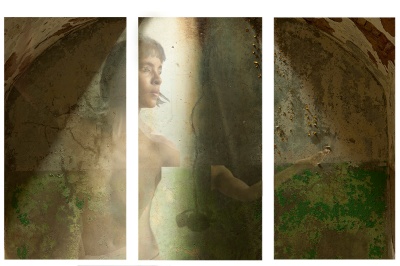
Lek Trima is a portfolio of photographs expressing reverence for feminine energy.

I had doubts as to whether I should create around this topic, I’m not a scholar, subject expert, or woman, but during flailing phases of the project I counted on sincerity and passion to keep me focused and hopeful.

In fact, after an exuberant start with some reading and research, I became dismayed in that any attempt on my part would seem to contribute to the problem that the majority of world literature on female archetypes, religious figures and myth traits has been written from a male viewpoint and projection. With a tempered demeanor, I continued. My intentions were earnest and as the work began to mature, I regained confidence and felt I could make something interesting and purposeful.

The title, Lek Trima, is taken from a mystical song composed by the first Dali Lama (1391-1475) in celebration of the Tibetan Buddhist deity, Tara. Tara is known as the “mother of liberation,” and recognized as a female Buddha. Ultimately, she represents a set of Buddhas and traits that are called on as focus points in developing inner qualities by practitioners of tantric mediation. Continue reading “Lektrima by 2 Worlds”

With Women by Kay Bee

Someone told me the other day that Death Doulas are one of the fastest growing career fields out there right now. As a (currently not practicing) Birth Doula, this does not surprise me. The term Doula came into its modern – predominately American – usage in the early 1970s, in reference to a woman who provided non-medical care for a birthing woman. The word is Greek in origin and depending on who you ask, means “with woman” or “servant woman.”

While I suspect the earlier “servant woman” version is the correct etymology, the romantic in me appreciates the “with woman” version, even in its technical inaccuracy. This is because at its core, the role of the Birth/Postpartum Doula is the formalized return of what I believe in my bones to be an ancient cultural practice of women being with each other as a woman passes through an intense life transition.

Whereas before, when a woman gave birth, the older, multiparous women of the local culture would gather around her to see her through her passage from expectant to postpartum motherhood; now some of us approaching that same rite of passage use the Internet to reach out into the culture to hire a Doula to do that very same thing. How we bring it about has changed, but what we desire has not. We desire to be supported, cared for, & loved by someone who has gone through what we are about to — we desire to be with women.

The number of Birth Doulas in the U.S. and abroad, at this point, has increased dramatically over the last ten years and now it would seem that the Conscious Birth movement has birthed a Conscious Death movement, complete with Death Doulas. Again, how we secure the care we want at birth or at death has changed, but what we desire in those powerful moments of passage has not.

The fundamental physical, emotional, and spiritual craving to be with women at life’s major rites of passage runs incredibly deep within us. It is also something denied to us by the patriarchal structures of most major religious systems, but over the last sixty years or so, we’ve worked hard at taking that back. Continue reading “With Women by Kay Bee”

Medusa and Athena: Ancient Allies in Healing Women’s Trauma by Laura Shannon

‘Rather than being a bleeding image of female disempowerment, Medusa may be read as…one of the most ancient European symbols of women’s spiritual abilities… [and] an empowering image of feminine potential.’

–Patricia Monaghan, O Mother Sun! (1994:244)

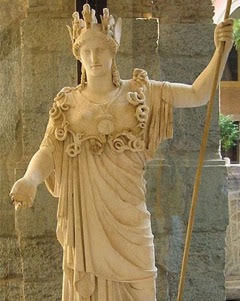
The name Medusa means ‘sovereign female wisdom,’ ‘guardian / protrectress,’ ‘the one who knows’ or ‘the one who rules.’ It derives from the same Indo-European root as the Sanskrit Medha and the Greek Metis, meaning ‘wisdom’ and ‘intelligence.’ (1) Metis, ‘the clever one’, is Athena’s mother. Corretti identifies Athena, Metis, and Medusa as aspects of an ancient triple Goddess corresponding respectively to the new, full, and dark phases of the moon. (2) All three are Goddesses of wisdom, protection, and healing.

Athena with Gorgoneion in her heart. 5th C BCE.

Athena and Medusa are particularly linked: indeed, one may have been an aspect of the other, ‘two indissociable aspects of the same sacred power.’ (3) Their many common elements include snakes, wings, a formidable appearance, fierce eyes and powerful gaze. The serpent, like the Goddess, has been cast as an embodiment of evil in patriarchal retellings; yet as Merlin Stone points out, serpents were ‘generally linked to wisdom and prophetic counsel’, associated with ‘the female deity’ and ‘entwined about accounts of oracular revelation…throughout the Near and Middle East.’ (4) According to Ovid, the poisonous vipers of the Sahara ‘arose from spilt drops of Medusa’s blood.’ (5) Although this is presented as a further sign of Medusa’s horrifying character, the original Berber inhabitants of North Africa – where Herodotus reports that the Medusa myth began – viewed snakes as bringers of luck and portents of joy. (6)

Despite Medusa’s fearsome appearance, she herself does not personify evil or demonic forces. According to Miriam Robbins Dexter, Medusa is a manifestation of the Neolithic serpent/bird Goddess of life, death, and regeneration. (7) Jane Harrison explains that the ancient Goddess wore the Gorgon mask to warn the uninitiated away from her rites (8), most likely mysteries of the great cosmic cycles of heaven and earth. Patricia Monaghan sees the snakelike rays streaming out from Medusa’s countenance as a sign of a solar Goddess (9), while Joan Marler, citing her connection with Hecate, identifies Medusa more with the moon than the sun (10); either way, Medusa is a heavenly deity ruling over the powers of the cosmos and the rhythms of time. Continue reading “Medusa and Athena: Ancient Allies in Healing Women’s Trauma by Laura Shannon”

Painting, Privilege, and “Going Tiny” in Hawai’i by Angela Yarber

Pelé by A. Yarber

It started with Pelé, the Hawai’ian Volcano Goddess who governs fire, lightning, volcanoes, and the flow of lava. When my little family set off on a big adventure in June 2015, I knew I’d research and paint her as a Holy Woman Icon, but I wanted to get to Hawai’i first so that I could experience her power firsthand. After three months volunteering without running water in Vermont, a month in southern Virginia’s finest fall foliage, and a holiday season traversing the country from east to west in a camper named Freya, we crossed the Pacific in search of Pelé.

The long-term goal of nearly two years of full-time travel was to discern next steps for our queer little family, and to find land to open an intersectionally ecofeminist retreat center. We always imagined returning to the southeast, likely buying land and creating the retreat center in the North Carolina mountains. Pelé had something else in store.

After three wild months volunteering on the Big Island, we fell in love, enlivened by this place we now call home: its beauty, the diversity of people, access to living off-grid, access to growing your own food, its rich culture and history, access to a vegan lifestyle, and the ability to live the majority of our life outside. In short, all of our plans were upended and recreated in the most beautiful and challenging ways because we knew Hawai’i must become our home. Continue reading “Painting, Privilege, and “Going Tiny” in Hawai’i by Angela Yarber”

A New Story for the Summer Solstice by Barbara Ardinger

This year the summer solstice occurs on Tuesday, June 20 in the Northern Hemisphere. (In the Southern Hemisphere, it’s the winter solstice and it occurs on June 21.) For us in the Northern Hemisphere, the summer solstice is the longest day of the year. The word “solstice” means “sun stands still.” It’s when the sun reaches its highest point in the sky and seems to stand in the same place before it begins moving toward the winter solstice. We like to think that the primary solar deity is Apollo, but there’s a whole crew of solar gods who are born near the winter solstice and live for a season in great honor, after which they’re sacrificed, spend a season underground, and are reborn.

But before there were solar gods, there were solar goddesses. Patricia Monaghan’s New Book of Goddesses and Heroines (Llewellyn, 1997) lists 58 of them, from Aclla to Xatel-Ekwa, who have been honored all around the world. Monaghan also tells us that Cinderella and Rapunzel may have been goddesses before they became heroines of what the Brothers Grimm called household tales. (Not fairy tales—no fairies in their stories.) Cinderella might have been a goddess of fire, and fire includes the sun. Rapunzel might have been “a sun maiden who would bring spring if she were not held prisoner by the witch of winter” (p. 265). Let’s reimagine Rapunzel in a solstice story… Continue reading “A New Story for the Summer Solstice by Barbara Ardinger”