The Four Phases of the Feminine Way by Elisabeth Schilling

For so long I’ve been wandering in the maiden stage, but now I am a mother, to myself, since I’ve made hard decisions to loosen or cut ties with people who have not always acted in my best interest in their attached and, at least to me, manipulative ways; I have long felt a mother to whatever group of students I have the honor of guiding; and I moonlight as a card reader/astrological guide where I feel I can nurture and provide compassionate advice to those who desire a connection from the universe. The way I practice is that I allow my empathy and research about ourselves to encounter the client’s own internal wisdom. There is not anything that qualifies me to be a teacher or reader any more than anyone else. We are all guru to each other when we listen closely.

I am not sure why I have never wanted to be a mother of a child. Not-wanting has felt very natural to me. Now that I have put some distance between myself and my own mother, her voice and so her desires are not so much hovering over me. I feel free and good about my decisions, about following the path that is normal for me.

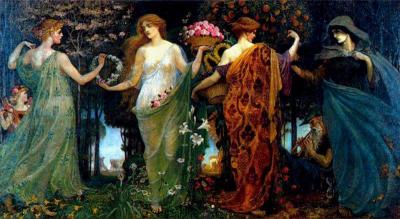
But what I really love about the four phases of the feminine way – maiden, mother, maga, and crone — is that we do not necessarily need to always identify with the stage that aligns with our age or any rites of passage. I remember going to a goddess ceremony in California where we could speak from any of the perspectives we felt aligned with that at the time and explain why.

Continue reading “The Four Phases of the Feminine Way by Elisabeth Schilling”
A Silhouette of a Woman, the Menorah, and a Pillar of Light: Discovering the Origins of the Goddess in Judaism by Alaya A. Dannu

2.24.2017

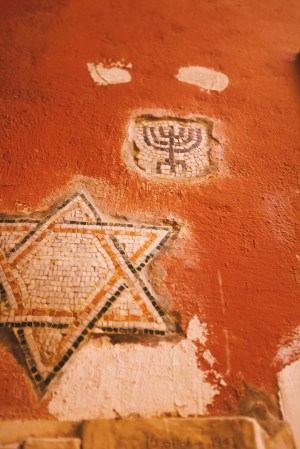
During a meditation before bed, I saw an image of a candelabra similar to what Jewish people use for Hanukkah. It was yellow/gold in color, engraved/etched onto a surface. All at once I saw the imagery of a star, a silhouette of a woman, and a beam of light move from the base of the candelabra through the top and beyond.

In these moments, I did not understand the significance of or the relationship between these images. What did a feminine figure have to do with the Jewish candelabra? What is the name of their candelabra? I could not even recall the name of it. It was something I grew up knowing the name of, as it was an image that I frequently saw beside the kinara of Kwanzaa in my school-aged years.

Because I was sheltered from the Abrahamic religions, my mother opted for participating in Kwanzaa as a means to shield me from any potential bullying from my classmates, and to celebrate a part of my diverse heritage. It was already a problem for my peers and the adult staff at school that I chose to identify as a Jamaican-American or a mixed person, as opposed to African-American. To tell a group of African-American Christians or those with an Afro-centric view that I didn’t celebrate Christmas or Kwanzaa, or that my mother taught me to listen to my dreams and intuition, would only serve as a means to further isolate myself; and by extension, my little sister. So celebrate Kwanzaa we did, until I began high school.

Continue reading “A Silhouette of a Woman, the Menorah, and a Pillar of Light: Discovering the Origins of the Goddess in Judaism by Alaya A. Dannu”

Pachamama – August 1st – A day to Honour the Great Mother Goddess

JassyIn Andean traditions the entire month of August is devoted to Pachamama.

Pachamama is the Supreme Goddess honored by the indigenous people of the Andes including Peru, Argentina and Bolivia. She is referred to as both the physical planet Earth as well as the universal Feminine Energy in time and space. Her name literally translates as Pacha – meaning world, land, earth, universe; and Mama, meaning Mother. She is the Mother of the World.

In Incan mythology Pachamama is also celebrated as a fertility Goddess who oversees planting and harvesting. She is responsible for the well-being of plants and animals and is often depicted as a Dragon or serpent representative of the Andean Mountains. When Pachamama feels disrespected it is thought that she causes earthquakes. Andean people believe that recent earthquakes in the region are a result of humanity’s destruction, disregard and disrespect for the planet.  Continue reading “Pachamama – August 1st – A day to Honour the Great Mother Goddess”

Reflections on the First Harvest by Deanne Quarrie and Belladonna Thomas

Deanne QuarrieThe harvest season of the first fruits is here. It is a time to be thankful for the labor and struggles needed for the harvest. We are at the height of the heat of the summer season. Our greatest wish is that the bounty of this season will add to the strength of our mind, body, and soul. It is for me, a time to take stock. So, I take up pen and paper and take some time to write about my own personal harvest.
I ask myself these questions:

When the moon is dark moon, she is the Crone. Many people think of a Crone as an old woman or hag, but in the Goddess tradition, the word “Crone” has a positive meaning. A Crone is a wise old woman, a woman who really knows herself well and draws from her long-life experience. She is often a guide and teacher to her community. People seek her out for wisdom and advice.

For years, we honored three phases of the Goddess—the Maiden, the Mother, and the Crone. Continue reading “Reflections on the First Harvest by Deanne Quarrie and Belladonna Thomas”

Women Can Change the World by Judith Shaw

judith shaw photoThese are dark days for those of us who believe in democracy, social justice, environmental stewardship/protection, and connectivity.  A rise in authoritarian rulers – from the U.S. to pockets of Europe to Turkey and beyond – are threatening the values upon which democracies are founded.

Continue reading “Women Can Change the World by Judith Shaw”

Finding Heavenly Mother with Rachel Hunt Steenblik by Caryn D. Riswold

Feminist theologies are filled with queries and questions about the divine feminine. Whether women need the Goddess. If She really is. Where herchurch might flourish. I have my own complicated views about the subject, and continue to be enriched by those who seek and find. Rachel Hunt Steenblik is the newest voice calling to and from the divine feminine, singing in a distinctively Mormon key.

If you read Mother’s Milk: Poems in Search of Heavenly Mother from front to back, you encounter what seem like scratches of verse and fragments of wisdom from a young mother catching time to write in the midst of her graced obligation to feed and sustain tiny bodies. If you read it back to front, you encounter a wealth and depth of engagement with Christian sacraments, feminist theology, sacred texts, Mormon history, modern philosophy, and children’s books and movies. This cacophony of source material and influence is distilled into sparse poems whose brevity bely decades of the author’s feminist engagement with vast religious history, philosophy, and theology.

In my review of Mormon Feminism: Essential Writings, edited by Steenblik along with Joanna Brooks and Hannah Wheelwright, I noted that feminists in many religious traditions “have had to document their history, make their theological case, and engage their scriptures as robustly as any conservative traditionalist would.” In Mother’s Milk, Steenblik offers us her contribution to the reconstruction of religious tradition. The words of her introduction state plainly: “These are the poems that I could write with my questions, my hurt, my hope, and my reading. Others could write other poems with theirs. I hope they will. We need them all.”

Continue reading “Finding Heavenly Mother with Rachel Hunt Steenblik by Caryn D. Riswold”

Brigid from The Goddess Project: Made in Her Image by Colette Numajiri

She is the reason BRIDES wear white, swan-like wedding gowns. Brides veil themselves like the Goddess herself, Whom all Bridegrooms honor, until revealing Herself to Her chosen groom. Tiny flowers and shamrocks are said to bloom in Her wake, She brings new life.

BRIDGET BRIGHT by Hedgewytch

She is known as Brigid Bright,
Goddess who shines against the night.
At Cille Dara, at the setting sun,
Her sacred flame is kept by one.
Nineteen times the earth turns round,
As sacred springs come forth the ground.
Twenty times the sun has burned,
And now the Goddess has returned.
Alone she tends her thrice-bright flame,
Born of her heart that bears her name.
The Dagda knows Brigid as Daughter,
Triple Blessed by fire and water.
Poets call her name to inspire.
And healers oft gain from her fire.
Wayland too would know her well
As hammer and anvil ring like a bell.
A sorrowful cry did she give meaning,
When first she brought to Eire keening.
Oh Sacred Fire against darkest night,
Burn for Brigid, for Brigid Bright!
Fire in the head…to quicken us.
Fire in the cauldron…to heal us.
Fire in the forge of the heart…to temper us.

Continue reading “Brigid from The Goddess Project: Made in Her Image by Colette Numajiri”

Inner Garbage (Fear) vs. Inner Goddess (Love) by Vanessa Soriano

I’m sitting on my meditation pillow for the thousandth time searching for clarity.  Initially, going within feels like traversing a jungle; swinging from one thought branch to another.  I’m itching for some peace and I’m almost certain this isn’t the way to it.  But, I’ve been here before and I won’t quit breathing through the discomfort.  I know I will greet the inner goddess soon enough.  Getting past the noise is part of accessing her wisdom.  The noise teaches me discernment (if I allow it to).

Eventually, the monkey mind gathers up all the branches and turns them into a prodigious figure that blocks the sun inside.  Hello darkness my old friend.  Inner garbage (fear) makes her entrance.  I’m still breathing.  Eyes closed.  Determined through slow, rhythmic breaths, to move past her.  I know I cannot run from her.  She’s faster and outwits me every time.  Continue reading “Inner Garbage (Fear) vs. Inner Goddess (Love) by Vanessa Soriano”

“The Burning Lava of a Song” by Joyce Zonana

Aurora’s autobiographical narrative is a passionate paean to poets as the “only truth-tellers, now left to God”; she celebrates them as agents for personal and social transformation. As we come to the end of this National Poetry Month in the U.S., where truth is under siege, it’s worth recalling Aurora Leigh and its daring exploration of poetry, gender, divinity, and social justice.

jz-headshotI was in graduate school when I first read Aurora Leigh, Elizabeth Barrett Browning’s fiery 1856 epic about a young woman claiming her vocation as a poet despite Victorian society’s patriarchal strictures. The poem was not on any assigned reading-list; I’d simply stumbled across it while doing research for my dissertation. The opening lines brazenly assert the speaker’s authority and ambition:

OF writing many books there is no end;
And I who have written much in prose and verse
For others’ uses, will write now for mine,–
Will write my story for my better self . . .

Encountering those words, I was immediately possessed by Aurora’s voice and vision, a welcome change from all the male poets and critics I’d been reading. I devoured the verse novel’s nine books in one night. The poem became the centerpiece of my dissertation, and I studied and enthusiastically taught it for years.

Continue reading ““The Burning Lava of a Song” by Joyce Zonana”

Sophia from The Goddess Project: Made in Her Image by Colette Numajiri

“Happy are those who find wisdom. . . . She is more precious than jewels, and nothing you desire can compare with her. . . Her ways are ways of pleasantness, and all her paths are peace. She is a tree of life to those who lay hold of her; those who hold her fast are called happy” (Proverbs 3: 13, 15, 17-18).

Sophia is DIVINE WISDOM, Her name comes from the feminine Greek word meaning Holy Wisdom. She is found all over the Bible (Proverbs, Sirach and the Wisdom of Solomon..) and in the Gnostic Gospels (unearthed at Nag Hammadi in 1947.) She has been called the MOTHER OF THE UNIVERSE, Mother of Yahweh and HOLY SPIRIT. The words: “Philosophy, theosophy and sophiology” all come from Sophia. The Bible links her to Christ: “Christ is the Wisdom (Sophia)” (1 Corinthians 1:24, 30). There is some evidence that Mary Magdalene was also called “Mary Sophia.”

Because She did not help advance the patriarchal scheme, Sophia was all but deleted from history. Hidden throughout the Bible and the Dead Sea Scrolls, knowledge of the DIVINE FEMININE all but went up in flames. Even a great cathedral build in Her honor in Constantinopole, Hagia Sophia (Holy Wisdom), was burned to the ground twice. It’s newest rebuild was a mosque and is now a museum. NOTRE DAME (Our Lady) has survived but they eventually claimed it was named after the Virgin Mary. (The famous Notre Dame rose windows are a common symbol of the Divine Feminine!). Some say there are secret societies that still exist to keep knowledge of Her alive.

Continue reading “Sophia from The Goddess Project: Made in Her Image by Colette Numajiri”