And No Religion Too by Elizabeth Cunningham

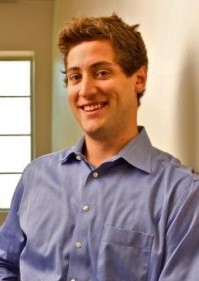
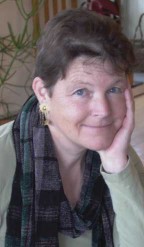
Elizabeth Cunningham headshot jpegReligion. As a species we can’t seem to live with it or without it. There is dispute about the derivation of the word, but some scholars believe it has the same root as the word ligament, ligare, to bind or tie, to reinforce the bonds between human and divine, or perhaps the bonds between believers. The words bond and bind also have a variety of meanings and connotations. A bond can be used to tie someone up; it can be a bond of kinship, or bond given as surety.

Religion’s impulses and manifestations are just as ambiguous. Did religion arise because the world seemed so beyond human control (weather, health of crops, availability of game)? Perhaps there were gods or spirits to appeal to or propitiate? Or did it arise equally from a sense of gratitude for the earth and seas that feed us, for a sky that dazzles us, for the life that flows through us and surrounds us. Song, dance, storytelling, drama, art likely began as religious or ritual expression. No aspect of life was beyond the sacred. And so religion also went into the business of law, social control. Religion has a long, bloody, ongoing history of occasioning and/or justifying war, oppression, persecution, torture, genocide.

Was religious expression ever purely benign? Were humans? Perhaps when we were still small bands of hunter-gatherers or when we lived in matriarchal, matrilineal cultures where men did not feel obliged to control women (or each other) to ensure the perpetuation of their own DNA. There are benign tenets in most religions still—food as something to share, the stranger as someone to welcome. Birth and death and all the phases of life as a time to gather in community to celebrate or mourn. The call to respond to infirmity, grief and suffering with compassion and to injustice with bravery and truth.

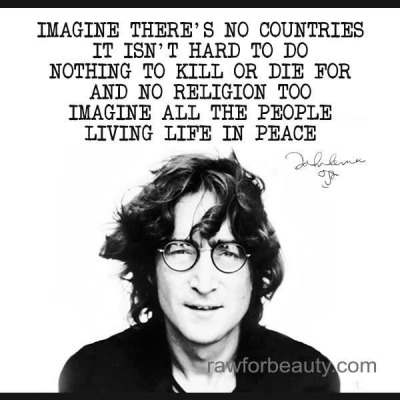
lennonI titled this piece “And no religion, too” after a line from John Lennon’s song “Imagine.” Maybe I am struck by that line, because my life and work have been dominated by religion, literally since birth. My mother’s labor was induced to accommodate my curate father’s schedule. One of my earliest memories, age three, is of plotting to kill God and Jesus. Other childhood memories include being terrified that I would go to prison or hell for trespassing on the property next door. (From the Episcopal version of the Lord’s prayer, I knew trespass meant sin.) I also remember a skirmish with the Roman Catholic kids down the street who used to be my best friends until we went to different schools. A backyard holy war.

As I grew up, I repressed my deicidal tendencies and remained a creed-saying Christian until my mid-twenties when I began to participate in the silent worship of The Religious Society of Friends (Quakers). Later an encounter with the goddess called me to join with others in creating earth-centered ritual at High Valley, a center I directed for eighteen years. During that time, I also became an ordained interfaith minister and counselor. All my life I have been writing novels that ponder religious questions, starting with The Wild Mother, a reimagining of the Garden of Eden story. For twenty years I worked on The Maeve Chronicles, novels from the point of view of a Celtic Magdalen who remains an unconverted pagan. My latest novel, Murder at the Rummage Sale, is set in the church of my childhood. Clearly I am still working with my primary material.

Yet I don’t know that I have a religion any more. I am still friends with my co-celebrants. We meet in a variety of contexts. But for the first time in my life I am not part of a religious community. No doubt I have beliefs, but I have no belief system. As I struggle to write this post, it dawns on me that it is my own life without religion that I am trying to imagine.

Continue reading “And No Religion Too by Elizabeth Cunningham”

Remembering to Be Thankful by John Erickson

Remembering to be thankful may just be a privileged illusion that individuals in positions of power get to write about in the December of each year to self-congratulate themselves about being actually able to be able to be thankful. It may just seem like people who write about being thankful are complaining or pontificating that being thankful is in itself a chore.

WEHO CA (June 7, 2015)©2015 Rebecca Dru Photography All Rights Reserved    www.rebeccadru.com
WEHO CA (June 7, 2015)©2015 Rebecca Dru Photography All Rights Reserved
http://www.rebeccadru.com

With the holidays just around the corner and the frazzled, crisp ping of anxiety, rush, and panic take over the air around us, it is easy to forget to stop and “smell the roses.”  In times where teaching positions continue to shrink and more universities switch to adjunct labor, fees and class costs continue to rise, or just simply life becomes a little more complicated, due to the nature of balancing life, activism, work, friendships, or relationships, remembering to remind myself to be thankful is another task, I find adding to the never-ending list of stuff I always seem I have to do.

However, remembering to be thankful, scheduling it into one’s daily schedule are vital to our success as new and emerging faculty or activists or just in general because being thankful reminds us that we have aspects of our lives that are worth being thankful for.  Remembering to be thankful proves that we are in some way, connected to a larger sense of life that, at times, grants our wishes, wants, or desires, brings us despair, and then allows us to get through it, or even makes us feel alive.

As I sit back and look at the personal and professional landscape around me I understand that I have a lot to be thankful for both consciously and unconsciously.  Most recently at AAR, I participated on a panel in response to Bernadette Barton’s Pray the Gay Away.  During the course of our panel, the conversation of chosen vs. biological families came up.   Most recently, my mentor and panel moderator, Dr. Marie Cartier, talked about the same topic here on FAR and the difficulties many of us experience in regards to our chosen families vs. our biological families.   With the holiday season all around us, and regardless of what or if, you celebrate it or not, it is quite hard to get away from it all without realizing who your “family” is and whether or not you’re close or connected with them can be traumatizing during these times where we’re taught or expected to be with them.

After our discussion on the panel and then at the hotel bar, people discussed the pains and traumas in relation to not having a biological family to go home to during the holidays.  Sitting there and listening to the conversations, I realized that, for once in my life, I had nothing to say. Continue reading “Remembering to Be Thankful by John Erickson”

Xmas and Feminine Wisdom by Vanessa Rivera de la Fuente

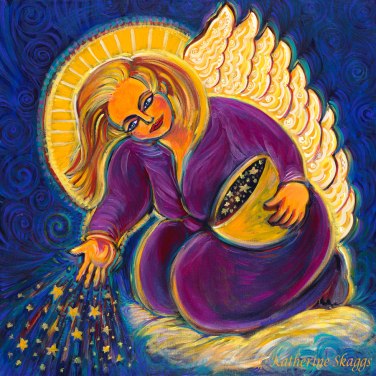
Katherine-Skaggs-1029.ABUNDANCE-ANGELI am not fond of Christmas and these holidays are very difficult for me to deal with. This has nothing to do with me being a Muslim. I have been a Grinch before this. I do not like excessive noise or crowds of people. It bothers me especially the excess, the lack of meaning and loud claims for kindness and mercy to decorate our lives for few days. This year is proving particularly hard for me.

Experiences of 2015 have forced me to question the paradigms under which I had lived until now. Life is suing me for an extra effort of introspective, growth and openness and that can be painful at times. A few weeks ago, I was venting my sorrows and doubts to my mother. I told her that the last thing I wanted to do was install a Xmas tree. She looked at her own Xmas tree full of golden balls and said:

“You know why I like Christmas trees? You were born a week before Pinochet’s coup. That year, the Dictatorship forbade people to buy, sell or cut pines trees under punishment, which ruined our Xmas, since plastic ones were very expensive. I built a tree for you at home, made of brass and wood. The center was a broomstick and the branches of wire. I cut leaves from empty cans of milk. I lost a child before you came to my life. And you were born in a country that suddenly lost freedom. I could not deny you hope. The Christmas tree has been my way to convey hope. That was my present.”

Listening to my mother, Christmas took on new meaning for me, a sacred dimension. I understand the sacred as those things, memories and spaces that are vital for us, all of what gives our lives meaning, purpose, reason and inspiration. I come from a family of women where husbands, brothers and male cousins are scarce. Joy, mourning, religion, knowledge or strength have been developed and shared from womb to womb. Continue reading “Xmas and Feminine Wisdom by Vanessa Rivera de la Fuente”

Not a Woman of the Cloth- an excerpt from Murder at the Rummage Sale by Elizabeth Cunningham

Elizabeth Cunningham headshot jpegWhen I finished writing The Maeve Chronicles, I returned to a mystery novel, abandoned thirty years earlier. I was finally ready to write about the small town Episcopal Church where I grew up in the 1950s and 60s and to explore the points of view of characters based on my late parents. When I began seeing through my mother’s eyes, the intensity of her suppressed fury took me by storm. Trapped in the role of minister’s wife, Anne Bradley strikes me as an embryonic feminist. In the scene below, Anne is hanging up laundry when she is approached by a pesky parishioner who makes a veiled reference to the death of Anne’s son.

*********

“Hello there, Mrs. Bradley,” Mildred Thomson said, adding some obligatory remarks about the weather. “I was hoping to find Father, I mean *Mr. Bradley in today. Do you know when he might be back?”

Anne did not. In fact, she realized she did not even know where he was. Hospital calls? A diocesan meeting? Surely she would have remembered if he’d gone all the way to New York. He had probably told her, and she had probably not listened. He was not there most of the time, or if he was, he was not available, not to her or the children. He stayed in his study in the parish house where no doubt Mrs. Thomson had hoped to ambush him.

“I’m afraid I don’t, Mrs. Thomson,” said Anne, feeling for her cigarettes in her apron pocket. Hell’s bells. She must have left them in the back hall on the shelf above the washer.

Anne turned back to the clothesline. Three children meant a lot of laundry, though in the summer the load was a little lighter, shorts and short sleeves, not so many filthy elbows and knees. There were always Gerald’s shirts. Short or long-sleeved, they had to be ironed, something she could not even contemplate till the cool of the evening.

“Did you have an appointment with him?” Anne asked, hoping the question did not sound too much like a reproof.

“No, no,” Mrs. Thomson said vaguely. “I just happened by. I suppose I ought to make an appointment. I never did with Father Roberts. He never minded my popping in.”

That was definitely a reproach. Anne felt almost sorry for her husband, almost. But it was part of his job to listen to parishioners maunder on, as much as holding services on Sunday and galvanizing his congregation to do good works in the community.

“Mrs. Bradley, may I ask you a personal question?”

Could she say no, Anne wondered? Or at least, excuse me while I get a cigarette? But Mrs. Thomson took her hesitation for consent.

“Do you ever struggle with your prayer life?”

Anne bit back a bitter laugh. She could hear it in her head, a sound a dog might make, something between a yelp and a snarl.

“I suppose you don’t,” Mrs. Thomson said wistfully.

Continue reading “Not a Woman of the Cloth- an excerpt from Murder at the Rummage Sale by Elizabeth Cunningham”