Queen Esther from The Goddess Project: Made in Her Image by Colette Numajiri

Queen Esther
An orphan child,
who became
a well respected queen,
Esther, the Queen of Persia,
was a woman of integrity,
Wisdom and courage,
a beautiful woman, truly supreme,
favored by God,
She had a awareness of dependability,
steady strong, long-suffering faithfulness, with vision foreseen
in courage to stand in times of trouble
with true self esteem,
wise above measure,
Esther, Queen of Persia.
Like many Goddess tales, Esther (from the Old Testament “Book of Esther” or the “Megillah”) took full control of a dangerous situation and against all odds created a miracle, saving the lives of ALL OF HER PEOPLE.
There is a yearly Jewish celebration because of Her called PURIM (today, March 1st this year) where people wear costumes, re-read the Megillah, feast and give gifts of food and money to the needy.

Continue reading “Queen Esther from The Goddess Project: Made in Her Image by Colette Numajiri”

Children of German Immigrant Farmers in Cherry Ridge: American Stories by Carol P. Christ

In my genealogy research, I traced my father’s grandmother, Catherine, to her roots on the Iloff farm in Cherry Ridge, Honesdale, Pennsylvania, about two hours north of New York City. Catherine’s parents were Henry Iloff, who emigrated in 1841 from St. Nicholas, Saarland, and Catherina Lattauer who emigrated in 1845 or 1846 from Ober-Floerscheim, Hesse-Darmstadt. They were married February 2, 1846 at St. Matthew’s Church in “Little Germany” on the Lower East Side of Manhattan.

Iloff farmhouse

In 1850, Henry and Catherina purchased land in Cherry Ridge, Honesdale, where they built the farm that remained in the family for a hundred years. In 1851 Catherina’s sister Agnes Lattauer Schweizer emigrated with her family from Ober-Floerscheim to Cherry Ridge. The Schweizer farm also remained in the family for a hundred years.

I had been told about the family Henry Iloff had with two wives who were somehow related: nine children with his first wife and nine with his second over a forty year period–fourteen of whom were living at the time of his death in 1889. I was shocked to learn that when his first wife died in 1869, Henry married his wife’s sister’s daughter Johanna Schweizer–who was half his age and his children’s cousin. I suspect that the marriage was considered scandalous in a conservative farming community, and that it did not sit well with the children of the first marriage, four of whom left the local area. Nonetheless, Henry Iloff was elected to the prestigious position of Wayne County Commissioner a decade later. Continue reading “Children of German Immigrant Farmers in Cherry Ridge: American Stories by Carol P. Christ”

Human Elements in Plants: Wisdom and Botanical Lore by Nazia Islam

My paternal side of the family comes from an extensive line of farmers. They were notable for growing eggplants, but they held all sorts of agricultural knowledge. My maternal side of the family has a hushed history of female kobiraj/ natural medicine practitioners. General folk knowledge was passed through mothers and mothers-in-law.

Much of this “folk knowledge” would peek into my life as I was growing up in New Jersey–especially through our garden. It didn’t matter where we lived, we would always grow something somewhere even if it was just germinating seeds for other people. My parents would go to great measures to bring back seeds of vegetables they could not find in the US–specifically gourds and beans– from Bangladesh whenever they visited.

Continue reading “Human Elements in Plants: Wisdom and Botanical Lore by Nazia Islam”

A Winter Woman by Molly Remer

“When winter comes to a woman’s soul, she withdraws into her inner self, her deepest spaces. She refuses all connection, refutes all arguments that she should engage in the world. She may say she is resting, but she is more than resting: She is creating a new universe within herself, examining and breaking old patterns, destroying what should not be revived, feeding in secret what needs to thrive…

Look into her eyes, this winter woman. In their gray spaciousness you can see the future. Look out of your own winter eyes. You too can see the future.”

–Patricia Monaghan, Seasons of the Witch

When the wheel of the year turns to winter, I always feel the call to retreat, to cocoon, to pull away. I also feel the urge for significant de-cluttering—my eyes cast about the house for things to unload, get rid of, to cast away. I also search my calendar for those things which can be eliminated, trimmed down, cut back on. I think it is the inexorable approach of the winter holidays that prompts this desire to withdraw, as well as the natural rhythm of the earth which so clearly says: let things go, it is almost time to hibernate.

This shift toward winter is a time of discernment. A time to choose. A time to notice that which has not made it through the summer’s heat and thus needs to be pruned away. In this time of the year, we both recognize the harvest of our labors and that which needs to be released or even sacrificed as we sense the promise of the new year to come. Continue reading “A Winter Woman by Molly Remer”

Grieving through the Holidays: Painting Holy Women Icons of Grief by Angela Yarber

The holiday season is a particularly difficult time for grief. Whether it is grieving someone who died earlier in the year as you celebrate your first holiday season without them, or the lasting memories of loved ones who are no longer present at family gatherings, this time of year makes grief bubble to the surface. Since this is my first holiday season without my little brother, who died in March, I’ve planned ahead with coping strategies that I’d like to share with other feminists struggling to grieve through the holidays.

Upon the death of a loved one, most people in the West are offered commodified grief, costly funerals, and stifled feelings pre-packaged as dignified tradition. When deathcare became a commercial enterprise at the turn of the twentieth century, there was what mortician and author Caitlin Doughty calls a seismic shift in who was responsible for the dead. “Caring for the corpse went from visceral, primeval work performed by women to a ‘profession,’ an ‘art,’ and even a ‘science,’ performed by well-paid men. The corpse, with all its physical and emotional messiness, was taken from women. It was made neat and clean, and placed in its casket on a pedestal, always just out of our grasp (Caitlin Doughty, From Here to Eternity: Traveling the World to Find the Good Death, 136).”

Continue reading “Grieving through the Holidays: Painting Holy Women Icons of Grief by Angela Yarber”

Thanksgiving, Pies and Remaking Tradition by Marie Cartier

Dear FAR readers—you will be reading this blog the day after Thanksgiving, which is one of my favorite holidays. It didn’t used to be—but it is now.

Over twenty years ago, I remade this holiday for myself. At that time I was in my late thirties and was just coming out of almost a decade of healing from a very rough childhood. I spent a lot of time in those early recovery years yearning for some kind of magical “family” I thought “everyone” had. Once I really opened up about my story, however, I realized everyone doesn’t have any one thing.  We all have something different—and everyone has a story.

I decided to create a ritual—I didn’t intend for it to turn into a tradition, but it did. Continue reading “Thanksgiving, Pies and Remaking Tradition by Marie Cartier”

Holy Women Icons Bearing the Light of Advent by Angela Yarber

There’s nothing like the holiday season to bring out everyone’s least feminist self. In one of the courses that I teach—Gender, Food, and the Body in Popular Culture—students are assigned to examine gender roles throughout the holiday season through the lens intersectional ecofeminism. Inevitably, almost every student returns from holiday break with the same assessment: mom, grandma, and a kitchen full of women prepare, cook, and clean every family meal; women do the holiday shopping; men in the family watch sports. Of course, this isn’t true of everyone. There are plenty of families who subvert and dismantle stereotypical gender roles, but the holidays seem to heighten these roles, undergirding them with some kind of nostalgic and theological weight that claims that if mama doesn’t arduously prepare her famed casserole, the season will be ruined. Otherwise committed feminists find themselves singing carols filled with sexist language and participating in holiday rituals that they would critique any other time of the year. Subversion be damned because we want our traditional family holiday!

I’ve long struggled with creative ways to subversively approach the holidays as a queer clergywoman, parent, artist, and author. People like their nostalgic and heart-warming traditions, even when they sometimes smack of patriarchy, racism, and heteronormativity. I’ve confronted this as a preacher and worship planner, often to raised eyebrows or angry phone calls from congregants who just want to sing the carols without the preacher changing the words, or dismissing the notion of a virgin birth, or hanging enormous paintings of pregnant women all over the sanctuary.

Continue reading “Holy Women Icons Bearing the Light of Advent by Angela Yarber”

Tonight Is Guy Fawkes Night by Barbara Ardinger

Mark Twain is reported to have said that while history does not repeat itself, it often rhymes. Let’s see what rhymes we can find in Tudor and Jacobean England and Trumpean America. Here’s the history lesson. What has changed in 400 years?

After about a thousand years of Roman Catholicism in the British Isles (with a few thrusts toward reform, like the 14th century theologian John Wycliffe, who translated the Bible into medieval English), it is Henry VIII who is usually given credit for “reforming” the English church, i.e., declaring his independence from the Roman church and the pope in 1534. While Henry still called himself a good Catholic (and even condemned Martin Luther), it was the Tudors and their advisors that thrust a militant and puritanical Protestantism on the people.

The Tudor dynasty, which lasted just over a century, began with the victory of Henry Tudor (who became Henry VII) over Richard III at Bosworth Field in 1485. (Shakespeare turned Richard’s story into a Tudor propaganda play. In real life, Richard was a good king.) Henry’s second son, Henry VIII, was a tyrant who is best known today for his six wives. He was also more interested in luxury (in his day synonymous with vice) and self-aggrandizement than anything else.

Continue reading “Tonight Is Guy Fawkes Night by Barbara Ardinger”

The Last Time, by Molly Remer

I lie in bed with him, cementing the details in my memory. The way the morning air is heavy and green. The sound of last night’s raindrops continuing to drip from the overfull gutters on the roof. The insistent stab of a single-note bird song in the air. His head nestles in the crook of my arm the way it has done every morning for three years. Blond hair against my nose, breathing in the slightly baby smell of him. “This is the last time,” I whisper softly. “We are all done after this. This is the last time we will have nonnies.”
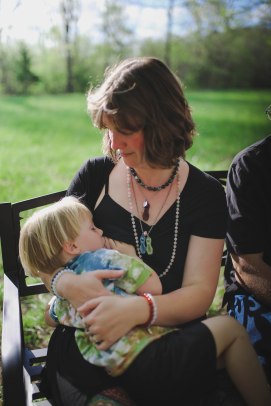
This is not the first last time for me, but it is the last, last time.  The first baby was born 14 years ago and gathered to my breast with all the tenderness and uncertainty and instinctiveness of a first, first. “Do you want nursies?” I whisper to that new little boy, and we begin the next steps in our bond, nursing for nearly three years, until one day, six weeks away from the birth of the next baby boy, I decide that we truly have to be done. I am a breastfeeding counselor for other nursing mothers and I feel like I should want to tandem nurse my two boys. I fondly envision their hands joining across my body, the easy love and camaraderie between them blossoming through this shared time with their mother. But, I feel an intense irritation with nursing while pregnant, nearly a sense of revulsion and the almost irresistible urge to shove away my sweet little boy as I prepare to greet the life of another. I talk to my midwife about my feelings and she explains that with her own two daughters, the agitated feeling at nursing the older one did not go away with the birth of the second, but instead became dramatically worse. After hearing this, I feel panicky and I decide we do, in fact, have to wean. He is a very verbal and precocious toddler and I am easily able to explain to him that it is time to be finished nursing. One night though, he lies in bed with me crying and begging to nurse. He says he really needs to. I tell him, “remember, we’re all done, but if you really, really need me, if you really, really still need to have nursies, you can.” He doesn’t nurse, but instead falls asleep, reassured that while our nursing relationship might be over, I’m still here.

Continue reading “The Last Time, by Molly Remer”

Painting Breast Cancer Goddess by Rev. Dr. Angela Yarber

October is Breast Cancer Awareness Month, though I imagine most of us are already relatively aware. One in eight women will have breast cancer. Pink is everywhere. It’s difficult to find a person who hasn’t been impacted by breast cancer on a personal level. In 2003, my mom was diagnosed. Radiation, a lumpectomy, and ten years later she was dubbed cancer free. When I finished my Ph.D. in 2009, I did a stint as a Research Assistant for a fabulous liturgical studies scholar working on a book that examined and created rituals for women with breast cancer. My task was researching everything written on breast cancer that intersected with feminism, womanism, religion, spirituality, and ritual.


Audre Lorde’s Cancer Journals struck me profoundly. The critiques weighed heavy as a movement that began with destigmatizing breast cancer and offering solidarity to patients has transformed into a pinkified commodity. Whether it’s the lack of transparency in major breast cancer foundations, pinkification, the essentializing conversations that equate breasts with womanhood, lack of access to comprehensive health coverage, the role of the meat and dairy industry in increased risks of breast cancer, the talk of “surviving” and “fighting” as though those who don’t survive aren’t fighters, or the complete lack of representation of women of color in any pink marketing (seriously, do a google image search of “breast cancer headwraps” and feast your eyes upon an endless array of young, white women), breast cancer awareness has been commodified so that helping cancer patients is second to profit. Amidst these pink teddy bears delicately embroidered with the word “fighter,” one can only wonder what we can actually do and offer and create to be supportive of those with breast cancer. What rituals might we offer? What sacred spaces might we create? What is a feminist response? A spiritual response?

Continue reading “Painting Breast Cancer Goddess by Rev. Dr. Angela Yarber”