
The Last Time, by Molly Remer

I lie in bed with him, cementing the details in my memory. The way the morning air is heavy and green. The sound of last night’s raindrops continuing to drip from the overfull gutters on the roof. The insistent stab of a single-note bird song in the air. His head nestles in the crook of my arm the way it has done every morning for three years. Blond hair against my nose, breathing in the slightly baby smell of him. “This is the last time,” I whisper softly. “We are all done after this. This is the last time we will have nonnies.”
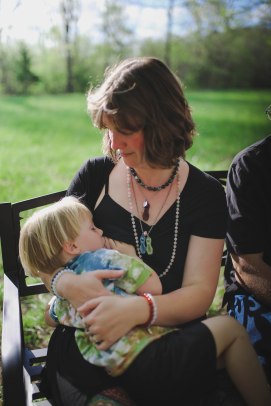
This is not the first last time for me, but it is the last, last time.  The first baby was born 14 years ago and gathered to my breast with all the tenderness and uncertainty and instinctiveness of a first, first. “Do you want nursies?” I whisper to that new little boy, and we begin the next steps in our bond, nursing for nearly three years, until one day, six weeks away from the birth of the next baby boy, I decide that we truly have to be done. I am a breastfeeding counselor for other nursing mothers and I feel like I should want to tandem nurse my two boys. I fondly envision their hands joining across my body, the easy love and camaraderie between them blossoming through this shared time with their mother. But, I feel an intense irritation with nursing while pregnant, nearly a sense of revulsion and the almost irresistible urge to shove away my sweet little boy as I prepare to greet the life of another. I talk to my midwife about my feelings and she explains that with her own two daughters, the agitated feeling at nursing the older one did not go away with the birth of the second, but instead became dramatically worse. After hearing this, I feel panicky and I decide we do, in fact, have to wean. He is a very verbal and precocious toddler and I am easily able to explain to him that it is time to be finished nursing. One night though, he lies in bed with me crying and begging to nurse. He says he really needs to. I tell him, “remember, we’re all done, but if you really, really need me, if you really, really still need to have nursies, you can.” He doesn’t nurse, but instead falls asleep, reassured that while our nursing relationship might be over, I’m still here.
Continue reading “The Last Time, by Molly Remer”

Painting Breast Cancer Goddess by Rev. Dr. Angela Yarber

October is Breast Cancer Awareness Month, though I imagine most of us are already relatively aware. One in eight women will have breast cancer. Pink is everywhere. It’s difficult to find a person who hasn’t been impacted by breast cancer on a personal level. In 2003, my mom was diagnosed. Radiation, a lumpectomy, and ten years later she was dubbed cancer free. When I finished my Ph.D. in 2009, I did a stint as a Research Assistant for a fabulous liturgical studies scholar working on a book that examined and created rituals for women with breast cancer. My task was researching everything written on breast cancer that intersected with feminism, womanism, religion, spirituality, and ritual.


Audre Lorde’s Cancer Journals struck me profoundly. The critiques weighed heavy as a movement that began with destigmatizing breast cancer and offering solidarity to patients has transformed into a pinkified commodity. Whether it’s the lack of transparency in major breast cancer foundations, pinkification, the essentializing conversations that equate breasts with womanhood, lack of access to comprehensive health coverage, the role of the meat and dairy industry in increased risks of breast cancer, the talk of “surviving” and “fighting” as though those who don’t survive aren’t fighters, or the complete lack of representation of women of color in any pink marketing (seriously, do a google image search of “breast cancer headwraps” and feast your eyes upon an endless array of young, white women), breast cancer awareness has been commodified so that helping cancer patients is second to profit. Amidst these pink teddy bears delicately embroidered with the word “fighter,” one can only wonder what we can actually do and offer and create to be supportive of those with breast cancer. What rituals might we offer? What sacred spaces might we create? What is a feminist response? A spiritual response?

Continue reading “Painting Breast Cancer Goddess by Rev. Dr. Angela Yarber”

Listening Deeply to Yourself by Xochitl Alvizo

“You need to take a step back. You need to take a pause, relax, reassess. Two steps back, you can see more clearly, then you can move forward.” That’s what my brother first told me as I shared with him the overwhelmingness of my life. My first reaction was: Well – that is easier said than done. Plus, the thought of taking a pause and relaxing only made me think about how much more behind I’d fall on everything. I confessed to him that beside my regular teaching-related responsibilities, I commit to too many other things – only to end up feeling poorly about my performance.
Do not be that person,” he said. I knew he was right. Some of my situation of overwhelmingness I do to myself; knowing I have limited time available, I nonetheless say “yes” more often than I say “no.” This is born of my own compulsion and socialization. But, as Dawn noted in a comment she left on Tuesday’s post, I need to remind myself that “my compulsion…is often just my compulsion.” Much of the time, I can choose otherwise. Continue reading “Listening Deeply to Yourself by Xochitl Alvizo”

Moving Toward an End: The Role of the Faith Community in the Struggle to End Domestic Violence by Katie M. Deaver

I have used my last few posts here on Feminism and Religion to begin unpacking the three primary understandings of atonement theology, the feminist critiques of these understandings, and how the relationship between power and violence influences how Christian women view the atonement.  This post will consider the role that faith communities are called to play in situations of domestic violence.

Personal faith often has a huge impact on the lives of survivors of violence.  This impact, unfortunately, as can be seen in the other posts as well as in the comments on those posts, is not always a positive one.  In her book, Redeeming Memories: A Theology of Healing and Transformation, Flora A. Keshgegian envisions communities of faith as communities of remembrance.  A community of remembrance does not ignore or suppress the negative experiences of its members but strives to  enable us to embrace personal identity, form our faith, and to nurture hope in order to heal and transform after such experiences.

One question that my dissertation set out to answer was how we might begin the difficult work of moving our communities of faith in this direction.  Sadly, the biggest difficulty seems to be the lack of awareness, or the downright denial, that domestic violence is an issue for the average faith community.  So many congregation members assume that if their pastor is not talking about an issue then it must not be a problem in their particular community.

Continue reading “Moving Toward an End: The Role of the Faith Community in the Struggle to End Domestic Violence by Katie M. Deaver”

Grief and Healing by Carol P. Christ

My father died on July 6, 2017, 98 years, 4 months, 12 days. The last time I saw him was in the spring of 2004. During that visit, he gave me “the silent treatment” (refused to look at me or speak to me) when I stepped over an invisible line. That was not the first time, but it would be the last. When I gave lectures in California in 2008 and 2010, I agonized and yet made the decision not to visit him. I did not want to give him the chance to hurt me again.
My father and I kept in touch at Christmas and birthdays. In recent years we found our mutual interest in the family genealogy to be safe ground on which we could make contact. I was pleased to be able to tell him that I found the place of origin of our branch of the Christ family in Unterpreppach, Lower Bavaria when I visited Germany in the spring of 2016 with my cousin Bill. My father was with me in spirit when I visited the Christ family graves at Most Holy Trinity Roman Catholic Cemetery in Williamsburg, Brooklyn in the winter of 2016.

When my father had his first heart attack a few years ago, I agonized again and made the decision not to visit. I did not want to give him the chance to hurt me again. This time the decision was final. Continue reading “Grief and Healing by Carol P. Christ”

Learning Compassion from Inmate Number 74799 by Cynthia Garrity-Bond

Technically I was employed as a lab assistant at our community hospital. This position entailed multiple responsibilities, from receptionist to actual bench work within the laboratory. The task I dreaded most was my assistance at autopsies. Beyond a strong constitution, it required no measurable skill set. This job was not the high-tech, immaculate setting of any of the CSI programs of today; instead the morgue was a stark, condensed room with two pullout refrigerators for the deceased, a stainless steel table the autopsy was performed on, and the necessary instruments and accouterments, some suspended from what appeared thin air. These tools of the trade ranged from the expected scalpels and retractors to saws and garden-like shears.

Fast-forward fifteen years. It is the morning of July 11, 1991. Prisoner number 74799 has just been transferred from the Department of Corrections, Arizona State Prison in Florence to Tucson County General Hospital in critical condition. Eight months prior to his admittance to the prison hospital, Prisoner 74799 was diagnosed with metastatic lung cancer. While considered inoperable, he was administered the customary chemotherapy treatments until four months later when the cancer spread to his brain, taking most if not all of his cognitive abilities away. Within one hour of his transport, Prisoner 74799, my brother, Michael Paul, died at the age of thirty-nine.

Continue reading “Learning Compassion from Inmate Number 74799 by Cynthia Garrity-Bond”

Family, Interdependence, and Mutual Support by Chris Ash

Christy CroftOver the past few months, a precious person has come closer into my family’s life in such a way that their presence in my home, among my loved ones, has come to feel natural and easy. This is someone I love, someone who adores my children and appreciates my partner of 18 years and whose sweet spirit and vibrant laughter have added joy and mirth to our family home.
Yesterday, they rode with me to drop my freshly-mohawked teenager off at a farm to help with preparations for an upcoming arts camp. I introduced them by name to the camp assistant and walked over to chat with the camp director for a bit. Later, as we got back into the car to head to lunch, I asked what they thought of the farm.

“It was nice,” they said. “I’m glad your children have a place like that. Also, while I was chatting with the camp assistant, she asked if I was family.”

“What did you say?”

“I said yes.”

They weren’t wrong.

The meaning the word “family” holds for me is something I’ve given much consideration over the years. For generations, many of us have been expected to turn a blind eye to the ways patriarchal domination of women’s and children’s bodies perpetuates abuse in our own family systems. My inability to sweep these abuses under the carpet, to keep silence and pretend all is well, has led to my estrangement from one entire side of my family. It’s an estrangement I feel will be permanent, and while I grieve the loss of an ideal I never had, I welcome the opportunity to live authentically and boldly, confident in my dedication to my ideals, which include honesty, justice, and the unconditional protection of children and vulnerable populations.

For a while, I sat with the gap this estrangement created in my life, unwilling to fill it with harmful relationships with those to whom I am blood-related, yet hesitant to broadly redefine it in a way that negates the importance of those who have chosen to love and raise up a child, however imperfectly. Continue reading “Family, Interdependence, and Mutual Support by Chris Ash”

The Intersections of Faith and Reproductive Justice by Katey Zeh

The Intersections of Faith & Reproductive Justice

Last week I participated in a panel discussion hosted by the Center for American Progress (CAP) on the intersections of faith and reproductive justice. These conversations are critically important, particularly in these political times when threats to our bodily autonomy and right of conscience are sanctioned by our current administration, Congress, and many state legislatures.

The framing of these public discussions is always interesting and somewhat troubling to me. Often progressive spaces like these do recognize that many people of faith support reproductive health care, but with that understanding is the assumption that supporting the full spectrum of reproductive healthcare, including access to safe abortion care, necessitates some kind of moral reckoning for religious people.

Continue reading “The Intersections of Faith and Reproductive Justice by Katey Zeh”

Reflections on Marriage by Ivy Helman

studyMy partner and I are getting married in a little over a month.  She, a lawyer, and I, a professor, live in the Czech Republic.  Technically, we aren’t getting married because the Czech Republic doesn’t have marriage equality.  Our relationship will not be recognized in the U.S.  For that, we need to be married in a state or nation that has marriage equality.  Germany might soon.  Other options would be a number of EU countries or the United States, but that doesn’t affect our status in the Czech Republic.  Finally, our marriage will also not be recognized by some in Jewish circles as well since the ketubah, the Jewish marriage document which possesses legal status in Jewish courts, is between two women.
There is nothing legal about our Jewish wedding except one could argue its Jewishness. So, the day after our wedding our relationship will have the same recognition as it had the day before and the day before that.   This would not be the case if we were a heterosexual couple.  It reminds me of the countless commitment ceremonies that took place before marriage equality in the United States.  They were not prohibited (like the marriages that slaves had because slaves weren’t considered people under the law or eligible to enter into legal contracts while in bondage (see pages 301-302).  Yet, similar to the “contubernal relationships” of slaves performed by their masters or other slaves (page 302), they weren’t particularly legal either.  Despite the ceremony, there was no change in status of the couple within society.  Yet, recognition was and still is an important component of both struggles for rights.  In fact, according to Darlene Goring in “The History of Slave Marriage in the United States,” (345-346), the process of gaining legal recognition was very similar for both ex-slaves and the marriage equality community in the United States. Continue reading “Reflections on Marriage by Ivy Helman”

Pride by John Erickson

When we come together, we are the Divine.  I didn’t think I could experience that twice in one year; clearly, I was wrong. 

If you’re anything like me you not only hate opening up your Twitter feed each morning but also feel compelled to in order to make sure you didn’t miss whatever new atrocity to come out of 1600 Pennsylvania Ave. After the Women’s March, I felt charged. I felt that whatever this administration threw at the proverbial “us,” I knew we could and would overcome it. Although that charge kept me going for a few months, there came a time where I just couldn’t go on anymore and that I was completely drained; then walked in a man named Brian Pendleton.

After the Women’s March on January 21, I didn’t know what to expect. The event was truly so successful that many of the organizers and coordinators were on an activist high as a result of what was a truly magical and divine moment. A few months came and went and the 45th President of the United States continued (much to our surprise) to be as awful as we all knew and expected. However, while I am able to exist in a world, no matter how oppressive, as a cisgendered white male and the full on privilege and power that comes along with that territory, many of the individuals and communities being attacked did not have those same freedoms; and like with the Women’s March and how that all took shape, in walked Brian Pendleton to my life to talk to me about the #ResistMarch.

Cover PhotoAlthough my involvement during the 120 days or more that led up to the #ResistMarch happened in a flash, one thing is for certain: miracles exist not because of divine intervention but because G-d places people on this Earth to make positive impacts. The beauty of the #ResistMarch was not just the passion of the organizers but the beauty of the rainbow that came out in full force on June 11
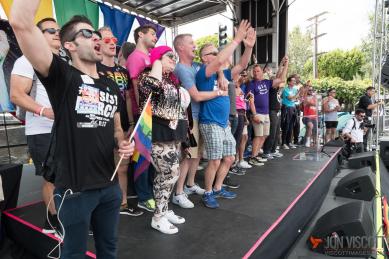
The strength shown by our community was one that, for all intensive purposes, proves that love does conquer all. RuPaul couldn’t have expressed the common and conquering theme better than when he said: “It’s all about love; giving love and being able to receive love. That’s our secret weapon; that’s the one thing they don’t have: our love and our music. That is our activism. That is what we use and what we always use to fight the ugliness.”

That is the one experience that I took most out of the #ResistMarch: the power of love and friendship; the beauty in the unexpected conversation that leads to changing the world, again.  Thank you, Brian. Thank you, for bringing us all together to resist, recharge, and love.

19055531_10158898620590385_6920780108892374453_o

When we come together, we are the Divine.  I didn’t think I could experience that twice in one year; clearly, I was wrong.

John Erickson is the President of the Hollywood Chapter of the National Organization for Women. John is a Ph.D. Candidate in American Religious History at Claremont Graduate University where he is finishing up his dissertation tentatively titled “Step Sons and Step Daughter”: Chosen Communities, Religion, and LGBT Liberation.” John holds a MA in Women’s Studies in Religion; an MA in Applied Women’s Studies; and a BA in English and Women’s Studies. He is the Founding and Past President of the University of Wisconsin Oshkosh’s LGBTQA+ Alumni Association and currently serves as the Chair of the Legislative Committee for the Stonewall Democratic Club, a Diversity and Inclusion Fellow at Claremont Graduate University. He is a permanent contributor to the blog Feminism and Religion, a Co-Founder of the blog The Engaged Gaze, and the Co-Chair of the Queer Studies in Religion Section of the American Academy of Religion’s Western Region, the only regional section of the American Academy of Religion that is dedicated to the exploration of queer studies in religion and other relevant fields in the nation. In April 2017, he was the first openly gay athlete to be inducted into the Wisconsin Volleyball Conference Hall of Fame. Most recently, John was one of the coordinators of the Women’s March Los Angeles, which brought together 750,000 people in downtown Los Angeles on January 21, 2017, and a Committee Member for the #ResistMarch, which brought together 100,000 people from Hollywood to West Hollywood in honor of LA Pride on June 11, 2017.