Let Us Proclaim the God Who Bleeds Now by Carol P. Christ

we need a god who bleeds now

we need a god who bleeds now
a god whose wounds are not
some small male vengeance
some pitiful concession to humility
a desert swept with dryin marrow in honor of the lord

we need a god who bleeds
spreads her lunar vulva & showers us in shades of scarlet
thick & warm like the breath of her
our mothers tearing to let us in
this place breaks open
like our mothers bleeding
the planet is heaving mourning our ignorance
the moon tugs the seas
to hold her/to hold her
embrace swelling hills/i am
not wounded i am bleeding to life

we need a god who bleeds now
whose wounds are not the end of anything

–Ntozake Shange

Continue reading “Let Us Proclaim the God Who Bleeds Now by Carol P. Christ”

The Hate U Give by Esther Nelson

These days I live in a perpetual state of simmering outrage given the popular support of the “goings on” and happenings within our current administration.  The lies, the deceit, the xenophobia, the racism, the misogyny, the homophobia, the anti-intellectualism—things that have been around a good long time, but now seem to have settled in comfortably with those who have the power to keep it all in place.  I’m discouraged.

But then, there’s this:

The Hate U Give, a YA (Young Adult) novel authored by Angie Thomas, spent 50 weeks at the top of the New York Times bestseller list after its publication in February 2017. The book has received numerous awards and also has enjoyed an immense popularity.  It has also generated considerable controversy.

The following is the author’s profile from Amazon’s website:  “Angie Thomas was born, raised, and still resides in Jackson, Mississippi as indicated by her accent. She is a former teen rapper whose greatest accomplishment was an article about her in Right-On Magazine with a picture included. She holds a BFA in Creative Writing from Belhaven University and an unofficial degree in Hip Hop. She is an inaugural winner of the Walter Dean Myers Grant 2015, awarded by We Need Diverse Books.”

Continue reading “The Hate U Give by Esther Nelson”

Women’s Ritual Dances and the Nine Touchstones of Goddess Spirituality – Part Four by Laura Shannon

In Rebirth of the Goddess, Carol P Christ offered Nine Touchstones of Goddess Spirituality as an alternative to the Ten Commandments. The Nine Touchstones are intended to inform all our relationships, whether personal, communal, social, or political.[1] In this four-part blog (here are parts 1-3 Part 1, Part 2, Part 3) I am exploring ways in which these Nine Touchstones are inherently embodied in traditional women’s ritual dances of the Balkans, which has been my spiritual practice for over thirty years.

Carol’s Fourth Touchstone is: ‘Speak the truth about conflict, pain, and suffering.’ Many women’s dance songs which allow the women to speak and sing their grief and pain. When we bring that pain into the healing container of the circle, sharing simple steps, Dancers in the circle simultaneously give and receive support for their own and others’ sorrow. Ultimately, the sense of community  and solidarity in the circle transforms our grief so that the burden becomes manageable. Many historical songs, too, tell stories of women being abducted or abused, and how they fought back or got away – or not – so that they are remembered and honoured by future generations.

Continue reading “Women’s Ritual Dances and the Nine Touchstones of Goddess Spirituality – Part Four by Laura Shannon”

Women’s Ritual Dances and the Nine Touchstones of Goddess Spirituality-Part Three by Laura Shannon

Women’s apron from Pentalofos, Greek Thrace

In Rebirth of the Goddess, Carol P Christ offered Nine Touchstones of Goddess Spirituality as an alternative to the Ten Commandments. The Nine Touchstones are intended to inform all our relationships, whether personal, communal, social, or political.[1] In this series of blogs I am exploring ways in which these Nine Touchstones are embodied in the traditional women’s ritual dances of the Balkans, which I have studied as a spiritual practice for more than thirty years.

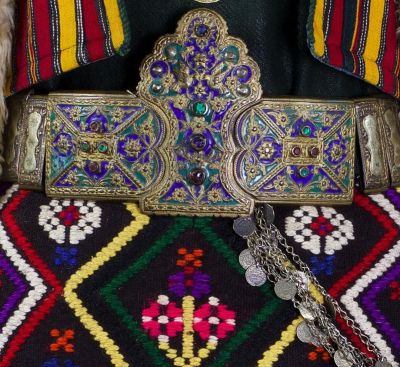
Carol P Christ’s Second Touchstone is: ‘Walk in love and beauty.’ As she says, ‘love and beauty are the great gifts of bounteous earth’.[2] Dancing women of the Balkans walk in love and beauty each time they put on their festive dress to dance together in the courtyard or the village square. Their ceremonial costumes are created from the bounty of the earth – just a couple of generations ago, this was literally the case, as the women tended the sheep, prepared and spun the wool, wove, sewed, embroidered and ornamented their garments with the work of their own hands. Even now, the cloth they buy is purchased with money they have earned from working and harvesting the land.

Continue reading “Women’s Ritual Dances and the Nine Touchstones of Goddess Spirituality-Part Three by Laura Shannon”

Lei by Elisabeth Schilling

Mauro Drudi’s installation of LEI (SHE/HER/YOU – formal) in the Chiesa de San Cristoforo on the Sicilian island of Ortigia where I usually take a bus to daily has become the shrine of women I’ve been searching for. Each time I cry, I am glad I can feel something: those tears are a mixture of communion, comfort, and recognition.

When one enters the church, there are two converging walls. On either side, a woman’s face is painted in shadow and light, gazing off toward the light, is reproduced over and over so that the number of women looks almost countless. They are the same face, a reproduction of Antonello da Messina’s “Annunziata” in the mode of pop art. The difference is not in expression. They all wear the same thoughtful, complicated, neutral countenance, holding deep thoughts and experiences of suffering and wise knowing, both acceptance and maybe resistance; they have lived and might be any age, although I see in our connection my own. The difference is between glossy, unblemished surfaces of wood vs. surfaces weathered, slightly ragged, sometimes scribbled on with ink. The former, found on the right when one enters supposedly represents the “positive” woman, the “western woman [. . . representing someone] happy, gorgeous, well-kept.” On the left, about these representations, Drudi says, “Which artist can paint the skin of a woman who has been abused, beaten, exploited, captivated or disfigured with acid? In my opinion, nobody, and so I let the material speak: the wall of a beach hut destroyed by a storm; woods and materials used and abused [. . .]; exhausted panels deriving from carrying tons of goods, tables, packagings, production wastes.”

Continue reading “Lei by Elisabeth Schilling”

Religions and the Abuse of Women and Girls: God Is the Problem by Carol P. Christ

At the 2009 meeting of the Parliament of World Religions, former US President Jimmy Carter called the worldwide abuse of girls and women the greatest unaddressed human rights crisis of our time. In the book that followed the speech, he compared sexism to the racism he witnessed in the US South, stating:

There is a similar system of discrimination, extending far beyond a small geographical region to the entire globe; it touches every nation, perpetuating and expanding the trafficking in human slaves, body mutilation, and even legitimized murder on a massive scale. This system is based on the presumption that men and boys are superior to women and girls.

He stated further that this problem is:

largely caused by a false interpretation of carefully selected religious texts and a growing tolerance of violence and warfare, unfortunately following the example set during my lifetime by the United States.

Carter also said:

There’s one more basic cause that I need not mention, and that is that in general, men don’t give a damn.

As a feminist theologian I was thrilled to learn that Carter joined us in recognizing religion as one of the primary causes of the abuse of women and girls. I am grateful to him for using his position as former President and Elder statesman to call attention to the roles played by religions in justifying the oppression of one half of the human race. And I am very happy that he gives a damn. At the same time, I have questions about Carter’s understanding of the problem of sexism in religions.

I agree with Carter that warfare is one of the main causes of the abuse of women and girls. War plays an important part in the oppression of women and girls because rape and slavery have been and continue to be “an ordinary part of war.” As wars continue and increase, the rape of women and girls, in many cases the brutal gang rape of women until they die, continues. Moreover, the sexual slavery known as trafficking of women and girls, flourishes in the wake of war, as women fleeing war torn homelands are targeted, tricked, and sold into forced prostitution.

If the idea that rape and slavery have always been part of war sounds strange to you, I call your attention to the founding work of western culture, the Iliad: set during the Trojan War, its plot turns on the dispute between Agamemnon and Achilles about which of them has the right to hold a woman from Lesbos named Briseis as his “spear captive,” a scholarly euphemism for rape victim and sexual slave. In their conquests of Canaan, the Hebrew people reportedly killed the men and took the women and children as slaves, raping the women as the right of the victors to “the spoils of war.”

Some were astonished to learn a few decades ago that Serbian soldiers routinely raped Bosnian women, but they should not have been, because rape in war had already been widely reported in Africa. One of the little known crimes of the Second World War is the widespread rape of German women fleeing Russian armies occupying territories that became part of the Soviet Union. As horrible as it is, rape in war is not the only reason to call warfare one of the major causes of the abuse of women. Soldiers bring the violence of war with them when they return home and thus a climate is created in which men understand that is their right to dominate women, using violence if necessary.

Jimmy Carter’s view that religions justify the abuse of women by “false interpretation of carefully selected religious texts” requires further scrutiny. Carter appears to view the Bible as a primarily liberating text with a few unfortunate exceptions that are cited by religious leaders to support patriarchy. Regarding his decision to leave the Southern Baptist Convention, Carter wrote:

So my decision to sever my ties with the Southern Baptist Convention, after six decades, was painful and difficult. It was, however, an unavoidable decision when the convention’s leaders, quoting a few carefully selected Bible verses and claiming that Eve was created second to Adam and was responsible for original sin, ordained that women must be “subservient” to their husbands and prohibited from serving as deacons, pastors or chaplains in the military service.

I suspect Carter knew Phyllis Trible’s essay “Eve and Adam: Genesis 2-3 Reread,” in which she argues that Genesis 2 teaches the equality of Adam and Eve. Surely he also understands that original sin is a Christian doctrine that could not have been anticipated by the authors of Genesis 2, though it is often justified by interpretations of it. Carter and Trible believe that their interpretations of Genesis 2 are correct and that interpretations supporting patriarchy are incorrect.

I, on the other hand, would say that Merlin Stone’s interpretation of the text as a “tale with a point of view” intended to disparage the woman, the snake, and the tree, all of which were symbols of the sacred in earlier and competing religions, is the correct one. St. Augustine, if he could, would probably still argue for his view. So how do we resolve this dispute?

Judith Plaskow and I say that we cannot. Rather we must accept that all interpretations of scripture are based in the standpoints of individuals and communities. While some interpretations seem less plausible when we take account of the original language and context of Biblical texts, we can never be certain that our interpretation is the correct one. On these grounds, Carter’s assertion that only “false interpretations” of Genesis support male domination must be rejected.

In addition, Carter states that only “carefully selected” texts can be used to support male dominance. If he has read feminist theology at all, Carter must be aware that some feminists assert that the Bible as a whole supports male dominance through the pervasive and almost exclusive use of language that portrays God as a male, most often as a dominant male, as Lord, King, Warrior, and Father.

Counting texts that portray God as male as justifying the idea that the male is God and the female is something less than God and males, Mary Daly opined that the texts in the Bible that do not support male dominance might be collected in a small pamphlet. In Goddess and God in the World Judith Plaskow admitted that when she read the Jewish Bible from cover to cover, she was appalled at the number of times the texts justified violence. She asks Jews and Christians to wrestle with the images of God as a dominating other in the Bible, rather than trying to explain them away.

Once again we are faced with a question of interpretation. Is the use of male dominator language for God irrelevant or at the root of the problem? I say that it is one of the main justifications for the abuse of women and girls.

*This is an excerpt from the speech I delivered at the Parliament of World’s Religions on November 5, 2018. My interview with Mary Hynes on CBC’s Tapestry recorded during the conference will be airing soon.

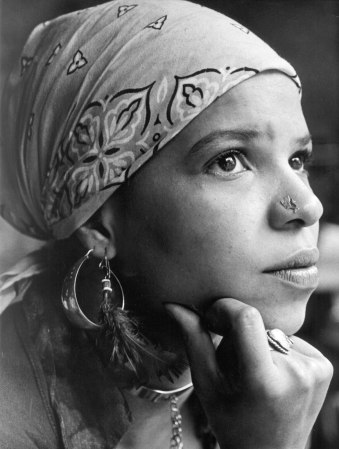
Carol P. Christ is an internationally known feminist writer, activist, and educator living in Greece. Carol’s recent book written with Judith Plaskow, Goddess and God in the World: Conversations in Embodied Theology, is on Amazon. A Serpentine Path: Mysteries of the Goddess is on sale for $9.99 on Amazon. Carol  has been leading Goddess Pilgrimage to Crete for over twenty years: join her in Crete. Carol’s photo by Michael Honneger.

 

Vayeitzei: Rachel and the Practice of Niddah by Ivy Helman

29662350_10155723099993089_8391051315166448776_oThis parshah contains the account of Jacob’s marriages to Leah and Rachel, (who happen to be his cousins) as well as the birth of his 11 sons and one daughter.  It describes the long amounts of time Jacob worked for Laban in order to marry Laban’s daughters, and recounts the trickery of Laban giving first Leah, the older daughter to Jacob, before allowing Jacob to marry who he wanted to, Rachel.

Like the relationship between Hagar and Sarah, there is animosity between Leah and Rachel over Jacob’s love as well as the ability to bear children.  This animosity spreads to the maids of Leah and Rachel, Zilpah and Bilhah respectively, as they are used by the sisters to conceive children on their behalf.  One can see also this animosity in how Leah and Rachel name their sons.  Yet, the parshah also contains two aspects that seem at odds with such a patriarchal perspective.  First, there are five named women who play key roles in the goings-on.  Second, Rachel is an active agent.  Continue reading “Vayeitzei: Rachel and the Practice of Niddah by Ivy Helman”

A Precious Gift by Natalie Weaver

This has been another hard month.  I don’t feel it to be hard.  I just know objectively that it is.  The typical challenge of balancing my work with the children’s needs and the management of a household has been intensified by the onset of a serious medical condition in my family.  I now enter that phase of elder care, which I understand is more or less bound to bankrupt the average household.  I have become the much-begrudged adult child, compelled to make decisions for other people’s lives and regarded in the fog of suspicion. My intentions are now under scrutiny; my time is usurped; my efforts are thankless.  I’m not complaining really.  I am just describing.

In the midst of things, I have managed to take my older son to the seeming ends of the earth to visit potential high schools.  I am managing a Destination Imagination team for my fourth grade son’s class.  I am teaching six courses, and my home is relatively clean.  I am running a weekly lecture series, I volunteered at the Church this month, and no one has missed any meals.  I even managed to sew a blanket for a friend’s new baby. There are many more serious family, medical, and economic issues that underlie my day-to-day, but along with everyone else, and perhaps a little more so than some others, I just accept that I am amazingly over-extended.

Continue reading “A Precious Gift by Natalie Weaver”

Women’s Ritual Dances and the Nine Touchstones of Goddess Spirituality-Part Two by Laura Shannon

In the first part of this article, I looked at how Carol P Christ’s Nine Touchstones of Goddess Spirituality from Rebirth of the Goddess are related to traditional women’s ritual dances of the Balkans. After more than thirty years of researching and teaching these dances and the way that they pass on information in encoded symbolic ways, I have come to see them as an educational system, a women’s mystery school.[1] The main message which the dances convey is an ethic of community, partnership, mutual support, and other life-enhancing values aligned with the Nine Touchstones, which can be directly experienced in the dance.

We know from the research of Marija Gimbutas that these values were central to the Old European civilizations which honoured the Goddess, while Yosef Garfinkel and Elizabeth Wayland Barber show that circle dances have their roots in these same early Neolithic cultures of Eastern Europe and the Near East. This leads me to suggest that Balkan women’s circle dances surviving today may have their origin in early egalitarian matriarchal cultures of Neolithic Europe. The Nine Touchstones of Goddess Spirituality provide an perfect template through which to explore the ethics of women’s ritual dances.

Continue reading “Women’s Ritual Dances and the Nine Touchstones of Goddess Spirituality-Part Two by Laura Shannon”

Just Show Up by Katie M. Deaver

Happy Midterm Election Day 2018!!

The first article I ever wrote for Feminism and Religion, (“I Never Thought That I Would Need to Be a Part of History,”) ran just a couple of weeks after the inauguration of the current President.  As I sat writing this Monday afternoon, I kept trying to find some new or more exciting way to talk about voting in today’s election, I couldn’t help but go back and take a look at that first article.

As I wrote in that article, I never really imagined that I would need to be a part of history.  As a scholar of theology and feminism I certainly understand that we are a long way from being a truly inclusive society. We still need to fight oppression and push for the acceptance of all those who are othered in our society, but somehow our current issues and “battles” seem so much larger than they did only a couple of years ago.

Continue reading “Just Show Up by Katie M. Deaver”