Drawing Pele, Retreating to Hawai’i by Angela Yarber

angelaI knew I’d paint her from the moment we discovered that we would spend three months of our Year of Volunteer Travel Discernment in Hawai’i. Little did I know how Pele would turn our world inside out, destroying what needed obliteration and recreating new life that we never could have imagined. Pele is the Hawai’ian Volcano Goddess who governs fire, lightening, volcanoes, and the flow of lava. According to legend, she lives in the Halema’uma’u crater of Kilauea on the Big Island.

For over a year, I’d corresponded with a retreat center on the Big Island for my wife and I to be Scholars in Residence, while I also taught yoga and my wife worked on the organic farm. We were beyond excited and arrived in Hilo this January with open hearts and minds, eager to begin our work. Pele had other plans for us. The retreat center where we were planning to work turned out to be a complete disaster: dengue fever, mosquitoes biting my child within five minutes inside our living quarters, proprietors clearly on drugs. We’ve roughed it with no running water in the middle of the woods for months at time, but this was squalor. My wife and I took one look at each other and knew that there was no way we were keeping our child in this environment. Continue reading “Drawing Pele, Retreating to Hawai’i by Angela Yarber”
Islamic Feminism and Heterosexual Dogma by Vanessa Rivera de la Fuente

12065675_170600583286234_3734458453482361154_n
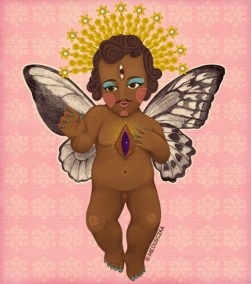
Santa Niña Marica

Reza Aslan says in his book “No God But God” that religions are myths. He explains that “religion” is a set of stories fluctuating between truth and fantasy that serve to explain and answer questions about human fate. Taking this idea as base, I think “religion” is a historical product that enables other mythical stories and must be addressed critically about its truth and meanings.

Patriarchal religious discourses, currently mainstream, have a common element that often is left outside the reading of equality and is part of the myth: Heterosexual belief.

Feminisms in Religions aim at challenging patriarchal readings. However, questioning the nature of God is not enough if we don´t challenge heterosexual belief that may or may not include the idea of a God Father/Male. In Islam, Allah has no sex or gender, is not masculine nor feminine. However, the heterosexual belief exists in the Islamic religious narrative. Continue reading “Islamic Feminism and Heterosexual Dogma by Vanessa Rivera de la Fuente”

Caroline Schelling on Birth & Death by Stuart Dean

Caroline Schelling

Of the many letters Caroline wrote to her lifelong friend Luise, one of the most intense  (the 57th Letter) dates from seven years after the 4th Letter discussed in my last post.  By then both were married; only a few months earlier Caroline had given birth to her first child (Auguste); though Luise already had children, Caroline knew that one of them was terminally ill.  In the first paragraph Caroline describes how difficult Auguste’s birth was for her; in the second she consoles Luise over the impending death of her child.  She thus subtly parallels birth with death and hence the labor for one with mourning over the other.

Fifteen years later, only a few months after the death of Auguste–the last of her four children to die–Caroline’s generally positive disposition evidenced in the 4th Letter and her experience in grappling with birth and death evidenced in the 57th Letter were being put to the test.  Though she was holding up well, Friedrich Schelling (Friedrich), the man who was to be her third husband, seems to have been suicidal from feeling guilty (rightly or wrongly) for having failed to do enough to cure whatever illness killed Auguste.  Caroline wrote frequently and urgently to him, offering advice and comfort.  In one of those letters (274d) she characterizes the challenge of overcoming grief as a formula to be solved: “(death/pain) x (love/bliss) = (life/peace).”  She terms this one of her ‘primal axioms’ (the “Ursatz”), although she seems playfully to concede to Friedrich that he or perhaps someone else shares responsibility for it. Continue reading “Caroline Schelling on Birth & Death by Stuart Dean”

Finding Bavarian Ancestors by Carol P. Christ

Bavarian first communion
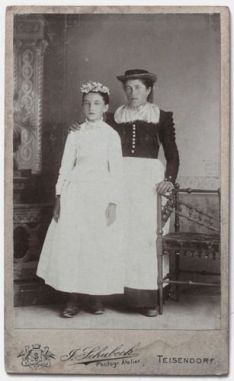
First communion, Bavaria 1800s

In the past month I have been on a spiritual journey seeking my German ancestors. Six of my 2x great-grandparents were born in Germany, which means I am 37 ½ percent German. Growing up, I was subjected to a form of patriarchal family disciple I came to identify as German, but I was told very little, positive or negative, about my German heritage.

Though I had been researching my family tree for five years when I began my trip to Germany, I had no clue about where in Bavaria the Thomas Christ-Anna Maria Hemmerlein branch of my family originated. While making final preparations before the trip, I learned that German church records are no longer kept in individual churches, but are grouped together in church archives. Some areas also have family records in state archives. Contrary to popular belief, the majority of German records were not destroyed  in the two World Wars. However, many of the German records are not online. Continue reading “Finding Bavarian Ancestors by Carol P. Christ”

Mary, Mary, Quite Contrary by Barbara Ardinger

Barbara ArdingerMary, Mary, quite contrary,
How does your garden grow?
With silver bells and cockleshells
And pretty maids all in a row.

From her lips to our ears.

Who wrote that poem? I’ve heard that some so-called scholars think it’s about a queen of England named Mary Tudor (slandered as “Bloody Mary” because she stuck to her religion after her father declared himself head of his own bloody church) or Mary Queen of Scots (slandered for other reasons, and then murdered). Well, much as I feel sorry for those two queens, the poem’s about me, and I don’t grow any little garden. I am a gentlewoman farmer. The fellow who wrote that silly poem probably works for one of those corporations that want to buy my land and plant their engineered crops on it and create monocultures that murder the land. Continue reading “Mary, Mary, Quite Contrary by Barbara Ardinger”

#HillYes by John Erickson

I’m going to do something I’d never thought I’d do: fill your newsfeed with yet another article pertaining to the 2016 United States Presidential election and yes, I’m going to talk about former Secretary of State Hillary Clinton (hint: I’m emphatically supporting her and I’m unapologetic about it.)


John Erickson, sports, coming out.I’m going to do something I’d never thought I’d do: fill your newsfeed with yet another article pertaining to the 2016 United States Presidential election and yes, I’m going to talk about former Secretary of State Hillary Clinton (hint: I’m emphatically supporting her and I’m unapologetic about it.)

Let me start off with my central point: a vote for Hillary is a vote to change history and the world. No, not because she’ll hail in some type of new economic stimulus (although I’m sure she’ll do just fine with our economy #ThanksObama) or because she’ll save us all from the evils of the GOP (looking at you Trump/Cruz/and the “moderate” Kasich) but because she’ll do one thing that’s never been done before: become the first female President of the United States, ever.

While I have tried not to get into “it” (read: online trysts with my friends on social networks who are #FeelingtheBern) the question I beg to ask is: what’s so wrong with wanting the right woman to be the President? This is one, but not my only reason, I will cast my vote for her both in the Democratic Primary in California in June as well as in November (and, if you haven’t guessed, I do not believe or promulgate the reasoning or rhetoric that Bernie Sanders will come from behind and win the Democratic Party’s nomination because I passed 5th grade level Math.)

Hillary Clinton

Continue reading “#HillYes by John Erickson”

Fuerzas Para La Lucha: Sources of Strength for the Struggle

Art work designed by Jaysen Waller - http://www.jaysenwaller.com/
Art work designed by Jaysen Waller – http://www.jaysenwaller.com/

When Ada María Isasi-Díaz lived in Chile, she had a neighbor who lived in extreme poverty who she remembered as someone “who never lost her sense of dignity and purpose of life,” even while she struggled day after day for her survival. She explained,  “I remember the steadiness of her struggle: day after day she dealt with the reality of the present and survived that day in order to be able to face the next.”

From that experience Ada María Isasi-Díaz began to develop la lucha as a category of social analysis and as a theo-ethical category. La Lucha is a way of recognizing the reality of the grand injustices very much in place impacting people in their every day lives and how embedded these are into our intersecting systems and structures. The need for fuerzas para la lucha (strength for the struggle) is therefore great. Continue reading “Fuerzas Para La Lucha: Sources of Strength for the Struggle”

Painting the Virgen de la Caridad, Doing Intersectionality by Angela Yarber

angelaThe most recent Holy Woman Icon with a folk feminist twist that I’ve painted is the Virgen de la Caridad. Like Mary, Guadalupe, La Negrita, and the Virgin of Regla, she was commissioned by a bold and brilliant friend, a scholar who lives, teaches, and does the work of intersectional feminism on a daily basis. As with my beloved friend who taught me so much about Jane Addams last month, this dear friend has taught me so much about feminist understandings of Marian Spirituality and of the need for many secular scholars to keep a connection to their religious roots.

When we discussed her commission, she wanted to make sure that the Virgin of Caridad was the primary focus of the icon, but since she is also often associated with Oshun, she also wanted elements of this Yoruban goddess to shine through. I was thrilled with the opportunity to learn, research, grow, and paint. Little did I know what kind of important learning was in store. Continue reading “Painting the Virgen de la Caridad, Doing Intersectionality by Angela Yarber”

Kasich Cuts Women by Gina Messina-Dysert

Gina Messina-Dysert profileKasich is cutting women from Ohio’s budget. In an attempt to prove himself a conservative and worthy of the title of POTUS, he has taken a step towards joining the ranks of Trump and Cruz using fear and misogyny as primary tactics.
Beginning with his defunding of Planned Parenthood in Ohio, Kasich is participating in the ongoing marginalization of women in the US based on supposed Christian values. His comment that “women are coming out of the kitchen to support me” demonstrates his inability to recognize the important role that women play in this nation. Likewise, it shows support for the ongoing notion that women belong in the home, and idea firmly entrenched in Christian dogma.

The former Catholic now Anglican presidential candidate continues to buy into the idea of complementarity, that men and women have distinct roles, a teaching Pope Francis calls “an anthropological fact.” And what does this mean? That women belong in the home, rearing children, and cooking for their husbands while men do the “important” work. Continue reading “Kasich Cuts Women by Gina Messina-Dysert”

Updates on Listening by Xochitl Alvizo

X.Alvizo CSUN Profile 2-editedThe pieces of my dissertation are beginning to float to the surface, piece by piece, released into the world as smaller parts of the whole. At some point this all may become a book, but for now, I have enjoyed the opportunity to share some of the learning from my dissertation research in book chapters, articles, and blog posts, which I’d like to share with you all so that you can see some of what I’ve been up to these days.

The most recent piece that has come to be is an article on The Listening Guidethe particular method of narrative analysis I used to analyze the transcriptions of the interviews I conducted with participants of Emerging Church congregations. I’m particularly excited about this piece because I think it could be a useful tool to many of us in our respective fields of study and work. And although my particular context is theological and, even more specifically, Christian, as a tool and method, The Listening Guide can be used for reflection and be of great value in a variety of contexts.  Continue reading “Updates on Listening by Xochitl Alvizo”