
Qu(e)erying Our Lady By Xochitl Alvizo

I love art. I especially love certain women’s art – women such as Frida Kahlo, Cathy Ashworth, Sudie Rakusin, and Alma Lopez. To me, their art is a reflection of women’s strength, creativity, and beauty. Frida Kahlo, for example, expressed so many aspects of herself and her experience through her art. In it one can glimpse her passionate love for Diego Rivera, her continuous physical pain, her search for meaning, and the unending hopefulness she maintained throughout it all. Frida Kahlo’s art, like her person, was vibrant and full of life, colorful and yet broken. She expressed the wide spectrum of her experience not in words only but in color and images, texture, paint and print. As she put it, “I paint my own reality” – her own reality is what she knew and it is what she painted.

I rely on art to do what academics often cannot do well – what I cannot do well – which is to communicate the truths that rattle our being down to its deep core in ways that connect with others. There have been times in my academic life when I have encountered new insights that changed my life forever. Moments of being shaken and awakened at my very core by a truth that until then had eluded me. But such moments can be hard to share with others because they can be hard to translate to words, even if such moments have come to me by words. Learning about feminist theology and being shaken by the truths it spoke to me is one such encounter – and it was indeed an academic one that is often hard for me to put into words and explain to others. On the other hand, encountering Alma Lopez’s artwork was also a core rattling moment, but one which I can more easily share.
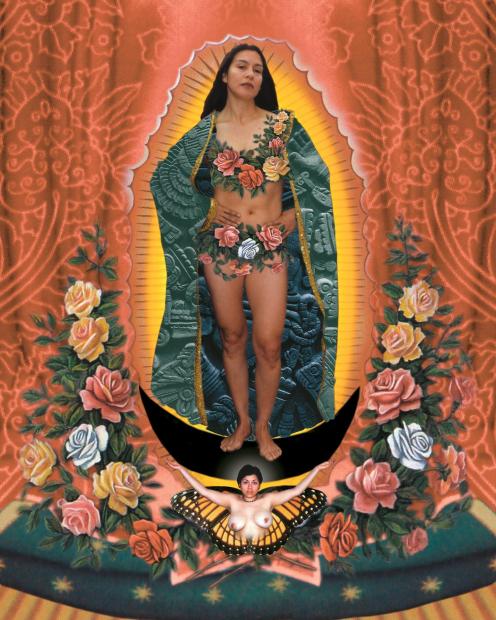
Our Lady - Lopez
“Our Lady” by Alma Lopez (1999)

Alma Lopez’s Our Lady is a digital art piece in which Our Lady of Guadalupe is depicted (embodied, really) in a more obviously female form than is traditionally expected. For this, every time her piece is on exhibit, Lopez receives a barrage of protest and harassment – as does the sponsoring institution. Accusations of obscenity, profanity, and blasphemy come her way.  But, why?

When I see Lopez’s Our Lady, I do not see blasphemy or obscenity, I see a celebration of the female and the sacred. I see the beauty of God’s queer incarnation – and I remember – I remember that the word became flesh and made her home among us. From the womb of a woman’s body, her life-giving body, the divine took human shape. Boundaries of sacred and profane forever blurred.

Alma Lopez, like Frida Kahlo, paints her own reality; she says this piece is a reflection of her relationship with Our Lady of Guadalupe, a divine image that has been part of her life since she was very young.  But I also think she reveals something more than just her personal relationship with Our Lady… Continue reading “Qu(e)erying Our Lady By Xochitl Alvizo”
Feminism, Ontology and the Priesthood of all Believers

At a surprisingly early age, perhaps nine or ten, I became the author of my own spiritual narrative, meaning, I took it upon myself to initiate and pursue the deep mystery of my faith.  Weekly Mass was an event, not an obligation, and something to which I attended without my family. The singleness of my worship at such a young age drew stares and whispers from those families who had arrived in tact. And while I was not unaware of their curiosity, I found it easier to lose myself in the absolute wonder of my environment. This was the world to which I belonged.  I was at once home and alive in a devotion filled with sacramentals, those objects of religious piety that created a force field of God’s protection around me. 

While the mystery of God’s love enveloped and graced my adolescence, a slow and creeping suspicion began to take hold of my faith. Because of my “girlishness,” I was barred as an alter server, and I began to absorb my otherness. I worried about my difference, and began to question the fairness of God. Telegraphic messages of inferiority caused me great confusion. The implicit reality that as female I was ontologically challenged, slowly sifted its way into my psyche and I would argue, my soul as well.

As a budding young feminist, what I found within the teachings of the church, either implicit or explicitly, did not coincide with what I felt to be the inner me.  On the cusp of adulthood, the collision between self and Church [read as God] was inevitable. The catechetical formation of my youth, of coming forth equally male and female in the image and likeness of God seemed like a childish myth and certainly not the reality of the andocentric church to which I was now departing.

Fast forward twenty years, and I cautiously found myself back in the Catholic Church, only this time in the arms of feminist theologians. I was hooked.  Their writings informed my life choices, directing me towards my current doctoral pursuit.  Yet I have found the academic arena is able to shield and protect me from the pain I continue to feel within the institutional church. To demonstrate the interweaving of the challenges and nourishment I experience as a Catholic I addressed above, I would like to share with you the following story. Continue reading “Feminism, Ontology and the Priesthood of all Believers”

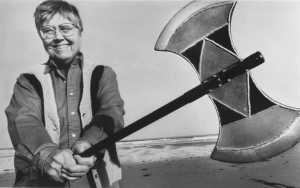
Mary Daly: Radical Elemental Feminist and Sinner By Gina Messina-Dysert

While some argue that Mary Daly was too radical, I have been greatly influenced by her contributions to the field of feminism and religion.  I can still remember the first time I read a piece of her work.  It was during my undergraduate career at Cleveland State University in a course entitled “Women and Religion.”  I was immediately impacted and wanted to know more about this bold, strong and courageous woman, and although I had already considered myself a feminist, it was in that moment I recognized the existence of patriarchy in religion.  Shortly thereafter I applied to a graduate program in religious studies and became better acquainted with Daly’s work and the intersection of feminism and religion.

While I must admit that I am troubled by some of Daly’s claims and disagree with some of her contentions, I have also been significantly influenced by her foundational work in feminist theology, her demand for women’s liberation and Spinning of new tales and new ideas.  Daly called for women to have the courage to be, to experience a new fall out of patriarchal systems and into a new being that allows women to discover their capabilities, the dynamic power women possess within themselves.

According to Mary E. Hunt, co-founder and co-director of the Women’s Alliance for Theology, Ethics and Ritual (WATER), “Her contributions to feminist theology, philosophy, and theory were many, unique, and if I may say so, world-changing. She created intellectual space; she set the bar high. Even those who disagreed with her are in her debt for the challenges she offered…She always advised women to throw our lives as far as they would go. I can say without fear of exaggeration that she lived that way herself.”[1]

While I never had the opportunity to meet Mary Daly, I have no doubt been inspired by her brilliance, courage, wit, and spirit.  My feminist and theological views have been shaped through her influence. I have been able to spiral into freedom and rename and reclaim my own experiences; I have found my own creative power.  Thank you for having the courage to sin big Mary Daly.

“There are and will be those who think I have gone overboard. Let them rest assured that this assessment is correct, probably beyond their wildest imagination, and that I will continue to do so.” – Mary Daly