Abuse Does Not Have “Fifty Shades of Grey” by Michele Stopera Freyhauf

WARNING: This article or pages it links to contain information about domestic abuse and sexual violence which may be triggering to survivors.

 

Freyhauf, Durham, Hahn Loeser, John CarrollNo matter what you call it abuse is abuse. This is highlighted in the popular book and now movie Fifty Shades of Grey. Because of the stir this book caused, I delved into the first book and my initial reaction was that of repulsion and wonderment. How could a woman let a man control her like that? Why would she let him do things like that to her and continue to come back to him? Why is this book so popular?

Are women sexually repressed in a way that their own sexual experiences are routine and boring (the book is full of BDSM) or they have never orgasmed (every time they have intercourse, Anastasia is guaranteed to orgasm)? Why do we find it okay to label body parts as “love boxes” or “considerable length” or the multitude of references to a man’s penis or woman’s vagina that is meant to sound sexy or romantic? Why does he announce “I am going to f*** you now” every single time they have intercourse? Can’t the reader figure out what is going on without making this announcement?

However, after I got beyond my initial reaction (or shock), I took a step back and became upset and outraged.  In essence, the overall issue with the book can be summed up in one word: control. Some women argue that the awkward doe-eyed virgin journalist exercises control over the sexually deviantPicture from fanpop.com
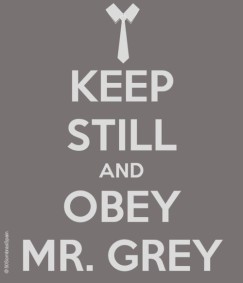
Picture from fanpop.com

billionaire that keeps him coming back to her – I disagree. I see control exercised by the sexually deviant man over a woman enamored by him in such a way that is sexually, physically, and psychologically exploitative and abusive. Yes – I understand this is fiction, but this type of writing causes immense problems.

In a culture that embraces “Blurred Lines,” money and power, and “the bad boy persona,” this storyline fuels the fodders of the fire with a sensationalism that plays on sexual fantasies and/or those wishing prince charming will sweep them away. One needs to look no further than “The Bachelor” or Bret Michaels’ “Rock of Love” television shows that promote the exploitation of women’s desires to be with the rich handsome man at any cost to self and dignity. In fact, an article posted about the movie stated that if Christian Grey was not a billionaire and behaved in the same way, he would be arrested and labeled a sex offender. So again, is the message we want to send to our daughters, nieces, and friends is that the rich can do whatever they want and you should let him? I think not.

Continue reading “Abuse Does Not Have “Fifty Shades of Grey” by Michele Stopera Freyhauf”
Be Wild this Holiday and Find the Face of God(dess) by Marie Cartier

MarieCartierforKCETa-thumb-300x448-72405I know that you all will be reading this the day after Christmas…so this is my Christmas and/or winter holiday gift to you. I so love the Feminism and Religion (FAR) community—its discourse, intelligence, and its community of like minds. And I appreciate that so many of us offer lessons to each other on how to live—wild. For in some ways the very juxtaposition of the words “feminism” and “religion” posits an out of bounds existence. What does it mean?
I was recently asked how I would teach a class on “women and religion.” Among my first responses was that I would, among other texts, use the book The Feminine Face of God: the Unfolding of the Sacred in Women by Sherry Ruth Anderson and Patricia Hopkins (1992). Although this book was published over two decades ago it still holds, perhaps unfortunately, as true today as then. The text is based on interviews with women regarding the “unfolding of the sacred” in their lives. This book was required as part of my graduate program in the first class I took at Claremont Graduate University (CGU) “Women’s Studies in Religion.” CGU was the first program in the country where you could get your Ph.D. in Religion, with an emphasis in Women’s Studies in Religion, and I believe it is still the only program where you can do so.

My professor for that class, Dr. Karen Torjesen, challenged us to write, if we could, the “theology” in the book—was there one? She challenged us to see if there was a “theo” “logo” word of God in this idea of the “unfolding of the sacred” in women. I took up her challenge—and so one of my first big graduate papers was to unpack this book of interviews and see if I could find a theology in these lives/stories. This is what I found—what is sacred to women—right now (in 1992 and still today)—is the chance to find the sacred. Continue reading “Be Wild this Holiday and Find the Face of God(dess) by Marie Cartier”

Right to Life vs Right to A Life: Abortion & The Death Penalty by Marie Cartier

MarieCartierforKCETa-thumb-300x448-72405Earlier this week I went to hear Sr. Helen Prejean speak about the death penalty. You will remember, if the name does not immediately ring a bell, that the amazing movie Dead Man Walking (dir. Tim Robbins, 1995) was about her and her ministry to provide solace and closure with God to those inmates on Death Row. In the film, Sr. Prejean was played by Susan Sarandon. Dead Man Walking, a phenomenal hit, chronicled her first attempt at this ministry—her trials and limited success—in helping Matthew Poncelet come to grips with what he had done, ask forgiveness of the victims’ parents (because he was complicit in the murder of two teenagers) and face his death with dignity.

dead man walkingIn addition to teaching Gender and Women’s Studies, I have also been the screenwriting professor at University of California Irvine since 1992. I have used the screenplay for this movie (adapted from Prejean’s book and direct interviews) almost since it was published. It’s a great example of how research, interview, and authenticity can make a movie work—rather than “making it up.” Even the title was new to most of America- “Dead man walking!” refers to the last walk an inmate makes as he (or she) walks to his (or her) death.
So, I was enthusiastic when I heard that Sr. Helen was speaking at a local church very close to my house. Although I’ve used the screenplay for well over a decade, I had never met her or read the actual memoir she wrote. It seemed the perfect opportunity to meet her and get a signed copy—and also something my students would love to hear about when we discuss the film in the winter. Continue reading “Right to Life vs Right to A Life: Abortion & The Death Penalty by Marie Cartier”

The Fault is in Our Stars: Feminism, Sisterhood, and the Fight for Awesome by Marie Cartier

If you haven’t yet read the book The Fault is in Our Stars (or seen the movie) I guess I should begin by saying this blog will contain spoilers.

This story is about having cancer as a teen and dying from it. It’s also about a young woman, Hazel Grace, having cancer, a sense of humor, belief in her ability to have her life on her own terms, fall in love and claim her independence. It’s about a young man, Augustus Waters, falling in love, being insecure as a young man, yet secure enough to cry, and his belief  in making life better for those around him for as long as he can—even after death.

It’s quite remarkable and…its aftermath is also remarkable.  This book and its film and following have created some remarkable trends.

The author, John Green has coined a few phrases that deserve coinage in my every day usage. Among them, Green has proposed we use the phrase: “nerd fighter.” Nerd fighters fight to “increase awesome and decrease suck.”

We fight against suck….we fight for awesome. We fight using our brains, our hearts, our calculators and our trombones.

Continue reading “The Fault is in Our Stars: Feminism, Sisterhood, and the Fight for Awesome by Marie Cartier”

Sexism and “Jerusalem” by Ivy Helman

headshot2Three weeks ago, I played a video entitled “Kingdom of David: Rivers of Babylon” from the PBS Empires series.  The series first aired in 2003.  For the first time, and I’ve played the video in class for probably six semesters in a row, I noticed that all of the biblical scholars, archaeologists and rabbis interviewed to discuss the Torah, the history of the Jews, the Talmud, the exile and the prophetic tradition were men.  This reminds me of a few months back when a female colleague of mine discussed about an encounter she had had with the producers of another documentary about the Hebrew Bible.  They had only interviewed one woman.  When asked about this decision, the producers told her that their audience finds men more authoritative than women when it comes to explaining topics of a religious nature.

***

Two weeks ago, on a Wednesday, an older woman walked into the liquor store where I work.  She wandered around for awhile and then appeared somewhat overwhelmed, which is usually my cue to inquire if the customer needs help.  She said she was just fine.  Five minutes later she was still wandering the store apparently unsure what to purchase so again I approached her and asked if she’d like some help.  She seemed somewhat desperate at this point and asked for my opinion on the Irish Cream Liquors and which one tasted the most like Bailey’s.  I told her I wasn’t exactly sure.  I had not tried them all but the one she was holding in her arms was very popular and we sell quite a bit of it.  She continued to hem and haw explaining to me that she was having a bunch of old ladies over for lunch.  She intended to offer them sips of Irish Cream afterwards.  Then out of the blue she looked at me and said that she still couldn’t decide so she was going to ask a man for his opinion.  This man also happened to be my boss.  He said that he hadn’t tried it, but that it was very popular.  His words, exactly the same as Continue reading “Sexism and “Jerusalem” by Ivy Helman”

Loss of Soul: Identity and The Stories We Tell by Kaalii Cargill

kaalii pic

The effects on the world of the loss of the Feminine, the loss of Soul, are incalculable. Instinctive knowledge of the holy unity of things, reverence for the interconnection of all aspects of life, trust in the power of the imagination and the faculty of the intuition — all this as a way of relating to life through participation rather than through dominance and control, has almost been lost. We can see the effects of this loss of soul everywhere today, not only in the devastation and pollution of vast swathes of the earth, but in the unhappy, impoverished and hopeless existence that people endure in the hideous and ever-expanding suburbs of our cities, in the increase of diseases like cancer, diabetes and mental illness — particularly depression. The old are neglected and even ill-treated in a culture more interested in achieving targets than caring for people. The young are offered nothing to aspire to beyond the material goals promoted by the media.

– Anne Baring, 2013. Awakening to the Feminine. Archive Publishing. Extract from Chapter 10 in “The Dream of the Cosmos: a Quest for the Soul.”

Continue reading “Loss of Soul: Identity and The Stories We Tell by Kaalii Cargill”

Film Radical Grace Highlights Nuns’ Response to Vatican Reprimand

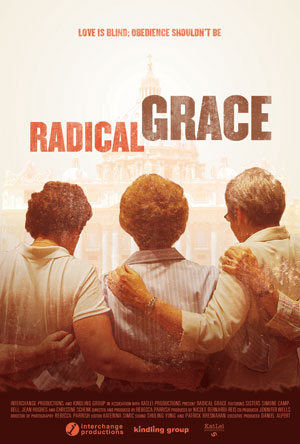
Radical GraceWhile the Catholic Church has sought to control US Nuns through what has been called the “New Inquisition,” it has been unsuccessful in its efforts.  The film Radical Grace documents the response of Sr. Simone Campbell, Sr. Jean Hughes, and Sr. Chris Shenk and is nothing short of brilliant.  Producers Rebecca Parrish and Nicole Bernardi-Reis chronicle their holy journeys in maintaining their vows by challenging the Vatican.  A full review of the film can be read here.

Please consider supporting the film through its crowdfund campaign.  The opportunity to meditate with Sr. Simone is incentive enough!  Congrats to Rebecca and Nicole on their fantastic project and much gratitude to Sr. Simone, Sr. Jean, and Sr. Chris for reminding us that “love is blind but obedience shouldn’t be.”

On April 30, the Vatican Doctrine of Faith “told the leadership group they were ignoring procedures for choosing speakers for their annual conferences and questioned if their programs were promoting heresy,” dashing hopes that the new pope would take a different attitude toward the nuns.

Continue reading “Film Radical Grace Highlights Nuns’ Response to Vatican Reprimand”

Watching “Noah” Brought Me Closer to Humanity by Andreea Nica

Andreea Nica, pentecostalismAs a child, I enjoyed the story of Noah’s Ark. I would often imagine pairs of animals running for safety in Noah’s architecturally majestic haven. Practical questions didn’t enter my mind during this blissful period of naivety. I ignored the part where God expressed regret in creating humanity, or when Noah gets drunk and lies bare naked for his children to cover his shame. My bible study teacher would explain to us that the point of the story was that Noah, a holy man, trusted God and carried out his will.

Disclaimer: I understand that the film is not meant to be an exact representation of the story in the bible, but loosely based around it. Also, if you plan on watching the film, read at your discretion.

In the film, Noah’s character is played by leading actor Russell Crowe, who appears strong, confident, and zealous in his trust in God – all necessary qualities to fulfill God’s demand of killing off the rest of humanity because of their wickedness. Later in the film, Noah realizes that he and his family are also wicked leading to his revelation, ahem, God’s revelation, that humanity must cease with Noah’s family. This doesn’t pan out too well with his children and wife. It was also bad news for Emma Watson, the orphan girl Noah’s family saves and raises as their own, who after accepting that she is barren is miraculously healed and gives birth to two girls. Noah decides that the female infants must die according to God’s will to end humanity. Continue reading “Watching “Noah” Brought Me Closer to Humanity by Andreea Nica”

Slavery and God/dess by amina wadud

amina 2014 - croppedWell the Golden Globe awards have been handed out.  I don’t have a television, so I didn’t actually watch, but a quick google search gives the results.  Highest honors go to a movie about blacks as slaves and whites as criminals.  That’s appropriate. 

But this is feminism and religion, so let me get to the point.  It’s about a chance discussion on social media about the “merciful god” and historical institutions like slavery (holocaust, or oppressions like misogyny, homophobia, Islamaphobia and others…).

My view of the divine, the cosmos and of the world is shaped by my slave ancestry.  Recent area studies about Islam in America estimate that one third of the Africans forced to the Americas were Muslim.   My first African relative on US soil identified as Moor (another term used for “Muslim”).  But Islam did not survive slavery. Continue reading “Slavery and God/dess by amina wadud”

Waiting for Jesus… I mean, Superman by Melinda Bielas

mindy BielasI grew up in a white-middleclass-fundamentalist-Protestant community. As a result I learned to think of God as my Father, and Jesus as my savior, similar to the fairytale prince in shinning armor or the ultimate boyfriend. As an undergraduate studying Religious Studies, I learned of other ways to relate to the Divine and discovered how to be a Feminist Christian. However, many women with backgrounds like mine do not have the opportunities that I did to discover different and liberating pictures of God. As a result they must choose between a religious life that enforces patriarchal norms, or life as a “secular” feminist. A recent song by a modern rock band, Daughtry, “Waiting for Superman,” reveals how the dependence on a male savior prevents Christian women from claiming their own personhood, independent of a patriarch. Continue reading “Waiting for Jesus… I mean, Superman by Melinda Bielas”