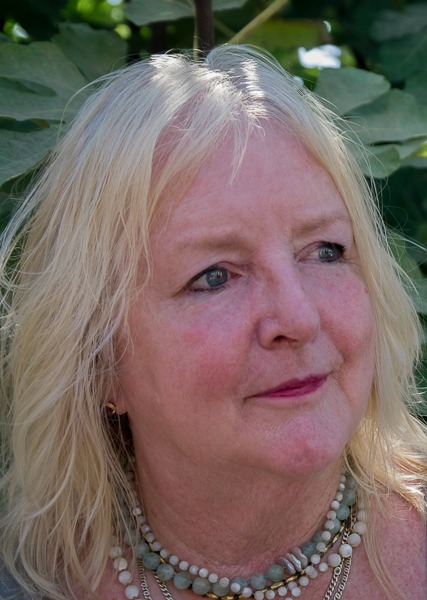
“Finding The Mother Tree” by Sara Wright


Susan Simard received her PhD in Forest Science and is a research scientist who works primarily in the field. Part of her dissertation was published in the prestigious journal Nature. Currently she is a professor in the department of Forest and Conservation Sciences at the University of British Columbia where she is the director of The Mother Tree Project. She is designing forest renewal practices, investigating the ecological resilience of forests, and studying the importance of mycorrhizal networks during this time of climate change.

Susan’s research over the past 30 plus years has changed how many scientists perceive the relationship between trees, plants, and the soil. Her intuitive ideas about the importance of underground mycorrhizal networks inspired a whole new line of research that has overturned longstanding misconceptions about forest ecosystems as a whole. Mycorrhizae are symbiotic relationships that form between fungi and plants. The fungi colonize the root systems of plants providing water and nutrients while the plant provides the fungus with carbohydrates. The formation of these networks is context dependent.

Continue reading ““Finding The Mother Tree” by Sara Wright”
Sleeping Beauty: An ancient tale for these challenging times by Diane Perazzo

Fairy tales are intwined in our imagination and our spirituality. As Jane Yolan writes, one of the subtlest and yet most important functions of myth and fantasy is to “provide a framework or model for an individual’s belief system.” (1)

In the Reclaiming spiritual tradition, we often use fairy tales in healing and self development work. These stories act as warp and weft as we weave and spin complex ritual arcs and other events that take place at extended Witch Camp sessions. In Twelve Wild Swans, Starhawk points out that fairy stories are “more than just encouraging and inspiring. They are also templates for soul healing from Europe’s ancestral wise women and healers. When the ancient Earth-based cultures of Europe were destroyed, these stories remained.” (2)

Continue reading “Sleeping Beauty: An ancient tale for these challenging times by Diane Perazzo”

How I Learned to Grow Wings by Marie Cartier

April 2021, Poem

Visibility is

this body opening against itself over and over… an existence moving through fibers was

the one thing I had. When was the time…breathe in? Breathe out.

My existence to myself was the most political act. You can’t erase me. I exist for myself.

I am thirteen. I stand next to my father and say, “Don’t you touch me. Don’t you ever touch me again.” My mother stands by the sink, her hand reaches out and clutches its edge. My father sits and looks up

at me. He opens his mouth and closes it. I turn away, expecting his hand to land across my back.

I imagine me falling. But that doesn’t happen. Not that day.

That day I stood up. Said no, turned my back and walked away. I am a political act.

I am a body with a voice and I heard myself speaking for myself when no one else would, I said no.

No is the most beautiful word in the English language for a woman who learns its power.

The spell of no. I cast it when I was thirteen.


The gaze is

when they saw me. I started to erase myself, I was without fingers first. They kept finding me, so

I erased my hands. They kept seeing me, so I erased my arms. They kept locating me, so I erased my feet and my legs. But they kept finding me. I erased my secret places between my legs—what they most wanted. I erased my belly so I wouldn’t be seen eating, and my breasts so I would not be noticed as

a girl. But they found me anyway. I erased my neck and my head disappeared.

All that was left was my shoulders. I felt the weight of their gaze, and everything they wanted and took. And so, I lifted my shoulders, and I found my wings.

And I flew, and in flight, I let all of my parts come home.

A woman flying was the one thing they never thought to look for. But I found her. And she was me.

Continue reading “How I Learned to Grow Wings by Marie Cartier”

Touch the Earth by Chasity Jones

I was recently asked how I reconcile being a Christian with also being a critic of Christian theology, traditions, and culture. I am asked this often and my answer is always the same. I have not found reconciliation and might always be finding a way to reconcile this – an endless cycle of trying to make my heart fit into a structure in which centers whiteness and domination.

This time is different though. When I was asked my mind immediately returned to the Earth. Nature. Creation. How I have always longed for a plot of sacred Earth of my own in which I would continually give birth to and create life in various ways. How so far this dream has seemed from my brown fingertips. Never in my almost twenty-nine years, have I imagined I would have the opportunity to own my own land. However, in the last few years since I worked and lived on a farm and have been manifesting with lunar energy and ritual that one day I would harvest and care for a land of my own. A land that I would pass down to my children. A land in which we would find God. A land which would sustain us.

Continue reading “Touch the Earth by Chasity Jones”

Wood Frog Mother by Sara Wright

Dead Cedar
Week after week
heat, wind, sun,
shrinks vernal pools.
 Ditches are dry.
Denizens
of wet forest,
masked gold leaves,
seek shallow depressions
 fed by Spring.

One night the
heat wave breaks
I smell rain,
hear hoarse croaks.
I stand there
swallowing sound
inhaling fragrant air
Lamenting absence –
so many voices stolen
by drought. 

Continue reading “Wood Frog Mother by Sara Wright”

Feeling Weary about US Politics by Carol P. Christ

Carol by Honegger cropped

Like many of you, I was anxious and angry during most of the Trump administration years. I watched MSNBC avidly, hoping against hope that a) he could be stopped or b) he would be impeached. Now that he is gone, it would be nice to be able to take a “breather” (I wasn’t breathing regularly during the Trump years), a break from thinking about US politics all the time, but sadly, the political situation in the United States continues to require attention.

President Biden has pleasantly surprised me with his progressive domestic agenda and his decision to remove troops from the heretofore endless war in Afghanistan. Nonetheless, he has proposed an increase in the military budget. Dwight David Eisenhower, who warned of the increasing power of “the military-industrial complex” as he left office, must be turning over in his grave.

Most worrying of all is the fact that so many Americans voted for Donald Trump, believe that the election was stolen from him, and support white supremacy, while the Republican party refuses to deviate from the Trumpian worldview.

As if it could not be any worse, police killings of innocent black men by white officers and mass killings by young white men with easy access to automatic weapons are proliferating. Moreover, Republican-inspired voting restriction legislation is once again threatening the foundations of our democracy. Continue reading “Feeling Weary about US Politics by Carol P. Christ”

Every Bird in the Mountains: Wisdom for this Climate Moment by Tallessyn Zawn Grenfell-Lee

I found a bird’s nest the other day. A perfect, round little nest, with five pale blue speckled eggs. I’ve been working for several years to figure out how to support the birds who share our yard, with bird feeders, leaf litter and better soil for caterpillars and worms to feed the baby birds, yellow LED outdoor lights, and native plantings to attract more insects and pollinators. I knew that songbird populations are struggling, but lately I’ve learned even more about their truly worrying decline, and how we can all create ‘homegrown natural parks’ to help. It’s been a deep source of joy and hope, through the long pandemic, to see the tufted titmice, dapper chickadees, and bright red cardinals at our feeders, and the soft gray juncos hopping about on the ground. When we moved here a few years ago, a bird’s nest appeared right above the floodlight on our deck, and we got to see and hear the wee fledglings that spring, as if they were welcoming us to our common home. We loved those baby birds, and I’ve often wondered whether they are now among the visitors that seem drawn to the window feeder whenever we start to play music.

Continue reading “Every Bird in the Mountains: Wisdom for this Climate Moment by Tallessyn Zawn Grenfell-Lee”

Broken Mothers by Sara Wright

I awakened under clouds
feeling respite from fierce
heat in April that
forced maple, birch,
beech, and poplar
to bud and burst.

First we planted
Balsam seedlings;
He climbed birch
to saw off
dying trunks,
some broken
beyond recognition,
wreckage from  
the ice storm
a winter holocaust  
that stole my peace,
my trust in white,
deep restful sleep.  

Continue reading “Broken Mothers by Sara Wright”

Biblical Poetry by Janet MaiKa’i Rudolph


This blogpost is about biblical verses and uncovering the magic and spirit behind its words. Why, you might ask, is this a project that belongs on a blog dedicated to feminism?

I believe it does because it helps us to strip away the many layers of patriarchy with its attempts to hide and/or change original teachings. Remember; these stories were originally oral wisdom teachings of the “folk.” They weren’t written down until the Babylonian exile, hundreds if not thousands of years removed from their origins. And who was doing the writing? Priests, scribes, and prophets, all with their own agenda. Even the earliest writings we have, the Dead Sea Scrolls, were still written in patriarchal times.

Continue reading “Biblical Poetry by Janet MaiKa’i Rudolph”

On Tazria-Metzora and Covid: Saving Lives, Saving Worlds, and Saving the World by Ivy Helman

It is often said that every year when you read the same Torah passages, you are in a different place, spiritually and otherwise.  Therefore, one will always be learning new meanings and discovering new insights from them.  No more is that true than in this week’s Torah parshah Tazria-Metzora.  

Tazria-Metzora (Leviticus 12:1- 15:33) is a double parshah containing a list of rules concerning ritual purity and impurity, mostly having to do with leprosy.  The parshah begins with the requirement for women a certain number of days after childbirth to immerse in a mikvah as well as offer animals for sacrifice at the temple.  Then, it commands the circumcision of a boy child at 8 days of age.  The next three chapters discuss an extensive list of what has to be all possible encounters with leprosy, including the infection of a home itself. The parshah prescribes various interactions between lepers, homes with leprosy, and the kohenim.  Mostly, the kohenim decide if the skin lesions people or houses have are leprosy, another skin disease or harmless.  If diseased or if the lesions are inconclusive, the people and houses enter quarantine. The kohenim also consult on whether a leper or house is healed and how to go about atonement.  For atonement, former lepers immerse in the mikvah and pay for the kohenim to offer specific sacrifices at the temple. Homes also undergo a type of ritual purification by the kohenim when they have been healed of leprosy. This double parshah ends with immersion requirements for emissions of semen and menstrual blood. 

Historically, there are two considerations, which I have discussed in other posts, to address first. To begin with, there is the ancient world’s understanding of disease as punishment for sin.  This sin can either be the sin of the diseased person or punishment from generations past.  For more about how this cycle of sin, punishment, repentance and atonement work as well as my thoughts on it, see here.    

Continue reading “On Tazria-Metzora and Covid: Saving Lives, Saving Worlds, and Saving the World by Ivy Helman”