My wife and I woke up to the fact that Joe Biden surpassed 270 electoral votes needed and that it appeared that he was in all likelihood going to be our next president and Kamala Harris our new VP, and the first ever female, first Black and first Asian American to hold that position. We watched television daring to believe these facts for four hours. Then I said, “We need to drive around.” I just felt we needed to celebrate with all of us who have wanted this so badly.
We yanked the lawn sign off the lawn and drove all around Long Beach, honking the horn, as I jumped up through the moon roof in the rain, my wife honking the horn and folks high-fiving us, thumbs up, waving and yelling shout-outs.
In the United States turkeys are equated with Thanksgiving. But there is so much more to Turkey – a gentle creature who forms strong attachments. Reputed to be dumb, Turkey is in fact quite intelligent and curious, with the ability to solve problems. Turkeys have an excellent understanding of the details of their location which makes them so successful at feeding themselves. They also love to play and to cluck along with music.
One of the symptoms of my chemotherapy is neurasthenia or partial numbness in my right foot. When it first occurred, I fell three times in my apartment because I was not lifting my foot automatically. I became afraid to move without holding onto the walls or furniture. I resisted my friends’ advice to get a walker, but finally agreed that I needed some form of physical support. I arranged for my friend Eirini Kouraki to have a rubber tip added to the shepherd’s cane I sometimes use walking in the mountains. When she brought it too me, I decorated it with three ribbons I saved from rituals at the Holy Myrtle Tree at the Paliani monastery in Crete. The most recent were brown, the color of the earth, and red, the strong energy I will need to heal. I added a light green-blue ribbon, representing the calm and clear optimism I feel as I face a crisis of life and death. The ribbons remind me of the healing power of the Holy Tree that I have called upon many times, turning a symbol of my infirmity into a symbol of healing and hope.
In the past weeks as my cancer treatment continues, I have been feeling strong enough to finish unpacking (with the help of Vera, my cleaning lady) and organizing my new home in Crete. As I rediscover sacred objects, I create altars. Altars are physical reminders of our spiritual beliefs. Creating and tending them helps to create the embodied knowing that brings the spirit into our daily lives.
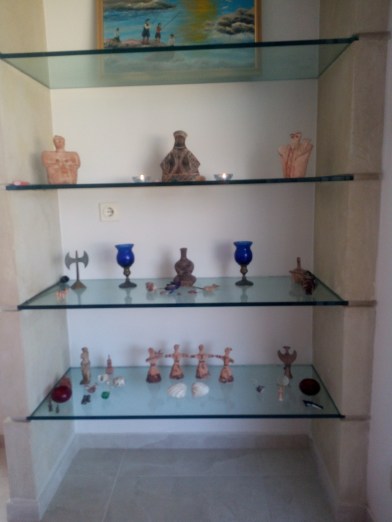
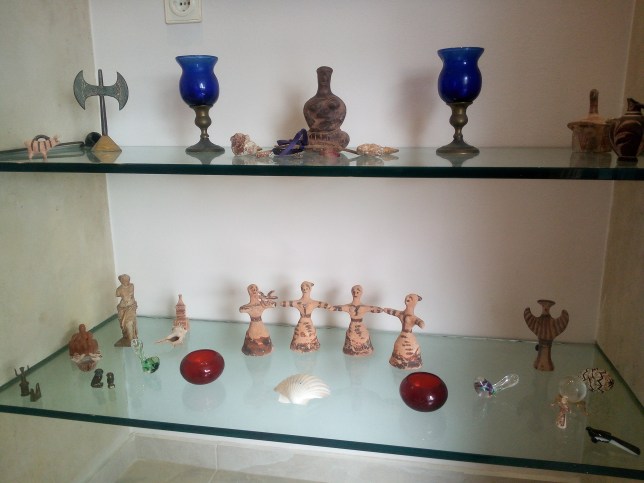
The living area of my new apartment has 3 glass shelving units. In one of them, I created a triple altar with images of the Goddess and female power from ancient Crete. Because the apartment is sleek and modern yet welcoming to my antique furniture, I kept the altar minimal.
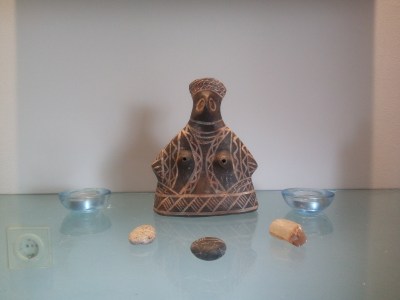
The second shelf holds one of the oldest images from ancient Crete, the Neolithic Goddess from Ierapetra. She is seated on massive buttocks, securely rooted in the earth. Her face is beaked, symbolizing her connection to the birds that fly in the air. Her body is decorated with lines identified by archaeologist Marija Gimbutas as the flowing water that nourishes all of life. Her body too is shaped like the mountain. She represents the never-ending powers of birth, death, and regeneration in all of nature.
In front of the Neolithic Goddess I placed a twig from Paliani with a dark blue ribbon reminding me that my friend Tina Nevans is sending the healing energy of the Blue Buddha to me in her daily meditations, as well as several handsewn triangles holding leaves from the Holy Myrtle tree, and a crystal extracted from the Trapeza Cave, found on the path outside of it. To Her right is a small image of the long-necked turtle Goddess from Myrtos who holds a pitcher recalling women’s daily visits to water sources, and a small copy of a Kamares ware pitcher used to pour libations in the Sacred Centers. To the left are a bronze copy of a labrys, originally the double sacred female triangle transformed into wings and also a happy little bull who reminds us that animals experience the joy of life.
On the lower shelf, copies of dancing women from post-Minoan Paliakastro symbolize the transmission of Old European values of community, lack of hierarchy, and most of all, celebration of the joy of life as Laura Shannon has written. The dancing women are surrounded by images of later Mycenaean Goddesses and of Aphrodite who was worshiped at the Minoan site of Kato Symi in classical times, and a small reproduction of the Neolithic Goddess from Catal Huyuk, who reminds us that Crete was settled c.7000 BCE by farmers from Anatolia.
In the hallway I placed a copy of a drawing of the Holy Myrtle Tree of the monastery of Paliani created by one of the nuns. According to the story told, the area where the monastery was later built was burned in a fire but a small myrtle bush survived. It was watered by girls who saw the image of the Panagia (Mary the Mother of Jesus) in its charred branches. So, the monastery which was known as ancient in 668 CE was built. The monastery is a sacred place for the surrounding villages. The sacred tree and the icon of the Panagia in the church are said to have performed many miracles. Below the drawing of the Sacred Myrle Tree is a small image of a face in a twig from tree given to me by German artist Carla Randel.
On a small table under the drawing, I placed an image of Aphrodite who was earlier associated with myrtle trees, along with a candle, a star, a blue glass paperweight, and a triton shell, symbolizing Aphrodite as the morning and evening star, and her relation to the sea.
When I light candles in translucent glass holders on the altar with the pitcher Goddesses as the day dawns and in the evening as day turns to night, and when I gaze at my other altars, I remember that I am always surrounded by the nurturing love of the Goddess. This love takes root in my body, and I am inspired to share it with others.
On Friday, Nov. 6th, the day before the Biden/Harris race was called I spent a day in a deeply meditative state. I live in the NY City metropolitan area and it was a beautiful day. I mostly sat in my backyard in a patch of sunshine musing on the world and seeking a personal sense of balance. I didn’t do anything that day. Well not entirely true, I did a few things, for example I shifted positions a few times to stay in the sun. I grew up in the Puritan based school system which frowned on “doing nothing” as if spending a day not actively achieving anything was somehow wrong, perhaps sinful. For my kids, 30 years after me, it was far worse, codified in hours of homework following a complete school day. And today it’s even harder with afterschool activities (although I must say, to my great pleasure, I have never seen so many children playing on the street in my neighborhood than since this pandemic began.) No wonder Mama Nature is not generally honored. We don’t raise our children to have the time nor space for Her. Continue reading “Election Musings by Janet Maika’i Rudolph”
I love my new life in Portugal and I’m so happy and grateful to be here. However, I have encountered one major roadblock–I simply cannot replicate my daily writing routine that I’d relied on in the UK for nearly twenty years. I used to get up and leap right on the page, but now I keep horses on my property and their care and feeding come first, before I even get my human breakfast. And horse care is the last thing I do before sunset. If once I was a morning writer, now I’m a late morning/early afternoon writer. Writing gets sandwiched between horse care. Creative ideas bubble up as I ruminate while picking poo in the early morning. I’ve had to find a new rhythm that fits my new life.
Many of us, particularly many women, are struggling to find their daily rhythm while balancing the demands of remote-working with childcare, home schooling, and elder care as we enter the eleventh month of our global pandemic. This can be depleting, to say the least. To make matters worse, the old boundaries between work, family life, and “leisure” have unravelled and become impossibly blurred. Many of us feel under even greater pressure to be productive during this time.
Experts preach that we need to manage our time, plan every minute of the day by making little boxes for each task in our daily planner. I have tried to do this, but always rebel in the end. It seems a pointless task to try to force the flow of my day into orderly boxes. Instead I try to find what rhythms work for me so it feels organic rather than forced.
Now as a woman in my mid-fifties, I feel I have arrived at the other side of the mountain. I moved to Portugal, in part, to slow down. To be less frantically obsessed about work and career. To take a step back from the whole competitiveness of the writing world that can be soul-destroying and completely antithetical to the creative process. I’m done running myself ragged in some misguided attempt to get ahead. Perhaps I’m losing my “edge.” Perhaps this is what it means to be literally “over the hill.” You’ve come so far on your journey that it’s too late to return to old ways of doing things or old ways of seeing the world–the view is completely different up here.
Due to the radical reset of the pandemic, I think that a lot of people are arriving at this place, regardless of their chronological age. At some point we reach a peak of life experience beyond which there is no going back. We have entered a new landscape, brand new territory where the old maps will not get us anywhere. We have to seek a new direction. We have arrived in the place where we can claim our power, our inner sovereignty, and live our life to the rhythms that work for us.
For me this means abandoning the cult of productivity, the pervasive belief that living to work makes us virtuous. That our worth is determined by our output. This cult is particularly damaging to women who still carry the bulk of childcare and domestic work–the whole second shift of wife work that goes unrecognized, unvalued, and unpaid. I believe the majority of male productivity gurus can only adhere to their monastically rigid schedules because they have an unpaid woman in the background doing all the childcare and mopping up all the mess.
One thing I’ve learned the hard way is that, if we let it, the cult of productivity will completely poison both our creativity and our spirituality.
The cult of productivity diminishes our daily spiritual practice as yet another demanding task on our to-do list, a result-oriented form of competitive striving. “I’m not a serious spiritual seeker unless I get up at 5:00 am to meditate. How else will I be on track to achieve enlightenment?”
Spiritual practice is by its very nature the precise opposite of doing or striving. It’s letting go, surrendering to a state of pure being and receptivity, relaxing into the divine luminosity welling up in our hearts.
As for creativity, international best-selling author Hilary Mantel, one of my great idols, has written one of the best essays on the writing process I have ever read. Writing world-class literature, for her, is not a matter of locking herself in her office for eight hours a day or adhering to a rigid word count but of finding the right rhythm.
“I have to grab a notebook and write before I am properly awake,” she writes. “The day’s writing starts to unroll in my head. It’s fragile and often a matter of rhythm rather than words.”
Mantel stresses the importance of writers trusting themselves, trusting their creative flow, rather than obsessing about productivity. Good writing is not a matter of “persecuting paper with ink or pounding the keys. . . . You can’t measure your productivity day-to-day in any way the world recognizes.”
Then Mantel spills her secret that cuts the productivity gurus down to size:
I feel shy of saying this, because to non-writers it sounds lazy–but if, seven days a week, you can cut out two hours for yourself, when you are undistracted and on-song, you will soon have a book. Unoriginally, I call these “the golden hours.” It doesn’t much matter where I find them, as long as I do. I usually work many more hours. But sometimes I wonder why.
When we step into flow, either creative or spiritual flow, we enter a realm of timelessness, where our calendars and clocks dissolve into oblivion. We lose ourselves in that rich inner world. And it’s not forced. It’s not imposed upon us. The flow carries us. May we all be blessed with golden hours.
Mary Sharratt is on a mission to write women back into history. Her acclaimed novel Illuminations, drawn from the dramatic life of Hildegard von Bingen, is published by Mariner. Her new novelRevelations, about the globe-trotting mystic and rabble-rouser, Margery Kempe, will be published in April 2021. Visit her website.
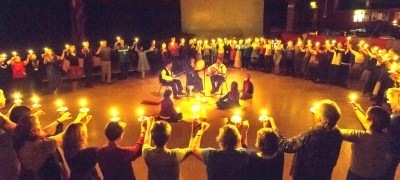
Armenian Candle Dance with Laura Shannon, Findhorn 2015 (photo: Hugo Klip)
When I first began researching traditional circle dances in the mid-1980s, I was amazed to find that the peoples who have suffered the worst of human experience – oppression, exile, genocide, war – also produce the most vibrant and joyful music and dance. Armenian, Jewish, Kurdish, and Romani (Gypsy) dances, in particular, were passionate affirmations of life, despite the horrors these peoples have gone through in their history. The dances seemed to hold clues to the mystery of moving on with life after trauma.
This was something I was desperate to learn how to do. Barely 20 at the time, I was struggling to keep my dignity and optimism while growing up female in a woman-hating world. The trauma of a violent rape on my 18th birthday had robbed me of my joy for life – but I could experience joy again in those dances.
Early on in my research and teaching, therefore, alongside the women’s dances which were always my main interest, I began to focus on the traditional dances of persecuted peoples, which I called Dances of Exile and Homecoming. These songs and dances seemed to have an inherently therapeutic potential, profoundly moving for people from any background and any culture.
One concrete way of accomplishing this change is to submerge ourselves in the rest of Nature and stay open to the appearance of animals, birds, plants, etc., and by paying close attention to images and words, nudges, synchronicities, dreams, and fantasies. Especially while caregiving, perhaps the most exhausting job of all. S/he provides us with a means to deal with the crisis of Covid 19 by staying in the present moment as much as we possibly can. Debra’s flowers/ four-leaf clovers, owls, stars, all speak to the importance of the presence of nature in different ways.
It is hard to miss the change of expression on Everywoman’s face. Held by the bear, her eyes are focused and there is a sense of peace that permeates the woman’s countenance. Clearly, Everywoman is able to be present to what is. This woman has once again found home.
To the right and below the moon there is a small leaf-like image that seems to be drifting. When I asked Debra what the image was she responded that the leaf was a simplified four-leaf clover. It symbolized the role that luck plays in the spread of an impersonal virus, but memories of being with her grandfather on Sunday afternoons searching for four-leaf clovers, and the way the two were connected with nature were also part of the reason she included this image. Once again we see the archetypal and the personal intersecting in Debra’s work. On an archetypal level, the impersonal presence of luck/trickster/fool determines viral outcomes, on a personal level this symbol attaches Debra to nature and her love for family.
During the past few days I have begun to breathe again. As I exhale, tensed muscles relax and feeling comes back into my body. I realize that I have been holding my breath not only for the days it took for the election results to come in, but for the past four years. After a long wait, Joe Biden and Kamala Harris were finally declared the next President and Vice President of the United States. Their ability to pass legislation now hangs in the balance in the two Senate run-off elections that will be held in Georgia on January 5.
The outcome of these elections is uncertain, but we can take hope in the fact that Stacey Abrams will be doing everything she can to turn out the vote. If you are thinking of donating to the Georgia Senate races, please contribute to Abram’s Fair Fight, which registered almost 800, 000 new voters over the past two years, in order to ensure that your money will be spent on an on-the-ground campaign to get out the vote and not just on advertising. Continue reading “Breathing a Big Sigh of Relief by Carol P. Christ”
One of the basic tenants of feminist methodology in religion is the recovery of women’s history. There are many ways to approach such a task. In religions with sacred writings, one avenue for recovery may be reinterpreting them. This could come in the form of a critique. For example, traditional interpretations may overlook or undervalue women, who appear in the text, reaffirm sexist, patronizing, and/or misogynist viewpoints already found in the text, or develop new ones. In order to recover women’s history, feminists working with their sacred texts would then call out these interpretations for their sexism. They would correct phrasing, understanding, and even translations, when necessary.
In addition to critiquing, feminist interpretations of scripture could also be constructive. Religious feminists may highlight values, teachings, and images that affirm women’s lives. They may incorporate documented history into their interpretations as proof of expanded roles for women. That would then contextualize or negate later traditions that deny women such roles.



 In a recent blog,


 On Friday, Nov. 6th, the day before the Biden/Harris race was called I spent a day in a deeply meditative state. I live in the NY City metropolitan area and it was a beautiful day. I mostly sat in my backyard in a patch of sunshine musing on the world and seeking a personal sense of balance. I didn’t do anything that day. Well not entirely true, I did a few things, for example I shifted positions a few times to stay in the sun. I grew up in the Puritan based school system which frowned on “doing nothing” as if spending a day not actively achieving anything was somehow wrong, perhaps sinful. For my kids, 30 years after me, it was far worse, codified in hours of homework following a complete school day. And today it’s even harder with afterschool activities (although I must say, to my great pleasure, I have never seen so many children playing on the street in my neighborhood than since this pandemic began.) No wonder Mama Nature is not generally honored. We don’t raise our children to have the time nor space for Her.

 Oh, bright flame of the dawn, You,
 During the past few days I have begun to breathe again. As I exhale, tensed muscles relax and feeling comes back into my body. I realize that I have been holding my breath not only for the days it took for the election results to come in, but for the past four years. After a long wait, Joe Biden and Kamala Harris were finally declared the next President and Vice President of the United States. Their ability to pass legislation now hangs in the balance in the two Senate run-off elections that will be held in Georgia on January 5.
 Feminism and Religion