The Hate U Give by Esther Nelson

These days I live in a perpetual state of simmering outrage given the popular support of the “goings on” and happenings within our current administration.  The lies, the deceit, the xenophobia, the racism, the misogyny, the homophobia, the anti-intellectualism—things that have been around a good long time, but now seem to have settled in comfortably with those who have the power to keep it all in place.  I’m discouraged.

But then, there’s this:

The Hate U Give, a YA (Young Adult) novel authored by Angie Thomas, spent 50 weeks at the top of the New York Times bestseller list after its publication in February 2017. The book has received numerous awards and also has enjoyed an immense popularity.  It has also generated considerable controversy.

The following is the author’s profile from Amazon’s website:  “Angie Thomas was born, raised, and still resides in Jackson, Mississippi as indicated by her accent. She is a former teen rapper whose greatest accomplishment was an article about her in Right-On Magazine with a picture included. She holds a BFA in Creative Writing from Belhaven University and an unofficial degree in Hip Hop. She is an inaugural winner of the Walter Dean Myers Grant 2015, awarded by We Need Diverse Books.”
Continue reading “The Hate U Give by Esther Nelson”

I <3 California by Sara Frykenberg

It’s Friday. I drive down PCH, Highway 1, at five-o-clock in the morning on my way to the airport. I left early and avoided the evacuation traffic. The sky is pitch black—not just dark, but black. Smoke cloaks the sky, sky presses against black mountains. I can’t actually see the ocean right next to me. I don’t look either, because the wind is pushing my car around on the freeway and I need to pay attention. Don’t look at the invisible water Sara, pay attention.

I admit to myself that I am afraid even though I am doing something I do every day.

I am getting on a plane. Why am I getting on this plane? I need to be here. I want to be here. But life goes on, doesn’t it? We hope that life goes on; even if we live like it does not. All I know is that I want to tell everyone I see that my home is burning. Not my house-home. Not mine. I’m safe just south of Ventura. I’m not on the freeway. I’m safe on a plane. But my home is burning. MY HOME IS BURNING. (Again.) Please somebody talk to me while my home is burning. But instead, I check the news and twitter reports every 5 minutes and worry about my students and my friends. I want to cry.

Continue reading “I <3 California by Sara Frykenberg”

Women’s Ritual Dances and the Nine Touchstones of Goddess Spirituality – Part Four by Laura Shannon

In Rebirth of the Goddess, Carol P Christ offered Nine Touchstones of Goddess Spirituality as an alternative to the Ten Commandments. The Nine Touchstones are intended to inform all our relationships, whether personal, communal, social, or political.[1] In this four-part blog (here are parts 1-3 Part 1, Part 2, Part 3) I am exploring ways in which these Nine Touchstones are inherently embodied in traditional women’s ritual dances of the Balkans, which has been my spiritual practice for over thirty years.

Carol’s Fourth Touchstone is: ‘Speak the truth about conflict, pain, and suffering.’ Many women’s dance songs which allow the women to speak and sing their grief and pain. When we bring that pain into the healing container of the circle, sharing simple steps, Dancers in the circle simultaneously give and receive support for their own and others’ sorrow. Ultimately, the sense of community  and solidarity in the circle transforms our grief so that the burden becomes manageable. Many historical songs, too, tell stories of women being abducted or abused, and how they fought back or got away – or not – so that they are remembered and honoured by future generations.

Continue reading “Women’s Ritual Dances and the Nine Touchstones of Goddess Spirituality – Part Four by Laura Shannon”

Women’s Ritual Dances and the Nine Touchstones of Goddess Spirituality-Part Three by Laura Shannon

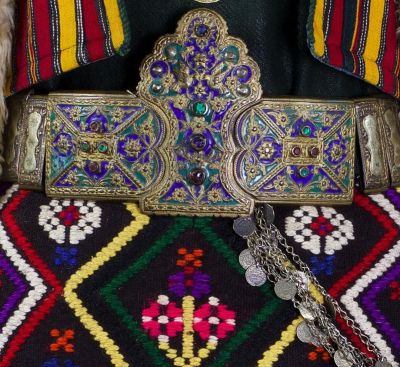
Women’s apron from Pentalofos, Greek Thrace

In Rebirth of the Goddess, Carol P Christ offered Nine Touchstones of Goddess Spirituality as an alternative to the Ten Commandments. The Nine Touchstones are intended to inform all our relationships, whether personal, communal, social, or political.[1] In this series of blogs I am exploring ways in which these Nine Touchstones are embodied in the traditional women’s ritual dances of the Balkans, which I have studied as a spiritual practice for more than thirty years.

Carol P Christ’s Second Touchstone is: ‘Walk in love and beauty.’ As she says, ‘love and beauty are the great gifts of bounteous earth’.[2] Dancing women of the Balkans walk in love and beauty each time they put on their festive dress to dance together in the courtyard or the village square. Their ceremonial costumes are created from the bounty of the earth – just a couple of generations ago, this was literally the case, as the women tended the sheep, prepared and spun the wool, wove, sewed, embroidered and ornamented their garments with the work of their own hands. Even now, the cloth they buy is purchased with money they have earned from working and harvesting the land.

Continue reading “Women’s Ritual Dances and the Nine Touchstones of Goddess Spirituality-Part Three by Laura Shannon”

Lei by Elisabeth Schilling

Mauro Drudi’s installation of LEI (SHE/HER/YOU – formal) in the Chiesa de San Cristoforo on the Sicilian island of Ortigia where I usually take a bus to daily has become the shrine of women I’ve been searching for. Each time I cry, I am glad I can feel something: those tears are a mixture of communion, comfort, and recognition.

When one enters the church, there are two converging walls. On either side, a woman’s face is painted in shadow and light, gazing off toward the light, is reproduced over and over so that the number of women looks almost countless. They are the same face, a reproduction of Antonello da Messina’s “Annunziata” in the mode of pop art. The difference is not in expression. They all wear the same thoughtful, complicated, neutral countenance, holding deep thoughts and experiences of suffering and wise knowing, both acceptance and maybe resistance; they have lived and might be any age, although I see in our connection my own. The difference is between glossy, unblemished surfaces of wood vs. surfaces weathered, slightly ragged, sometimes scribbled on with ink. The former, found on the right when one enters supposedly represents the “positive” woman, the “western woman [. . . representing someone] happy, gorgeous, well-kept.” On the left, about these representations, Drudi says, “Which artist can paint the skin of a woman who has been abused, beaten, exploited, captivated or disfigured with acid? In my opinion, nobody, and so I let the material speak: the wall of a beach hut destroyed by a storm; woods and materials used and abused [. . .]; exhausted panels deriving from carrying tons of goods, tables, packagings, production wastes.”

Continue reading “Lei by Elisabeth Schilling”

Vayeitzei: Rachel and the Practice of Niddah by Ivy Helman

29662350_10155723099993089_8391051315166448776_oThis parshah contains the account of Jacob’s marriages to Leah and Rachel, (who happen to be his cousins) as well as the birth of his 11 sons and one daughter.  It describes the long amounts of time Jacob worked for Laban in order to marry Laban’s daughters, and recounts the trickery of Laban giving first Leah, the older daughter to Jacob, before allowing Jacob to marry who he wanted to, Rachel.

Like the relationship between Hagar and Sarah, there is animosity between Leah and Rachel over Jacob’s love as well as the ability to bear children.  This animosity spreads to the maids of Leah and Rachel, Zilpah and Bilhah respectively, as they are used by the sisters to conceive children on their behalf.  One can see also this animosity in how Leah and Rachel name their sons.  Yet, the parshah also contains two aspects that seem at odds with such a patriarchal perspective.  First, there are five named women who play key roles in the goings-on.  Second, Rachel is an active agent.  Continue reading “Vayeitzei: Rachel and the Practice of Niddah by Ivy Helman”

Rest as a Radical Act by Mary Sharratt


This summer I committed an act of radical and deeply liberating change. I started taking Sundays off, a new thing for me. As a writer, I had come to regard Sunday as just another working day, part of the same old workaholic grind.

And by taking Sunday off, I mean that in the most literal sense–I went offline and pulled the plug on my internet for 24 hours. Without the distraction of my smart phone, email, or social media, I suddenly seemed to have so much time and so much peace. It was like being on retreat except I could do it here and now, in my own home. In this hallowed time out of time, I now spend my Sundays meditating, reading real books with paper pages, going on long horse rides or hikes, and enjoying deep communion with family and friends.

Continue reading “Rest as a Radical Act by Mary Sharratt”

Second Class Citizen by Sara Wright

Second Class Citizen


When he backed me

up against the tree

inching towards me

menacingly

with his big powerful car

I couldn’t believe

what was happening.

I was holding the space

for a car full of dogs

waiting to park

just behind him.


He got out of the car

And I said

You can’t do this

this spot is taken.

Six feet tall, he sneered

You can’t save spaces

in a parking lot.

Continue reading “Second Class Citizen by Sara Wright”

A Precious Gift by Natalie Weaver

This has been another hard month.  I don’t feel it to be hard.  I just know objectively that it is.  The typical challenge of balancing my work with the children’s needs and the management of a household has been intensified by the onset of a serious medical condition in my family.  I now enter that phase of elder care, which I understand is more or less bound to bankrupt the average household.  I have become the much-begrudged adult child, compelled to make decisions for other people’s lives and regarded in the fog of suspicion. My intentions are now under scrutiny; my time is usurped; my efforts are thankless.  I’m not complaining really.  I am just describing.

In the midst of things, I have managed to take my older son to the seeming ends of the earth to visit potential high schools.  I am managing a Destination Imagination team for my fourth grade son’s class.  I am teaching six courses, and my home is relatively clean.  I am running a weekly lecture series, I volunteered at the Church this month, and no one has missed any meals.  I even managed to sew a blanket for a friend’s new baby. There are many more serious family, medical, and economic issues that underlie my day-to-day, but along with everyone else, and perhaps a little more so than some others, I just accept that I am amazingly over-extended.

Continue reading “A Precious Gift by Natalie Weaver”

Women’s Ritual Dances and the Nine Touchstones of Goddess Spirituality-Part Two by Laura Shannon

In the first part of this article, I looked at how Carol P Christ’s Nine Touchstones of Goddess Spirituality from Rebirth of the Goddess are related to traditional women’s ritual dances of the Balkans. After more than thirty years of researching and teaching these dances and the way that they pass on information in encoded symbolic ways, I have come to see them as an educational system, a women’s mystery school.[1] The main message which the dances convey is an ethic of community, partnership, mutual support, and other life-enhancing values aligned with the Nine Touchstones, which can be directly experienced in the dance.

We know from the research of Marija Gimbutas that these values were central to the Old European civilizations which honoured the Goddess, while Yosef Garfinkel and Elizabeth Wayland Barber show that circle dances have their roots in these same early Neolithic cultures of Eastern Europe and the Near East. This leads me to suggest that Balkan women’s circle dances surviving today may have their origin in early egalitarian matriarchal cultures of Neolithic Europe. The Nine Touchstones of Goddess Spirituality provide an perfect template through which to explore the ethics of women’s ritual dances.

Continue reading “Women’s Ritual Dances and the Nine Touchstones of Goddess Spirituality-Part Two by Laura Shannon”