

 It certainly is a busy time of year for me, but I’m fortunate that many of the events I am participating in offer a chance to share what is important to me. Next week, I’ll be speaking to a group of students in one of my campus’ residence halls about feminism and Christianity. For this informal setting, I was allowed to choose my own topic under the broad heading of “Questions That Matter.” I’ve decided to take on the f-word in religion and attempt to explain why it’s important to me and how it relates to my religious identity. Although I’m still trying to figure out what to say, I’d like to share my thoughts so far and get some insight from you. Continue reading “Questions that Matter: What is Feminism? by Elise M. Edwards”
Category: General
My Journey to Define Libyan Feminism by Samah Elbelazi
 Before coming to the U.S., I felt disconnected from feminist theory. I thought this framework labels women as haters of men and seekers of obscure rights. I was not sure who could identify with it or belong to it. For me, it was just a scholarly concept women used to justify their rights. I could not perceive it as an empowering tool, even if it is being so popular. While there is no problem having the concept to be loud and popular, this loud voice did not speak for me. I could not let it represent me or speak on my behalf. Every time I google it, I see angry faces, naked women, people yelling, women in chains, and much more. Instead of accepting it, I resisted it.
At that time, my understanding of feminism was associated with women’s liberation outside the circle of culture and religion. It scared me since I am who I am because of my culture, my community, and my religion. This feminism has my respect, but it is alien and does not call for my needs. For a long time, I resisted feminist discourse or, to be clear, white western feminism. Its discussion about equality, oppression, and marginalization is different from mine. I knew that as a Muslim woman, I had no room in this discourse.
Until one day, things started to change. Continue reading “My Journey to Define Libyan Feminism by Samah Elbelazi”
Teachers by Valentina Khan
 I recently told my 4-year-old son the following, “son, I pray you fall in love with someone you call your best friend. I pray you both never cross the line and say mean and terrible things to each other, I pray you are not constantly apologizing for your bad behavior, I pray you will complement and enhance each other’s best qualities, and lastly, I really hope you fall in love with a teacher!”
A teacher? Of course, a teacher! I have always loved my teachers growing up. I never had one bad teacher. Teachers are caregivers and authority figures children experience separate from their own parents. Each teacher brings his or her unique love of learning and educating to the students. I was influenced so much by the vibe of teachers. And in the journey to my “career,” I became one myself….a yoga teacher.
A yoga teacher? Yes, a yoga teacher, which eventually led me to coming a ballet barre instructor. This all 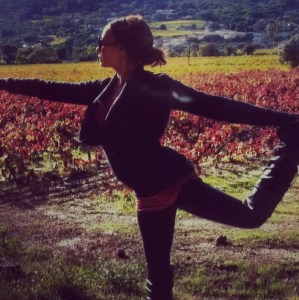 happened when, after a tedious and challenging few years of getting myself through law school, I rewarded myself with an entire summer off to become certified to teach yoga. Yoga got me through sticky times in my young adulthood, from soured relationships, to poor scores on my legal exams. It also kept my feet on the ground when I was flying high, whether from planning my wedding or completing my studies. Yoga was the antidote in my life. I cherished not requiring medication for all the different feelings I’ve had throughout my adult life; whether it was anxiety, depression, loss of focus, too much energy, or the run of the mill aches and pains, I always turned to yoga. The feeling of stretching and flushing out toxins, negative energy, frustration, while building strength and teaching myself how to breath, were all things I wanted to learn in more depth and, eventually, to teach. Continue reading “Teachers by Valentina Khan”
A Rescue Remedy, Part 2 by Barbara Ardinger
The handsome but uncharming prince having been magicked, the witch and her coconspirators know it’s time to focus on finding Ella. The witch looks around the table.
“Mrs. Janedoe and Mrs. Worthington,” she says, “you are two of our most highly experienced sauceresses…I mean sorceresses. Mrs. Bezukhov, you are also a woman of great, if temporarily diminished, power. Let us work together and see what we can do. Surely when people of good will work together they can raise energy that leads to positive results. Yes?” She looks around. “Please come up to my study.” The ravens of course know they are members of this ad hoc coven, and Mrs. Bezukhov goes out to her little room (actually a stall) in the barn to fetch her old scrying stone.

“Now,” says the witch, “we need to find out where Ella is and—”
“Before that,” says Kahlil, the prophetic raven, “we gotta fly that…er…sausage to the city ’n’ drop it on that lousy prince and hit ’im where it’ll do the most good. Make sure he got the message, doncha know. I got a new buddy who’ll fly with us.” He waves a wing at the window and another raven flies in. “This’s Icarus.” The new raven bows. “Despite his name, he’s a good flyer ’n’ he knows the safest routes to the capital and the bestest ways to get around the city.” Kahlil shows the bagged sausage to Icarus, who studies it and shakes his head like he’s just been attacked by a million fleas. “Okay,” says Kahlil, “youse girls just keep an eye on us in that there scrying stone.” He starts to rise from the table, but Mrs. Worthington stops him.
Continue reading “A Rescue Remedy, Part 2 by Barbara Ardinger”
Opening Our Hearts Through Armenian Dance by Laura Shannon
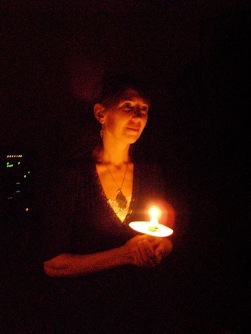
In these challenging times, one of the hardest things to do is to keep our hearts open. Grief and despair tend to shut them down. And even among close friends, colleagues, family members, and people with whom we share worship, when we clash over differing political opinions, trust can swiftly erode. These kinds of losses and sorrows can make us just want to close the doors to our hearts.
Yet hardened hearts and minds are not going to help us overcome conflicts and affirm connections. Only if we can open our hearts to one another, holding the fullness of our (and others’) feelings in a compassionate way, can we weather the storms which threaten to divide us further. And only if we are united can we find our way together through those storms.
One of the best ways I know to connect with others and to open my heart is through the joyful experience of traditional circle dance, particularly Armenian dances. I have written previously on this blog (The Dance of Memory, The Wishing Tree) about Armenian dances and their ancient roots, their links to the pre-Christian Goddess, and how they affirm survival throughout the traumas of history. I have also written about my friend and colleague Shakeh Major Tchilingirian and her inspiring Circle of Life project, which brings Armenians, Turks, Kurds, Assyrians, and other survivors of atrocities and genocide to dance together for reconciliation.
Continue reading “Opening Our Hearts Through Armenian Dance by Laura Shannon”
In Light of Women by Mary Jane Miller

Why are so few women mentioned in the great feast days like Pentecost, the Last Supper, the Baptism of Christ, etc.? God made no commandment that they not be included.
Inquisitive women like myself have always been around Christ listening to His message. There they were, cooking and cleaning at the Last Supper, at the wedding at Canon and when He fed the five thousand. When Christ invited the children to come to him, you can be sure the mothers were there, too.
Beginning as early as the fourth century the dominant Christian leaders, all men, twisted and distorted Holy Scriptures to thwart the ascendant positions for women within the religious hierarchy and in christian societies in general. Yet, the underlying teachings of Jesus Christ, the Apostle Paul, Moses and the prophets, – all call for the proper and equitable treatment of God’s children. Without a doubt, God and Christ love all of humankind with no gender bias. When women listen to scripture we naturally fill in the gap, or adjust the gap knowing in our hearts and souls, we are not inferior to men.
The Feminist-O-Meter by Vanessa Rivera de la Fuente

Have you heard about, applied or received the Feminist-O-Meter lately?
The Feminist-O-Meter is a tool that often appears in feminisms and women rights activisms, fostering power struggles, cliques, jealousies and -if that is not enough – encouraging the reproduction of mainstream socialization that fosters competition and alienation among women.
It can be summed in the expression:
“Not my way to see Feminism? Then, that’s NOT Feminism”
I see feminisms as revolutions of subjectivities based on the radical idea that women are people … and it turns out that people are diverse, we are the result of our experience and the way we interpret them.
So, I do not understand why there is so much drama, judgment, outrage and social punishment in feminist spaces when those involved are undertaking the process of discovery, of claiming back our personhood by legitimizing our different ways of thinking, our understandings of liberation, and our acknowledgment of what makes us happy and makes us feel feminist.
Continue reading “The Feminist-O-Meter by Vanessa Rivera de la Fuente”
Just How Rotten Are Things in Denmark? by Marcia Mount Shoop
The Shakespearean quote, “something is rotten in the state of Denmark,” comes from a palace guard. After watching Prince Hamlet walk away with the ghost of Hamlet’s murdered father, the former King, the guard has a sinking feeling about how screwed up things are in his country.
And if you remember the play at all, things were pretty rotten. By the end of the story just about everybody dies. Revenge, misunderstandings, accidents, and lust for power are just a few of the causes of death. The guard was right. Something was rotting away at his country—something that was vacating people’s integrity and trust, something that was not afraid to use violence and lies to get its way, something that was blind with a hunger for more and more power no matter the cost.
Continue reading “Just How Rotten Are Things in Denmark? by Marcia Mount Shoop”
Run Women Run! You Can Do Better than a Mediocre White Man! by Carol P. Christ
 When I was in graduate school, I learned to doubt myself. Despite having won Danforth and Woodrow Wilson graduate fellowships that paid for my tuition and living expenses, I was continually told by professors and male students alike that I would not finish my degree and that if I did I would get married, have children, and never use the degree I had earned. I tried hard to maintain my confidence in myself, but it was difficult when I was the only woman in the program. There was one other woman my first year, but she was older than I was, a nun, and I never saw her in class or at social events. My self-esteem was gradually eroded. If I had not had a fellowship, I would probably have dropped out.
Fast forward a few years. There were several more women in the program, but only one in theology, my friend Judith Plaskow, and she too struggled. I was working on my comprehensive exams and wondering if I had what it takes to pass them and then write a Ph.D. thesis. After the initial shock of being treated as if I was not the equal of the male students in the program, I began to look around me. A few of the male students seemed really bright, many of them were average, and some of them were plodders. I hate to admit it, but I looked at the least competent among them and said to myself, “If he can do it, then surely I can.” And I did. I passed my exams. A few years later my Ph.D. thesis was approved.
If contributions to the field are any indication, Judith Plaskow and I were not only as good as the most mediocre men in our graduate program, we smarter than the average ones, and at least as smart as the smartest ones. But we didn’t know that then. Men have been getting degrees and being promoted and moved up that ladder because other men like them, identify with them, feel sorry for them, and for lots of other reasons having nothing to do with excellence, and sometimes not even do do with competence.
Last week I heard Cecile Richards say something to Lawrence O’Donnell that reminded me of this. Speaking of the huge numbers of women who—inspired by the women’s marches–will be voting, registering voters, campaigning, and running for office in 2018 and beyond, she said women “totally understand that they can do better than who’s in office now.”
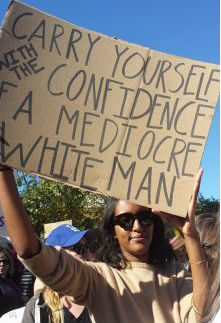
For far too many years women have been held back by lack of self-confidence and self-esteem. We didn’t think we could and we didn’t. We don’t think we can and we don’t. We thought men were smarter than us or had more time or more drive. The founder of the Society of Women Engineers at San Jose State told my classes that women who got even one B+ in an engineering class were likely to drop out of the program, while men graduated who graduated with C averages went on to get great jobs. Now we see truly mediocre white men holding public office all across the country and in its highest offices. The harm they are doing to women, to children, to the elderly, to people of color, to the environment has been a wake-up call for all of us. There are so many mediocre white men in office that women–of all colors and ethnicities–are realizing that we can do better than that! Once we begin to see what we can do when there are large numbers of us holding office all across the country, there will be no stopping us!
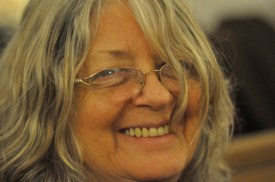
Carol P. Christ is an internationally known feminist writer and educator living in Molivos, Lesbos, who volunteers with Starfish Foundation that helps refugees, assisting with writing and outreach. Carol’s new book written with Judith Plaskow, is Goddess and God in the World: Conversations in Embodied Theology. FAR Press recently released A Serpentine Path: Mysteries of the Goddess. Join Carol on the life-transforming Goddess Pilgrimage to Crete. Carol’s photo by Michael Honegger.
A Time to Make New by Deanne Quarrie
 We, Goddess types, are getting ready to celebrate Imbolc, beginning on the evening on February 1st through the following day, until dusk. Many ask, “well, just what is Imbolc?”
To give you a quick etymology …. From Old Irish it means “in the belly” referring to the pregnancy of ewes. It might also mean “to wash or cleanse oneself” and finally, perhaps, “budding.”
The easiest way for me to understand it is in remembering when I carried each of my children “in the belly.” There was this magical moment when I felt them move for the very first time. This is an event called “quickening,” a stirring of the unborn child in the womb. Every woman who has given birth, remembers this moment with her child. Continue reading “A Time to Make New by Deanne Quarrie”
 Feminism and Religion