Spirit of Bali by Jassy Watson

Over the past year I have travelled to Bali on a number of occasions for both pleasure and work, and with each visit a little more of my heart and soul stays behind on this green tropical island paradise waiting for my next return. I was never really that keen to travel to Bali in the past; my pre-conceived ideas had been largely influenced by the negative media attention this “hot destination” often receives in Australia.  Whether it be a volcano erupting, scooter accident, terrorist attack. or young Australian party-goers getting up to mischief while on holiday, the shadow side of Bali tourism remains the focus for hype-hungry media – with consequences often detrimental to the tourism industry that the island has become so reliant on.

Yet for many years pilgrims from all over the world have been flocking to Bali to experience the spirit and culture. I was curious and decided it was finally time I went to see firsthand what all the hype was about. After seeking an inexpensive and close overseas getaway to recharge our parenting batteries, my husband and I decided to join the flock and fly to the island paradise. From the moment my feet hit the ground I was engulfed with the chaos & humidity that is Bali – and I was captivated. Continue reading “Spirit of Bali by Jassy Watson”

Just South of Ventura by Sara Frykenberg

For those of us living in Southern California, it has been a tense week to say the least: flames ravaging up and down the coast, homes lost, thousands displaced, freeway and school closures, smoke thick in the air, and ash raining from the sky.

And the fires are still raging. 

Whether or not one is directly impacted by the wildfires here in Ventura and Los Angeles County, you can’t walk through the grocery store, turn on the radio, or get a cup of coffee without engaging the fear and concern, or hearing about the devastation left behind. We are sharing a trauma, howbeit differently, and with different levels of need.

I have been lucky during the fires.  I live just south of Ventura. My work is on the Getty side of the 405: it was threatened, but not in flames.  I spent the week checking in with family and friends, offering my home, and breathing the toxic air. I also made dinner, picked my brother up from the airport, attended a baby shower, and graded papers. … This is a strange juxtaposition, and like many Californians, I have had a hard time processing what’s going on.

On Sunday afternoon, surrounded by the unnatural darkness of an ash filled sky while traveling down the 101 freeway, I wrote the following. This is my effort to make sense.  And I offer it to you all here, in case this helps you make sense too.  Continue reading “Just South of Ventura by Sara Frykenberg”

Sheela na gig: The Dark Goddess of Sacred Power BOOK REVIEW by Kay Bee

If there are devotees of the Dark Goddess on your Yuletide gift list, Starr Goode’s gorgeous book, Sheela na gig: The Dark Goddess of Sacred Power, may be the best gift you could choose for them.
Goode’s connection to the Sheela is profound. Equal parts scholastic study, visual feast, & ardent devotional, this book will take the reader along on the author’s epic journey into the Mysteries of the Sheela na gig. As Goode explains thoroughly, there are no written primary source documents illuminating the origins & purposes of the Sheelas that survive today. Scholars and thea/ologians argue about the truth behind Her presence, but no one can yet definitively declare Her history and meaning. However, that does not mean one cannot  still study that history as one way of connecting deeply with Her Mysteries today. Continue reading “Sheela na gig: The Dark Goddess of Sacred Power BOOK REVIEW by Kay Bee”

What Happened When I Dared to Wear a Kippah by Ivy Helman

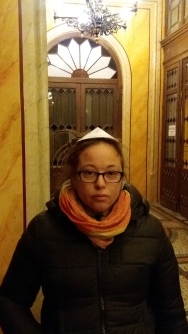
20171203_124919Last week Sunday, my partner and I were in Budapest, Hungary.  We stopped at the Dohany Street Synagogue, the second largest synagogue in the world and the largest in Europe.  After we bought our tickets and proceeded through security, we decided to go into the synagogue first and then the museum.


We walked into the synagogue.  A younger man (maybe 20) was handing out paper kippot (yarmulke in Yiddish).  My partner and I both put our hands out but were refused.  There was an elderly man there who said that the kippot were only for men.  That didn’t surprise me initially as I take my students to the Jewish Museum in Prague and I often argue with the elderly ladies over the right and acceptability of women wearing kippot.  They begrudgingly give my female students kippot saying “only as souvenir,” which boils my blood.  Usually, by the time they give the women kippot even those who traditionally wear them are too shamed to do so.   Continue reading “What Happened When I Dared to Wear a Kippah by Ivy Helman”

Grieving through the Holidays: Painting Holy Women Icons of Grief by Angela Yarber

The holiday season is a particularly difficult time for grief. Whether it is grieving someone who died earlier in the year as you celebrate your first holiday season without them, or the lasting memories of loved ones who are no longer present at family gatherings, this time of year makes grief bubble to the surface. Since this is my first holiday season without my little brother, who died in March, I’ve planned ahead with coping strategies that I’d like to share with other feminists struggling to grieve through the holidays.

Upon the death of a loved one, most people in the West are offered commodified grief, costly funerals, and stifled feelings pre-packaged as dignified tradition. When deathcare became a commercial enterprise at the turn of the twentieth century, there was what mortician and author Caitlin Doughty calls a seismic shift in who was responsible for the dead. “Caring for the corpse went from visceral, primeval work performed by women to a ‘profession,’ an ‘art,’ and even a ‘science,’ performed by well-paid men. The corpse, with all its physical and emotional messiness, was taken from women. It was made neat and clean, and placed in its casket on a pedestal, always just out of our grasp (Caitlin Doughty, From Here to Eternity: Traveling the World to Find the Good Death, 136).”

Continue reading “Grieving through the Holidays: Painting Holy Women Icons of Grief by Angela Yarber”

Depicting Mary by Natalie Weaver

In October I had the opportunity to travel to the Louvre Museum on a free day I had from a conference I was attending in Leuven, Belgium.  I went predisposed to consider images of the Madonna as I had been thinking about her representations in art for some time.  In my own painting, I have been developing a version of the Annunciation that depicts Mary as a teenage girl reading a pregnancy test.  Her fear and consternation, coupled by the shock of the event of learning of her pregnancy strikes me as a more accessible telling of the true vulnerability and risk of the unwed child Mary than classic depictions of Mary as a reclining queenly figure quietly receiving the angel’s message.  I likewise had been working on a wood burnt figure of a Black Madonna as a study in both icon making and also understanding the tradition of Black Madonnas found throughout Eastern Europe.

I am deeply aware that representing this figure is a culturally laden task because the Madonna speaks both to some of the deepest spiritual needs and inclinations of many faithful Christians world over, just as she is almost shorthand for division among Christian communities.  Her presentation is tremendously political as it is received by fans and critics simultaneously as at once championing women (and the divine within women) and also condemning real women whose maternity and bodies can never be as morally or physically pristine as Mary’s.  Mary’s skin, clothing, age, gesturing, posture, gaze, and more speak volumes about the social location of her patrons and creators as well as the manner in which the viewer is being invited to receive her.

Continue reading “Depicting Mary by Natalie Weaver”

Looking for a Mouth to Tell the Story by Esther Nelson

In Chinua Achebe’s novel, THINGS FALL APART, Okonkwo, a proud, hard-working, albeit quick-tempered tribesman living in the village of Umuofia, fires a gun at Ekwefi, one of his three wives, almost killing her.  Chielo, a widow with two children, who also serves as the priestess of Agbala, Oracle of the Hills and Caves, asks Ekwefi, “Is it true that Okonkwo nearly killed you with his gun?”

Ekwefi replies, “It is true indeed, my dear friend.  I cannot yet find a mouth with which to tell the story.”

I love Ekwefi’s turn of phrase as she responds to Chielo.  Shaken, distraught, and outraged over being shot at by her fiery husband, she “cannot yet find a mouth with which to tell the story.”  That’s exactly how I feel these days.

Continue reading “Looking for a Mouth to Tell the Story by Esther Nelson”

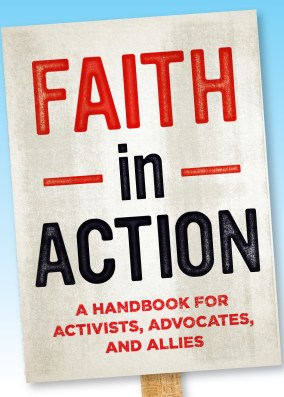
Faith in Action by Lisa Kloskin

Nearly a month ago, American voters showed up at the polls and delivered some big wins: the first openly transgender person was elected to a statehouse—Danica Roem in Virginia. Roem defeated an incumbent candidate who authored an anti-trans bathroom bill. Also in Virginia: the boyfriend of a reporter shot and killed on live TV, Chris Hurst, won a seat to the statehouse on a gun-control platform, defeating the three-term NRA-backed incumbent. And Hoboken, New Jersey, got its first Sikh mayor: Ravi Bhalla. These and others are encouraging signs that love and tolerance are gaining ground in the public sphere. But there’s still so much work to do. White Supremacists and Nazis still walk boldly in the streets, LGBTQIA teens still face bullying and higher rates of self-harm, women are still paid less for equal work and harassed in every arena, sea levels are rising at faster rates than we previously thought, people of color are still being killed by police, mass shootings are still a regular part of our news cycle, refugees are still waiting in camps around the world for a chance at a better, safer life.

Activists and advocates have been working for justice in these and other areas for decades. In the last year, spurred on by events like the Women’s March, a growing group of would-be activists has emerged. These allies are a welcome addition to the justice movement, but many worry they won’t do or say the right things, and want to have their perspectives deepened on important issues. They need guides and resources to give them the knowledge, tools, and confidence to make a real impact.

Continue reading “Faith in Action by Lisa Kloskin”

Gifts from My Father by Carol P. Christ

My father was a very intelligent man who tested “genius” in the army. Drafted into the army at a young age, he decided not to take advantage of the “GI Bill” that would have paid for his college education after the war, because he already had a family to support. My father was lucky not to have served in combat. Scheduled for the invasion of Japan, he served in its occupation. I once asked him if he saw the devastating effects of the atomic bombs that the United States dropped on Japan. Instead of answering directly, he said dismissively, “I suppose you think I was traumatized.” I imagine that on some level he was, because unlike many WW II veterans he never spoke about his time in the army, and most tellingly, he was the only member of his unit not to sign up for the “extra pay” to be earned in the reserves, and thus the only one not to be called up to serve in Korea. Although he never questioned the US government’s right to wage war, he always told me, “war is hell.” Though he was not at all pleased when I became active in the anti-war movement, I found some of the roots of my opposition to war in my father’s refusal to glorify it. Continue reading “Gifts from My Father by Carol P. Christ”

Gas-lighting on Al Franken(stein)’s Street by Elisabeth Schilling

I will add my #metoo, but don’t feel like going into details. I will just say that in light of my past experience and Al Franken’s statement of apology, I’m realizing why some of us don’t tell at an even deeper level.

This is Al Franken’s statement:

“I’ve met tens of thousands of people and taken thousands of photographs, often in crowded and chaotic situations. I’m a warm person; I hug people. I’ve learned from recent stories that in some of those encounters, I crossed a line for some women — and I know that any number is too many. Some women have found my greetings or embraces for a hug or photo inappropriate, and I respect their feelings about that. I’ve thought a lot in recent days about how that could happen, and recognize that I need to be much more careful and sensitive in these situations. I feel terribly that I’ve made some women feel badly and for that I am so sorry, and I want to make sure that never happens again.”

Summary: It’s super hard to be a guy in this society.

Continue reading “Gas-lighting on Al Franken(stein)’s Street by Elisabeth Schilling”