 My social media accounts have recently been ablaze with announcements of meetings, sessions, and receptions to attend for those of us who study or work in religion/theology in the U.S. Some 12,000-15,000 scholars and students will descend upon San Diego this weekend for the annual American Academy of Religion/Society of Biblical Literature (AAR/SBL) conference.
While as a theological and philosophical ethicist I attend this gathering every year regardless of venue or conference theme, I’m particularly excited about this year’s focus on climate change.
Sessions devoted to the topic include a panel on the release of the Public Religion Research Institute/AAR National Survey on Religion, Values, and Climate Change (Sat, 9-11:30am, CC-20D) presentations by the Intergovernmental Panel on Climate Change (IPCC) (Sat, 11:45-12:45, CC-20D), a talk by environmentalist Bil McKibben (Sat, 7:30-8:30pm, CC-20D), the AAR Presidential Address by Laurie Zoloth (an eminent bioethics and Jewish Studies scholar; Sun 11:45-12:45,CC-20D), and remarks by former president Jimmy Carter on “The Role of Religion in Mediating Conflicts and Imagining Futures: The Cases of Climate Change and Equality for Women” (Mon, 4-5:30pm, CC-20) among others.

Beyond that, I’m especially excited about the number of sessions I see devoted to discussing ecofeminism–the scholarly and activist movement that takes seriously the interconnections between the oppression of women and the exploitation of nature. Let me enumerate a few of these (n.b. the following is a non-exhaustive list):
– On Friday, 1:30-3:30pm (CC-14A), the Women’s Lounge Roundtable will entail a pre-conference luncheon on “Ecofeminism and Earth Healing” featuring emerging scholars from Claremont Graduate University.
– On Sunday, 9-11:30am (CC-3), the Feminist Theory and Religious Reflection Group will feature a panel of papers on “ecological, epistemological, and ethical habitations.”
– On Sunday, 1-2:30pm (CC-30A), the Feminist Theory & Religious Reflection Group will sponsor another session tied to the conference theme: “Strategic Negotiations with Feminism on the Borders: Rhetoric in American Homiletics, ‘On the Move’ Ethics in Ecofeminism.”
– On Sunday, 3-4:30pm (CC-26), the Womanist Approaches to Religion and Society Group will convene a session entitled “Ecowomanism 101: A Roundtable Discussing Vital Themes and Trajectories.”
I’m looking forward to this conference and wish all AAR/SBL attendees an enriching and eventful time as well!

Grace Yia-Hei Kao is Associate Professor of Ethics and co-director of the Center for Sexuality, Gender, and Religion at Claremont School of Theology. She is the author of Grounding Human Rights in a Pluralist World (Georgetown University Press, 2011), has a forthcoming co-edited anthology with Ilsup Ahn on Asian American Christian Ethics (Baylor University Press), and is working with Rebecca Todd Peters on anthology of women’s theological lives. Read more about her work on her website.


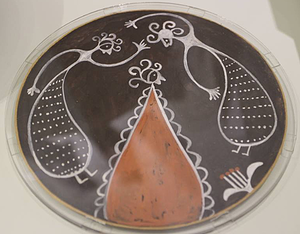 The image from an ancient Cretan bowl (c.1700 BCE) from the Sacred Center of Phaistos pictured here has often been interpreted as an early depiction of Persephone’s descent or rising. But are clues from later Greek mythology pointing in the right direction in this case?


 Here’s how my mind leaps around. I was mooning about and trying to figure out what I wanted to write for this blog when I picked up one of the books in the stack at the other end of the couch. I bought


 I admit I had the fortune of loving my father, the late Reverend Teasley, and feeling loved by him. I also date my fascination with the divine back to my father. There are many ways this fascination could have taken shape, but for me it led to the experience of religious diversity as an element of the global community of human beings that has never abated.
 Ten thousand people descend on San Diego this weekend for the

