Ancestor Connection Revisited: Anna M. Christ of Little Germany, Brooklyn by Carol P. Christ

carol-christThese days I can’t get my 2x great-grandmother Anna Maria Christ off my mind.  She may be the independent female ancestor I have been looking for all these years.

My father’s father was transferred from New York to San Francisco during the depression. When I moved to New York City, I felt powerfully connected to its diverse immigrant culture, but I never thought of trying to figure out where and when my ancestors lived there.

Recently I found my Scottish and Irish 2x great-grandparents, James Inglis, the seaman, and Annie Corliss, mother of 9, living in the tenements on Cherry Street near the port of New York.  These were my father’s ancestors on his mother’s side.  I felt inspired by a photograph of Annie to take her Irish spirit of triumph over adversity into my soul.

Because it has become fashionable to be interested in things Irish, I began my ancestor research there.  In fact, I am more German (3/8) than I am Irish (3/16).  As I have delved into my German ancestry, I realized that being German became a cause for shame in both the First and Second World Wars.  German language newspapers were banned, Germans were interned, people hated Germans, and many Germans changed their names.

As a child I learned to create mock battles against “krauts,” Continue reading “Ancestor Connection Revisited: Anna M. Christ of Little Germany, Brooklyn by Carol P. Christ”

Painting Sappho by Angela Yarber

angela

“Someone, I say, will remember us in the future,” she once wrote.  To my knowledge, she was never dubbed a prophet.  A muse, yes.  A romantic, perhaps.  But never a prophet, rarely holy, and nary an icon.  Until now.   Hailed as one of the best Greek lyric poets, many have tried to forget her, or at least the more provocative elements of her life.  The passionate poet Sappho was born on the island of Lesbos around 620 BCE (sometime between 630-612 BCE).  The word lesbian stems from the place of her birth and her name is the origin of the word sapphic, though most scholars assert that little is known of her actual life and that the majority of her poetry is not autobiographical.  Yet her lyric poetry speaks of love for both sexes and myriad people.

What is more, the idea of homo and heterosexuality are not transhistorical essences, but instead are relatively recent socio-historical constructs. To say that there were strict sexual binaries in the ancient world in which Sappho lived would be an anachronism. Sexuality was much more fluid.  Not surprisingly, many scholars have tried to name and claim male lovers for Sappho, a heteronormative attempt to erase her fluid sexuality, her hope to be remembered in the future dashed, demeaned, forgotten.  In fact, during the Victorian Era, many asserted that Sappho was the headmistress of a girls’ school, another attempt to straighten out her memory, her poetry, her love. Continue reading “Painting Sappho by Angela Yarber”

Invoking the Blessings of the Tibetan Buddhist Goddess Tara through Chanting Her Mantra to Overcome Fear by Karen Nelson Villanueva

Karen Nelson Villanueva has recently successfully defended her doctoral dissertation, “Invoking the Blessings of the Tibetan Buddhist Goddess Tara Through Chanting Her Mantra to Overcome Fear,”

Of all the graduate institutions in the world, I chose the California Institute of Integral Studies (CIIS) in San Francisco because of its unique program in Women’s Spirituality. Only here could I integrate my love of the Goddess Tara, my spiritual practice of Tibetan Buddhism, and my passion to chant into a scholarly study titled “Invoking the Blessings of the Tibetan Buddhist Goddess Tara Through Chanting Her Mantra to Overcome Fear.”

I conducted my research in the summer of 2008. Fortunately, I was able to draw from the many academic, contemplative, and spiritual groups of my acquaintance in the San Francisco Bay Area to solicit study co-participants. Over the course of three months, we convened on six occasions to meditate, pray, and chant to Tara with the intention of overcoming a particular fear. Between our meetings, we chanted on our own and kept a journal about what we were experiencing. Continue reading “Invoking the Blessings of the Tibetan Buddhist Goddess Tara through Chanting Her Mantra to Overcome Fear by Karen Nelson Villanueva”

A Song For All Beings by Jassy Watson

At the Jennifer Berezan concert
Jassy and sisters at the Jennifer Berezan concert

Last month I was blessed to have attended Jennifer Berezan and friends concert “A Song for all Beings” with Shiloh Sophia and a tribe of Cosmic Cowgirl Alumni sisters while visiting California – a long way from my Australian home. I first heard Jennifer’s music on tour with Carol Christ in Crete. I clearly remember  “Returning” being played as our bus descended the mountains on dusk one evening, and I was deeply moved. I now have a selection of her music and have played ‘A Song for all Beings’, inspired by the Buddhist practices of Lovingkindness and Compassion, nearly every day since.

To have been given the opportunity to see the show in the flesh was a wonderful gift. It was the seemingly endless recital of the ‘Prayer for the Disappearing Species’ by Luisah Teish that left the greatest impression: Leatherback Sea Turtle, Northern right whale, Javan Rhinocerous, Siberian Tiger, Mountain Gorilla, Giant Panda, Orangutan, Polar Bear, Tiger….this is just a handful. Hearing this led me on a search to find out more about animal conservation efforts. Continue reading “A Song For All Beings by Jassy Watson”

My Experience of Community by Ivy Helman

For many feminists, expheadshoterience is crucial.  Experience has long been associated with feminist epistemological theories which suggest that reflection on and analysis of one’s experiences offer crucial insight into society.  In the history of the women’s movement, this insight and analysis has many times translated into direct action to change the way our society functions.

Experience too has been problematized by various postmodern and postcolonial feminist theorists.  They rightly point to the situated-ness of all experiences along class, race, gender, ethnic, religious and other lines.  (For more on these ideas, one could read Postcolonialism, Feminism & Religious Discourse edited by Laura E. Donaldson and Kwok Pui-lan.)  The context of each and every experience is different.  It would be unwise therefore to assume that experiences produce adequate knowledge about societies and how they function.  For example, the experience of white middle-class British women living in India during the British occupation is very different from her indigenous contemporary and completely different from lower caste men and women of the same time period.  It is important to remember here that patriarchal privilege rears its head and favors some people’s experiences over others, often codifying an experience as “the experience.”  When we talk about experience then we should acknowledge that there is no such thing as a generic experience.  In fact, some post-modernist feminist thinkers think that situated-ness can color experience so much that our experiences may not even be reliable descriptions of the way society functions. Continue reading “My Experience of Community by Ivy Helman”

THANKS-giving by amina wadud

Amina Wadud 2 I am Muslim, by choice, practice and vocation

Last week was that most contested U.S. family holiday, Thanksgiving.  No, I’m not going to revisit the numerous points of contestation.  I’m hoping we’ve heard them all and maybe even participated in support for or against some of the contests.

I’m actually reflecting on thanks, and even more, on giving.

One of the five pillars upon which Islam stands is Zakah, the required “poor-due” or almsgiving.  Like tithing, the 10% of earnings required in certain branches of Christianity, Zakah is enumerated.  It is 2.5% of your unused wealth. Continue reading “THANKS-giving by amina wadud”

On the Transmission of Life by Natalie Weaver

Natalie Weaver

Among the more controversial Roman Catholic documents is Humanae Vitae, the 1968 encyclical of Pope Paul VI on birth control.  This encyclical famously instructs against the use of artificial contraception methods in the regulation of birth.  This position is based on the theological warrant that the natural law of God’s reproductive design requires human sexuality, if it is to be moral, to be always nuptial, companionable, and open to new life.  The encyclical anticipates a number of reasons why people will object to this teaching, including: population problems, family and personal limitations, economic concerns, and so on.  It also anticipates that some will suggest procreative and unitive ends must be seen diachronically in the context of the fullness of nuptial sexuality, such that sexuality would be understood holistically rather than as a series of individual sexual acts.  Despite its acknowledgement of these concerns as legitimate, the encyclical argues that grave harm flows from the distortion of natural law and leads inevitably to the degradation of sexual dignity and nuptial integrity (for example, in making free sex more available to young people outside of marriage or cheapening male regard for women on account of women’s sexual objectification).  The encyclical thus opts for an approach that evaluates sexual morality in terms of individual sexual acts.

The perspective of the document has been critically unpacked for decades, and its instruction is in the very least unconvincing to many Catholic couples.   I find in my teaching that Catholic college students today are unfamiliar with the document’s language and rationale, even though they may know the basic instruction that Catholics aren’t supposed to use birth control.   Since this issue is both topical currently due to the healthcare legislation and since birth regulation is a requisite discussion in my course on sexual ethics, I have the students read the encyclical itself.  Now, this is a hard task because I know by and large what the student reactions will be.  Their most favorable reaction is generally that the document has no instructional or binding value for them.  Their least favorable reaction is that the document makes poor sense of the human situation today, especially because human sexual expression reaches well beyond the Church’s vision of normative, heterosexual, marital union. Continue reading “On the Transmission of Life by Natalie Weaver”

SACRED RHYTHMS OF THE OLIVE HARVEST by Carol P. Christ

carol-christOlives are being harvested in the fields outside my town these days.  We have been having the first rains of the season.  The roads are wet and muddy, and the trees are partially shrouded in mist.  The fields are spread with black plastic nets, and people are hard at work, the men hitting the trees to make the olives fall, and the women picking up the olives from the nets.  The harvest will continue throughout the winter.

The olive press is busy. Cars and trucks come and go, unloading heavy bags filled with olives.  These days the bags are white, made of sturdy woven plastic. In Crete this fall several of us bought canvas olive bags, hand-woven by women.  These, along with baskets hand-woven by men, were still in use only a few decades ago.

olive harvest in Lesbos early 20th century by Theofilos Hajimichael

A friend who died a few years ago told me that “in the old days” there were no nets. The women and the children had to pick the olives up from the ground, often cutting their hands on thorns and stones.  The nets are a Goddess-send.  Between harvests, the nets are simply folded up and placed in the crotch of the tree. Here no one steals them.

In the fields where I walk some of the trees have enormous trunks. Some of them have two trunks, growing like sisters.  Many of them are 300, some perhaps 500, years old.  A man emerges from a field that has some particularly old trees.  I ask him how old they are. “Older than I am,” he replies. “They were here before I was born.  They will be here after I die.” Continue reading “SACRED RHYTHMS OF THE OLIVE HARVEST by Carol P. Christ”

Water, Activism, and Thirsting for Change by Xochitl Alvizo

XA yellowMike Wilson’s persistent replacement of water sources in the desert for those who may be dying of thirst is part of his affirmation that we are all inextricably connected…the affirmation that our individual well-being cannot be separated from our collective well-being.

I carry two water bottles with me at all times, one for water and one for change – quarters, nickels, dimes, and pennies, as well as the occasional dollar bill. I carry the first bottle because, here in the U.S., I have the luxury of accessing potable drinking water, from which I am able to refill my reusable water bottle, almost everywhere I go. I don’t go anywhere without it. Even at a friend’s house or out to eat at a restaurant, when offered a glass of drinking water I simply pull out my water bottle and if needed refill it from the tap. No need to wash an extra cup. I especially find it necessary to have my water bottle with me when I am at conferences or business meetings where the default is to provide people with brand new single-use disposable water bottles that more often than not end up in the trash can instead of the recycling bin – which is often not even available. I carry my water bottle with me at all times.

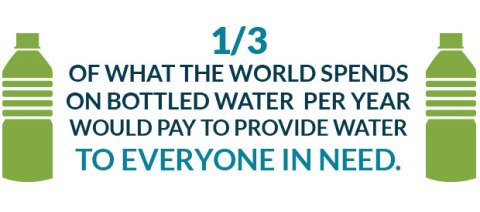
Sadly (and, criminally, really), people in the U.S., 90% of whom have access to perfectly good drinking water from their tap, are the top consumers of store bought bottled water – and unnecessarily so. The great irony is that 40% of bottled water comes directly from public water supplies – from the city’s public works for which tax-payers are already paying. Meanwhile, in many parts of the world people are literally dying of thirst and access to fresh drinking water continues to be a growing crisis. Single-use bottled water makes me angry, for unless water is being bottled in order to be transported to people in places that have no access to it, buying bottled water is unnecessary, indulgent, and willfully uninformed.blue planet, water crisis, Mike Wilson Continue reading “Water, Activism, and Thirsting for Change by Xochitl Alvizo”

Jesus, the Woman at the Well, and the Meaning of ‘Man’ by Stuart Dean

 Stuart WordPress photoThe story in the Gospel of John of the encounter Jesus has with a Samaritan woman (hereafter, ‘the Samaritan’) at Jacob’s well (4:7-29) has attracted considerable scholarly attention.  For an overview of some of the interpretive issues raised by it there is a video of a conversation about it between H. W. Attridge and D. L. Bartlett of Yale Divinity School available on Youtube here.  I intend to focus primarily on only four verses, John 4:16-19.

Here is my translation (the underlying Greek and links to interpretive resources can be found here):

16 [Jesus] said: “go tell your ‘man’ and come back here.”
17 The Samaritan answered, “I do not have a ‘man.”’ Jesus said to her “Beautifully you said ‘I do not have a man.’
18 You have had five ‘men,’ and the one whom you have now is not your ‘man.’  You spoke truthfully.”
19 The Samaritan said to him: “Sir, I see you are a wise listener.”

My translation is intended to bring out what I take to be a play on the meaning of the underlying Greek word for man.  Before I explain exactly what the play on meaning is about I want to justify the assumption that there is some sort of play in the first place. Some have argued that the reference to the bride and bridegroom at John 3:29 foreshadows the meeting of Jesus and the Samaritan as a spiritual wedding.  The theme of a spiritual wedding is arguably also foreshadowed in how John starts the book itself, for ‘beginning’ is a feminine noun in Greek and ‘word’ is masculine, making ‘in the beginning was the word’ sexually symbolic; that, in turn, suggests that the well before which Jesus and the Samaritan stand, or the water in it, symbolizes God, or at least the spirit of God. Continue reading “Jesus, the Woman at the Well, and the Meaning of ‘Man’ by Stuart Dean”