

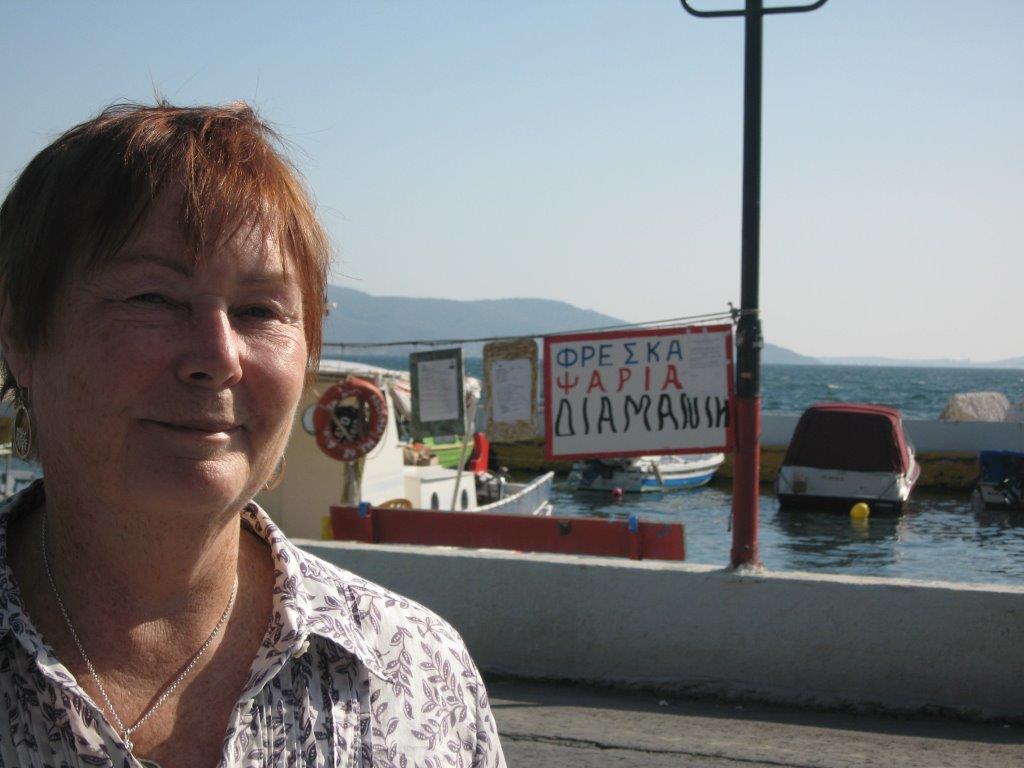
 Last fall I undertook the Ariadne Goddess Pilgrimage to Crete and saw many wonders. Foremost for me was our descent into the Skoteino Cave, following in the footsteps of ancient Cretans who understood the cave to be the Source of Life, the womb of the Goddess, and a place of transformation. I ventured down tentatively taking very wary steps, protecting my two new hip replacements, determined to join our sacred ritual in the cave with my sisters. My hips called a stop to my descent half-way down. I perched perilously on a small rock ledge and there I confronted inner and outer darkness. It was indeed a profound transformation. Continue reading “Inner and Outer Darkness in the Skoteino Cave by Coleen Clare”
Category: General
Men, Men, Everywhere by Kecia Ali

I recently published an essay in the British quarterly Critical Muslim. In it, I chose books on Muslim thought and reform by three prominent, well-regarded male scholars and I counted mentions of individual women in their indexes, their texts, or both. I didn’t have to count very high. I looked at how often they cited – or didn’t cite – books by women in their notes and bibliographies. And then I wailed and gnashed my teeth.
I didn’t really. But I wanted to.
Consider:
A study of modern Muslim intellectuals with a chapter on women, law, and society, that names only three women, none of them Muslim as far as I can tell, in an index which names 240 individuals?
Two books about Blackamerican Muslim thought and identity that do not mention Amina Wadud, the African-American Muslim thinker who has had the most significant global impact?
A book about Muslim reform that names only four Muslim women, all from Muhammad’s seventh-century community, and all but one from his household, in the main body of the work? Which segregates every book by a Muslim woman into one lengthy endnote, and says nothing about them or their authors anywhere else? Continue reading “Men, Men, Everywhere by Kecia Ali”
IS IT ESSENTIALIST TO SPEAK OF EARTH AS OUR MOTHER? by Carol P. Christ
 The charge of “essentialism” has become equivalent to the “kiss of death” in recent feminist discussions. In this context it is taboo to speak of Mother Earth. Yet, I would argue there are good reasons for speaking of Mother Earth that do not add up to essentialism. What if the values associated with motherhood are viewed as the highest values? What if the image of Mother Earth encourages all of us to recognize the gift of life and to share the gifts we have been given with others?
For those not familiar with the “essentialism” debate in feminist theory, it might be useful to define “essentialism.” In philosophy, essentialism is the idea that every “thing” has an “essence” which defines it. In its pure form, essentialism is a by-product of Platonic “idealism” which states, for example, that the “idea” of table is prior to every actual table and that every actual table is an embodiment of the idea of table.
Aristotle disagreed with the Platonic view “way back then,” arguing that the idea of what a table is can be inferred from actual tables, and so on for every “thing.” There is no need for an idea to exist prior to the existence of anything. Rather ideas help us to name and categorize existing things. In the 20th century “existentialism” again challenged “essentialism,” asserting that “existence precedes essence.” Existentialism argued that free individuals are defined by what they do, not by what they “are” prior to or apart from their actions.
When Whitehead said that all western philosophy can be understood as a footnote to Plato, he was referring in part to disagreements among philosophers about the relationship of ideas to things and existence to essence.
In the context of feminist theory, the charge of “essentialism” is used to criticize theories which speak of woman as opposed to man or feminine as opposed to masculine. Continue reading “IS IT ESSENTIALIST TO SPEAK OF EARTH AS OUR MOTHER? by Carol P. Christ”
Baby, You Are My Religion by Marie Cartier

—it’s a girl and she weighs 240 pages!
I just heard from the United States distributor of my book, Baby, You Are My Religion: Women, Gay Bars, and Theology before Stonewall.
This blog has to be about that. I feel like I am waiting for my child to arrive and, as I’ve already written about in a previous post, I am announcing the “birth” of my book. The book is on the East Coast – it’s almost here!
The book was published in the United Kingdom by Acumen Publishing and it has taken several weeks for the books to “cross the pond.” So although the book has been in my hands in galley form three times and I know it was published in the U.K. I have yet to see the finished copy! Continue reading “Baby, You Are My Religion by Marie Cartier”
Vipassana: Intensive Meditation and Silent Retreat by amina wadud

It had been on my bucket list for some time. I thought it preferable to fulfill it while I was still in India since this is where the current movement started. How it ended up being completed during the last hectic and intense month of my year adventure in South Asia, I cannot say. Now I take up the next challenge to write about it in 1000 words or less…
I live alone. I don’t have radio, television, or such devices. I rarely talk on the phone – phobia. But I do go online every day. I’m a word person, so to give up words for 10 days: not to speak to anyone, not to read, not to write, and the only major daily activity being sitting in silent meditation, could be a challenge. Continue reading “Vipassana: Intensive Meditation and Silent Retreat by amina wadud”
Moral Courage by Kelly Brown Douglas

The time for false solidarity is over…Let’s us stop talking about it, let us just dig deep inside of ourselves and find a way to do it.
Fifty years ago in response to President Kennedy’s assassination Martin Luther King Jr. wrote: “Our nation should do a great deal of soul-searching …” It is these words of Martin King’s that echo in my mind fifty years later as news headlines continue to be filled with stories of innocent young black bodies falling victim to a social climate that nurtures racialized fears and breeds racialized violence. If the deaths of Renisha McBride, Jonathan Ferrell, Jordan Davis, and Trayvon Martin tell us nothing else, they proclaim loud and clear that we are a people in need of a “great deal of soul-searching.” For me, this time for soul-searching is nothing less than a kairos time. Continue reading “Moral Courage by Kelly Brown Douglas”
GIVING BACK TO THE MOTHER by Carol P. Christ
One of the inspirations for the Goddess Pilgrimage to Crete was the spiritual power and energy I felt at the monastery of Paliani with its Sacred Myrtle Tree. The Panagia, She Who Is All Holy, is said to live in the tree, and the nuns who tend the tree follow customs far older than Christianity. When I first visited Paliani, I asked Her to heal my broken heart and help me find my true love.
 Over the years, I have offered many other prayers: for my books and tours, for health, for citizenship that would enable me to stay in Greece. I tell other pilgrims that the Panagia of Paliani has performed many miracles and repeat the story of the doctors who desperately wanted to have a child, who had tried everything, and who had a son a year to the day after making a prayer at Paliani. I point to the many “tamas,” including gifts of precious jewelry, crutches and body braces that have been given in honor of the power of the Panagia of Paliani.
In the fall of 2012 one of our members prayed that a heavy flow of menstrual blood that often lasted for more than half of every month be stopped so that she would have the strength to participate fully in the pilgrimage. She had been bleeding for 5 weeks when she came on the tour, and her bleeding stopped the moment she touched the tree. Continue reading “GIVING BACK TO THE MOTHER by Carol P. Christ”
Dreaming the dream on . . . by Kaalii Cargill
 I am author, writing fiction and non-fiction. My short stories have been published in various magazines and I have won an international writing prize. When my work was first published, I wanted to write a best-seller and earn enough from my books to retire from my ‘day job’ and write full time. I know the formula: open fast and strong, pick up the reader and carry her along until the last page, action, action, action…
Instead I found myself writing about balance, about land in need of healing and about the people called to defend the balance. My stories are as much about meaning and value as about action, and the same themes cycle though: cooperation vs. domination, defending the Earth, being an integral part of the world around us, cooperation with the rest of Nature. Continue reading “Dreaming the dream on . . . by Kaalii Cargill”
Poetic Stumbles by Xochitl Alvizo

They feel like incomplete thoughts. One day I finally realized the reason why I, for a very long time, was unable to connect with poetry or appreciate it. When I would read a poem I would feel as if the expression was incomplete; poetry felt abstract in a way that did not make sense to me. Even if I would initially have a positive response to a poem and would think, “Ah, that was poetic!” in the same instance I would also judge it to be pretentious, trying to communicate more than what the words could actually mean or rightly convey. And this was precisely the reason why I struggled to appreciate poetry in the first place, I had learned to value only that which communicates clearly, cogently, and ‘logically’. I had been well trained for academic writing, and got stuck there! Eventually, a class I took with Kwok Pui Lan helped me break out of such a narrow way of thinking and valuing, but it was not an easy task. Continue reading “Poetic Stumbles by Xochitl Alvizo”
Can Secular Immigrant Assimilation Promote Equality? Pt. 2
 I often wonder how my life would have been different if I had undergone a secular immigrant assimilation process. My former faith within Pentecostalism not only shaped my identity, but augmented my ability to assimilate into the American culture. Subsequently, this led me to explore how nonreligious narratives help immigrants better acculturate to western society. Despite my interests originating in personal exploration, emergent studies within religion and sociology show that there are many factors that come into play when considering social and cultural assimilation.
Following up on my most recent post, Liberations of Immigrant Women in Western Religious Conversion, I will draw on a comparative analysis to consider secular immigrant assimilation processes. Women’s experiences during their migration process contribute to their cultural and social identity formation. Many studies point to the established idea that religion is a key variable in influencing immigrant assimilation, particularly among the Latino community. “Faith plays an important role in their lives: 74 percent of Latinos say religion provides a ‘great deal’ or ‘quite a bit’ of guidance for them” (Philanthropy Roundtable). Continue reading “Can Secular Immigrant Assimilation Promote Equality? Pt. 2”
 Feminism and Religion