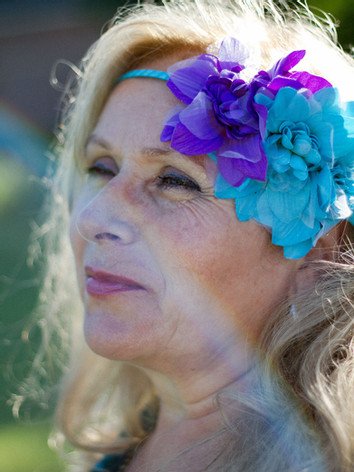
Remembering Carol Christ – and going forward in her footsteps by Laura Shannon

When I was 17, I left the US to live and study in Europe for a year, with Womanspirit Rising crammed into my backpack. This book, edited by Carol P. Christ and Judith Plaskow, gave me the solid ground of a feminist worldview which honoured women, the body, and the earth. My favourite chapter was the last one: Carol’s foundational essay ‘Why Women Need the Goddess’, where she writes, ‘The simplest and most basic meaning of the symbol of Goddess is the acknowledgement of the legitimacy of female power as a beneficent and independent power’. These words, indeed that whole essay, became the pole star for my journey through the world, helping me name what was missing in both the academic world and the world of dance.

Continue reading “Remembering Carol Christ – and going forward in her footsteps by Laura Shannon”

Loving Venus, a poem by Marie Cartier

Dedicated to Carol Christ, 1945-2021, who taught so many of us how to love the Goddess


She is called “Nude Woman” and currently lives
in her natural museum house in Vienna.
Nude woman. She is art, but she is not in an art museum.
And there are questions:
why was she originally painted red? Why are her breasts so large?
Why is her stomach so large?
Why does she fit in a human hand?
What was her purpose?
Was it to entice men, or to comfort women?
Historians disagree.
Is her hair woven? Or is it a hat?
Why does she have no eyes? No feet? Why is she there?

Continue reading “Loving Venus, a poem by Marie Cartier”

Biblical Poetry, 5th Installment

This is the 5th in a series of work I have been doing to translate passages of the bible into poetry that strips out the patriarchal overlays. You can read the previous posts.

In this installment I am grouping together some passages that deal with vibrational energy and its role in creation. We humans often express sacred vibration as song or chant. When we get into the vibrational flow they are truly uplifting. In the translations below, I have kept two of the words in Hebrew because of their wonderful vibrational essences:

Continue reading “Biblical Poetry, 5th Installment”

The Goddess in Portugal by Mary Sharratt

Luiza Frazão

Most people know Portugal as a deeply Catholic country with a rich Islamic past and an ancient Sephardic Jewish heritage reaching back to Roman Lusitania. But what about the country’s pre-Roman, pre-Abrahamic Goddess cultures? 

Like many foreigners, I moved to Portugal knowing nothing about Portugal’s Goddess heritage.

Then I met Luiza Frazão, Priestess, author, and independent scholar who studied at the Glastonbury Goddess Temple in England with Kathy Jones. After years of training and steeping herself in the lore of the Celtic Goddesses of the Avalonian Tradition, Luiza returned to her native Portugal to research the rich Goddess lore of her country. Intrigued and eager to learn more about her research, I met up with Luiza in the medieval town of Óbidos.

Continue reading “The Goddess in Portugal by Mary Sharratt”

Biblical Poetry, Continued by Janet Maika’i Rudolph

This is the 4th in a series of work I have been doing to translate passages of the bible into poetry that strips out the patriarchal overlays. You can read the previous ones here: Part 1, Part 2, and Part 3.

In this installment I have picked out some passages I really like but that I feel their power and beauty have been deeply hidden. I seek to reveal those hidden wisdoms.

To review; my usage of the 2 main names of divinity:

YHVH or LORD, I translate as Vibration.Being

EL or god, I translate as All-Potential Powers.

I discuss my reasons for these translations in my prior posts referenced above.

Genesis 3:6

And when the woman saw that the tree was good for food,
 and that it was pleasant to the eyes,
and a tree to be desired to make one wise,
she took of the fruit thereof, and did eat,
and gave also unto her husband with her; and he did eat.
KJV (King James Version)

and the woman saw that the function of the tree
is for nourishment and that he is yearning to the eyes
and the tree was a craving to make calculations
and she took from his produce and she ate
and she gave also to the man with her and he ate
Benner Mechanical Translation[i]

When the woman saw the tree, she recognized herself
She recognized and remembered beauty and wisdom
She took its seeds within her in knowing wholeness
She gifted its seeds to her husband in knowing wholeness
MPV (Mystic Pagan Version – my own translations)

Note for Genesis 3:6 – the word for “food” in the KJV version of this passage is “maakal” (Strong’s 3978). The word used for to eat is “akal” (Strong’s 398). Both are built on the root word “kl” which means complete or whole and traditionally refers to how food or nourishment makes us whole.[ii] I would add that in the context of spirit, it is that essence or element that we fill ourselves with to achieve a sense of wholeness.  

Genesis 49:25

Even by the God of thy father,
who shall help thee;
and by the Almighty, who shall bless thee with blessings of heaven above,
blessings of the deep that lieth under,
blessings of the breasts, and of the womb:
KJV

from the mighty one of your father,
he will help you,
and with Shaddai [my breasts] he will respect you,
presents of the sky from upon
the presents of the deep sea stretching our underneath
presents of the breasts and bowels.
Benner

The All-Potential Powers of your ancestors
Who watches compassionately over you
With nourishment from the dripping milk of the cosmos
And blessings from the misty cauldrons of the goddess Tiamat
Blessings of the breast, and the loving womb
MPV

Notes on Genesis 49:25: this passage had to have been a very old pre-biblical blessing. We don’t often see blessings that are clearly given by female divinity figures, or in this case, a divinity that has breasts and womb. Even in the conservative, male-centric King James Version the blessing is of the breast and the womb. The word for breasts is “shad.” To take this theme a step further, the phrase El Shaddai or Shaddai appears 48 times in the Bible. In English, El Shaddai is usually translated as “God Almighty” and Shaddai as “Almighty.” Sometimes they are translated as “God, the One of the Mountain.”[iii] Both are almost always referred to in scholarly discussions with the pronoun “he.” 

I have put the following two passages together because they speak to the same theme. One is a Psalm and the other a Proverb. I really like them because they both speak to the condition of our hearts. As some of you know I am an alaka’i of Aloha International. That is a spiritual guide of Huna or Hawaiian Adventure Shamanism. I love the lessons of Huna which foremost and foundationally remind us to keep a loving and open heart. Aloha not only means hello and good-bye, it means “the breath [ha] we all share,” and it means LOVE. Picture this, the Hawaiian people greet and part from each other which a statement of connection and love. The first principle of Huna is “the world is what you think it is.” The lesson behind this is that what is in our hearts will shape our experiences and ultimately our world. I believe that this is the lesson behind these biblical passages. (I have also included the New International Version for Proverb 4:23 because I think it is particularly beautiful.)

Psalm 37:4

Delight thyself also in the LORD;
and he shall give thee the desires of thine heart.
KJV

Cherish thyself in harmony with Vibration.Being
And gifts will be returned as per the radiance of thy heart.
MPV 

Proverbs 4:23

Keep your heart with all diligence,
For out of it spring the issues of life. 
KJV

Above all else, guard your heart,
For everything you do flows from it.
 (New International Version)

Treasure your heart in lovingkindness,
For it is the wellspring of your life.

MPV 


[i] https://www.ancient-hebrew.org

[ii] Benner, Lexicon; 146-147.

[iii] The Jewish Study Bible; 37.

Bio

Janet Maika’i Rudolph. “IT’S ALL ABOUT THE QUEST.” I have walked the spirit path for over 25 years traveling to sacred sites around the world including Israel to do an Ulpan (Hebrew language studies while working on a Kibbutz), Eleusis and Delphi in Greece, Avebury and Glastonbury in England, Brodgar in Scotland, Machu Picchu in Peru, Teotihuacan in Mexico, and Giza in Egypt. Within these travels, I have participated in numerous shamanic rites and rituals, attended a mystery school based on the ancient Greek model, and studied with shamans around the world. I am twice initiated. The first as a shaman practitioner of a pathway known as Divine Humanity. The second ordination in 2016 was as an Alaka’i (a Hawaiian spiritual guide with Aloha International). I have written three books: When Moses Was a ShamanWhen Eve Was a Goddess, (now available in Spanish, Cuando Eva era una Diosa), and One Gods. In Ardor and Adventure, Janet.now available in Spanish. Cuando Eva era una Diosa

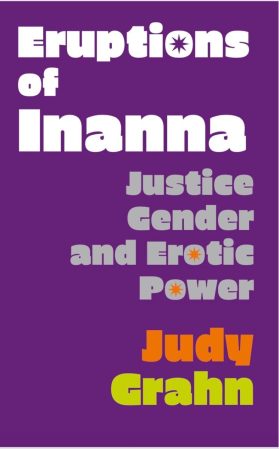
Eruptions of Inanna: Justice, Gender, and Erotic Power by Judy Grahn BOOK REVIEW by Carolyn Lee Boyd

Judy Grahn Eruptions of Inanna

Any new book by Judy Grahn is cause for celebration. For decades, Grahn has been a lyrical and passionate poet, author, mythographer, and cultural theorist whose work  features both goddess wisdom and contemporary culture centering on women and queer people. Nightboat Books has just published her newest book, Eruptions of Inanna: Justice, Gender, and Erotic Power, which offers ancient yet fresh world views with which to approach such issues as injustice, sexuality and gender, climate change, and more just when we need it most. 

In Eruptions of Inanna, she brings what she calls her “poet’s eye” to eight stories featuring the Sumerian goddess Inanna as well as religious practices of those devoted to her. She explores how these have directly influenced our world and, in her words, can continue to “feed our needs and help us take better care of each other and our world.” According to Grahn, Inanna “is a combination of human, creature, erotic and other energetic forces, and civilization. She also inherited very old powers that grew out of women’s rituals” (55).  Her essence engenders sovereignty and self-worth, especially in women and queer people.  She is a goddess of love, espousing passion and the joy of eroticism as integral to both life and society. She practices an expansive justice that creates positive outcomes in response to horrific acts. She creates a civilization of the arts, beautiful and useful crafts, abundance, and a jubilant communal life. She demands respect for nature and ecological sustainability.  

Continue reading “Eruptions of Inanna: Justice, Gender, and Erotic Power by Judy Grahn BOOK REVIEW by Carolyn Lee Boyd”

More Biblical Poetry by Janet Maika’i Rudolph


This is the 3rd in a series of Biblical poetry where I am “translating” verses of the Bible. You can read the first two here: Biblical Poetry and Biblical Poetry, Part 2.

One of my primary purposes of doing this work is to strip away patriarchal veneers that have been layered upon original teachings. I reach into ancient pagan knowledge in order to reclaim what I believe to have been lost.

Below is each verse in 3 versions. First is the King James Version (KJV) for familiarity, the second is Jeff Benner’s Mechanical Translation (Benner) which uses a consistent translation for each word. I use his translations to get a better sense of how the words originally fit together.[i]

Continue reading “More Biblical Poetry by Janet Maika’i Rudolph”

A Wish-Fulfillment Dream by Barbara Ardinger


Rest awhile, Dear Reader, and dream along with me. We’re standing on a corner, call it Main Street, Any City, USA. We’re chatting, passing the time of day, being happy we can stand among other people without the fear of a giant virus jumping out of someone’s breath and attacking us. It’s a nice day here on the street. Not much traffic.

Oh, look—there’s a huge box in the middle of the intersection. It’s shabby, looks to be made of old, thin wood loosely clamped together. The box starts shaking, rocking back and forth. What’s in there? Something is obviously trying to get out. As we watch, an orange mist starts seeping out through the cracks in the box. More shaking. Now the box seems to be jumping. More orange mist. And the box shatters. An orange form—is it human? It’s fat. It’s shaking an iPhone. Or is that a golf club? The orange one speaks. “Do you miss me yet?” “Stand back and stand by.” “I’ll be baa-ack.”

Continue reading “A Wish-Fulfillment Dream by Barbara Ardinger”

The Healing Spirit of Sacred Play by Carolyn Lee Boyd

Many years ago I participated in seasonal, Goddess-focused celebrations featuring handmade decorations, including some by enormously talented artists who attended.  One year, our spring fete was graced with gorgeous paintings, intricately woven and colorful fabric art, sensuous sculptures, and exquisitely painted eggs. I brought a Peeps diorama depicting the reunion of Demeter and Persephone.  (For anyone wondering, Peeps are brightly colored marshmallows in the shape of bunnies, chicks and other shapes and are sometimes made into dioramas for contests in schools and libraries.) The reason I brought the diorama was partly because, though my own artistic talent is somewhere between extremely questionable and non-existent, I thought people might enjoy a little bit of whimsy to honor spring’s exuberance. In addition, however, I was  also going through a time of great personal and professional stress and my soul deeply needed to be creative with just a little outrageous fun. 

Demeter and Persephone diorama

To recap the story, Persephone had been abducted by Hades and taken to the Underworld. Her mother, Demeter, made the Earth barren until the gods agreed to Persephone’s release. Demeter is the purple Peep and Persephone is yellow, and they are about to be reunited. Hades is pinkly enraged as he stands at the gateway to Hades. Gummi bears are romping while green humans dance in a circle. Snow is on the trees to show that winter is giving way to spring as Demeter returns abundance to the world.

Continue reading “The Healing Spirit of Sacred Play by Carolyn Lee Boyd”

Biblical Poetry by Janet MaiKa’i Rudolph


This blogpost is about biblical verses and uncovering the magic and spirit behind its words. Why, you might ask, is this a project that belongs on a blog dedicated to feminism?

I believe it does because it helps us to strip away the many layers of patriarchy with its attempts to hide and/or change original teachings. Remember; these stories were originally oral wisdom teachings of the “folk.” They weren’t written down until the Babylonian exile, hundreds if not thousands of years removed from their origins. And who was doing the writing? Priests, scribes, and prophets, all with their own agenda. Even the earliest writings we have, the Dead Sea Scrolls, were still written in patriarchal times.

Continue reading “Biblical Poetry by Janet MaiKa’i Rudolph”