There was a moment of realization recently when I saw clearly how in every moment of every day we place trust in the hands of others, many of whom we do not even know. Every time we step onto a bus, train or plane or take a ride in a taxi, we are doing so in faith that they will get us to our destination safely. Every time we drive a car we trust that all those driving on the road with us are safe drivers. We place trust in schoolteachers and childcare workers to care for our children often without knowing anything of their background. We place trust in doctors and healthcare workers, many of us never even questioning treatments or procedures.
Every moment of our lives requires some level of trust and faith. Of course, I know this – we all do, but I have never really questioned this trust or taken the time to think about how much trust it actually takes just to do the everyday. Our lives are immeasurably built on trust. But what happens when fear and doubt start taking over? Continue reading “A Dance Between Fear and Trust by Jassy Watson”
“I believe that these circles of women around us weave invisible nets of love that carry us when we’re weak and sing with us when we’re strong.”
–SARK, Succulent Wild Woman
Seven years ago, a small postcard at the local Unitarian Universalist church caught my eye. It was for a Cakes for the Queen of Heavenfacilitator training at Eliot Chapel in St. Louis. I registered for the training and went, driving alone into an unknown neighborhood. There, I circled in ceremony and sisterhood with women I’d never met, exploring an area that was new for me, and yet that felt so right and so familiar.
I’d left my two young sons home for the day with my husband and it was the first time in what felt like a long time that I’d been on my own, as a woman and not someone’s mother. At the end of the day, each of us draped in beautiful fabric and sitting in a circle around a lovely altar covered with goddess art and symbols of personal empowerment, I looked around at the circle of women and I knew: THIS is what else there is for me. Continue reading “Restoring Ourselves to Ceremony: Red Tent Circles, by Molly”
This week Judith Plaskow and I submitted the final version of our new book Goddess and God in the Worldto our publisher at Fortress Press. Just before completion, I added a shorter version of the following passage to my final chapter. In it I tried to describe the odd feeling of not being moved any longer by a religion that once moved me profoundly. Our book, which explores an embodied theological method, will be out in the summer of 2016.
I have never regretted my decision to leave Christianity. Although I have a sentimental attachment to Christmas trees, Christmas dinners, Christmas carols, and some hymns, I miss little else about Christianity. At a distance of several decades, I find that I quite simply have no feeling for the Christian edifice of doctrines and rituals based on the life and death of a single individual. Jesus was a visionary, but there have been many others like him—including Martin Luther King, Elizabeth Cady Stanton, and Gandhi, all of them flawed, as Jesus must have been as well.
A few years ago, I decided to participate in the Greek Orthodox Easter week services, because they are attended by so many of my neighbors. But while enjoying the company of the women who decorated the epitaphios (tomb for Jesus), the procession through the streets of our town on Friday night, and the lighting of candles at midnight on Saturday, I came to a clear understanding that the Easter drama is no longer my drama. During the Thursday night services, I realized that many of the women were openly grieving the death of Jesus. Though intellectually I could understand that the Easter drama allowed my friends to release pent-up and repressed feelings, I found their deeply emotional response to the re-enactment of the death of Jesus bizarre.
Idean Cave
In leaving Christianity, I had gained the freedom to name the sacred in my own experience, confirmed my deep inner knowing about the human connection to nature, and found the power to create and participate in rituals that have meaning in my life. For me now, the rituals on the Goddess Pilgrimage to Crete are at the center of my spiritual life. To listen to Alice Walker’s words, “We have a beautiful/mother/Her green lap/immense/Her brown embrace/eternal/Her blue body/everything we know”* on a mountaintop or to repeat Ntozake Shange’s cry, “we need a god who bleeds now/whose wounds are not the end of anything”** at the mouth of a cave, moves me more than any passage from the Bible.
Singing “Light and Darkness” in the depths of caves is an embodied act of reclaiming the womb as a symbol of creation and the darkness as a place of transformation. I still enjoy singing the Doxology (Hymn of Praise)—and doing so connects me to my history. But I now sing it in front of altars laden with summer fruits or winter vegetables and with words that express my spirituality: “Praise Her from whom all blessings flow/Praise Her all creatures here below/Praise Her above in wings of flight/Praise Her in darkness and in light.”***
*Alice Walker, “We Have a Beautiful Mother,” Her Blue Body Everything We Know: Earthling Poems 1965-1990 (New York City and Orlando, FL: Harcourt Books, 1991), 459-460.
**Ntozake Shange, “we need a god who bleeds now,” A Daughter’s Geography (New York: St. Martin’s, 1983), 51.
***See Carol P. Christ, She Who Changes: Re-imagining God in the World (New York: Palgrave Macmillian, 2003), 238, for a discussion of the meaning of the new words.
E pluribus unum (‘EPU’), which first began to be used by the U.S. in the 18th century, comes from a poem entitled Moretum that until well into the 19th century was generally attributed to Vergil. During those centuries Latin would have been studied from what was the equivalent of today’s elementary school through at least high school. Because Vergil is to the study of Latin what Shakespeare is to the study of English, Moretum would have been read by anyone lucky enough to receive formal education in those centuries–mostly boys–including the white sons of slave owners.
Those boys, however, would have been motivated not just to read, but to memorize Moretum. That is because Moretum, through a variety of clues, encourages allegorical interpretations, one of which is that it celebrates the sexual intercourse of a single white farmer and his sole companion, his black female slave. Such an interpretation requires ignoring the clues that the author thinks of such sex as rape (as anyone other than a male slave owner would); those clues lead me to think the author may have been a woman.
Illustration of Moretum from a 1558 edition of the works of Vergil available here.
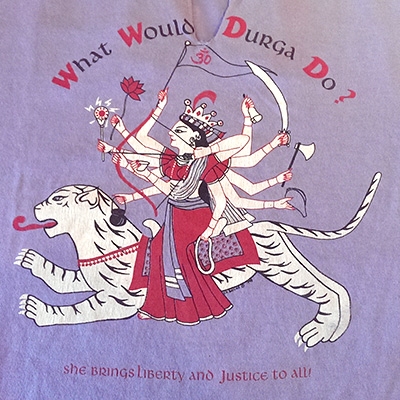
It’s one of my favorite T-shirts. Every time I wear it, people who know who Durga is comment. So do some people who don’t know who the Hindu goddess is.
“What would Durga do?” is of course an echo of the question What would Jesus Do?
I’ve just done a bit of research and learned that this phrase may come from the Middle Ages, that it was famously used in a sermon in about 1891, and that it became very popular among evangelical Christians during the 1990s. What would Jesus do? I think he’d remind us to pay closer attention to the Sermon on the Mount (Matthew 5, 6, 7), especially the Beatitudes and the Golden Rule: “So whatever you wish that others would do to you, do also to them” (Matt.: 7:12). The Golden Rule is of course given in the other major religions, too. WWJD has also been turned into WWBD—“What would Buddha do?” I think the Buddha would tell us to live more mindfully.
But who, you may be asking, is Durga? Why does she have all those arms? Why is she carrying all those weapons? Why is she riding on a tiger? I’ll answer with reference to Patricia Monaghan’s New Book of Goddesses and Heroines (Llewellyn, 1997). While all the Hindu goddesses are ultimately one goddess with the collective name Devi (“goddess”), Monaghan writes, the goddess appears in different forms. “One of the fiercest of Devi’s forms is Durga … [who is] also the eldest.” She appeared during the “primordial war between gods and antigods” and is the “first manifestation of goddess energy” (p. 106). Continue reading “What Would Durga Do? by Barbara Ardinger”
Bas relief of Atropos, shears in hand, cutting the thread of life
In Greek myth, the Fates, the Moirai, are three sisters – Clotho, Lachesis, and Atropos – who spin, measure and cut the thread of life for every person born. Their rule is law; even the gods, so the legend has it, have no power to bargain with the one who cuts the thread and ends the life. Her name, Atropos, means ‘she who cannot be turned’.
In Greece today, others are making the life-or-death decisions. It is not the three sisters of ancient folklore, but a bunch of men in suits now wielding the power to uplift or cast down an entire nation and its millions of citizens. I would like to shine a little light on just two of these groups of (mainly) men who have had the most impact on the recent decisions to bring Greece to the brink of bankruptcy, default and catastrophe. Continue reading “The Unelected and Unaccountable Men Who Decide Our Fate by Laura Shannon”
As we near August 2, known to the ancient Celts as Lughnasadh or Lammas, examples of abundance are everywhere. Gardens and farms are in full bloom with some crops ready for harvest and others very near. Lambs born in spring are now reaching maturity. Days are still long and we are full of energy. It is a perfect time to remember the Celtic Goddess, Rosmerta.
Rosmerta, a goddess loved by both Celtic and Roman Gauls was known as ”The Great Provider”. She is a goddess of fertility and wealth. She was worshipped in South-western Britain, Gaul, and along the Rhone and the Rhine rivers.
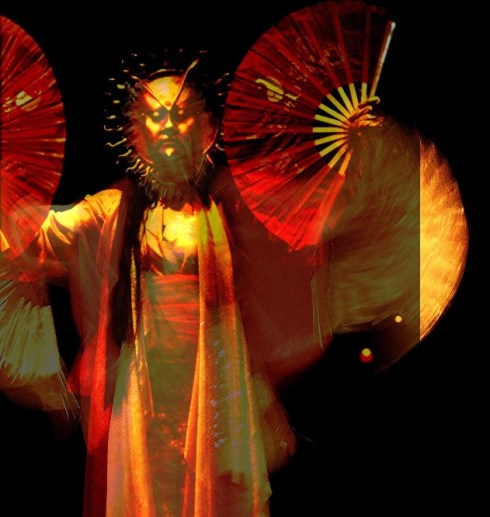
“What the audience saw when a dancer looked through the eyes of the mask was the Goddess Herself, an ancient and yet utterly contemporary presence, looking across time, across the miles.”
Diane Darling, Playwright
In Salt Lake City in October at the Parliament of World Religions a group of women and men will be will be literally “bringing the Goddess to life”. “Goddess Alive!” is produced and written by M. Macha NightMare (Aline O’Brien), with Mary Kay Landon. Participants will use my “Masks of the Goddess” Collection to create a ritual theatre event honoring the many faces of the Divine Feminine throughout the world.
The Masks of the Goddess Project began in 1998, and since then the ever-evolving, multi-cultural collection of masks have travelled around the U.S. to different communities for dance, storytelling, exhibit, and personal invocation, always collaborative.
The creative ‘Wisdom of the Goddess’ Journey Within Program I am facilitating has moved into its’ second trimester, ‘Transformation’. It is winter here in the South; a time to release what no longer serves us and look at the shadow aspects of ourselves. I decided that the goddess Kali Ma, often referred to as the “Dark Mother” was most suitable to explore at this stage. Kali Ma is the Hindu goddess of creation, preservation, and destruction and is better known for her destroyer aspect. She serves as the archetypal image of the birth-and-death Mother, simultaneously the womb and tomb, the giver of life as well as the taker. She is the primordial female principle of manifestation and embodies shakti – feminine energy, creativity and fertility.
Kali is a warrior and is usually depicted with her tongue protruding, brandishing a sword in one hand a decapitated head of a demon in the other. She wears a necklace and belt of skulls, and she drips with blood. The demons she slays however, are the demons of the ego and the attributes of ignorance. Kali is the enlightening force that dismantles preconceived notions, frees you from conditioned beliefs, false personal identities, and anything else that keeps you from recognizing your true identity. In other words, part of what Kali represents is the power to release that which is true in you. Even in destruction, She reminds us that good really can come of bad situations. If you find your hopes and dreams have been crushed, Kali can change the cycle and produce life out of nothingness. Where there is sorrow, She dances to bring joy. Where there is fear, She dances in courage. Continue reading “Kali Ma by Jassy Watson”
Sappho is the first Greek author to attest to the usage of frankincense. The word she uses to refer to it (libanos) is what comparative linguists call a ‘loan word,’ in this case from ancient South Arabic (the root meaning of which is ‘white’), the language spoken in the only region in the world still now, as then, where the trees grow that produce the resin that is frankincense (the finest being White Howjary from near Salalah Oman).
This was long before Amazon Same-Day Prime: that frankincense even made it to where Sappho was is astonishing given the thousands of miles of desert terrain that had to be covered. That fact plus the fact that Sappho chose to use the Arabic word for frankincense suggests it must have been of special importance to her. How important can be seen in the power she attributes to it. In one prayer poem (S.2, composite translation and very brief notes here) she completes a stanza by referring to frankincense burning from Aphrodite’s altars; she completes the very next stanza with a reference to ‘sleep falling.’ The parallelism implies a reciprocity: the smoke goes up, the sleep comes down and a stanza later, there is Aphrodite. Continue reading “Sappho, Frankincense, and Female Spirituality by Stuart Dean”


 I have been deep in thought about TRUST.



 It’s one of my favorite T-shirts. Every time I wear it, people who know who Durga is comment. So do some people who don’t know who the Hindu goddess is.

 Feminism and Religion