I’ve often thought that we (in the USA) have been somewhat, albeit reluctantly, willing to discuss and perhaps even change our minds, behavior, policies, and laws when confronted about the long-lived presence of racism in our local and national institutions. However, when it comes to misogyny—not so much.
Shirley Anita ChisholmSt. Hill (1924 – 2005), was an American politician who, in 1968, became the first black woman to be elected to Congress. “Chisholm represented a district centered in Bedford-Stuyvesant, Brooklyn, for seven terms from 1969 to 1983. In 1972, she became the first black candidate for a major-party nomination for President of the U.S. and the first woman to run for the Democratic Party’s presidential nomination. Throughout her career, she was known for taking ‘a resolute stand against economic, social, and political injustices’ as well as being a strong supporter of black civil rights and women’s rights” (Wikipedia).
Chisholm noted that “…she had faced much more discrimination during her New York legislative career because she was a woman than for her race” (Wikipedia). Why are not more of us aware of Chisholm’s confession?
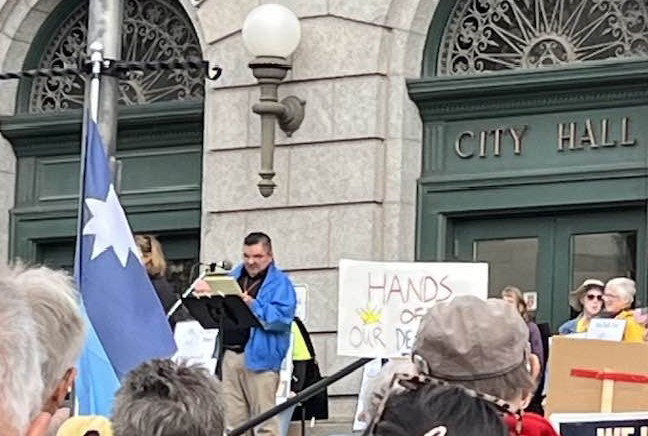
It’s been over a week now since I first heard the news on MPR that four people had been shot in their homes near a golf course in Brooklyn Park where my son once lived. My first thought was that I was glad my son was no longer living there. A little while later I learned that this was not a random act of violence, but rather political violence targeting two Minnesota lawmakers and their spouses. Gradually the details came in. The lawmakers were Democratic lawmakers, former Speaker of the House Melissa Hortman and State Senator John Hoffman and their spouses. And then came the tragic news that Hortman and her husband had been killed. As I drove to pick up a friend to attend the “No Kings” protest downtown, I listened to the news reports of warnings not to attend the protests out of an abundance of caution, with the shooter still at large, as well as the voices of protest leaders saying the tragic events of the morning only strengthened their resolve. In the first few moments of the protest, we observed a moment of silence for Hortman and her husband, and for the recovery of Hoffman and his wife. The entire rally felt like a strange mix of grief and rebellious revelry.
As the identification and eventual arrest of the suspected shooter became known, the tragic events took on an even more ominous tone. The suspect, Vance Boelter, is a far-right Christian nationalist extremist who had preached against abortion and gay rights. He was schooled in his religious beliefs at the Christ for Nations Institute in Dallas, Texas[i] and was aligned with a charismatic Christian movement whose leaders, in the words of The Atlantic columnist Stephanie McCrummen, “speak of spiritual warfare, an army of God, and demon-possessed politicians.”[ii]
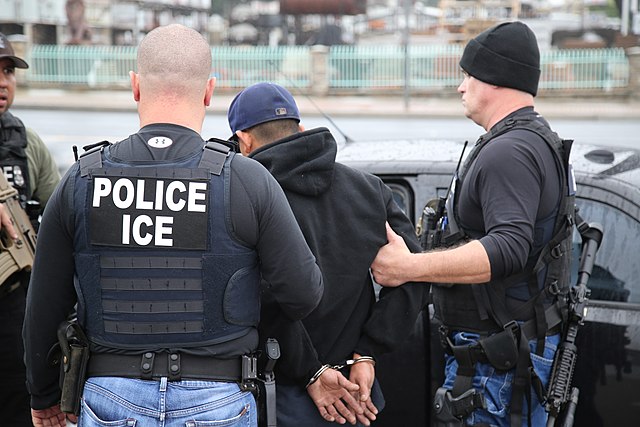
Mahmoud Khalil, one of the first people arrested under the administration’s ICE raids. He was targeted because of his outspoken views on Palestinian rights. He is a legal green card holder and was never charged with a crime. Nevertheless the administrations flew him to a holding cell in Louisiana (from NY) in a particularly cruel move that prevented him from being present at the birth of his first child. Even after the baby was born, the government tried to put up roadblocks for his family to visit him and for him to touch his newborn son. He has now been freed by court order but US government is still trying to deport him. He has vowed that he will not be quiet and has already been seen at protests. He is a profile in courage.
Kilmar Albrego Garcia is another case entirely. The eyes of the government have turned his way and now that this has happened, they are doubling down on their cruelty. Just think for a moment of what it is for the government which the power of law enforcement, the powers of detainment to focus their sights on one person. He was originally deported to El Salvador in March. After the government ignored court orders for months he was finally brought back to the US to face federal charges. It is likely this was a face-saving move on the part of the government so they could say, “see he’s a bad guy who deserves this, look at these horrible criminal charges.”
Climate change is in the news again due to the devasting storm known as Hurricane Sandy. Scientists, activists, journalists, and politicians are telling us that Sandy is not just another “unpredictable event” brought to us by “Mother Nature.” Will we listen this time?
Hurricane Sandy is a human-made and entirely predictable and sure to be repeated environmental consequence of the use of fossil fuels, especially oil and coal. Burning fossil fuels puts carbon dioxide into the atmosphere. This raises the global temperature in the air, land, and sea. Melting of polar ice caps is a result of the rise in global temperatures. This will cause a 3 foot or more rise in the seas, leading to the permanent flooding of the seacoasts and sea coast constructions, including homes, restaurants and shops, office buildings, and harbors and ports.
The warming of the seas is also producing extreme weather conditions, including high winds and hurricanes, along with colder winters and hotter summers. Extreme weather conditions will lead to regular storm-related flooding of rivers and sea coasts, erosion of hills and mountains in winter, followed by catastrophic fires in summer. Prolonged droughts and unseasonal rains will devastate farms and food production. Wildlife habitats will be destroyed. Places where people live will become too hot, too cold, too wet, and generally unfriendly to life.
Photo from Amnesty International. For more information and to support his petition click here.
This is a project that FAR has started to share the stories of immigrants who are targeted by the US administration. It is our belief that when people are recognized as human beings, it is harder to dehumanize them and to take away their civil rights. We are facing a devastating situation where in the United States people are being “disappeared” without any recourse to the legal system. The viciousness of what is happening is growing. Some of those arrested have been released but it is a small drop in the bucket of the flood of arrestees, most not even receiving a day in court and some caught in legal mazes that show no sign of ending.
Take Mahmoud Khalil, whom we have already discussed. He was arrested in March due to his outspoken Pro-Palestinian views. In May, U.S. District Judge Michael Farbiarz in New Jersey ruled that Secretary of State Marco Rubio likely violated the Constitution when he stripped Mahmoud Khalil of his green card and ordered him deported. Even so the Judge declined to release him because he has not proven “irreparable harm” caused by his detention. I think an elementary school child can even understand the irreparable harm one suffers by being detained, esp. in Trump prisons that are designed for harshness. And to add to it, Khalil is a new father who only got to hold his son while in prison after a flurry of lawsuits.
Once there was a tree who loved two young children, twins, a boy and a girl.
Thay came everyday to play under her canopy.
Gather her leaves and play fairies of the forest.
Climb her trunk and play in her branches
And sleep with their backs against her trunk
They loved the tree and the tree loved them.
Time went by and the twins grew older.
They didn’t come to visit the tree as often.
One day when they did come, the tree asked them to play but they responded they needed money because they wanted to go on dates.
The tree responded, take my apples to sell. But leave enough behind for the squirrels and birds and other animals so they can eat too. Leave enough behind for the seeds.
I recently attended an event in Salem, Virginia, put on by The Salem Choral Society titled “People Get Ready,” directed by S. Reed Carter IV. This popular group has sung on numerous occasions locally as well as performing at Carnegie Hall in New York City and the National Cathedral in Washington D.C. The choir (11 men and ~45 women) sang fourteen selections. The song arresting my attention was “People Get Ready.”
From Wikipedia: “‘People Get Ready’ is a 1965 single by the Impressions, the group’s best-known hit, reaching number three on the Billboard R&B chart. The gospel-influenced track was a Curtis Mayfield (1942–1999), American singer-songwriter, guitarist, and record producer. This particular composition displayed [his] growing sense of social and political awareness…. In 2021, Rolling Stone named this song the 122nd greatest song of all time. Martin Luther King Jr. named the song the unofficial anthem of the Civil Rights Movement and often used the song to get people marching or to calm and comfort them.”
I was walking along the street the other day thinking about the comforts I find at home, my favorite tee-shirt, the three or four books I’m reading at a time, photos of loved ones. Around that time, I heard the news that Rümeysa Öztürk, a Turkish PhD student at Tufts who was whisked off the street by ICE agents in Massachusetts. She disappeared into the system until she showed up in detention in Louisiana. This is the facility that has been called “a black hole” by civil rights groups. So many have been swept off the street, how do we keep track? Ozturk had a valid student visa until the State department revoked it without notice nor telling her. She was on her way to break her Ramadan fast with friends. After her arrest she asked for food, not having eaten for 13 hours. She was given snacks. She still hadn’t eaten a meal by the next day and was feeling faint. She was given more snacks.
I began thinking, who are her friends? What was she going to eat? In fact, what are her favorite foods? In other words, who is she as a person. Her name is foreign, she comes from another country so it might be too easy to dismiss her as one of many. But if we know her story, if we humanize her, her story becomes harder to dismiss. The first step in the authoritarian playbook is to dehumanize people for some feature of who they are. When someone is dehumanized, it is far easier to do hateful things.
The antidote is to know their stories, share their stories, speak their stories.
“ . . . the uprising of [our] nature is but the effort to give to [our] whole being the opportunity to expand into all [our] essential nobility.” – Sarah Grimké [i]
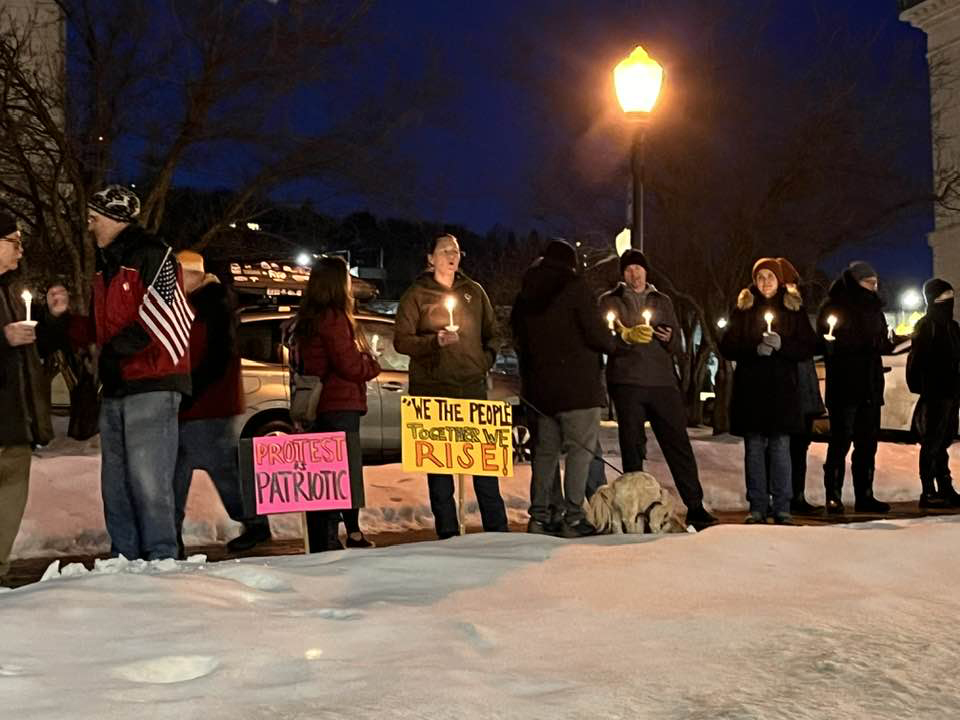
It wasn’t the first time I had stood in protest on that street corner. I’m sure it won’t be the last. But the gathered crowd was by far the largest I’d been a part of there, covering not just the plaza on the western corner of Lake Avenue and Superior Street, but all the other corners as well, and up and down the sidewalks for half a block. We were a motley crew, from young people perhaps at their first protest to the many well-seasoned grey-haired. Though I met a few indigenous friends there, I was struck by the overwhelming perceived whiteness of the crowd. I imagine Black and Brown people were more reluctant to join a street protest where they might be targeted. Indeed, on my way home I heard a report that the number of “driving while Black and Brown” traffic stops has increased in recent days.
Standing in the wet snow, chanting, “This is what democracy looks like!” and “What do we want? Democracy! When do we want it? Now!,” the atmosphere was more of a party than of a wake.[ii] Yet, when the chants began, I found myself near tears, wanting to sob rather than shout. As some report seeing their lives flash before their eyes when facing imminent death, I saw my protest life flashing before my eyes – all the anti-war marches – from Vietnam to Iraq to the recent Israeli attacks on Gaza, the marches for the ERA, the Take Back the Night marches, the MMIW marches, the Standing Rock and Line 3 protests, the Women’s Marches, the march for science, the vigils after school shootings and nightclub shootings and the murder of George Floyd, the rallies to protect trans rights, . . . the list goes on and on. And I felt like weeping, for all these efforts to bring peace and justice and equality to this land were being trampled on and were under threat of being destroyed.
Moderator’s Note: Below is a letter from Mahmoud Khalil in its entirety, dictated over the phone from Immigrations and Customs (ICE) detention in Louisiana. A permanent resident taken by the government for his political speech. The phrase “who has the right to have rights?” was coined by Hannah Arendt who escaped Nazi Germany and wrote poignantly and pointedly about the rise of fascism. While on the surface, this letter doesn’t have an obvious link to FAR’s mission, we feel it is deeply intertwined. Who has the right the have rights? Women once had no rights and it appears we are losing them again at breakneck speed. Immigrant’s rights in this country are being stripped also at breakneck speed. And that is just the tip of the iceberg. If we can’t answer “EVERYONE” to Arendt and Khalil’s question, then human rights mean nothing for any of us.
Wikimedia Commons: Protests in Thomas Paine Park against the detention of Palestinian activist and Columbia student Mahmoud Khalil. [SWinxy]
My name is Mahmoud Khalil and I am a political prisoner. I am writing to you from a detention facility in Louisiana where I wake to cold mornings and spend long days bearing witness to the quiet injustices underway against a great many people precluded from the protections of the law.
Who has the right to have rights? It is certainly not the humans crowded into the cells here. It isn’t the Senegalese man I met who has been deprived of his liberty for a year, his legal situation in limbo and his family an ocean away. It isn’t the 21-year-old detainee I met, who stepped foot in this country at age nine, only to be deported without so much as a hearing.
Justice escapes the contours of this nation’s immigration facilities.
On March 8, I was taken by DHS agents who refused to provide a warrant, and accosted my wife and me as we returned from dinner. By now, the footage of that night has been made public. Before I knew what was happening, agents handcuffed and forced me into an unmarked car. At that moment, my only concern was for Noor’s safety. I had no idea if she would be taken too, since the agents had threatened to arrest her for not leaving my side. DHS would not tell me anything for hours — I did not know the cause of my arrest or if I was facing immediate deportation. At 26 Federal Plaza, I slept on the cold floor. In the early morning hours, agents transported me to another facility in Elizabeth, New Jersey. There, I slept on the ground and was refused a blanket despite my request.