An Open Letter to President Obama about the Dakota Access Pipeline by Elizabeth Cunningham

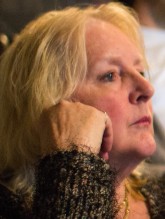
Elizabeth_Author Photo 2I wrote this letter to President Obama on November 18, the morning after I returned from a few days at Standing Rock. I am not an activist by temperament. I went to Standing Rock to support a friend who felt strongly called to go, as well as, to support the cause. I did not participate in direct action, because I did not fully grasp till I was there the preparations I would need to make in terms of clearing my calendar for jail time and a return to North Dakota for a trial. Gratitude and respect for those who are taking this risk and dedicating their lives to this cause.

One thing this letter below does not address is how to donate to the Water Protectors at Standing Rock. Given the overwhelming donations of food and clothing that are still pouring in, financial donation is more practical now. Here’s a link to the donation page: http://standwithstandingrock.net/  You can also donate to the legal fund: https://fundrazr.com/campaigns/11B5z8 People are being arrested on a daily basis.  

I am still sorting through the experience of this journey and its connection to what lies ahead for this country. Unlike many people who have suffered privation and injustice for years and centuries, I have lived in a relatively comfortable, privileged bubble in the Northeast, surrounded by natural beauty and by friends, family, and community of like mind. After this presidential election, I don’t think it is possible or conscionable to live such an insular life, though I do intend to savor and celebrate all moments of joy. The President Elect is clearly bent on environmental depredation. We all have a great deal to learn from the Standing Rock Sioux Tribe. Continue reading “An Open Letter to President Obama about the Dakota Access Pipeline by Elizabeth Cunningham”
Can Good Theology Change the World? Part 2 by Carol P. Christ

Carol P. Christ by Michael Bakas high resoultionIn the first blog in this series, I argued that one of the hallmarks of a good theology is recognizing that the source of authority must be located in individuals and communities who interpret texts and traditions as they encounter divinity anew in the present. In our new book Goddess and God World, Judith Plaskow and I suggest that a second hallmark of good theology is the “turn to the world.” What we mean by this is not only that divinity is immanent in the world, but also that the purpose of human life is to be found in this world—not the next.

The God of traditional theologies is pictured as an old man with a long white beard who rules the world from heaven. It is commonly assumed by those familiar with this picture that the purpose and meaning of human life is not to be found in this world—but rather in heaven. This assumption is increasingly being challenged. Many people no longer believe in life after death. The purpose of morality is increasingly being understood as improving the conditions for the flourishing of human and other forms of life—not on gaining the approval of a God who has the power to assign individuals to heaven or hell in the next world. Continue reading “Can Good Theology Change the World? Part 2 by Carol P. Christ”

Restored in Beauty by Carol P. Christ

Carol Christ in LesbosThe path leading to the Klapados Waterfall begins at the edge of an open meadow in the pine and oak woodlands of a mountain in the island of Lesbos. After driving several miles on a very rutted dirt track, we parked under an oak tree, crossed the meadow and scrambled down a winding path. After about 20 minutes, it ended at a stream surrounded by plane trees. From there, we climbed over rocks to reach a pool created by the seasonal waterfall.

waterfall at klapados 1On the day we visited it, the waterfall was only a trickle of cascading drops that moistened its moss-covered path to the pool. The roots of a plane tree growing at the top of cliff followed the path of the water, weaving a web over the rockface all the way down to the pool.

Sitting on a rock at the edge of the pool I realized that the cliffs that embraced it on three sides were the remains of a crater formed twenty million (or so) years ago when a finger of molten lava pushed its way through the earth, exploding in clouds of dust and projectile rocks.

In Lesbos the volcanic activity came not from a single source–for example, from the highest mountain. Rather, like the plane trees in whose shade we rested, the volcano’s trunk with roots in the molten lava of the earth’s core, had many branches from which it erupted at different times. Huge boulders thrown out in the explosions can be seen in the meadows, while the trees in the forest curve their roots around them to reach the soil. The mountain was also shaped by the settling of volcanic dust that crumbles again into tiny fragments when exposed.

As I was thinking of all of this my friend Cristina climbed over the roots of the plane trees that surrounded the pool, removed her clothes, and slipped into the water. Soon I followed her. We sensed that we were in a sacred place, and as we have done rituals together many times before, our ritual emerged spontaneously: it almost seemed as if our minds and bodies were moving as one.

We renewed ourselves in beauty, submerging our bodies under the water three times, while floating in the embrace of the pool, gazing up at the rock formations, admiring trees that looked like dancing women, moss that looked like pubic hair, and blue black damselflies that all together had created a most beautiful place that called to something deep within us on that day.

Later we would sing the English version of the song of the Navajo Beautyway:

klapados waterfall 056


I walk with beauty before me.
I walk with beauty behind me.
I walk with beauty all around me.
As I walk the beauty way.
I walk with beauty above me.
I walk with beauty below me.
I walk with beauty inside me.
As I walk the beauty way.

We are the creative process of life.

We are restored in beauty.

Blessed be!


Carol leads the life-transforming Goddess Pilgrimage to Crete (facebook and twitter).  Carol’s books include She Who Changes and and Rebirth of the Goddess; with Judith Plaskow, the widely-used anthologies Womanspirit Rising and Weaving the Visions and forthcoming next year, Goddess and God in the World: Conversations in Embodied Theology. Explore Carol’s writing.

Moving the World Forward on the Spiral of Life by Carolyn Lee Boyd

Carolyn Lee BoydThe wasp nest dwells at the edge of my vision waiting for me to notice what it has to show me. In my mind, I have come to this beloved circle of earth beneath the embracing branches of this tree to ponder because the need is urgent for all the world’s women to have lives of peace, safety, equality, opportunity, and enough prosperity to guarantee necessities, and to save our planet from ecological disaster. I seek new ways of thinking about my life and actions and those of the global community of women to inspire more effective means of progress.
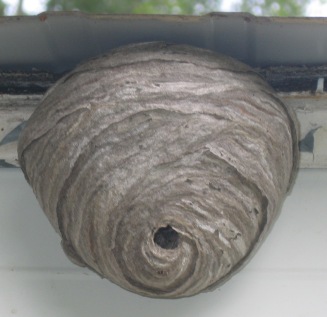
wasps nestI finally spy the wasp nest. I follow its spiral shape, beginning at one point and then expanding in circles ever-outward and upward. I wonder, what if, in addition to perceiving my life as the more traditional journey or age-defined stages, I imagined it as a spiral like the galaxy, flowers, ancient sea creatures caught forever in fossils, swirling water, and so much else of nature? What if at my birth I was like a spiral’s central point, perhaps me at my most essential or as an infinite potential, and then, over time, I spiraled endlessly into the cosmos? Continue reading “Moving the World Forward on the Spiral of Life by Carolyn Lee Boyd”
Winter Solstice Meditation by Molly

December 2014 022When the wheel of the year turns towards fall, I always feel the call to retreat, to cocoon, to pull away. I also feel the urge for fall de-cluttering—my eyes cast about the house for things to unload, get rid of, to cast away. I also search my calendar for those things which can be eliminated, trimmed down, cut back on. I think it is the inexorable approach of the winter holiday season that prompts this desire to withdraw, as well as the natural rhythm of the earth which so clearly says: let things go, it is almost time to hibernate.

Late autumn and the shift toward winter is a time of discernment. A time to choose. A time to notice that which has not made it through the summer’s heat and thus needs to be pruned away. In this time of the year, we both recognize the harvest of our labors and that which needs to be released or even sacrificed as we sense the promise of the new year to come. Continue reading “Winter Solstice Meditation by Molly”

Reciprocity, Empathy, and Reconciliation: The Roots of Human Morality in Our Primate Ancestors by Carol P. Christ

carol mitzi sarahA link to a talk called “Moral Behavior in Animals” by Franz de Waal recently found its way into my email inbox. I am a big fan of Franz de Waal because his findings confirm what I always believed—that animals are intelligent. I followed the link and other suggested links and spent most of the evening listening to de Waal.

De Waal began his studies of animal behavior at a time when instinctual behaviorism was academic orthodoxy: the idea that animals can think and feel was “poo-pooed” by “scientists.” As de Waal observed ironically, everyone who has a pet knows better than that. But academic researchers continued down this path, expressing contempt for ordinary people who thought their pets were intelligent and the likes of de Waal who suggested that scientists might be colossally wrong.

De Waal’s discovery that chimps almost always “reconcile” after fights by touching hands, hugging each other, grooming, and even kissing, led him down “the garden path” to his discovery that what he calls the “two pillars of morality”—“reciprocity and empathy”– are found in primate social systems and in those of other higher mammals including dolphins and elephants . Continue reading “Reciprocity, Empathy, and Reconciliation: The Roots of Human Morality in Our Primate Ancestors by Carol P. Christ”

A New Perspective on the Story of Ruth by Ivy Helman

20140903_180423When I think about having returned to the Judaism of my family, I often think about a short phrase that is on almost all of the conversion documents I’ve seen. “Your people shall be my people and your G-d shall be my G-d.”  It comes from the Book of Ruth and is a powerful phrase in and of itself.  Imagine choosing a journey to a foreign land and being so committed to the person you are traveling with that you are willing to forsake the religion and practices of your people to join hers, even when she extorts you to return to your home.   Think about the kind of trust one needs in another to be able to leave everything behind and follow another path.  That is ideally what the convert to Judaism has chosen: to leave behind their past, setting out on a new religious path.  In fact, it is often frowned upon to ask a convert about their religious past because it is as if it never existed.

Besides these documents, I’ve also encountered the Book of Ruth early in my training as a feminist scholar of religion.  I read many commentaries on the story of Ruth, but what I read never spoke to me.  Yes,  two women were bonded in a deep friendship (perhaps as lovers) struggling to survive and avoid bouts of harassment from men. They also defied patriarchal standards of the day.  Sweet and touching, yes.  A good example of the importance of friendship between women, definitely!   What I 20140904_125500didn’t get then that I do now are the values elevated in these two women.

First, what struck me is just how much our pasts are an important part of who we are.  In many ways, they help to shape our futures.  Ruth’s past built within her the values necessary to make the decision to journey to a foreign land with another woman and without what, could be thought of, as adequate protections.

Continue reading “A New Perspective on the Story of Ruth by Ivy Helman”

Thealogy of the Ordinary by Molly

crop027

The Goddess Gaia is alive
In this time and in this space
She speaks in sunrises
And waves against the shore
She sings with the wind
She dances in moonlight
She holds you close
Your heart beats in time with hers
A great, grand hope and possibility
For this planet…

Over the last two months, I have been listening to a wonderful telesummit about priestesses. I am also a huge fan of the radio show, Voices of the Sacred Feminine. However, as I listen to both, I sometimes find myself wondering if walking a Goddess path is also viewed as synonymous with, “believe everything, question nothing.” Crystal essences, gemstone healing, soul contracts, past lives, spirit guides, astrology, the many realms and dimensions of the occult, mystical, New Age and metaphysical. Is wholesale suspension of logic required to join hands with the Goddess? Is deft management of the tarot essential to the priestess path?  Is excavating my “inner masculine” relevant or appropriate? Must I ascribe to “enlightened” tenets like, “you are not your body,” “I am a spiritual being having a spiritual experience” and “we made an agreement to do this work before we showed up in this body at this time and place” in order to move forward? Continue reading “Thealogy of the Ordinary by Molly”

Mountain Mother, I Hear You Calling by Carol P. Christ

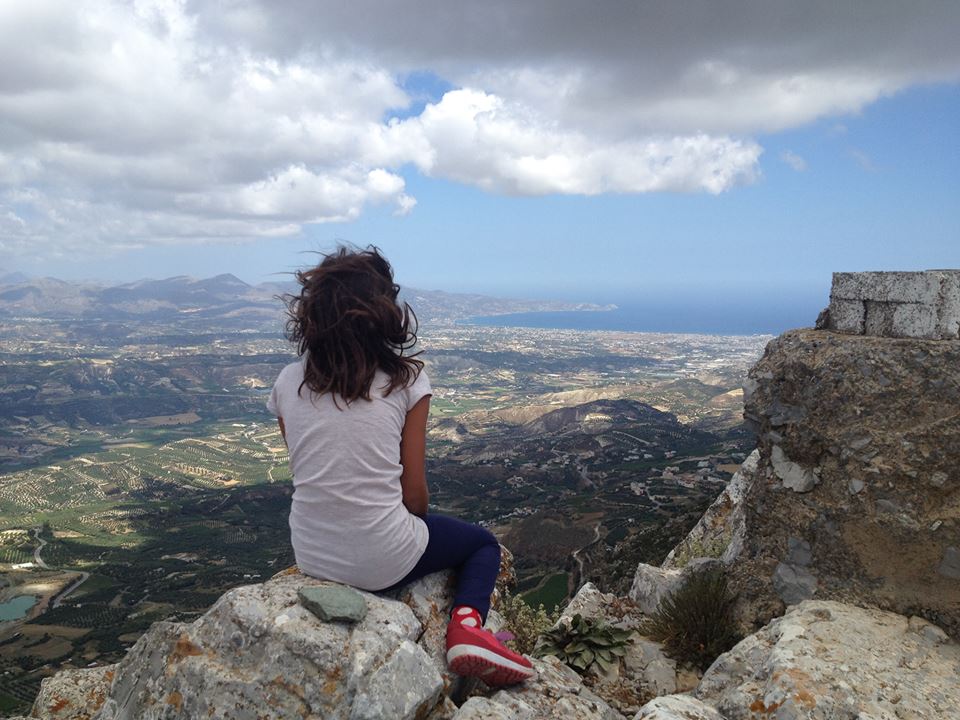
carol christThe mountaintop shrines of Mount Juctas in Archanes, Crete are situated on twin peaks, which may have symbolized breasts. Ancient shrines on the northern peak date from 2200 BCE until at least the end of the Ariadnian (Minoan) period in 1450 BCE. A crevice in the rock was filled with offerings of pottery, clay images of women and men in ritual dress, diseased bodies and body parts, sheep and cattle, and other objects. Excavations to a depth of 13 meters did not reach the bottom layers. Many offerings had been burned, suggesting that the objects were first thrown into fire and then dropped into the crevice. People who climbed the mountain for the festivals would have spilled over both peaks and there may have been shrines as well as fires on both of them.

Goddess Pilgrim on Mount Juctas

With lack of imagination, archaeologists often write that worship in mountaintop shrines in Crete began when the king ascended the mountain to survey his realm. This ignores the fact that people are like goats and will climb anything if they can. Bones provide evidence of domesticated sheep, goats, and cattle in Crete long before there were kings. Surely shepherds climbed Mount Juctas before any kings did.

The idea that mountains are for kings also ignores the fact that there are no kings in Crete today, no realms to be surveyed, and yet the people of Archanes still ascend the mountain for the summer festival known as the Transfiguration of Christ on August 5th and 6th. A church called Afendis Christos or Christ the Lord on the southern peak of Juctas is the destination of current pilgrims. Today the uneven dirt road recently cut into the mountain is clogged with cars (only) during the festival. Continue reading “Mountain Mother, I Hear You Calling by Carol P. Christ”

The Outraged Ancestral Mother by Molly


crop027During the fifth week of the Rise Up and Call Her Name curriculum by Elizabeth Fisher, “We honor the Outraged Ancestral Mother and the belief that the sacred and secular are one.” When I priestessed this session for my women’s circle, I was caught by the idea of the Outraged Ancestral Mother and we spent some time discussing her and the degree to which humanity has hurt our planet. The next morning while I was practicing yoga, snippets of a poem came floating to my mind. I had the distinct feeling that the Outraged Ancestral Mother was ready to speak to me. I went down to the woods to listen to what she had to say.

Continue reading “The Outraged Ancestral Mother by Molly”