Of Waterfalls and Wonder by Beth Bartlett

“A child’s world is fresh and new and beautiful, full of wonder . . . . If I had influence with the good fairy who is supposed to preside over the christening of all children I should ask that her gift to each child in the world be a sense of wonder so indestructible that it would last throughout life . . . .”[i]   – Rachel Carson

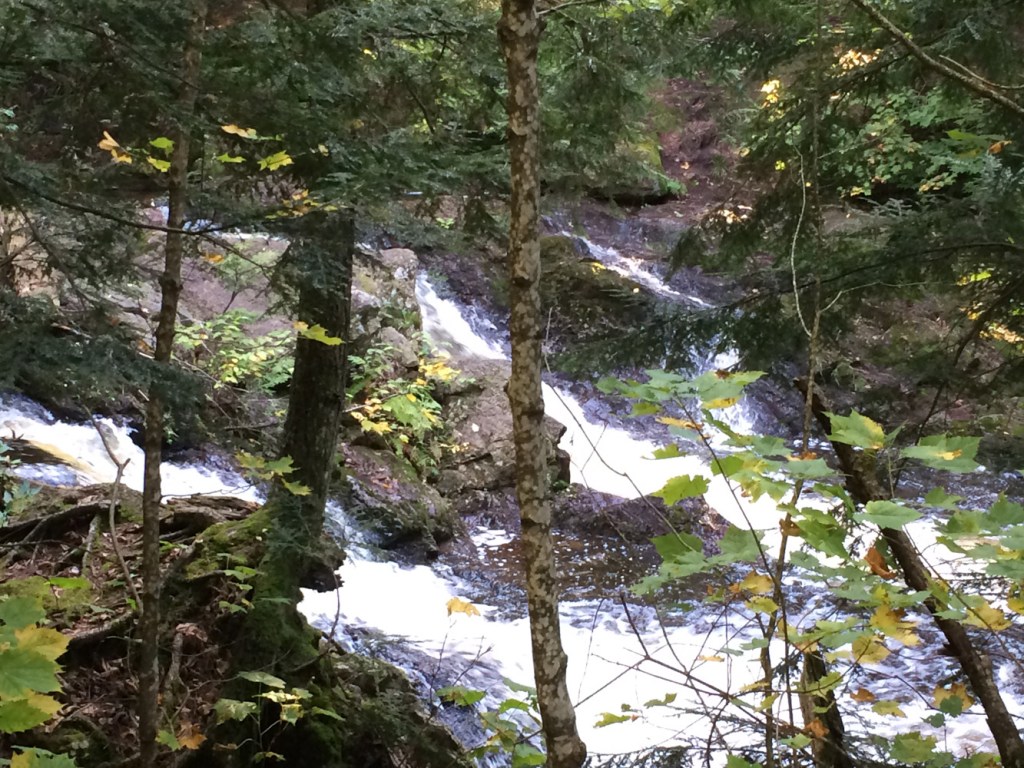
When I flipped my wall calendar on May 1st, the accompanying photo was of a waterfall.  My two-year-old grandson noticed it immediately, and said “waterfall!” I asked him if wanted to go see waterfalls, and ever since then we’ve been hiking local trails along rivers and streams in search of waterfalls.  Fortunately, we live in a city and surrounding area with a wealth of waterfalls, many within a few minutes of our home.  Each one is unique and changes with the volume of water as it varies from day to day.

I was lucky enough to be raised by parents with a love of waterfalls, so they were a staple of my childhood. We lived near waterfalls on the Cuyahoga River, where we would sometimes go for picnics and hikes, and our family vacations when I was young were often to visit waterfalls – Bridal Veil Falls in Yosemite, Tahquamenon Falls in the UP of Michigan, and of course, Niagara Falls.

Continue reading “Of Waterfalls and Wonder by Beth Bartlett”

My Grandmother’s Pearls are Green by Sara Wright

“That move into mystery
is not an abandonment of
perception
into a cloud of unknowing.
It’s a move
into a different form
of knowing.”

Robert Macfarlane

I stepped outside when the sun was just rising over the horizon and low enough in the sky to create a play of shadow and light. This is my favorite time of the day to witness the astonishing beauty of the earth that is spreading her shimmering cloak around my feet… ‘oh, my grandmother’s hair, the words rose unbidden’. Chartreuse, plum, wine, lime, gold leaf and emerald canopies stretched across the brook blurring the leaves between birch, ash, beech and maples. The silvery water glistened, and I imagined myself flowing around those serpentine moss-covered banks listening to an ancient song  that has been sung by water for more than 4 billion years. How I wish I understood what ‘ki’ was saying but I am no longer able to discern the language.

Continue reading “My Grandmother’s Pearls are Green by Sara Wright”

Diana Beresford-Kroeger: Integrating Celtic Wisdom and Science, part 2 by Theresa Dintino

Part 1 was posted yesterday

Combining ancient wisdom and western science

At age sixteen Beresford-Kroeger was graduated from her mentorship of the Lisheens and went on to become a scientist, learning medical biochemistry and botany. Eventually she saw that many of the things she learned from the Lisheens elders could be scientifically proven. This offered her delight and reassurance.

One of the first of these was the plant Chrondrus crispus or seaweed named Irish moss. Her Great-Aunt Nellie taught her that it cured tuberculosis and how to prepare and use the gel-like mucilage it released upon being boiled.

In the lab Beresford-Kroeger later discovered that this mucilage has antibiotic properties.

“The feeling this confirmation of Nellie’s teaching gave me is hard to describe. I loved my teachers in Lisheens, but I hadn’t completely ruled out the idea that the things I’d been taught there were just old superstitions. I needed to confirm them for myself. There was always the chance that there would turn out to be nothing of import in the plants they’d emphasized to me, and nothing more to the ancient knowledge than beautiful clouds of vapor”(96).

She began to understand that what she had been taught was an oral tradition and that it existed in no other format and that she was meant to be a bridge between “the ancient and the scientific”(97).

“My teachers in the valley might have indicated that a particular plant was good for poor circulation, which I’d taken to mean heart trouble. I would then know to keep a particular eye out for the presence of any chemical known to benefit the heart. “Well, Diana,” they might have begun, while cradling a small, five-pointed yellow flower in the crook of two fingers. “St. John’s Wort, as you see here, has a strong medicine for nervousness and mental problems.” I would later find out that St. John’s Wort contains phytochemicals such as hyperforin, which increase the effectiveness of dopamine and serotonin in the brain. The plant is as effective as many prescription anti-depressants, and may in some cases be more effective”(98).

Continue reading “Diana Beresford-Kroeger: Integrating Celtic Wisdom and Science, part 2 by Theresa Dintino”

Diana Beresford-Kroeger: Integrating Celtic Wisdom and Science, part 1 by Theresa Dintino

Moderator’s Note: This post is brought to you by a collaboration by FAR and Nasty Women Writers written and hosted by Maria and Theresa Dintino. This post originally appeared on their website on Sep 12, 2023

In her book To Speak for the Trees: My Life’s Journey from Ancient Celtic Wisdom to a Healing Vision of the Forest, Diana Beresford-Kroeger  shares her origin story, the humble beginnings of the famous scientist, the activist and crusader for the planet she became. We learn on what forge that will, strength, brain and consciousness were smelted. And it is one of beauty, strength and love, one that takes the breath away.

I loved this book. I loved going deeper and deeper into Beresford-Kroeger’s life story, into the rich depths of her Celtic heritage and medicine lineage. To learn the secrets and the wisdom. Beresford-Kroeger offers sacred transmission in this book, revealing another part of herself. It is a vulnerable telling and an irreplaceable gift.

Continue reading “Diana Beresford-Kroeger: Integrating Celtic Wisdom and Science, part 1 by Theresa Dintino”

Summer Lessons, by Molly M. Remer

Let us be gentle with ourselves 
as we cross the threshold 
into summer, 
as we both open our hearts to change 
and open our hands to choice. 
It is now that we both let things go 
and celebrate what is flourishing, 
what is thriving and growing 
and calling us onward. 
Let us be soft and supple, 
luminous and languorous. 
Let us practice the discipline of pleasure 
and the liturgy of delight. 
Let us protect wide margins for magic,
commit to our own life’s unfolding 
and swim freely 
in the current of the sacred 
that is always available 
to receive us 
and welcome us home.

Today, I sit missing the orioles and thinking about cycles of change, how things grow and decline, and how we can choose to be present or not with what we see and feel. I tip my head back in the green filtered light of morning and discover berries beginning on the mulberry trees. The wild raspberries and blackberries too are tipped with small, firm caps of green. I am feeling the sort of overdue clarity that descends when I finally realize I can let something go, that not everything is mine to carry or mine to fix. I know that this clarity too will come and go, but for now, I welcome it, feeling the cool wind stirring my hair and brushing my shoulders as I enjoy the sunshine and the sound of hawks on the wing. There is a powerful hope in these blue sky days and for now, I bask in the sensation of both remembering and reclamation.

This year, as we tip into summer in the Northern hemisphere, the temperatures in my own Midwestern biome have been surprisingly cool, peaceful and rainy. In an era of climate change, this slow entry into the heat of the year has felt welcome and encouraging. Something that continues to inspire and teach me this year has been to start where my feet are, to return again and again to where I am on this earth and in my body. In a culture that encourages fragmentation and distraction, distance, discord, and dis-embodiment, this practice of return is an act of both rebellion and reclamation.

I have been writing for Feminism and Religion for 13 years. This year, sitting down to write and reflecting on the life lesson of starting where my feet are, I decided to go back through my past summer posts here to discover the other lessons I have learned from summers gone by. I chose thirteen lessons to share from past summer posts:

Continue reading “Summer Lessons, by Molly M. Remer”

Empty Nest by Sara Wright

 She fluttered
out of a woven
mossy green
basket
above the door
at dawn
the
nest
had fallen
onto granite
stone.
Oh
my drowning senses
couldn’t
contain such grief
every cell
drilled
deeper
I gasped
this
cavernous
hole
had no
bottom
I continued
to fall
Nature had
Spoken
my silent
plea went
unanswered
Ki’s* message
was clear
I replaced
the nest
added a
cedar shingle
enticing
the phoebes
to return
listened
to a vibrating
body
whose mourning
bell
rang clear
Nature
had Spoken
my beloved
birds
and those
I loved
were gone.

Continue reading “Empty Nest by Sara Wright”

Deep Time and Dreaming by Sara Wright

   I am standing on top of a mountain looking over a landscape of unspeakable wild natural beauty that stretches as far as I can see. This is the ‘long view’ the dream -maker tells me. The trees are stretching out their lush green needles to the sky as if in prayer, and they are whole. The forests, clear waters, the animals, birds, insects. All of Nature has been returned to a State of Grace.

An Old red skinned Indian Man appears. He is a Grandfather. He is on the mountain with me but also stands below (both and). He speaks to me.

 “Sit, listen, this is the Song of Life”.

 A finely crafted flowing red clay seat appears below (it flows like a wave) although it is situated a few inches above the earth. Almost hovering. I also see a drum made from deerskin and red clay sitting on the ground. There is a four directional equilateral black cross on the skin of the drum. The cross is thick and around the cross an intricate design is etched/inked into its skin also highlighted in black.

Continue reading “Deep Time and Dreaming by Sara Wright”

Kinship, the Powers of Place, and Leavetaking by Sara Wright

What do I mean by the word kinship? I believe that kinship is the idea, and the belief that all aspects of nature from photons to galaxies are connected to one another. Practically, I think of kinship as my feeling/sense of being intimately linked to place/landscape. In my mind Kinship and Place are not only related, each is shaped by the other.

The powers of place are invisible threads that work by exerting a kind of physical and psychic pressure, pulling me into relationship. Place acts like an attractor site. My body behaves like a lightening rod or perhaps a tuning fork picking up information from the landscape. Once I have heard the “call” the door opens through my relationship with elements, trees, animals, stars or stones to name a few possibilities.

As this presence manifests through its individuals place begins to teach me what I need to know about an area and how I might best live in harmony with a particular landscape, if not its people. This learning occurs in bursts or very slowly just below the threshold of everyday consciousness. Either way, information seeps in through my body as I listen and pay close attention to what my senses are telling me. I allow animals, trees, plants to speak to me in their native language, and I note synchronistic occurrences. Information also comes to me through dreams. Eventually a discernable pattern emerges. My body acts as the bridge between self and the rest of Nature; the vehicle that keeps me connected to the whole.

Continue reading “Kinship, the Powers of Place, and Leavetaking by Sara Wright”

Of Birds and Dogs –Invisible Birds and the Weaver by Sara Wright

Ovenbird nest by Geoff Dennis

I am not feeding my year-round avian friends in the hopes that ‘my’ phoebes can nest in peace above my door and raise their brood without red squirrel interference. Last night I startled a nesting mother by turning on an outdoor light, so egg laying has begun. Every day I apologize to my beloved chickadees who must find food elsewhere (for now).

It’s hard to ignore the truth. So many birds that used to be common around here are gone. Mourning doves and white throated sparrows are two species that I miss too much. Occasionally, I hear a solitary w/t sparrow’s call. In March one mourning dove visited for a day; the flocks are gone

In this space in between bird loss and my choice not to feed those that I recognize by sight and sound, I have gradually learned how to listen to the invisible warblers that have probably been here all along.

Continue reading “Of Birds and Dogs –Invisible Birds and the Weaver by Sara Wright”

Mountain Song on May Day by Sara Wright

I moved to the mountains to move mountains, to find peace in the hidden crevices of an endangered planet.
We pull out her hair, clumps at a time
, self-harming her* in a myriad of new ways.
Wildfires burn up our forests, floods destroy precious lowlands. Loggers strip the possibility of new life from the soil. Our childhood stories become our adult lives: The Giving Tree who gave it all. . . .
The land doesn’t break; just dips and hides in private caves.
I moved to the mountains so that the predators of my past wouldn’t find me.
 Their spirits crawl out from unvisited graves.

[Excerpted from the poem, Mountain Life by Rebecca Rogerson.

They slip past the disappearing forests of canopied evergreens that once shaded and protected Ki’s children. [Ki is short for Kin – more on what this word means in Part 3.]

Continue reading “Mountain Song on May Day by Sara Wright”