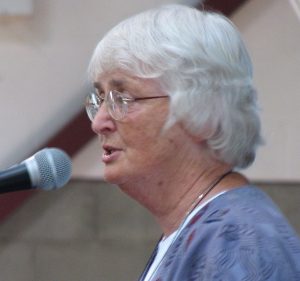
Our Children by Annelinde Metzner

 How do we bring our children along?  How do we share with them all that is best about being human?  All too often, I hear of events in children’s lives that no one should ever experience. Children are being subjected to trauma that will reverberate through all our lives. We are all one people, and all children are our own.  These poems are just a few simple meditations on how to bring children along with the best we have to give. My own son passed on in 2004, and I honor all that we taught each other.

The Poet Walks the Woods               

“That’s what I’m here for!” says the poet
to the young family,
gazing downward beside the trail.
“The Trillium- they’re called ephemerals
because they don’t last long!
They bloom in spring
just before the leaves are on the trees.
Three petals, three leaves, three everything.
So, Trillium.”
The littlest girl stows away a note
in some memory pocket.
“…When I’m an old woman,
I’ll walk the woods
looking for Trillium…”

Continue reading “Our Children by Annelinde Metzner”

Falling into Spring by Sara Wright

The glorious
white stars
waited in vain
for rain
for miner
sweat
mason
or bumblebee
to feast
on pollen
sacred to All
after three days
petals
drooped
golden
eyes shut
pearled
almonds
fell
one by one
next year’s
compost
soaked in
unshed
tears.
Perhaps
Bee Goddess
has a plan
Changing Woman
transforms
Sky Woman
holds the
seeds …
clasping
bloodroot
spears
and
buds
wrapped in
gray shawls
she may
yet
choose
to
intervene.

Continue reading “Falling into Spring by Sara Wright”

Missing Trees by Beth Bartlett

“Tree of Life” photo by author

The gap in the trees is a painful reminder of the one that is missing. This past winter an ice and wind storm late in the season brought down the aspen that had sheltered our deck. Its absence is more than a hole in the canopy – it is a hole in the heart. I miss its friendly presence, its shelter, its shade.  I suspect I never fully appreciated it until now.  It is just the latest in a long line of missing trees – trees lost to disease, insects, climate change.

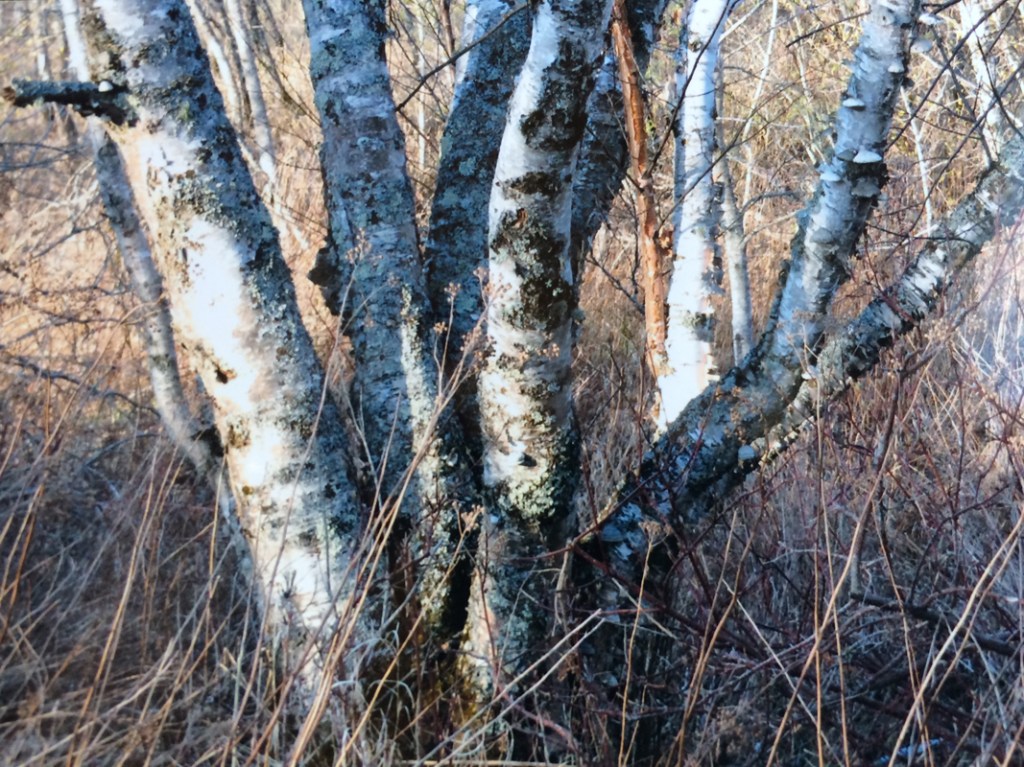
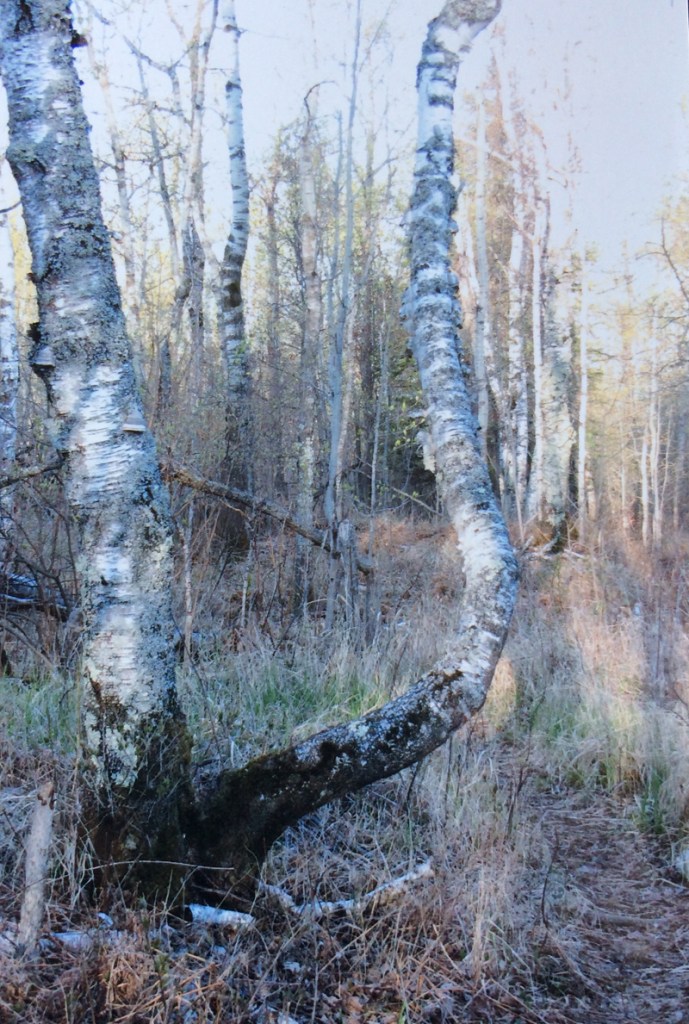
The paper birch were the first to go. When my dad first bought our family cottage in 1964, paper birch trees arched delicately over the cottage, framing it in white branches against the blue sky.  Another large birch stood as a landmark on the top of the hill, and another by the lake was the centerpiece of the circular bench built around it.  Several more lined the path down to the lake and dotted the hillside.

“Mama” birch, photo by author

When we bought our home in Duluth, paper birches graced the yard on all sides.  In the woods out back I’d befriended several of the birches, naming them according to their distinctive shapes – there was the “Mama” birch with its bulging pregnant belly, the three then four-clump birches that I’d named after our music group – “Wild By Nature,” and the glorious “Tree of Life” – a magnificent clump birch of at least twenty connected trunks that served as a talisman for me during the most difficult days of my illness and for many years after my transplant. 

Continue reading “Missing Trees by Beth Bartlett”

 NPR meets My Telepathic Bird Lily b, part 2 by Sara Wright

Part 1 was posted last week. You can read it here.

About ten years ago I began to keep a (public) though never advertised blog to help me keep track of my life. Because I am so severely directionally dyslexic this blog helped me to organize my material. Drafts of published and unpublished papers, poetry, opinions, changing seasons, virtually anything that I was experiencing and writing about ended up on that blog. Without conscious awareness/intention I began to include the more esoteric aspects of my experiences, and this is how stories of Lily b, lizards, various extraordinary encounters with birds, bears etc. ended up on this online journal sort of by ‘accident’.  I didn’t even realize what was happening. I wasn’t talking about these experiences, but I was starting to write about them publicly, not just privately. People read what I wrote, I realized vaguely.  Frankly this didn’t matter much because that wasn’t why I kept an online journal. Its primary purpose was twofold. It helped me organize my writings but more importantly it distanced me from particulars so that patterns emerged. Enter NPR. Anna had apparently been reading my blog for a couple of years and asked me if I would do an interview on Lily b my telepathic bird. I was astonished, but agreed, although with some trepidation because I had so rarely discussed this subject. The old fear of crazy surfaced.

Continue reading ” NPR meets My Telepathic Bird Lily b, part 2 by Sara Wright”

Earthprayer, by Molly M. Remer

Sometimes I describe my work and writing as “a love song to the Ozarks.” I am deeply embedded, body and soul, in this land that I come from, my bloodland, the place where I belong. Seven generations of my family have called these wooded hillsides and stony ridgetops home. This is my mystery school, where I explore hundreds of ways to kneel and kiss the earth.

The Earth is my teacher
I shall always want
I witness her still meadows
She leadeth me to green pastures
She restoreth my soul
On tree covered hills
She reminds me I am home
and, yea, I walk in her valleys
and I fear no suffering
She is with me
Her mountains and rolling rivers
they comfort me joy bubbles through my veins
and enlivens my footsteps
my cup runneth over
truly I stand
in mysterious awareness
all the days of my life
and She holds me
in the palm of her hand
forever.

Continue reading “Earthprayer, by Molly M. Remer”

Poems for Season by Sara Wright

In late November I first snowshoed our woodland trails to include the little balsam that I lit to honor all evergreens throughout the winter months. Every day when my little dog and I circled the tree I told her I loved her and called her ‘Lightbringer’. This daily encounter never lost its magic. The Goddess Lived during the darkest winter nights!!

The rest speak to the subtle changes that occurred from late winter into spring. My writing naturally follows both seasonal and intraseasonal shifts that might not be noticed unless a person is paying close attention.

(1) Lightbringer

Will she still
be there
 shining
after the storm?
 Moon Bear
is on the rise.
I peer through
white flakes
at dawn
 light
pierces
her powdery
 fringed shawl
 Love lights
the darkest
Night.

Steadfast Balsam
cloaked or not
 Ever-green,
Tree of Life.
Heartlines flow
crystalline
waters
pour down
deep sleep
oh,
 Daughter
of the Night
Daughter of
The Light,
Light -Bringer
Life -Bringer
The Miracle
Is that 
You Live.

Continue reading “Poems for Season by Sara Wright”

Miriam MacGillis and Cosmology Revisited, part 2 by Janet Maika’i Rudolph

Part 1 was posted yesterday. Miriam MacGillis’ words from Education for a Small Planet continue:

“And those implications, have been the unspoken assumptions which lie at the heart of the way western civilization evolved, distinctly different from eastern civilization or from tribal civilizations. That’s why we look so different. That’s why in 300 years where I live, our ancestors totally, totally altered the natural world. Their obsession with development is outside themselves.

“So, what has transpired in the unfolding of western civilization has been this extra-ordinary capacity of the human in its rational, linear, analytical mode of knowing, to understand, to probe, to analyze, to uncover, to discover, to alter, to change, to redesign and to bring about a better state of affairs than what was. Whether it was the discovery of fire, or the wheel or the printing press or the computer, always the real issue behind the technology is not the technology itself, it’s the vision of bringing about development, the perfection of.

“Now ironically, it’s because of that very detachment from the world that the western mind was free to do that. “If this is just matter, you can do anything you want with it.” That’s not really where there is any moral dimension. Moral development happens between humans, human/human, human groupings and human/god. That is why the whole unfolding of western civilization, we were able to probe to such a depth of the physical energies of the world that in this century we were able to do what we did.  

Continue reading “Miriam MacGillis and Cosmology Revisited, part 2 by Janet Maika’i Rudolph”

Miriam MacGillis and Cosmology Revisited, part 1 by Janet Maika’i Rudolph

Author’s Note: When my mother died in 2018, I became the custodian of her voluminous files. I found some gems inside them. My mother lived in NJ not too far from a place called Genesis Farms and its founder and proprietress was/is Sister Miriam MacGillis. There was a whole file on the farms.

Included in these files was a binder of cassette tapes from a workshop Miriam MacGillis gave in 1986 called “Education for a Small Planet.” There are 4 double-sided cassettes.  When I first saw them, I was afraid to even touch them as 40-year-old cassette tapes are not known for their sturdiness. A friend helped me find an agency that agreed to digitize them. Since then, I have had the great honor of transcribing the tapes. It took me several months, but I have now completed the transcription. (They are a little rough as I added punctuation as I went.) I have been in touch with Miriam about them and she agrees that the message from 1986 is still important, in fact, likely more important now and they should have as wide an audience as possible. 

Miriam MacGillis is a modern-day prophet who not only holds a broad understanding of cosmology but brilliantly expresses it. She was an early colleague of Thomas Berry, introducing many people to the Story of the Universe.

I believe these tapes need to be studied and shared and I am happy to make them available to anyone who is interested.  Below is a taste of their wisdom. It is from Tape #1A (first tape, first side), lightly edited. This is really just an introduction and it will be in two parts.

***

Continue reading “Miriam MacGillis and Cosmology Revisited, part 1 by Janet Maika’i Rudolph”

Artemis (II) by Beth Bartlett

This pretty planet
Spinning through space
You’re a garden, you’re a harbor
You’re a holy place.

Tom Chapin

Earth from the perspective of Atemis

A few weeks ago, NASA successfully launched the second in its Artemis series of rockets. Appropriately named for the Greek Goddess of the Hunt and the Moon, the Artemis mission has the moon as its focus.  The first rocket in the series, Artemis I, orbited the moon without a crew. The second, Artemis II, carried a crew of four astronauts to the moon and beyond — the farthest from the Earth that humans have ever traveled – so it’s fitting in more ways than one that it is so named since Artemis was known for her ability to rise to a challenge and aim for a distant target with keen accuracy.

In her masterpiece, A Chorus of Stones, ecofeminist Susan Griffin traced our trajectory to the moon through the intimate interweaving of flight and its uses in war — from the delegates to the Second International Peace Conference overturning of the prohibition against dropping projectiles from flying machines that had been adopted previously at the First International Peace Conference to the research and funding for the development of the V-1 and V-2 rockets at the Nazi Peenemünde Army Research Center during WWII and on to ever increasing enhancement of guided missile systems mostly for purposes of war.  Those early days of flight generated an enthrallment with technology that continues to this day, and that Griffin found alarming. In the poetry and scientific writings of the early days of flight she found an expressed desire to escape the limitations of the earth and feared our ever-increasing exploration of space beyond the Earth would lead to Earth’s abandonment altogether.[i] Indeed, the ultimate mission of the Artemis program is to establish a colony on the moon, and talk has swirled in popular culture about the need to establish colonies on Mars should Earth become uninhabitable due to climate change or nuclear annihilation.

Continue reading “Artemis (II) by Beth Bartlett”

The Glorians written by Terry Tempest Williams, discussion by Sara Wright

The Glorians: Visitations from the Holy Ordinary is an astonishing book written by internationally acclaimed  writer Terry Tempest Willams that is predicated on the necessity of bearing compassionate witness to all beings during these troubled times. It is a book about family, friends, earth and dreams, the later of which inspired the title. The volume is composed of a series of essays, only one of which I will discuss here.

Terry, who teaches at Harvard Divinity School, writes about the Divinity Tree, a two-hundred-year-old red oak that was removed from the Commons. Listening to this narrative as a ‘Tree Woman’ was/is excruciatingly painful. My stomach roils in misery, but I am compelled to listen, over and over, because this is my story too.

I came to the mountains because I was in love with trees and bears discovering an evergreen paradise or so I thought until the dreams began. In my night stories all the trees were being slaughtered and there was nothing I could do. Since I was surrounded by fragrant forests that stretched from horizon to horizon, I could make no sense of these terrifying warnings and let them be.

Continue reading “The Glorians written by Terry Tempest Williams, discussion by Sara Wright”