

 I am of my mother –
from the swirling stars of the cosmos
through the long passage,
contacting and expanding –
birthed of her body,
nourished by her love.
Category: Motherhood
What I Celebrate at Christmas by Carol P. Christ
 Though I have not been Christian for many years, I love to decorate my house for the holidays. I have many decorations that I have collected over the years, including a Hummel angel gazing at the Christ child that was my father’s mother’s and a small crocheted Christmas tree given to me by my mother. My Christmas tree is a living one in a pot, and I usually manage to keep it alive on the balcony or outside for several years. One of my hobbies is collecting ornaments for the tree. Among my favorites are glass icicles and snowflakes crocheted by my friend Alexis many decades ago. There are white doves and brown birds that land on the tree branches and glass balls that have come into the stores again in recent years.

During the years I lived in Lesbos I was always invited to my friend Birgitt’s for a German Christmas Eve dinner with many of her friends. The meal began with fresh cured salmon (gravadlax) with dill sauce prepared by Swedish Christina, followed by meat and and all the trimmings—once it was wild boar and another time venison, but more often beef or turkey. I always brought a spinach salad with pomegranate seeds and special dressing from the Silver Palate cookbook. For dessert there was German Christmas cake called stollen made with nuts, spices, and candied fruit, covered with powdered sugar, as well as a variety of German Christmas cookies and chocolates. On Christmas day, I often went out to a restaurant on with other friends and feasted on Symrna style lamb stuffed with rice, raisins, pine nuts, and parsley, sweetened with orange juice.
Among my most treasured childhood memories are holiday meals at mother’s mother’s house. Continue reading “What I Celebrate at Christmas by Carol P. Christ”
To Bless One Another, by Molly Remer
May you allow yourself to 
taste your longings
and to bravely honor them.
May you make wise sacrifices.
May you trust in abundance.
May you savor the many flavors
of this sweet life before your eyes,
beneath your feet,
below your skin,
within your soul,
around your heart.
I had imagined making beautiful loaves of herbed and flowered breads, but instead we hold scraps of plain white biscuits in our hands. Homemade, yes, but not as seasonally resplendent as I envisioned. It is Lammas, the festival of First Fruits, a celebration of sacrifice, gratitude, abundance, and renewal. I remind my four children of these themes as we stand in our small family circle on our back deck at sunset. There has been rain and the air is cool and beautiful, unseasonably delightful for August. The mulberry trees are broad leaved and heavy, leaning over the rails of the deck, where the last of the blackberries also hang, black and red beneath rusted red, gold, and green leaves, spotted with last month’s heat, brambles twined through the railings in a way that delights me—the wild’s insistence on creeping steadily closer and closer to enfold our home.
I have made four extra little biscuits, round and a bit lumpy, an offering for each of the four directions. I extend my hand into the center of our circle, cupping one small round biscuit at a time. My children and my husband extend 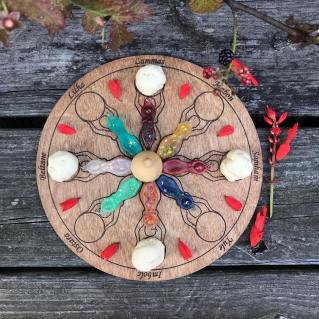 their hands over and under mine and we offer our gratitude into each morsel in turn, one for each direction and each element. For North, we speak of stability and strength, the health of our bodies, the safety and security of our foundation, the earth on which we live. For East, we speak of air, our mental states, how we will be mindful of how we speak and think and focus our energy and time. For the South, we speak of fire, of tending the flames of our inspiration, nourishing our passions, and watching for burnout. In the West, we speak of water, of being emotionally stable and loving. In the last seventeen years of parenting, if there is one thing I have learned is that rituals with children need to always involve action. The kids are eager to toss the biscuits into the air, in the directions we are honoring. In past years we have tossed pinches of cornmeal, at other times of the year grains of corn or flower seeds or dried herbs or petals, at the Winter Solstice we toss pieces of our annual golden “sun bread.” This bread, washed with egg and laden with butter is one we make together on solstice morning, shaping the smooth dough into a large sun face with a spiraled corona of rays. After it has baked, we offer scraps to the sun at noon, tossing them high into the air as we shout “Thank you! Thank you!” again and again into the crisp winter air. Last year, my garnet bracelet, a symbol of the path I walk with the goddess Persephone, flies off as I toss my sun bread and disappears into the waving stalks of wild grasses. We are never able to find it and the unexpected symbolism of Persephone becoming joined anew with the amber waves of Demeter’s grains delights me.
On the summer solstice this year, I made a cake in the shape of a honeycomb, decorating the hexagons with wild 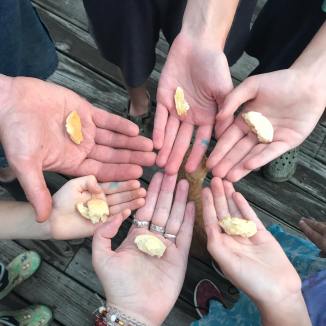 blackberries and rose petals. And, now on Lammas, there are these small white biscuits in our hands. My oldest son is almost seventeen. He is nearly as tall as his father, six feet. He has the biscuit for the south, which from where we stand on the deck is our house. He winds up his arm and lets the biscuit fly up, up and over the roof.
We offer our own small personal pieces of biscuit next, pinched as the first bite from each of our servings at dinner, as representative of a sacrifice we will make this season. And then, we cup our open hands close to our hearts and one by one we speak of what we are grateful for and what abundance we are welcoming, what we are making space to harvest in our open hands.
We join hands and sing, our six year old son requesting “We Are a Circle,” and following his lead, we sway from side to side as we sing, eventually all kicking our legs back and forth into the center of the circle and laughing. We say our closing prayer next, as we do each time we celebrate together: may goddess bless and keep us, may wisdom dwell within us, may we create peace* and then I extend my arms and gather them to me, for a large family hug. There is a sense of connection and renewal around us as we laugh and smile and I tell them thank you for participating.
This ritual was largely spontaneous, all I knew when I stepped outside was that we wanted to offer our gratitude symbolized by our four tiny loaves of biscuit-bread and that we wanted to acknowledge this next turn on the wheel of the year.
Several years ago, when I was still teaching at a local college, one of my students objected to the fact that material on working with LGBTQ clients was part of my class outline. She went through my personal Facebook page and those of my family members, where she noticed photos of the wedding ceremony I performed for my brother and his wife. A message arrived in my email: “by whose authority do you think you have the right to perform marriages?” she inquired. By my own authority, I thought, though in my reply I also cited that I am a legally ordained priestess and as such am recognized by the state of Missouri as capable of solemnizing legal marriages. Not much later, she dropped my class explaining in writing that to continue taking it would be to turn her back on Jesus Christ.
At mother blessing ceremonies, we often sing a song called “Call Down a Blessing.”** After one ceremony, I was asked, “but WHOSE doing the blessing?” and my answer was simple: We are. We are blessing one another.
These are radical acts. These are feminist acts. This is feminism and religion. To express gratitude for the earth, to name the elements as holy, to honor the cycles of the seasons and our lives, to design our own ceremonies, to hold our own circles, to be our own authorities, to bless one another and the spaces between us.
I have two teenage sons now, one seventeen and one fourteen. We have lifted our arms to the rising moon, tossed scraps of bread to the noontide solstice sun, and dabbed sweet spring water on one another’s faces in blessing since they were born. This is what they know.
And, even though they are now teenage boys, each night without fail they come to me and to their dad in turn to be kissed on the forehead in our nightly ritual, a benediction of love. Good night, sleep good, I love you, we each say. My seventeen year old usually drops his return kiss on the top of my head in my hair, speaking the familiar words back to me, good night, sleep good, I love you. Sometimes as I’m getting ready for bed, brushing my teeth in the bathroom, I look up to see him standing in the doorway, “mom,” he says, “did I forget to kiss you?” and I proffer my forehead, just in case we’ve forgotten. The boys each kiss their dad goodnight too and he them—on the forehead, a kiss, and the words, spoken and returned, good night, sleep good, I love you. Sometimes I think this is most potently feminist act of all, these two boys rapidly becoming men beneath our roof, going to bed each night with a kiss and the affirmation that they are loved.
Molly Remer’s newest book of poems, Sunlight on Cedar, was published in March. Molly has been gathering  the women to circle, sing, celebrate, and share since 2008. She plans and facilitates women’s circles, seasonal retreats and rituals, mother-daughter circles, family ceremonies, and red tent circles in rural Missouri. She is a priestess who holds MSW, M.Div, and D.Min degrees and wrote her dissertation about contemporary priestessing in the U.S. Molly and her husband Mark co-create Story Goddesses, original goddess sculptures, ceremony kits, mini goddesses, and more at Brigid’s Grove. Molly is the author of Womanrunes, Earthprayer, the Goddess Devotional, She Lives Her Poems, and The Red Tent Resource Kit and she writes about thealogy, nature, practical priestessing, and the goddess at Patreon, Brigid’s Grove, Feminism and Religion, and Sage Woman Magazine.
*Thanks, Carol Christ! We’ve used this family blessing to close our ceremonies for about ten years.
**Originally by Cathy Barton and Dave Para.
Caprine Community by Laurie Goodhart
 Two recent posts, Community Immunity by Natalie Weaver on May 6, and Carol Christ’s May 11 essay, Women Invented Agriculture, Potter, and Weaving…, have spurred me to focus and finally share something that I’ve meant to for a long time. For 30 years I helped my husband realize his dream of a small farm, while I continued working as an artist. We both came from urban backgrounds and both (separately) charged out into the wild world at age 17, inventing as we went along. That fearless approach continued with the farming many years later.
We started with sheep and cows but soon turned to focussing on goats. We wanted to farm organically from the start (1988) and that, combined with a lack of childhood indoctrination into Big Ag Culture had us devouring all the information we could while carefully observing the animals and applying our shared humanistic approach to daily life to the care of goats. I say this last part so no one imagines a slavelike situation as is often seen in images of dairy farms. Continue reading “Caprine Community by Laurie Goodhart”
Moments of Beauty by Sara Frykenberg
 Last week a friend of mine started a post asking people to share something that they’ve enjoyed or appreciated since shelter-at-home orders began across the country and globe. This friend was in no way trying to minimize the very difficult situations that so many of us find ourselves facing during this pandemic. Rather, the list she elicited and generated helped to create, at least for me, a moment of hope or peace—a moment that I suspect many of us need right now.
Inspired by my friend (who has quite a talent for pointing out the potential for joy or happiness), I would like to add to her list here by sharing a couple of my “moments of beauty” in the hopes I can share this hope or peace. Continue reading “Moments of Beauty by Sara Frykenberg”
Answering the Call by Joyce Zonana
All along, I’ve believed that Malicroix had something important to offer English-speaking readers: an embrace of solitude, a profound connection with nature, a bold exploration of dream-states. And right now it seems to resonate with our current moment of introspection and reassessment of priorities.
 Very early in Henri Bosco’s 1948 novel Malicroix, a young man, Martial de Mégremut, living placidly amid fruitful orchards in a tame Provençal village, receives a letter informing him he has inherited “some marshland, a few livestock, a ramshackle house” from a reclusive great-uncle, Cornélius de Malicroix. Against his family’s strenuous objections–with alarm they speak of “marshes, mosquitoes, miasmas”–Mégremut resolves to travel alone to the remote Camargue to claim his “wild” Malicroix inheritance. The house is on an island, and to reach it Mégremut must cross a rough river, at night, in a frail wooden boat piloted by a taciturn old man who meets him at dusk in the middle of a vast plain.
So begins a deeply internal quest narrative, an initiatory journey that forces Mégremut to come to terms with himself and with the elements–earth, water, wind, and fire–that are ever-present, sometimes terrifyingly so, on the island. For once he arrives, he learns that he must remain there alone for a full three months if he wishes to obtain the inheritance. Torn about whether to stay or leave, he finds that the decision to stay is made of its “own accord,” unconsciously.
A Lonely Mystic by Molly Remer
I want to be a lonely mystic
dwelling in devotion,
constantly dialoging with divinity,
drenched in wonder,
and doused with delight
in knowing my place
in the family of things.
I want to weave spells
from wind and wildness,
soak in solitude,
and excavate the depths
of my own soul.
I want great expanses of time
to be and to listen,
to feel and know,
each step a prayer,
ceaselessly walking with the goddess.
I crave the clarity of insight
dropping with a flash
into my open hands,
the clear space of listening
with no other voices in my head.
I want to pray with my eyes wide open
from sunrise until sunset,
never missing an opportunity
to commune with the sacred,
to feel myself enrobed,
ensconced,
ensorcelled,
enspelled
with divine wonder, curiosity,
awareness, and understanding.
I want to light candles
and speak spells,
weave magic from the ordinary
and listen,
always listen,
to the whispers of my heart.
I want a chamber of quietude
with only crows and owls
for companions,
the soft eyes of deer
in a wooded glade
my witnesses,
steam rising from my broths and brews,
weeds and roses twining together
into the medicine of my spirit.
I want to be quiet and contemplative,
waiting in the shadows to spot the magic,
to feel the power,
to see through to the threads of things.
I want to feel still and holy
grateful and graceful,
to be an enspirited beacon
embodying my prayers.
Instead,
I am a mama mystic
I nestle children against my shoulder,
my nose resting in blonde hair and needs,
mediate disputes,
knead bread dough,
make dinner,
fold laundry,
read books,
find filaments of magic
wound around the smallest things,
claw solitude from scraps,
and weave small spells
and bits of enchantment
from moments of magic
that wander by my full hands and head.
I gently coax quiet poems
from full spaces,
let prayers wind up over days,
nosing patiently into the cracks
between my deeds.
And, with my hands in the dough,
or my nose in the hair,
or the hand in mine,
I am drenched in devotion,
dialoging with divinity,
each step a prayer,
and knowing my place
in the family of things.
This is where the goddess dwells
right through the middle of everything,
in the temple of the ordinary.
Here, she says,
this too,
is holy,
sacred,
true,
and it needs you,
not that bloodless,
imaginary,
perfect priestess,
of silent
secret praise.
This is the real work of living
and it shows you who
you
are.
*“Family of things” phrasing from Mary Oliver.
Molly Remer has been gathering the women to circle, sing, celebrate, 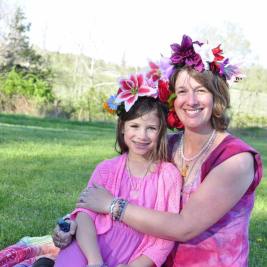 and share since 2008. She plans and facilitates women’s circles, seasonal retreats and rituals, mother-daughter circles, family ceremonies, and red tent circles in rural Missouri. She is a priestess who holds MSW, M.Div, and D.Min degrees and wrote her dissertation about contemporary priestessing in the U.S. Molly and her husband Mark co-create Story Goddesses, original goddess sculptures, ceremony kits, mini goddesses, and jewelry at Brigid’s Grove. Molly is the author of Womanrunes, Earthprayer, the Goddess Devotional, She Lives Her Poems, and The Red Tent Resource Kit and she writes about thealogy, nature, practical priestessing, and the goddess at Patreon, Brigid’s Grove, and Sage Woman Magazine.
Do We Have to Hate Our Mothers? No, We Do Not! by Carol P. Christ
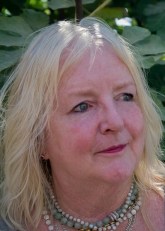 It is commonly accepted in American culture that children–boys especially–must go through a “phase” where they hate their mothers in order to grow up. We are told that the mother-child bond is so intense as to become suffocating. We are told that unless children – boys especially – reject their mothers, they will not individuate, become individuals. And nobody, we are told, wants a mama’s boy.*
Recently, I read an article written by a mother who, though she had prepared herself for rejection, had not prepared herself for the degree of hatred and contempt her teen-age son would express towards her over a several year period. I do not recall whether or not this particular story had a happy outcome or whether the mother was still living the story of rejection.
The idea that children—boys especially–must reject their mothers in order to grow up is one of the ways matricide is played out in our culture. In rejecting our mothers, we also reject the idea that nurturing life is the highest value. Continue reading “Do We Have to Hate Our Mothers? No, We Do Not! by Carol P. Christ”
Mother – Daughter Betrayal by Sara Wright

(1)
Today is my mother’s birthday and although she has been dead for more than a decade I still think of her almost every day. At the time of her death I had not seen her for twelve years. Not by choice. After my father’s sudden demise my mother chose my children, her two adult grandsons to be her protectors, and dismissed me from her life, permanently.
When she died, my mother divided her assets evenly between my children and me, forcing her only daughter to live beneath the poverty level for the remainder of her life.
The final betrayal.
At the time of her death I was teaching Women’s Studies at the University.
Continue reading “Mother – Daughter Betrayal by Sara Wright”
To Light a Flaming Pumpkin: The Inexact Art of Family Ritual, by Molly Remer
Our bounty is in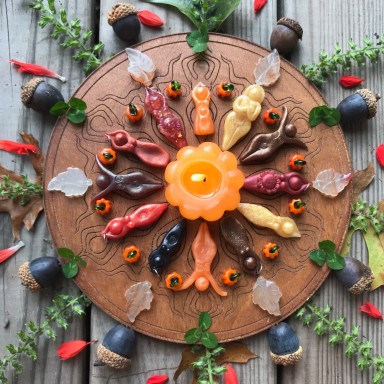
creativity
friendship
community
the myriad small adventures
of everyday.
We tell of magic
and moonrise
and listening to the pulse
of the earth beneath our feet.
Ah, October. Fall has settled into the trees and air. Last year on Samhain (Halloween), as the sun was setting and the full moon was rising, my family stood together in the dim light on our back deck, lit a fire in a hollowed out pumpkin and offered handfuls of herbs into the flames as we celebrated our blessings, our harvests, and our bounty, as a family and as individuals. As we spoke aloud our blessings and our bounty, our words got deeper, broader, and more authentic. My twelve year old son stepped forward to say how thankful he is that he gets to live with his best friend, his fifteen year old brother, and they embraced over the flaming pumpkin. My fifteen year old son offered his thanks for a family that has “cool 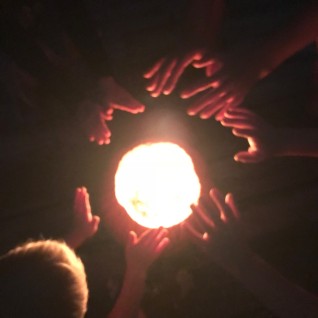 rituals like this” and my four year son offered his blessings for the “energy we feel together.” My seven year old daughter offered her gratitude for pandas and for toys.
The next week, we returned the seeds to the pumpkin and released it to the outdoors to grow next year.
Seventeen years ago, I held my first Winter Solstice ritual. I wrote my wish for a baby onto a small piece of paper and rolled it up into a “seed” of my dreams that I planted within a special wooden box. On the autumn equinox the following year, I gave birth to my first child, a son who now stands inches above me, but who joins hands with his family each month to sing “Dance in the Circle of Moonlight” together on the back deck under the full moon.
After having this first baby, it became increasingly important to me that we celebrate holidays and traditions that reflect our spiritual values and worldview rather than the packaged version of the holidays offered by society, or the religious observances of dominant faiths that do not match our own. While we have celebrated the wheel of the year together in a variety of ways in what has now been sixteen years of parenting and twenty-one years of marriage, it wasn’t really until last year that I felt I finally, truly hit my stride in planning fulfilling, nourishing family rituals. Perhaps it is because I am no longer trying to juggle nursing a baby or changing a diaper while simultaneously also guiding a ceremony. Perhaps it is because I’ve loosened up and accepted the myriad imperfections possible within a multi-age celebration. Perhaps it is because when one of the children wanders off during circle or interrupts me while I’m talking, I accept it as part of the flow, and continue our work without breaking my stride. Perhaps it is because I now laugh too when someone makes a joke during my careful ritual, and continue to roll with it, instead of feeling like it is disrespectful. Perhaps it is because I consider a 15-20 minutes family ritual perfectly sufficient instead of trying to plan for a full-fledged, retreat-style “program” of activities. Perhaps it is because we’ve joined hands in family circle in so many ways and for so many years that we all now trust that I’m not giving up on doing this together.
In the course of the year we’ve anointed one another’s foreheads with fragrant oils while standing in the freezing water of a freshwater stream. We’ve felt the raindrops kiss our faces and the rays of the sun peek in and out of the clouds as we celebrated the summer solstice by releasing wildflowers into the river. We’ve howled at the moon together, built a green man face from leaves, stones, and sticks in the field, created flower mandalas, thrown pinches of cornmeal into the woods as a symbolic sacrifice, soaked our feet in warm water laced with rose petals and then massaged one another’s feet with lotion, walked through a spiral of candlelight, and offered handfuls of herbs into a flaming pumpkin.
As we notice the changing seasons and honor the call of nature within our lives through ceremony, celebration, and song, we make visible the interconnected dance of life. We reaffirm our commitment, our relatedness, to each other and to the natural environment around us. We communicate with and are in relationship to that larger force of life and spirit that we call Goddess. And, we bring our spiritual beliefs into our bodies, hands, minds, and hearts in an ever-spinning Wheel of celebration, attention, observation, enjoyment, communion, and love.
“We can think of ritual as the container we weave in which we can be carried away by magic and ecstasy.”
—Starhawk and Valentine, The Twelve Wild Swans
For your own flaming pumpkin ritual, choose a large, round pumpkin, cut off the top 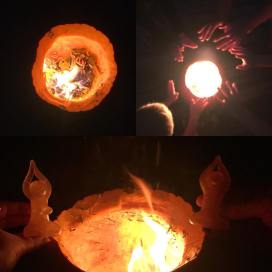 and hollow it out. Keep the seeds to plant with the remnants of your fire later. You may start the fire with paper and a lighter and then keep adding herbs to keep it burning, or you may stoke it by putting some alcohol in the bottom of the pumpkin to begin with. Alcohol burns cool and can create a longer lasting, less smoky flaming pumpkin. Offer your autumn bounty into the pumpkin with herbs sprinkles/handfuls—these can be spontaneous spoken aloud declarations of your harvest, your celebrations, your gratitude, etc. What are you thankful for?
- Optional: offer any sacrifices/releasing on slips of paper into the flames
- Optional: Sing “Hallowed Evening” chant (by my kids and me)
Hallowed evening
Hallowed night
We dance in the shadows
We offer our light.
Additional Articles:
- All We Need to Make Magic by Molly (Feminism and Religion)
- Tips for Rituals with Kids by Molly (Brigid’s Grove)
- To Light a Flaming Pumpkin cross post with full family Samhain ritual.
- Flaming pumpkin inspiration from Coloring Book of Shadows: Planner for a Magickal 2018 by Amy Cesari
 Feminism and Religion