I Was Called by Mama Dove by Judith Shaw

As we move into the Winter Holidays, when calls for peace are found everywhere, my reflections keep returning to the wisdom of the little dove.

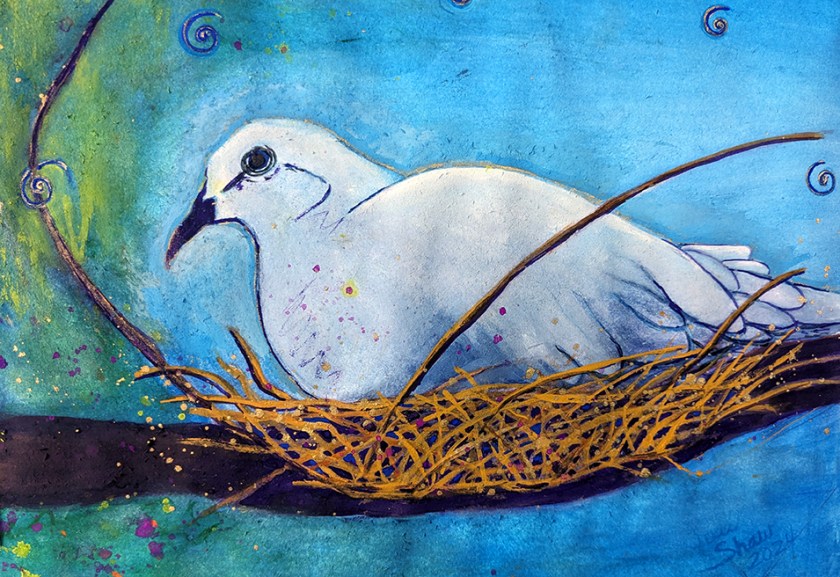
Unlike most of my animal paintings, which start with research into their myths, Mama Dove was different. This painting came about through direct experience in the natural world. In the summer of 2024, a dove nested in the deteriorating lattice roof of my pergola, allowing me to observe her closely as she sat on her eggs. This amazing experience revealed her nurturing strength, and inspired me to create this painting.

mama_dove_painting_Judith_Shaw
Mama Dove, gouache on paper by Judith Shaw
Continue reading “I Was Called by Mama Dove by Judith Shaw”

Legacy of Carol P Christ: WAR, WAR, WHAT ARE WE FIGHTING FOR?

This was originally posted Sept 16, 2013. It is sadly pertinent today

“They used chemical weapons, we must do something to stop them.”  A justification widely used in support of President Obama’s decision to launch a military strike against Syria.

We fought the Civil War to end slavery and racism. We fought the Second World War to end fascism. Did we end racism? Did we end fascism? Howard Zinn

At the time of the Revolutionary War, “a not inconsiderable Quaker element was on principle opposed to war, as itself a greater evil than any it might seek to right.”

Michelle Obama is against military intervention in Syria. Does the President dismiss Michelle’s dissent as “womanish”?

Continue reading “Legacy of Carol P Christ: WAR, WAR, WHAT ARE WE FIGHTING FOR?”

Children Are The Future by Judith Shaw

If the saying “Children are the future” is true, then it must also hold true that exposing children to a worldview which supports a loving world is important. Authors, illustrators, animators, musicians, and film and tv producers are hard at work creating stories that nurture children’s capacity to follow their dreams, to share, to resolve conflict peacefully, and to love and accept themselves and others. 

Continue reading “Children Are The Future by Judith Shaw”

To See Ourselves In Others: Part One by Beth Bartlett

I have felt both a responsibility and a reluctance to write about the escalating conflict in the Middle East.  The situation is so complex and such an unspeakable tragedy – acts of such terror and violence on the part of Hamas toward civilian populations met with even greater violence and repressive measures on the part of Israel toward the people of Gaza. It is a perplexity of the human condition that a people with such a deep history of being displaced and oppressed rather than refusing to oppress in turn, instead engage in the displacement and oppression of others that then erupts into more violence. Both are traumatized peoples acting out of deep pain and woundedness. Thousands have died, more are wounded and displaced, all will carry more trauma into generations to come. The very earth bears the scars of war. In the face of such unspeakable suffering, any kind of analysis feels distancing at a time when what we most need is to let the suffering move us to our depths.

Continue reading “To See Ourselves In Others: Part One by Beth Bartlett”

War, War and More War – Can Goddess Wisdom Offer a Path to Peace? by Judith Shaw

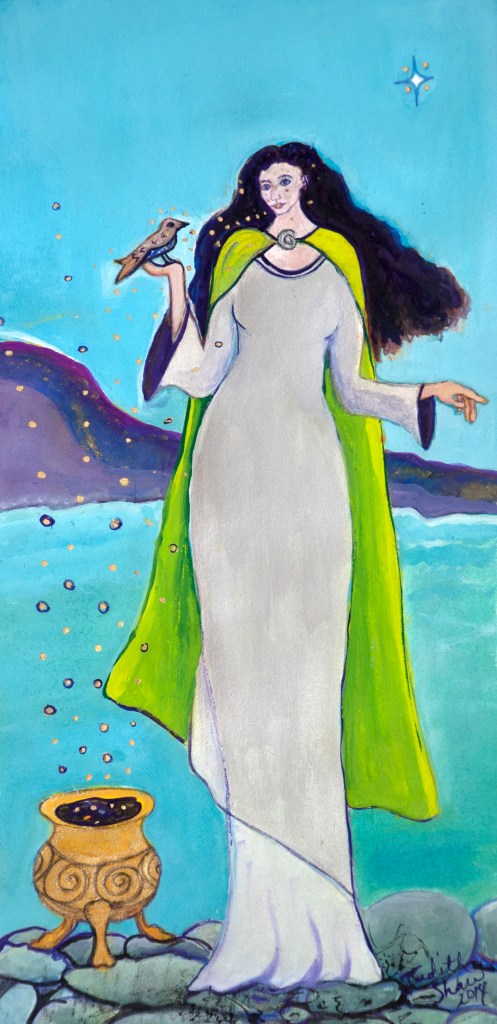
Branwen, Celtic Goddess painting my Judith Shaw

I was on my way home from a wonderful morning spent with my son when I heard the news of the horrific attack by Hamas on Israeli citizens. We had risen early to witness the mass ascension of balloons at the Albuquerque Balloon Fiesta, joining tens of thousands of people from around the world. For 10 days, a diverse crowd gathers on a vast field, experiencing childlike wonder as they watch brightly colored balloons ascend into the early morning sky. It was a joyful morning.

But then, after all that wonder, the car radio delivered the shocking news of the Hamas attack. My joy was shattered. 

Continue reading “War, War and More War – Can Goddess Wisdom Offer a Path to Peace? by Judith Shaw”

Snapshots from the Parliament of World Religions by Janet Maika’i Rudolph

The Parliament of World Religions ran from Aug 14th to the 18th  in Chicago.  I returned with my head spinning having met new people, connected with inspiring beliefs, discussed fascinating ideas, watched meaningful performances, engaged in sacred play, danced, sang, cried, ate, and mostly experienced . . . just experienced. It is still overwhelming to sort out individual experiences. I am going to write up a few of my impressions, snapshot style. They scratch the surface, not only of my individual experience but of the Parliament in general where upwards of 7,000 people attended. It was incredible

Setting the tableau: As I was going down the escalator, a woman was followed by 2 groups were heading up. The woman was beautiful and young in full Mayan dress with white blouse, long orange skirt along with headdress and belt with Mayan symbols. Her thick dark hair was flowing down her back.

She was followed by five Sikh men who were dressed head to foot in white. Their heads and hair were covered by white turbans.

They were followed by two Buddhist nuns dressed in grey robes carrying beads. Their heads were shaved.

Such scenes were common.

Continue reading “Snapshots from the Parliament of World Religions by Janet Maika’i Rudolph”

Peace Weaving: A Task for Our Time by Carolyn Lee Boyd

MaestraPeace (“Woman Teacher of Peace”) mural on San Francisco Women’s Building

Throughout centuries and across continents, women peace weavers have intertwined the threads of diplomacy and connection to make of their societies a harmonious whole amid war, violence, and seemingly endless conflict. James Rupert of the US Institute for Peace notes that, in our time, “Over a decade in countries facing warfare, women have organized more nonviolent campaigns for peace agreements than any other group.” Yet, women are outrageously under-represented in formal, higher-resourced, male-dominated institutions, with only 4% of negotiating positions in the United Nations and governmental organizations held by women. According to the Kroc School of Peace Studies, women-led peacemaking efforts are grievously underfunded and put women peace makers at risk of gender-based violence and online harassment.

Yet, if we look to the past, peace making has traditionally been an honored sphere of influence in which women have used the power of the esteem in which they were held, their ability to envision peaceful ways of being, and their skills as communicators, consensus builders, and relationship makers to bring concord from conflict and positively transform their societies. 

Continue reading “Peace Weaving: A Task for Our Time by Carolyn Lee Boyd”

The Religious Aspects of Star Trek: Discovery Season 1, by Ivy Helman.

I have been watching more television than usual.  Perhaps, the reader has too. Two weeks ago, while I was rewatching Star Trek: Discovery, I thought to myself, “wouldn’t it be nice if I could write something about this series?”  

After all, I want to acknowledge how grateful I am for the ways the series celebrates diversity with: women of color in leading roles; the normalization of gay relationships; and, in the latest season, the inclusion of non-binary and transgender identities. Not only that, it has strong female characters that are empowered, supported and mentored by each other and other crew members. I am also glad that it expresses ecological sustainability, the interconnectedness of life through the mycelial network, and the ethical treatment of animals.  Finally, I have appreciated the way this series questions violence and war.  Notably, it contends with the question: how does a united planetary organization committed to peace find itself in the midst of war?  The answer: war and violence are learned behaviors.  That has a very feminist ring to it, doesn’t it?

However, the show is not perfect.  It contradicts itself in one major area: Starfleet’s hierarchical ranks and the corresponding requirement to follow orders.  Captain Lorca in season 1 episode 3 reminds the crew that they are not part of a democracy.  Yet, the Federation preaches equality and freedom and often touts itself as utopian, where hunger, wants and needs no longer exist.     

Continue reading “The Religious Aspects of Star Trek: Discovery Season 1, by Ivy Helman.”

Sappy modern carols won’t cut it; Gritty Advent Hope is what we need this year. — by Trelawney Grenfell-Muir

As we careen toward ever more terrifying surges in the Covid pandemic, with experts predicting apocalyptic catastrophes by Christmas time, I find myself reacting to the vast majority of modern Christmas songs, stories, movies, and cultural norms with increasing distaste. In these scary, painful weeks leading up to Christmas, my culture has very little to offer other than distraction and superficial jollity. Ho ho ho, Santa Claus is comin’ to town.

Distraction does help, a little. It’s addictive, of course. We turn more and more to social media, with its carefully designed dopamine boosts from each “like” and “love” reaction, each funny cat video, each smug political joke, to keep us from confronting the terror and trauma of our current reality. It’s a legitimate coping mechanism, a crutch that can be useful in many ways. Continue reading “Sappy modern carols won’t cut it; Gritty Advent Hope is what we need this year. — by Trelawney Grenfell-Muir”

Like Water Flowing Down a Mountain: Creating Lasting Change by Carolyn Lee Boyd

Carolyn Lee Boyd

As we strive to create a better future, we can look to our rich heritage of global goddess and heroine tales for insight into peaceful, creative, and effective means to achieve our goals. Let me introduce you to the delightful ancient story of two young Chinese heroines, Gum Lin and Loy Yi Lung.

Summarized from Merlin Stone’s Ancient Mirrors of Womanhood:  Gum Lin’s village was starving due to a drought. Even the bamboo she needed to make objects to sell had disappeared. Searching for bamboo on a nearby mountain, she found a lake, but a locked gate stopped its abundant waters from flowing down to the village. A dragon living in an underwater cave held the key. Gum Lin sang sweetly until the dragon’s daughter, Loy Yi Lung, arose from the depths and together they hatched a plan. They sang in unison to draw the dragon to the surface. While Loy Yi Lung continued her song and the dragon listened, Gum Lin swam to the cave where she encountered treasures she could easily steal for herself. She ignored them and found the key.  She unlocked the gate and the waters gently flowed down the mountain in a newly-made river, nourishing the rice and bamboo. In time, Loy Yi Lung moved to the village where she and Gum Lin happily sang at the edge of the water.

Continue reading “Like Water Flowing Down a Mountain: Creating Lasting Change by Carolyn Lee Boyd”