
The Religious Aspects of Star Trek: Discovery Season 1, by Ivy Helman.

I have been watching more television than usual.  Perhaps, the reader has too. Two weeks ago, while I was rewatching Star Trek: Discovery, I thought to myself, “wouldn’t it be nice if I could write something about this series?”  

After all, I want to acknowledge how grateful I am for the ways the series celebrates diversity with: women of color in leading roles; the normalization of gay relationships; and, in the latest season, the inclusion of non-binary and transgender identities. Not only that, it has strong female characters that are empowered, supported and mentored by each other and other crew members. I am also glad that it expresses ecological sustainability, the interconnectedness of life through the mycelial network, and the ethical treatment of animals.  Finally, I have appreciated the way this series questions violence and war.  Notably, it contends with the question: how does a united planetary organization committed to peace find itself in the midst of war?  The answer: war and violence are learned behaviors.  That has a very feminist ring to it, doesn’t it?

However, the show is not perfect.  It contradicts itself in one major area: Starfleet’s hierarchical ranks and the corresponding requirement to follow orders.  Captain Lorca in season 1 episode 3 reminds the crew that they are not part of a democracy.  Yet, the Federation preaches equality and freedom and often touts itself as utopian, where hunger, wants and needs no longer exist.     

Continue reading “The Religious Aspects of Star Trek: Discovery Season 1, by Ivy Helman.”

Sappy modern carols won’t cut it; Gritty Advent Hope is what we need this year. — by Trelawney Grenfell-Muir

As we careen toward ever more terrifying surges in the Covid pandemic, with experts predicting apocalyptic catastrophes by Christmas time, I find myself reacting to the vast majority of modern Christmas songs, stories, movies, and cultural norms with increasing distaste. In these scary, painful weeks leading up to Christmas, my culture has very little to offer other than distraction and superficial jollity. Ho ho ho, Santa Claus is comin’ to town.

Distraction does help, a little. It’s addictive, of course. We turn more and more to social media, with its carefully designed dopamine boosts from each “like” and “love” reaction, each funny cat video, each smug political joke, to keep us from confronting the terror and trauma of our current reality. It’s a legitimate coping mechanism, a crutch that can be useful in many ways. Continue reading “Sappy modern carols won’t cut it; Gritty Advent Hope is what we need this year. — by Trelawney Grenfell-Muir”

Like Water Flowing Down a Mountain: Creating Lasting Change by Carolyn Lee Boyd

Carolyn Lee Boyd

As we strive to create a better future, we can look to our rich heritage of global goddess and heroine tales for insight into peaceful, creative, and effective means to achieve our goals. Let me introduce you to the delightful ancient story of two young Chinese heroines, Gum Lin and Loy Yi Lung.

Summarized from Merlin Stone’s Ancient Mirrors of Womanhood:  Gum Lin’s village was starving due to a drought. Even the bamboo she needed to make objects to sell had disappeared. Searching for bamboo on a nearby mountain, she found a lake, but a locked gate stopped its abundant waters from flowing down to the village. A dragon living in an underwater cave held the key. Gum Lin sang sweetly until the dragon’s daughter, Loy Yi Lung, arose from the depths and together they hatched a plan. They sang in unison to draw the dragon to the surface. While Loy Yi Lung continued her song and the dragon listened, Gum Lin swam to the cave where she encountered treasures she could easily steal for herself. She ignored them and found the key.  She unlocked the gate and the waters gently flowed down the mountain in a newly-made river, nourishing the rice and bamboo. In time, Loy Yi Lung moved to the village where she and Gum Lin happily sang at the edge of the water.

Continue reading “Like Water Flowing Down a Mountain: Creating Lasting Change by Carolyn Lee Boyd”

From Military Wife to Peacebuilder – Learning from the Greenham Common Peace Women by Karen Leslie Hernandez


There’s a pinnacle moment, I believe, when everyone’s path is laid before them. The funny thing about that, is that we usually don’t see that moment, until many years later. It is then, at that sudden moment of clarity, in that epiphany, that it all comes together.

My former husband was in the United States Air Force and from 1990-1992, we were stationed at RAF Greenham Common, in the United Kingdom. When we first received our orders, not even ten minutes after, other service members started to inform us: “You’re going to where all those crazy ass bitches are.” “You’re gonna have to deal with those dike peaceniks.” “Wait until you get a load of those nasty, dirty women. They live at the base, camp out there, never shower, stop the convoys – they’re disgusting pigs.” Continue reading “From Military Wife to Peacebuilder – Learning from the Greenham Common Peace Women by Karen Leslie Hernandez”

Gardening Through the Storm by Tallessyn Zawn Grenfell-Lee

I spend a lot of time thinking about gardens. I think there might be something to them.

It seems strange to talk about gardens during such an intense time. The crucible of injustice, laid so bare during the pandemic, is overflowing all around us in a volcanic eruption of protests and retaliation. And more and more, we understand how it’s all connected – poverty, violence, choking black men, choking women, a choking planet. All connected in a huge, toxic river of greed, fear, destruction, and death.

Continue reading “Gardening Through the Storm by Tallessyn Zawn Grenfell-Lee”

The Terrible-Horrible, Wonderful-Beautiful, Superbowl Halftime Show by Trelawney Grenfell-Muir

A lof of people have been raving about the Superbowl Halftime show, and for good reasons.

A lot of people have been raging about the Superbowl Halftime show, and for good reasons.

[Please hang in there with me as I conduct a back and forth exercise in this blog post; try to read it all the way through.]

Two famous, talented women of color performed impressive, culturally rich songs and dances, and along with children of color, they denounced the racism and cruel policies of the current administration. In many ways, it was the most progressive, ethically compelling Halftime show in history.

That’s all wonderful. It’s so wonderful, that one might ask whether anything more should be said. Why bring negativity into such a fabulous, fantastic celebration of culture and denunciation of racism? Continue reading “The Terrible-Horrible, Wonderful-Beautiful, Superbowl Halftime Show by Trelawney Grenfell-Muir”

The Cuisine Cards by Laurie Goodhart

Suit of Tomatoes

With every wonderful, heart-wrenching, deeply researched, and inspiring  post I read on F.A.R., I feel less inclined to share my own somewhat out-of-step contributions to this world. Nevertheless, I keep reminding myself that they are the things that I do, and I do them because I feel compelled, and have consistently been compelled in those two specific directions — art and agriculture/wildcrafting — since childhood. Also, the paintings and prints are a product of my always thinking about and feeling into both feminism and spirituality, and the fruits of the intersection of the two. So here is another offering.

I’ve always had a fondness for the visual aspect of playing cards, and collect books on them. One image of an uncut sheet of cards printed in 1585 in Frankfurt, where the black and white cards were jammed in every which way on large sheets of paper, inspired the look of these four prints, The Cuisine Cards.

They are conceived as celebrating food and cultures from various parts of the world. The face cards are non-hierarchical in terms of rank and gender. The 10 is a Table of the suit’s food, then there are the Shaper, Mover, and Taster, who, although usually carrying on in a certain sequential order, each contribute equal value to the whole experience of eating food. Two suits have all female face cards and two all male.

Continue reading “The Cuisine Cards by Laurie Goodhart”

I’m That Trump Voter You Hate by Trelawney Grenfell-Muir

There are people in my family who believe Christianity to be so inherently oppressive and harmful, that anyone who identifies as Christian is culpable for all of the harm done by all imperial colonization by Christian empires and nations, all harm done to Native Americans, to LGBTQ people, most slavery, racism, genocide, ecocide, and basically almost every problem the world has had for 2000 years.

Theirs is not an unusual view. I encounter this view regularly here in the Northeast US, though most people assign the blame to religion in general. For parts of my family, Christianity is the true evil because it was so popular, and thus the religion most commonly tied to violent and oppressive political leaders and structures.

I also encounter this attitude from feminists, quite frequently. According to many feminists, I am everything that is anti-feminist and misogynist… precisely, solely because I am Christian.

Continue reading “I’m That Trump Voter You Hate by Trelawney Grenfell-Muir”

The Berlin Wall—what did the US learn? by Marie Cartier

I am writing this from Berlin. I am here for two weeks for the ALMS conference entitled, “Queering Memory.” Berlin is a city of such memory. You walk the streets and there are small brass plaques in the sidewalk in front of you memorializing Jews that were deported who lived in the residence. Everywhere there is memory of war, and hope.
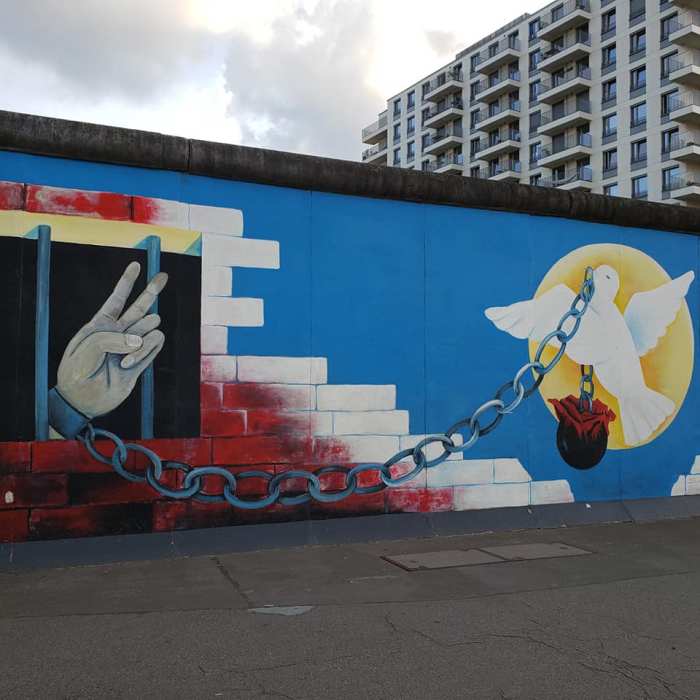
For me, perhaps the most visible symbol is the wall. The Berlin wall was in place from 1961-1989. When it fell, the East Side which had been closed off for decades, burst into freedom, as evidenced by the images on the east side of the wall, at the East Side Gallery – an open air mural gallery painted directly on that side of the wall.

Continue reading “The Berlin Wall—what did the US learn? by Marie Cartier”

The Sound of Silence: a mother’s day reflection 2019 by Sara Wright

Here in the high desert it has been raining off and on for the last few days. A giant puddle sits in the driveway and all the trees range in color from subtle shades of sage to emerald. Fringed Chamisa, spun gold and salmon wildflowers are bent low but stems are luminescent. Seedlings are sprouting in unlikely places.

I can’t think of a better mother’s day present for the desert than these ongoing cloud-bursts that are nourishing the earth with water and minerals from the sky. I am profoundly grateful for this year’s spring greening.

The earth is experiencing a sense of renewal. I wish I could say the same for me with respect to mothering and mother’s day. I cross this cyclic threshold with the same feelings of dread and grief that overpower me each year. Neither of my children acknowledge me as the mother who once loved them so fiercely, but oh so imperfectly in her own confusion and despair.

I was such a young wife, barely twenty when I became pregnant with my first child. Two years later I was a mother of two sons. Within five years I was divorced and on my own.

Although I tried to repair the damage as soon as I was able, neither child was willing to join me. I desperately suggested counseling – many times. As adolescents and young adults both Chris and later David, responded with chilling silence and apparent indifference to every frantic attempt I made to bridge the gap.

Continue reading “The Sound of Silence: a mother’s day reflection 2019 by Sara Wright”