Buddhas In Snowflakes, Enlightenment In A Bathtub

Stuart WordPress photoThis year’s Tibet House Benefit Concert coincided with a snowstorm in Manhattan and though snow is not uncommon in Manhattan (especially this past season), it is particularly associated with Tibet and its high, perennially snow covered peaks.  The timing of the snowstorm was thus peculiarly appropriate, leading Robert Thurman, US President of the Tibet House, to muse in his opening remarks about there being Buddhas in the snowflakes.

I was lucky enough to attend that concert thanks to my wife and some of her colleagues being invited by Thurman to attend in appreciation for work they had done on a book consisting of a collection of speeches by the Dalai Lama, My Appeal to the World.  Snow had been a topic of conversation at the dinner we had before the concert not just because of the coincidence of the snowstorm and concert, but also because one person in our group had recently broken her wrist slipping on what was left from an earlier snowstorm.  She was lamenting being sidelined from her yoga practice, at which point I brought up the topic of the therapeutic benefits of bathing.  As is typical of dinner conversations, that quickly morphed into a discussion of other issues; soon it was time for the concert and off we went.

Several weeks later, while taking a bath after my own yoga practice, as I often do, it occurred to me that being in a bathtub was analogous to being in a snowflake–a very large and warmed up snowflake.  The basis for the analogy is that ‘buddha’ is not a name but commonly interpreted to be the past participle of a verb, the primary meaning of which is to awaken.  The roots of Indo-European (IE) verbs only refer to bare existence or an action and as such can ‘belong’ to any noun (person, place or thing) of any gender (female, male or neuter).  Any person of any gender can be ‘awake.’  As a participle ‘buddha’ is a hybrid–part verb and part noun–and thus specifies gender (masculine), but that is an artifact of grammar, a way of speaking, that manifests its interdependence with other elements of language and how that language is used at any particular point in time.

There are a number of fascinating implications in analyzing language in this way (what used to be called ‘speculative grammar’ in Medieval times), but the single most important is that by itself language is not particularly enlightening, but rather quite dependent upon the context in which it is used.  It helps explain why the tradition of rejecting textual authority in favor of direct enlightenment, the ‘moment of zen,’ became particularly prominent in Chinese, Korean and Japanese Buddhism.  The grammatical differences between Sanskrit and Chinese are relatively substantial compared, for example, to those between any one IE language and another IE language.  Grappling with translating and interpreting first Sanskrit and then Chinese and then Korean or Japanese, seems to have heightened the sensitivity to the limitations of language, especially with respect to spiritual beliefs and practices.

This aspect of Buddhism can be readily demonstrated to share roots in an equally ancient tradition of Greek poetic culture.  It seems, however, that the guardians of the text based religious traditions emanating primarily from regions controlled directly or indirectly, at one time or another, by Roman emperors, are more than happy to let that aspect of the Western heritage go unnoticed.  Instead these guardians seem to emulate the command and control tactics of Roman emperors with what can be fairly characterized as intellectual imperialism.

Because of its importance to all such traditions, Song of Songs (Songs) is a useful example to cite.  Only by walling off a substantial amount of evidence is it possible to prevent Songs from being seen to be in part or whole a product of female spirituality that celebrates sexuality in a manner a Buddhist would identify as tantric.  Proof that is exactly what the guardians of the text based religious traditions have been doing is not hard to find, for the fact that few women have authoritative positions within any organization associated with such traditions is an artifact of just such a wall.

Such tactics ironically expose the vulnerability of these traditions to decline and fall.  One way that might happen can be discerned in what happened to Buddhism as it spread east.  It was creatively interpreted in harmony with a far more ancient tradition of nature worship associated with early Taoism, a tradition that privileges individual artistic expression, such as poetry, over textual study or ritualized recitation.  That tradition is comparable to the Western philosophy of nature evidenced, for example, in the poetry of the ancient mystic Greek of Sicily, Empedocles.

Though I have referred to this philosophy in previous posts, I hope to discuss it in more detail in upcoming ones as it relates both to ancient traditions such as Taoism and Buddhism as well as to how spirituality might evolve in the future.  Suffice it for now to say that what is essential is appreciating that experience itself is the ultimate, authoritative a priori of all spirituality.  That can mean doing yoga, meditating upon snowflakes or sloshing about in a tub of water.

Eventually, though, it leads within, to what the poet Holderlin calls ‘Innigkeit,’ a state of inwardness that is itself speechless, but which is the source of poetic/artistic inspiration.  That is in an essay on Empedocles, but given what was then known about him, Holderlin was largely projecting onto Empedocles his own beliefs (shared with his friend Schelling) about nature, with “all her melodies,” as the ultimate source of inspiration.  Decades after that essay was written, Schelling used Innigkeit in a lecture on mythology to translate a key term from the Bhagavad Gita: yoga, a term that as used there many scholars today think betrays Buddhist influence.  Several other translations were then available and it seems likely Schelling’s unprecedented choice of Innigkeit was an homage to Holderlin.

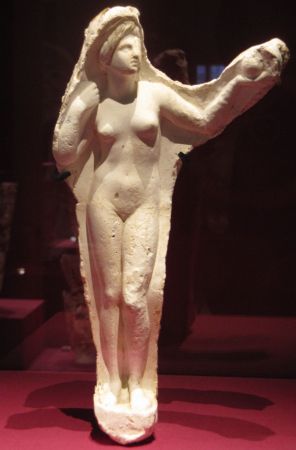
As it happens, substantial new fragments of Empedocles’s poetry were discovered in the 1990s.  In 2004, after piecing together those fragments with many of the other previously discovered ones, Richard Janko suggested Empedocles should be thought of as the Greek equivalent of Buddha.  Be that as it may, there is no question who Empedocles would say is in snowflakes: Aphrodite.

Stuart Dean has a B.A. (Tulane, 1976) and J.D. (Cornell, 1995) and is currently an independent researcher and writer living in New York City.  Previously he worked in a variety of other capacities, including 15 years as a corporate attorney.

Gretchen at Her Spinning Wheel by Natalie Weaver

Natalie Weaver editedIn my continuing music education, I was recently introduced to Schubert’s Gretchen am Spinnrade (hear, for example, Renee Flemming’s performance of this work). The song is a setting of Goethe’s poem “Gretchens Stube,” in which Gretchen, a poor but upright maiden, sits alone in her room at the wheel, thinking longingly of Faust. Gretchen spins her mind and her threads on the cusp of ruin.

Faust desires Gretchen and with the help of his demonic wingman Mephistopheles (to whom he has bartered his soul in exchange for worldly favors), Faust has laid a trap to seduce Gretchen. Faust eventually gives Gretchen a sleeping potion to administer to her mother so he can come to Gretchen at night undisturbed. Contrary to the assurances of Faust, the potion kills Gretchen’s mother, even as Gretchen is conceiving a child from the illicit union, with the voyeur-devil panting in the wings. Gretchen’s enraged soldier-brother is subsequently fatally wounded in a brawl over the sordid matter, living just long enough to tell Gretchen exactly what he thinks of her. Destitute, Gretchen drowns her illegitimate child, is imprisoned, and dies burdened with grief. In Goethe’s Faust, Gretchen is ultimately saved because she was once so stainless a figure and in her failings became so sufficiently penitential. Stripped of her name and transformed as una poenitentium, her soul re-appears in the final scene of the second act of the tragedy among the choir of angels receiving Faust in his own redemption, who, by those same angels, is himself bewilderingly whisked away from the clutches of a very confused Mephistopheles.

Leaving off for the time being the interesting and important question of men writing women’s stories, the whole of Faust, and specifically Gretchen’s song within it, engaged me in a feminist religious critique in ways I found counter-intuitive. On one level, I could not help but read Faust as a Promethean sort of hero. Here you have an accomplished scholar who is simply exhausted by the futility of his work, and especially the shortcomings of theology. He is seeking empirical knowledge from any place that it can at last be found. Minus his grandiose local stature, he kind of reminds me of myself (and lots of other academicians in theology who have glimpsed religious faith and myth in their most tiresome and dangerous social distortions). I incline to commend Faust for entertaining the background, the darkness, the animal, the bodily, the elemental, the unspeakable – for, that is also classically the “feminine,” yes? Continue reading “Gretchen at Her Spinning Wheel by Natalie Weaver”

Poppaea & Paul: Was This About A Female Challenge To Male Privilege? by Stuart Dean

Poppaea Sabina as portrayed on a Roman coin minted 62-65 CE.


As suggested in my first post on Poppaea it is likely she knew one or more of the women Paul refers to in Romans. Of particular interest is the woman Paul refers to as his ‘mother’ (Romans 16:13).  If Poppaea knew her she surely knew about Paul.  If that was the case, then it seems all but certain Poppaea was among those members of the imperial household to whom Paul refers at Philippians 4:22.  Corroboration of that may have been in the source(s) of an anecdote Saint John Chrysostom tells, attributing Paul’s incarceration and execution to Nero’s anger at his interaction with a woman with whom Nero was erotically involved.

Though it is difficult to place much reliance on Chrysostom’s anecdote without more knowledge about his source(s), in the aggregate the evidence for Poppaea knowing about or even meeting with Paul is relatively strong, especially when compared to the sort of evidentiary problems with which ancient historians regularly grapple.  Furthermore, it is easy to spot the issue Poppaea would have focused on (that precisely because it relates to sexuality could have led in antiquity to the sort of distortion or misunderstanding of her motivation in meeting with Paul) that may underlie Chrysostom’s anecdote: circumcision.  The problem with understanding that issue today, however, ironically relates to modern perceptions of no relevance whatsoever to the ancient evidence. Continue reading “Poppaea & Paul: Was This About A Female Challenge To Male Privilege? by Stuart Dean”

My Immortal Mother-in-Law by Elizabeth Cunningham

Elizabeth Cunningham headshot jpegBefore Olga Eunice Quintero Smyth died on December 4, 2014 at age 101 and 10 months, I was tempted to believe she was immortal, literally. I knew Olga for forty-five years (from age 16 to 61). For thirty-five of those years she was my mother-in-law. Our history began when I was kicked out of high school and went to work at her free-wheeling school, her utter lack of any interest in reforming me a blast of fresh air. It ended with me sitting beside her as she was dying, softly singing “Row, Row, Row Your Boat.”

Olga was named for a Russian princess her mother encountered when she was a babe in her arms en route to Trinidad from her native Venezuela. Olga took for granted her descent from Incan royalty as well. Her mother moved the family to New York when she was eleven. A few years later, she won a scholarship to Mount Holyoke College. She married a classmate’s brother, Julian Smyth, great grandson to Nathaniel Hawthorne. If that weren’t enough, Olga claimed for Julian’s line direct descent from the first century Celtic Queen Boadicea. As long as she could speak, she spun tales. “Where in Africa was she born?” one of her nurses asked me. “What kind of a dancer was she?” Continue reading “My Immortal Mother-in-Law by Elizabeth Cunningham”

Winter Solstice Meditation by Molly

December 2014 022When the wheel of the year turns towards fall, I always feel the call to retreat, to cocoon, to pull away. I also feel the urge for fall de-cluttering—my eyes cast about the house for things to unload, get rid of, to cast away. I also search my calendar for those things which can be eliminated, trimmed down, cut back on. I think it is the inexorable approach of the winter holiday season that prompts this desire to withdraw, as well as the natural rhythm of the earth which so clearly says: let things go, it is almost time to hibernate.

Late autumn and the shift toward winter is a time of discernment. A time to choose. A time to notice that which has not made it through the summer’s heat and thus needs to be pruned away. In this time of the year, we both recognize the harvest of our labors and that which needs to be released or even sacrificed as we sense the promise of the new year to come. Continue reading “Winter Solstice Meditation by Molly”

One Small Red Leaf by Deanne Quarrie

Deanne QuarrieIt seems to me that the goal of most people is to be happy. We seek it ourselves and hope that those we love find it as well. Happy is an elusive state. At best it is hard to define – what is happy anyway?

As young adults we may seek happiness in alcohol and parties, perhaps even in drugs. We hope to find it in our careers and certainly in the unions we make and partners we choose. Happy is to be pleased, or glad, over a particular thing. The dictionary associates a state of happiness with contentment as well as with the experience of joy. And it also says that happiness is associated with good fortune or luck. Continue reading “One Small Red Leaf by Deanne Quarrie”

Devotional Poetry: You’re Invited to a Community Bardic Exercise

Kate BrunnerLet the creative word romp begin!  Our exercise will be simple, yet challenging. I invite you to write one devotional poem per day for the next seven days about whatever moves you spiritually that day in whatever poetic format the words emerge.

Your goal for the next seven days is to let loose a little- step into the creative flow and allow your Bardic Soul to speak. What we will not be going for is perfect, publication-ready material. I know whenever I undertake something like this, I have to remind myself of that. And I have to muzzle that horribly devious little fellow known as my Inner Critic in order for my Courageous Bard to spring free.

Poetry is the creative form which attempts to capture in words and sound the mystery which lies beyond language. We are all capable of writing poetry.

~from Priestess of Avalon, Priestess of the Goddess by Kathy Jones~

Look for divine poetic inspiration in any and everything around you during next week. Step with intention through your days. Let the whole world sing to you. Dance with language- FEEL it move you! Do not bludgeon yourself with repeated editing. Write, share, and be brave enough to let it be. Continue reading “Devotional Poetry: You’re Invited to a Community Bardic Exercise”

She Alone Was There In The Beginning: Nature Creatrix by Stuart Dean

Stuart WordPress photoI concluded my last post by suggesting that “Creator” in the Declaration of Independence (DI) should have been ‘Creatrix.’  Though ‘Creator’ imbues the DI with a bit of quasi-scriptural authority, the possessive pronoun “their” before it effectively limits the full benefits of creation to men.  That alone should have precluded even the suggestion that the DI effectively endorses Christianity or that it constitutes the basis for a civil religion.

Quite obviously that has not been the case, but that should not be taken to validate the misogyny the DI manifests.  ‘Creator,’ the masculine form of the Latin noun derived from the verb ‘to create’ (‘Creatrix’ is the feminine), is unambiguously masculine in a way that ‘God’ simply is not.  Its appearance in the DI raises the suspicion that it was selected to underscore the masculinity of “Nature’s God,” the phase used in the DI’s opening paragraph.  Surely some of the signatories of the DI knew their Latin authors well enough to know how peculiar it is to speak of Nature as having or needing a God.  Perhaps they wanted to clarify things. Continue reading “She Alone Was There In The Beginning: Nature Creatrix by Stuart Dean”

A Change in the Air by Deanne Quarrie

Deanne QuarrieWe had a wonderful taste of the autumn yet to come here in Austin, Texas. It began with a lovely, cool and drenching rain. We have been blessed with more rain than normal this year.  When one comes in, however, after days of scorching heat, it feels like such a gift.  This one brought cooling temperatures for a couple of days, a damp coolness that makes you want to lie in bed with the window open feeling the cool breeze and lingering just a bit, relaxing longer than usual. You know it won’t last for long so you have to just stop and be with it. Revel in it! For us to go from the near 100’s dipping down into the 60’s for the high of the day was such a treat!  Later today, we will be back up in the 90’s, the coolness just a memory and yet a taste for what is coming.

Lying in the cool, green grass, I feel it thick beneath me.
I gaze at the clouds in the sky and my mind wanders,
drifting out to times remembered and times yet to come.
I feel close to the Earth, immanently connected and
embraced by the unknown universe above. Continue reading “A Change in the Air by Deanne Quarrie”

Painting Tiamat/Tehom by Angela Yarber

angelaToday I am honored to give a lecture on “Queering Iconography: Holy Women Icons from Sappho to Pauli Murray” at the North Star LGBT Center in Winston-Salem, NC. So, I want to continue the theme of featuring some of my queer Holy Women Icons. Joining Virginia Woolf , the Shulamite, Mary Daly, Baby Suggs, Pachamama and Gaia, Frida Kahlo, Salome, Guadalupe and Mary, Fatima, Sojourner Truth, Saraswati, Jarena Lee, Isadora Duncan, Miriam, Lilith, Georgia O’Keeffe, Guanyin, Dorothy Day, Sappho, Jephthah’s daughter, Anna Julia Cooper, the Holy Woman Icon archetype, Maya Angelou, Martha Graham, Pauli Murray, La Negrita, and all my other Holy Women Icons with a folk feminist twist is the often overlooked and misunderstood primordial goddess of creation: tehom.

In Genesis 1 we read, “In beginning, God created the heavens and the earth, the earth was a formless void and darkness covered the face of the deep, while a wind from God swept over the face of the waters.” It is the creation narrative held dear, formative, and meaningful for countless Jews and Christians. Interestingly, this word, deep, in Hebrew is tehom. Tehom translates as “deep or depths,” but it’s also a cognate for Tiamat, a Babylonian Goddess of creation. Out of the face of the deep, the world begins. Out of tehom, God creates. Out of Tiamat, the earth comes into being. This dancing Babylonian goddess syncretistically intermingles with the creation myth so pivotal to the faith of Christians and Jews in a way that could be terrifying, or beautiful, or—like the chaotic body of Tiamat that brings the world into being—both. Continue reading “Painting Tiamat/Tehom by Angela Yarber”