 In my home, in my journals and notebooks, and in my office, I display proverbs and quotes of all kinds around me to inspire me to live meaningfully. Proverbs and fables from around the world are stacked on my bookshelves and bedside tables. I love reading what is called “wisdom literature” in the Christian Scriptures. But when I get to those final lines of the Book of Proverbs in the Bible, Proverbs 31 sets me on edge.
Proverbs 31 is a poem that begins with sayings of King Lemuel described as “an inspired utterance his mother taught him.” Lemuel’s mother instructs him to not spend his strength on women, to refrain from drinking and to defend the rights of the poor and needy. Verses 10-31, the ones I’ve heard most often read in church settings, follow that advice. They are an acrostic poem of verses that begin with the successive letters of the Hebrew alphabet to describe a noble wife. Instead of reciting the entire A-Z list (A is for adoring, B is for busy, C is for caring, D is for dutiful…), Christians will frequently read aloud only the verses selected below.
Epilogue: The Wife of Noble Character
10 A wife of noble character who can find?
She is worth far more than rubies.
11 Her husband has full confidence in her
and lacks nothing of value.
12 She brings him good, not harm,
all the days of her life.
25 She is clothed with strength and dignity;
she can laugh at the days to come.
26 She speaks with wisdom,
and faithful instruction is on her tongue.
27 She watches over the affairs of her household
and does not eat the bread of idleness.
28 Her children arise and call her blessed;
her husband also, and he praises her:
29 “Many women do noble things,
but you surpass them all.”
30 Charm is deceptive, and beauty is fleeting;
but a woman who fears the Lord is to be praised.
31 Honor her for all that her hands have done,
and let her works bring her praise at the city gate.
I’ll admit it–the woman described here does sound honorable and praiseworthy. My problem with this poem has more to do with the way I’ve heard it used than its content. In all but one setting, I’ve heard these verses proclaimed as a model for the ideal woman or as a guide to virtuous living for young women.
My first concern about that is a common feminist criticism: Not all women aspire to be wives and mothers. Some of the poem’s statements could apply to all women, like verse 21: “She opens her arms to the poor and extends her hands to the needy.” But others are specific to marital domestic life, like verse 28 (above) and verse 15: “She gets up while it is still night; she provides food for her family.” Women without husbands and children cannot meet all Proverbs 31’s standards. And while family is of primary importance to many women, it is not the only area of a woman’s life that can provide her value and meaning.
I am also concerned that defining Proverbs 31 as a standard of womanhood communicates the idea that it is about women only. While there are references to tasks that have been traditionally gendered (women cook and sew, men take leadership roles outside the home), many of the qualities extolled here are commendable for adults of all genders. Strength, dignity, wisdom, and care are not gender-specific virtues. So why haven’t I heard this proverb set as an example for men, too?
My third concern about making this a guide to womanhood is that it seems to reinforce a standard of perfection. The Proverbs 31 woman is certainly industrious—no one can call her idle! But she also sounds exhausted. By my count, this woman does 23 things surpassingly, including buying fields, planting vineyards, making clothes and selling them. I’m concerned that when emphasizing the Proverbs 31 woman tells Christian women that they are not good, are not lovable, or are not enough until they meet this standard. For me, the message of the Christian gospel is about God’s radical, all-encompassing love for humanity in the face of our imperfection. While I do know some women with a healthy self-image, many are painfully aware that they do not meet some standard set for them. They could stand to be told more often that they are loved simply because they exist, not for what they do.
When I heard Proverbs 31 read at my Aunt Ruby’s funeral , I began to see something more meaningful in these words than an impossible standard for women to attain. The preacher quoted “She is worth far more than rubies” noting my beloved aunt’s name and her character. However, the message he preached that day wasn’t to set a standard of a good wife. It was to honor a woman who had lived a noble life. She was strong, dignified and wise. Her family knew she was blessed and that they were blessed by having her in their lives. She worshiped God and communicated her love of the Lord to successive generations.
When I heard Proverbs 31 spoken about my aunt, I began to find resolution to my concerns. In that setting, the poem was an affirmation of a life lived well, not an exhortation to perfection. Honoring someone is primarily about demonstrating love or respect to that person, not a list of qualities or accomplishments. Certainly, the person we admire may have qualities we seek to adopt to our own lives, but following their model involves more creativity and agency than reducing a poem like Proverbs 31 into a list of standards allows. Integrating those qualities into our own lives requires adapting their traits to our own circumstances and even rejecting some of our model’s qualities that don’t fit the unique vision of our lives that we (or God) have. While I admire the Proverbs 31 woman’s work ethic, I strive for a life with regular periods of rest and renewal.
Elise M. Edwards, PhD is a Lecturer in Christian Ethics at Baylor University and a graduate of Claremont Graduate University. She is also a registered architect in the State of Florida. Her interdisciplinary work examines issues of civic engagement and how beliefs and commitments are expressed publicly. As a black feminist, she primarily focuses on cultural expressions by, for, and about women and marginalized communities. Follow her on twitter, google+ or academia.edu.


 This is the first poem I ever wrote and had published.

 The summer is getting late. School supplies are coming in, and it is time to try on the uniform pants in order to get them hemmed before the first day. I always feel a little funny at this time of year, almost queasy from my mixture of nostalgia for waning days at the pool and excitement for crisp plaids and fresh notebooks. I continually miss the scents of summer skin, chlorine and suntan lotion, even while I look forward to the autumnal fragrances of newly sharpened pencils, cinnamon sticks, and rubbery Halloween costumes. Time, at this transitional time, is always pregnant with the promises of both bounty and loss, so I am not surprised by my wistfulness as we turn to fall. I am, however, taken by its depth for me this year. For, this transition has been a little heavier than usual as I ask myself, “Where did it go?” and “What did I do?”

 This reflection was initially a part of an attempt to create radical liturgies that might connect the frequent theological bias towards ‘light’ and the implicit White Supremacy that such theologies perpetuate. In addition, this particular reflection was inspired by a friend’s resistance to societal gender norms.

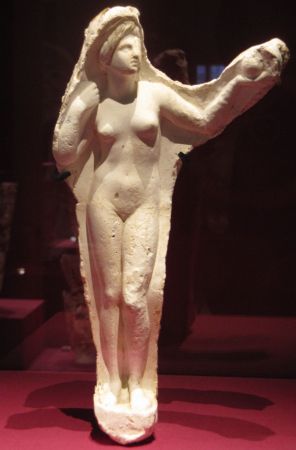 Though it is not known what the motivation originally was for acquiring the Bagram Aphrodite, its presence in Afghanistan arguably evinces an interest in female spirituality–if not in the owner of the storerooms then among some of the people in the market for which she may have been destined. Evidence of such interest among Buddhists is to be found in the
