The Furious Sun in Her Mane: Nine Poems to Goddesses by Annie Finch

Poet’s Note: I composed this sequence of poems for performance, for chanting, and for devotion. I wanted people who would hear, read, memorize, and speak each poem to channel the original energetic patterns that the poets who best knew that Goddess used to connect with Her. So for each poem, I researched the meter and prosody of the original language in which that Goddess was first worshipped.  Then I carried the exact rhythmical pulse of Her language into my poem to Her in English.

The sequence was set to music by composer Laura Manning and choreographed by Georgia Bonatis, and I directed and performed a devotional dance collaboration version of it in 1994. That archival video of this performance has just been recovered for the first time in 31 years. It is now posted on my Youtube channel.

Continue reading “The Furious Sun in Her Mane: Nine Poems to Goddesses by Annie Finch”

PEOPLE GET READY by Esther Nelson

I recently attended an event in Salem, Virginia, put on by The Salem Choral Society titled “People Get Ready,” directed by S. Reed Carter IV.   This popular group has sung on numerous occasions locally as well as performing at Carnegie Hall in New York City and the National Cathedral in Washington D.C.  The choir (11 men and ~45 women) sang fourteen selections.  The song arresting my attention was “People Get Ready.” 

From Wikipedia:  “‘People Get Ready’ is a 1965 single by the Impressions, the group’s best-known hit, reaching number three on the Billboard R&B chart.  The gospel-influenced track was a Curtis Mayfield (1942–1999), American singer-songwriter, guitarist, and record producer.  This particular composition displayed [his] growing sense of social and political awareness…. In 2021, Rolling Stone named this song the 122nd greatest song of all time.  Martin Luther King Jr. named the song the unofficial anthem of the Civil Rights Movement and often used the song to get people marching or to calm and comfort them.”

Continue reading “PEOPLE GET READY by Esther Nelson”

Three poems by Rebecca Rogerson

Don’t Take Me to Church

He never let me eat communion because I wasn’t a catholic, but it was okay for me to eat his dick. My tiny palms forced to stroke him, the same dextrous hands that coloured in the lines. 

I knew his God wasn’t my God. I knew she saw everything there was to see and that he wouldn’t reach salvation; no matter how many Hail Marys he said at mass in Ireland.

The Virgin Mary knew what he stole from me, what they steal from all of us.

I couldn’t fall apart on Sundays at noon when he took me to church—before he took me home after he did what he did—to the little Jewish girl who didn’t know she was Jewish.

I couldn’t remember it because I buried it in Survive, until, it was resurrected by nightmares and demons who professed caring and brought me to altars of despair to vomit up all the darkness, and when there was no more left to cleanse or tear out; light ripped in.


No one talks about the embarrassment that goes along with the telling, sharing and surfacing of sexual violence. How it comes up, how it comes back. How we’re always haunted by the deadbeat dead and grabby grandfathers who try to reach from there into here, pretending they are made of heaven.

I fled a friend’s choir concert because perpetrators keep stealing time, moments, sleep, joy, and friendship, in churches and baths. On my flight, I hunted for nature, soil and anything else that felt most alive in the hilly town of Nelson. Pretending I was like everyone else, I hid the panic that strikes broken hearts.

Continue reading “Three poems by Rebecca Rogerson”

Two Poems by Rebecca Rogerson

ROSE WATER

I am the holy place somewhere in the stars of eternity,
 someone’s daughter who seeks reprieve somewhere.

Yetta changed her name to Mary. She tried to erase her past, not as a Jew, well maybe some of that, but more as a Jew molested by her father—a frum[1], “Monster”, his daughters called him.

On my altar sits my tallit alongside a Menorah with seven brass holders. No stars of David—before or after the decimation of Gaza. Can rose water sweeten our hearts? We pour it graciously in our hands, hoping the lost petals heal our guts and brighten our thoughts. She searches hungrily for hope in glass bottles adorned with Farsi, that cost $4.29 each.

Continue reading “Two Poems by Rebecca Rogerson”

Regeneration by Annelinde Metzner

This time one year ago, our world here in Appalachia seemed like it hadn’t changed in a thousand years.  The giant, churning, awesome power of Hurricane Helene had not yet whipped our waters into a frenzy, and caused the mountains to slide downhill, carrying our lives away.  And yet, from just below the earth’s surface, Spring reappears with all Her perseverance, Her steadfastness, Her fertile abundance.  The slow, steady regeneration of our Mother inspires me to keep going, day by day, hour by hour.

Primavera

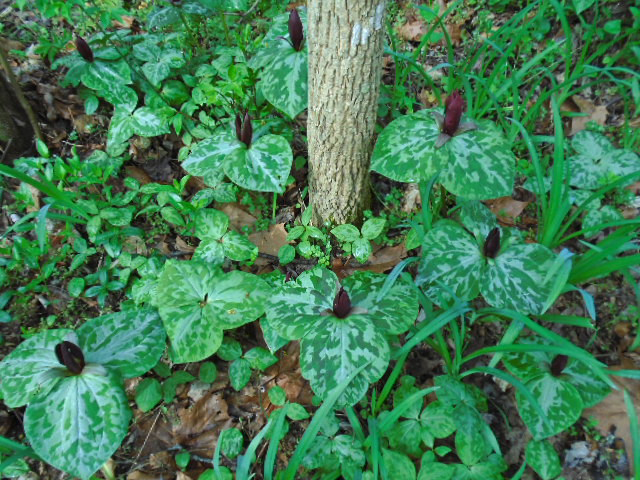
Toadshade Trillium

The newness of Spring, Primavera,
”first green,”
soft petals that banish Winter’s icy grip,
the return of the Galax, the trillium,
the return!
Full-blown rebirth,
bright, brilliant green shining in the sun,
Spring!
Rebirth decked out like a debutante
with a roomful of courtiers,
flipping the world from darkness to light.
Ferns unfurl,
fiddleheads play on the forest floor,
insects awaken and buzz 
in a hundred keys of life.
Humans awaken too, reminded once more
of the richness of the return.
A breeze blows over the galax,
the Mayapples spread their elegant leaves
The promise of the Great Mother:
we will begin again.

Continue reading “Regeneration by Annelinde Metzner”

Showing Up, by Molly M. Remer

When we return home, I see a meme on social media that says: “Ten minutes online will show you everything that is wrong with the world. Ten minutes outside will show you everything that is right.” I think about the students and professors, each one alight with enthusiasm, with passion, for their work, their projects, their art, the contributions they are making. This is what we need. We need to see, spend time with, and BE people who are involved, connected, committed, and passionate. People who are creating instead of destroying. People who are connecting instead of controlling. People who are reaching out to offer what they can, who create and care, and who show up.

We may let connections thin
and interests slide,
forgetting that it takes work
to nurture and tend
to what we love,
that following what is easy
can be the wrong direction,
one that eventually leads
to the withering of what we value
and to the shrinking of our worlds.
We must evaluate the balance
between effort and ease,
yes,
but let us remember
that both are essential to thriving.
Let us lean into effort sometimes,
when there is meaning on the line,
put our backs into it,
feel sweat on our brows
and the satisfaction that comes
from choosing to immerse ourselves
in wholehearted living,
in presence,
in the work of reaching out
and holding on.

This past weekend, I went to my oldest son’s next college campus. The green spaces were filled with students working on art. The halls of the buildings were lined with art by high school students there for a visiting show. The art gallery was filled with diverse works of many mediums. The speakers for the day were filled with enthusiasm for their subjects, talking about study abroad trips to Paris and being part of the chorus or the band. We pass the student theater, abuzz with activity, and listen to a young man playing rippling tunes on the piano in the atrium of the library. This school is in a rural Missouri farming community, where we passed tractors laden with hay on the potholed road. Their mascot is a mule (“the only college with live mascot in Missouri!” they proudly report. The mule’s name is Molly, so I like her right away). Missouri is a “red state” and yet the students handed me the school paper with a front page story about protests at the capitol and a large color photo of someone holding an “Impeach Elon” sign. I happily picked up a library button proclaiming “libraries are for everyone” and another saying “what’s more punk than a library?” as well as snagging a “plant queer” sticker from the LGTBQ+ alliance table for my sister. The History table gives me a bookmark reading: “Don’t make me repeat myself.” –History

Continue reading “Showing Up, by Molly M. Remer”

Changing Woman’s Light, part 1 by Sara Wright     

Born of Stone and Trees
Birthing a People
from a Mountain
of Light
I hold slivers of her body
touch numinous fragments
worked by Peoples
who honor and
live the Great Round
Pungent scent of
red pine and
spruce,
luminescent
lemony cottonwood
cobalt sky
steep gorges, sand
flakes of pink,  rust
a splash of bittersweet
translucent charcoal
flint
spiny cactus
juniper serpents
twisted into
fantastic shapes
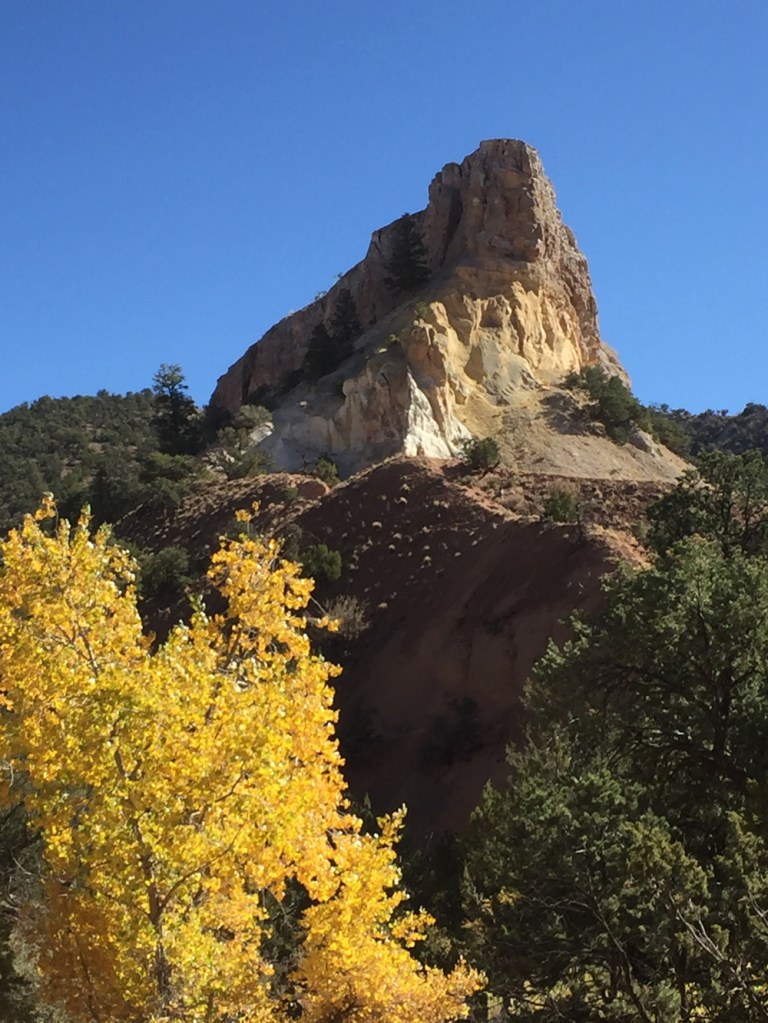
a peak that pierces sky
flat topped
on one side
I belong to Her
and She to me
Mother of all
Creation.

Changing Woman’s Mountain

I have written before about Changing Woman’s Mountain located near Abiquiu New Mexico. Most call this mountain Cerro Pedernales and an image of the flat side of this mountain, her mesa, was made famous by artist Georgia O’Keefe.

 Astonished by my first glimpse I climbed a long serpentine road that wound around steep gorges, rivulets of water, open meadows and unbroken stretches of lush fragrant green forests to reach the backside of this mountain.  I couldn’t get over the fact that one side was a mesa and other was a peak that pierced the sky like a sword.

Continue reading “Changing Woman’s Light, part 1 by Sara Wright     “

The John Howard Society: Poetic Justness & Hope by Margot Van Sluytman

COMMUNITY

Unexpected comfort
Permeated raw, cold ache.
Warmth melted sorrow.
Embraced we are.
Once again
Knowing we are loved.
And loving too.

©Margot Van Sluytman

~~~
“Supporting neighbours. Protecting communities. Providing supports. Rebuilding lives.”
Donna De Jong, Executive Director of The John Howard Society, Hamilton-Burlington, Ontario, Canada.
~~~

I think often about why and how community matters. About joy and justice and hope and healing. And indeed, the importance of spaces such as our own here on FAR, this community of poets, writers, artists, activists, advocates, allies, academics. Each whose choice to put pen to page, affords light and life to throb and to thrive.

Continue reading “The John Howard Society: Poetic Justness & Hope by Margot Van Sluytman”

Ice Above and Below and the Coming of the Light by Sara Wright

January’s twilight
hours draw me
into her pale embrace
stalactites and frozen
streams whisper
that winter’s skin
is thin even with
months to go
flowing water
is muted
under seeded snow
underground roots
pulse
with light
 sleeping
forest boughs
wake in wild winds
crack and moan
rest in peace
 at dawn
bears sleep
fox and weasel
seek slivers of
open water
I walk in slow
motion to
stay upright
at the edge
of a meandering
serpentine stream
listening for
the scent
of just one
hemlock singing
feeling the tangles
of gray and green
 Indoors
standing at the window
I ask
 how many
forested eyes
are meeting my own?

Continue reading “Ice Above and Below and the Coming of the Light by Sara Wright”

Two Poems by Alice Bullard, PhD

Dear FAR Community, These poems arise from feminist spiritual practice with syncretic dimensions. The Irish-American Catholicism of my family mixes with the popular American confessional-style that charts and embodies emerging spirit, yet this very American path of self-styling and narrative self-creation has been refined via the influence of Zen practices, originally via the influence of the Soto practictioners of Green Gulch in Marin and then later via the teachings of Vietnamese refugee and Zen Buddhist monk, Thich Nhat Hanh. The feminism here is deeply personal, political, and spiritual.

This post was inspired by one written my Janet Maika’i Rudolph about Alice Munro which you can read here.

About Alice Munro: I experienced the revelations of her daughter very personally … I’ve read Alice Munro since I was very young and used to read my parent’s copy of the New Yorker. Because we shared the name Alice and also shared the cold Midwestern prairie though she was further north and across the border, I had always felt some affinity for her but also I felt something I really didn’t get. To me her stories took inexplicable turns and now we know why. Her daughter’s experience is dreadful and probably much more common than anyone would care to admit. That Alice Munro was famous doesn’t make that type of negligent mothering something rare.

Continue reading “Two Poems by Alice Bullard, PhD”