An Ambitious Task: A Queer, Feminist, Decolonial Listening to the Gospel According to Mark by Xochitl Alvizo

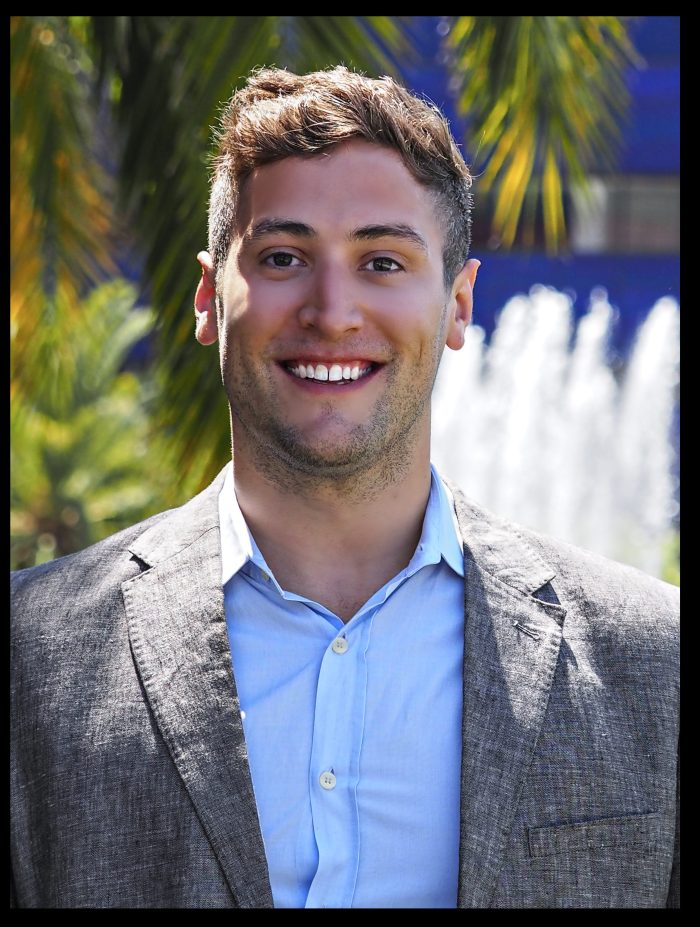
Photo by Chris Pinkham. (I recently shaved by head again – I’ll get an updated photo soon!)

I was recently invited to give the Castañeda-Jennings lecture via Zoom at the Chicago Theological Seminary. The lecture was yesterday and it was founded to celebrate the the awarding of the Castañeda-Jennings Scholarships, which go to students whose work helps transform Christian congregations from places of hostility to places of support and empowerment for the LGBTQ community. It really was an honor to get to participate and share through a lecture. And, it was an opportunity to do what I don’t often get to do, which is to be fully theological – to present my critical reflection on Christian praxis in light of the scripture, which is considered the word of God by Christians, and in this case, I was specifically reflecting on the gospel according to Mark.

This lecture is a snapshot of the larger book project on ecclesiology that I am working on – a feminist, queer, anti-racist, decolonial theology of church. So here I’ll share some of the highlights of the talk…

Continue reading “An Ambitious Task: A Queer, Feminist, Decolonial Listening to the Gospel According to Mark by Xochitl Alvizo”

The Divine Presence Within and All Around Us by Xochitl Alvizo

Back in 2008, I took a class with Mark D. Jordan titled Queer Incarnation. As you can imagine from the title, the topic was the incarnation of God in Jesus within Christian understanding but though a queer theory lens.

The idea that God took flesh and made God’s home among us.

God took flesh.

Continue reading “The Divine Presence Within and All Around Us by Xochitl Alvizo”

Can I get an “Amen” up in here? by Laura Montoya 

I am a great evangelist. I used to evangelize in Pentecostal settings until I was 22. Then, I left my church to evangelize about feminist issues to every woman that crossed my path. Rhetoric is a gift I received when I was a kid and that I inherited from my grandpa and my dad. But during the COVID lockdowns, it was hard to socialize, and my evangelization skills turned toward making my friends and family join the privileged fan base of Ru Paul’s Drag Race. One by one, I convinced my sister, cousins, neighbors, and best friends to watch the reality show, and they did with astonishing devotion. Every week, two or three of us gather in someone’s living room wearing masks to watch episode after episode after episode. Our debates about the queens in the show could last all night long. Who had the best performance? Did you like their lip-synching? “That elimination was so fair/unfair!” 

Continue reading “Can I get an “Amen” up in here? by Laura Montoya “

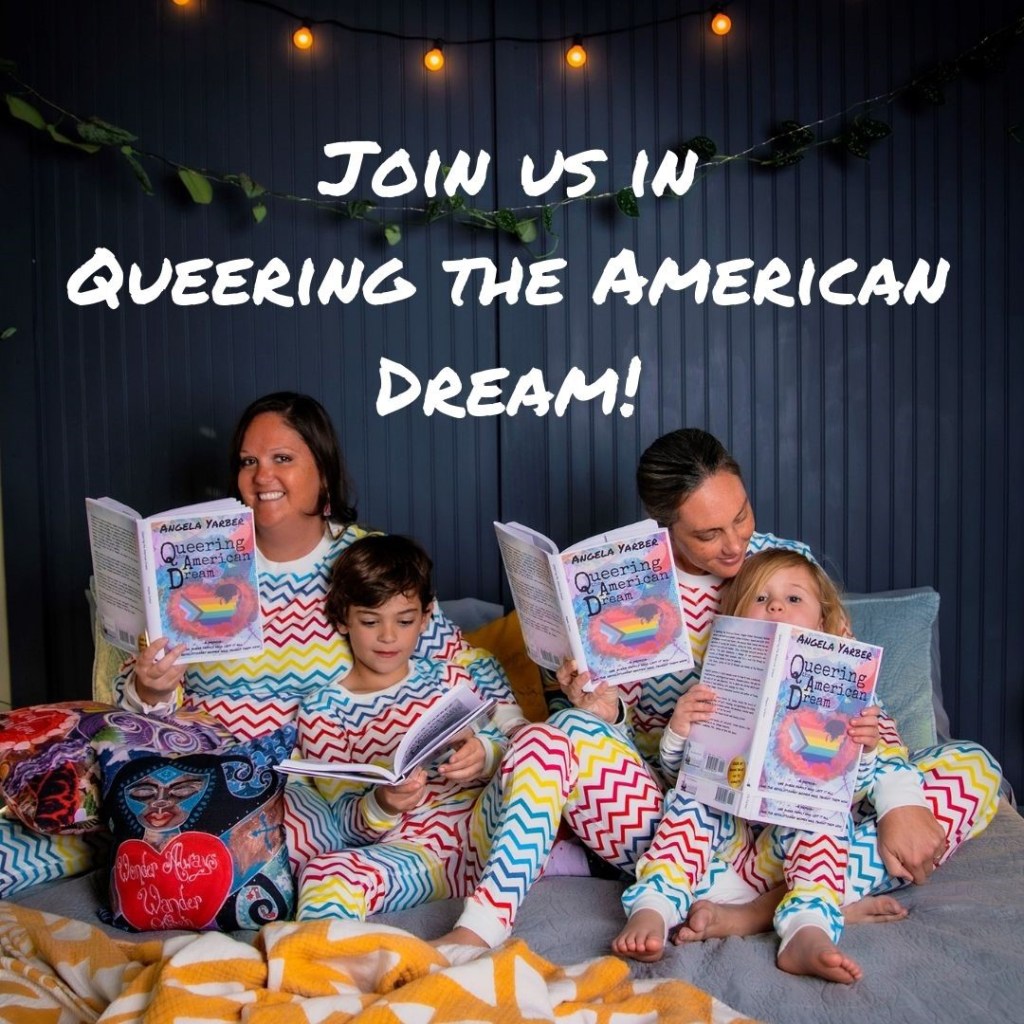
Queering the American Dream by Angela Yarber

As Florida politicians try to ban teachers from including LGBTQ+ issues in the curriculum, admonishing them, “Don’t Say Gay” at school, I’m shouting “GAY!” from the rooftops. Because I’m celebrating the release of my eighth book and first memoir, Queering the American Dream. It’s my queer family’s story of leaving it all and the revolutionary women who taught us how.

Our story began the day the Supreme Court ruled our marriage legal and ended the moment my younger brother’s addiction spiraled into a deadly overdose. In-between were eighteen months of full-time travel with a toddler in tow. Criss-crossing the American landscape, my wife and I came face to face with jaw dropping natural beauty on the one hand, which contrasted with the politics, policies, and people who continued to discriminate against marginalized families like ours on the other. At each stop along the way, a different revolutionary woman from history or mythology guided our footsteps, reminding us that it’s not simply our family who dared to queer the American dream, but a subversive sisterhood of saints who have upended the status quo for centuries. From Vermont to Hawai’i, and everywhere in between, the beauty of the American landscape bore witness to a queer clergywoman whose faith tradition was not enough to sustain her. But the revolutionary women were.

Continue reading “Queering the American Dream by Angela Yarber”

Lucky by John M. Erickson

This past weekend, I was asked by an individual why I decided to get my Ph.D. in American Religious History focusing on LGBTQ spirituality and sexuality.  Now, I’ve been asked this before, and if you know anything about me, you know I like to shock people at times, so my usual response is: “I have always been fascinated with people tell me I was going to hell.” 

It’s almost the end of Pride Month and I wanted to take a moment to reflect on where we’ve come and where we must go.

This past weekend, I was asked by an individual why I decided to get my Ph.D. in American Religious History focusing on LGBTQ spirituality and sexuality.  Now, I’ve been asked this before, and if you know anything about me, you know I like to shock people at times, so my usual response is: “I have always been fascinated with people telling me I was going to hell.” 

Continue reading “Lucky by John M. Erickson”

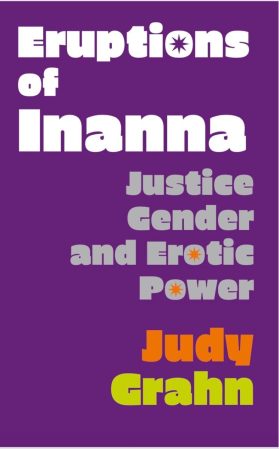
Eruptions of Inanna: Justice, Gender, and Erotic Power by Judy Grahn BOOK REVIEW by Carolyn Lee Boyd

Judy Grahn Eruptions of Inanna

Any new book by Judy Grahn is cause for celebration. For decades, Grahn has been a lyrical and passionate poet, author, mythographer, and cultural theorist whose work  features both goddess wisdom and contemporary culture centering on women and queer people. Nightboat Books has just published her newest book, Eruptions of Inanna: Justice, Gender, and Erotic Power, which offers ancient yet fresh world views with which to approach such issues as injustice, sexuality and gender, climate change, and more just when we need it most. 

In Eruptions of Inanna, she brings what she calls her “poet’s eye” to eight stories featuring the Sumerian goddess Inanna as well as religious practices of those devoted to her. She explores how these have directly influenced our world and, in her words, can continue to “feed our needs and help us take better care of each other and our world.” According to Grahn, Inanna “is a combination of human, creature, erotic and other energetic forces, and civilization. She also inherited very old powers that grew out of women’s rituals” (55).  Her essence engenders sovereignty and self-worth, especially in women and queer people.  She is a goddess of love, espousing passion and the joy of eroticism as integral to both life and society. She practices an expansive justice that creates positive outcomes in response to horrific acts. She creates a civilization of the arts, beautiful and useful crafts, abundance, and a jubilant communal life. She demands respect for nature and ecological sustainability.  

Continue reading “Eruptions of Inanna: Justice, Gender, and Erotic Power by Judy Grahn BOOK REVIEW by Carolyn Lee Boyd”

Subversive Sister Saints by Angela Yarber


As the American Embassy was bombed in 1999, I was hunkered in a Russian Orthodox Church, gazing at the brooding, whitewashed faces of icons, hands raised in endlessly frightening benediction. Hundreds of men met my eye, as I found myself asking, “Where are all the women?” In 2005, the sun peaked over the horizon on Mount Sanai as I entered the chapel at Saint Catherine’s Monastery, which houses the oldest collection of Christian orthodox icons in the world. As a sensory overload accosted my eyes, ears, and nose, I scanned the scene to find only two women crammed among all the icons; one was a nameless daughter sacrificed by her own father. Where were all the women? A few years later, I knelt at the Temple of 1,000 Buddhas in Thailand. Not a woman could be found. Where are all the women?

For over a decade, I’ve painted folk-feminist icons of revolutionary women from history and mythology, a subversively artistic attempt to answer my own question by painting the women who have been ignored, excluded, or strategically erased. From Pauli Murray to Sarasvati, Gloria Anzaldua to Papahanoumoku, this work continues to be a gift, joy, and a tremendous part of the mission of my non-profit, the Tehom Center, which empowers marginalized women by teaching about revolutionary women through art, writing, retreats, and academic courses. Continue reading “Subversive Sister Saints by Angela Yarber”

Coming Out of Quarantine by Angela Yarber

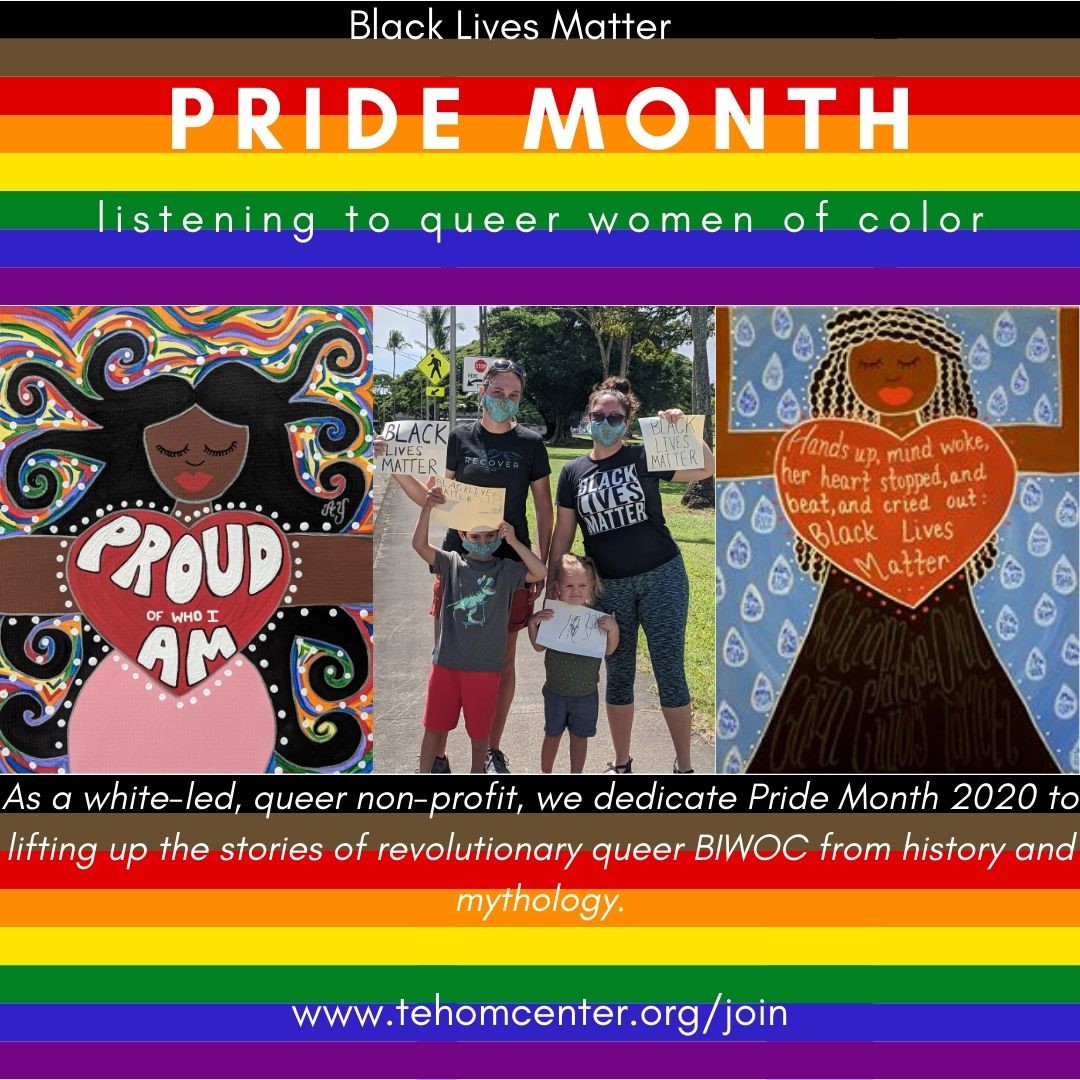
As Pride Month and Black Lives Matter protests co-exist, the spirituality of queer women of color teaches white allies how to listen.
After nearly eighty days of sheltering in place, I feel like I’ve stepped out and found the world on fire. June isn’t supposed to be this way. It’s Pride Month, after all, and I’m queer, eager to dance alongside my favorite drag queens, albeit reticent to embrace capitalism’s commodification of our beloved rainbows.

Most of our annual Pride events have been cancelled due to concerns of social distancing amid a global pandemic. I support these cancellations, though my first family outing since quarantine was a Black Lives Matter protest in Hilo, Hawai’i; we all stood six-plus feet apart, wore masks, and waved our signs beneath the King Kamehameha statue. As my six-year-old was complimented on how he wrote his own sign, I adjusted my three-year-old daughter’s face mask and thought about how queer BIPOC started the Stonewall riots only 51 years ago. I thought about how we queers would have every right to demand our Pride celebrations, storming capitals with glitter bombs, and demanding our civil liberties, not completely dissimilar to the myriad gun clad white dudes demanding haircuts only weeks ago. But we don’t. Continue reading “Coming Out of Quarantine by Angela Yarber”

Lifting the Veil – #WontBeErased by Joyce Zonana

Samhain is upon us. Halloween. The Day of the Dead. All Saints’ Day. All Souls’ Day. That liminal time of year when the doorways to what the Celts called the Otherworld, Annwn in Welsh, are open. In New York City, we have the 45th annual Village Halloween Parade, a queer extravaganza of puppetry, masquerade, and cross-dressing that draws some 60,000 participants and over 2 million onlookers. Elsewhere, we have children in costume and lawns covered with plastic skeletons and illuminated ghouls. Everywhere, if we’re lucky, we might catch a glimpse of  “the piper at the gates of dawn,” the vision granted Rat and Mole in Kenneth Grahame’s The Wind in the Willows: “something very surprising and splendid and beautiful”—Pan the goat-god, boundary-crosser, Friend and Helper, trans-being.

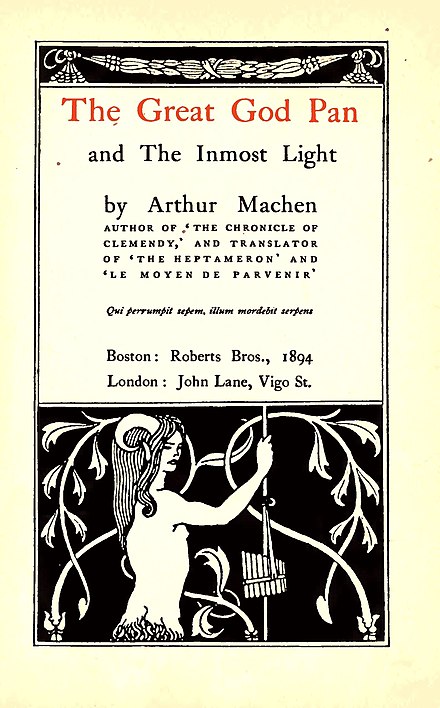
jz-headshotJust last week—a few days after the New York Times reported on the Trump administration’s efforts to define transgender out of existence—I read for the first time Welsh writer Arthur Machen’s 1894 novella, The Great God Pan, today considered a classic of horror fiction. Condemned as “morbid” and “abominable” by most critics when it was first published, the tale was hailed as “un succès fou” by Oscar Wilde, recuperated in the 1920s by H. P. Lovecraft, and particularly praised more recently by Stephen King, who called it “maybe the best” horror story “in the English language.”
440px-Title_page--The_great_god_Pan
Original edition with cover illustration by Aubrey Beardsley

The “queer” tale (the word “queer” recurs frequently throughout) is told by a series of straight-laced Victorian men, each of whom is horrified by the unspecified behavior and bearing of a mysterious woman, Helen Vaughan. Readers are led to suspect that Helen is guilty of some sort of sexual excess or transgression, but nothing is specified until after her suicide, when the medical examiner reports that he was “privileged or accursed” to see the “skin, and the flesh, and the muscles, and the bones, and the firm structure of the human body that I had thought to be unchangeable, and permanent as adamant, beg[i]n to melt and dissolve”: Continue reading “Lifting the Veil – #WontBeErased by Joyce Zonana”

Celebrating Pride: Honoring the Spiritualities of Queer Holy Women of Color by Angela Yarber

With rainbow colors erupting from even the big box stores, I find my super queer-feminist-self scratching my head at the way Pride has transformed into a capital enterprise. I mean, I’m pretty stoked that the cultural climate seems to be slightly more affirming of queer people, but as queer culture is commodified, I cannot help but think of what is being lost or forgotten. And I want to shout from the rooftops that the rich spiritual history of Pride rests firmly on the shoulders of queer women of color who have marched and meditated, prayed and protested long before rainbow Pride headbands were available at chain stores across the land. It is for this reason that, in honor of Pride Month, the Holy Women Icons Project (HWIP) has launched a 7-Day Online Queer Spirituality Retreat that celebrates seven different queer holy women of color.

HWIP’s 7-Day Online Queer Spirituality Retreat is an opportunity to subversively queer your spirituality, and for the LGBTQ+ community to celebrate our spirituality without having to translate it through the lens of heteronormativity. Open to everyone, the Queer Spirituality Retreat features seven different queer women of color: Pauli Murray, Frida Kahlo, Perpetua and Felicity, the Shulamite, Marsha P Johnson, Guanyin, and Gloria Anzaldúa. Each retreat day takes about 20 minutes and includes an inspirational quote, an icon image, a reflective essay, a guided writing exercise, a ritual exercise, and a closing blessing. The most important part of the retreat is, of course, the revolutionary queer women who make it possible. So, allow me to briefly introduce you to seven queer women of color who should make us all proud…

Continue reading “Celebrating Pride: Honoring the Spiritualities of Queer Holy Women of Color by Angela Yarber”