A Blinding Light? by Sara Wright

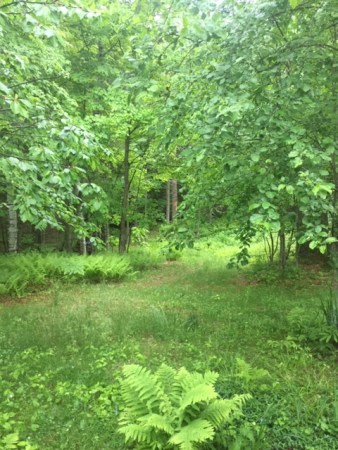
Nature is a Living Being. Animals and plants have souls, and a spirit. Each species is unique, and yet we are all interconnected, human and non – human species alike. This is more than a both and perspective; its multi-dimensional.

Many books are written about using nature to heal humanity of its ills. ‘Recreate’. Climbing a mountain, or taking a walk are common examples of using nature to help ourselves, but how many of us are asking the question of how we can give back?

This is a question I was obsessed with for about thirty years and may be the reason I gained entrance into this seemingly secret world that we call Nature.* When I experienced unconditional love from both animals and plants I needed to reciprocate in kind. This idea of reciprocity between humans and the rest of Nature is probably similar to what Indigenous peoples experienced because they loved (or feared) and learned directly from animals, plants and trees. They respected animals, for example, for their unique qualities. Indigenous people never psychologized Nature the way westerners routinely do.

I rarely read books about Nature anymore because I am so troubled by this psychologizing. From my point of view psycho-babble is just another way of dismissing the reality of Nature as a living feeling, sensing, sentient Being.

Continue reading “A Blinding Light? by Sara Wright”

I’m That Trump Voter You Hate by Trelawney Grenfell-Muir

There are people in my family who believe Christianity to be so inherently oppressive and harmful, that anyone who identifies as Christian is culpable for all of the harm done by all imperial colonization by Christian empires and nations, all harm done to Native Americans, to LGBTQ people, most slavery, racism, genocide, ecocide, and basically almost every problem the world has had for 2000 years.

Theirs is not an unusual view. I encounter this view regularly here in the Northeast US, though most people assign the blame to religion in general. For parts of my family, Christianity is the true evil because it was so popular, and thus the religion most commonly tied to violent and oppressive political leaders and structures.

I also encounter this attitude from feminists, quite frequently. According to many feminists, I am everything that is anti-feminist and misogynist… precisely, solely because I am Christian.

Continue reading “I’m That Trump Voter You Hate by Trelawney Grenfell-Muir”

The Truth About Humans by Natalie Weaver

I have greatly enjoyed an odd little book I read over the summer.  It is Lucy Cooke’s The Truth About Animals (Basic Books, 2018). Cooke takes us through a journey of animal behavior, chronicling the curious narratives that naturalists, philosophers, theologians, and other high-thinking professionals impose on animals to render their behaviors meaningful, moral, and relevant.  Cooke shows us how tempting it has been historically for people to seek and discover confirmation of human values in all those other pairs so happily coupled on Noah’s Ark.

It has often been an important tool for feminists, as with other sets of thinkers, to make these connections as well.  And, as one familiar with the classical charges that women are more inherently corporeal than their spiritual-intellectual male counterparts, and that therefore women are more animal than the more accurately “human” form that their male counterparts represent, I understand the feminist investment in nature.  I appreciate that it involves a sort of ownership and redefinition of the slur; an acceptance of space and place as limited and essentially animal; an awareness of environmental sustainability; a deep sense of connection to the continuum of creaturely being that is the giant ecology of our planet.

Continue reading “The Truth About Humans by Natalie Weaver”

Movement of Moving and Spiritual Journey by Elisabeth Schilling

It looks like it is time again for me to pack up and drive a few hundred or more miles to a new destination, a place I will finally try to plant roots, this time offering commitment + endurance, hoping to build a life of more balance and authenticity. I assume I will need a constant reminder of gratitude, quelling the entitlement that can bubble up when I think “this should be easier.” I’m not sure when, why, or where I’ve picked up that refrain, but I see it in others and myself and wish for an alternative.

With the help of several people, I’ve secured a full-time college teaching position on a beautiful college campus of a kind of institution I am certain is doing its part to heal the world. At least that is what I feel when I serve at a community college, a place where I feel inspired and challenged by students who have a diversity of needs. I’ve been teaching in such institutions for so long, I’ve fallen in love and know, by experience, that I can help in such spaces.

Continue reading “Movement of Moving and Spiritual Journey by Elisabeth Schilling”

Independence Day? by Sara Wright

She haunts me

little bear,

too slight,

too wary

to seek

seed I cast

for her

under

White Pine

in whose strong arms

she finds

comfort and safety,

if only for one night.


The animals are innocent


Where was she when

exploding fireworks

whitened a black velvet sky

split stars night after night?

Where was she

when mindless drones

spewed raging gunfire

screaming for Right?

Who comforted her

in her fright?


The animals are innocent

Continue reading “Independence Day? by Sara Wright”

All Are Our Teachers by Elisabeth Schilling

Art by doanminh0205

What can we learn from each other? Some people teach us that we need help with boundaries. Some remind us that we are easy to love. We can observe the way some lovers make us want to escape, simmering a queasy feeling in our stomach that we practice patience and non-attachment with so that we are not harmed too much whilst in their presence and other lovers are always ready with a supportive word, assuring us that what we desire is valid, that we do not need to justify our path.

The people who we react to the most intensely, most of the time negatively, are these people our lessons? That sounds rather crass when thought to apply to anyone in an extremely oppressive and/or abusive situation. I would not suggest we apply this to anyone but ourselves, if indeed, it works for us. This is not the fatalistic idea of people belonging in a certain state or being punished for something. This is more a strategic curiosity of looking at our own agency from a back door. For example, my body might contort in frustration and sadness with someone, which could indicate I need to not be in relationship with their energies, but until I can create another path (maybe due to work commitments, relational obligations, financial situations, etc.), I feel more empowered reflecting so that I can learn about myself and others so as to perhaps not invite the same energies in during the future or to not have them affect me so harshly so that it doesn’t matter.

Continue reading “All Are Our Teachers by Elisabeth Schilling”

Surviving My Recovery by Esther Nelson

For the past fourteen months, I’ve been going from doctor to doctor trying to figure out what ails me.  Specialists I’ve seen included wonderfully competent people immersed in their individual disciplines of nephrology, cardiology, rheumatology, and neurology.  At long last, the neurologist diagnosed my condition (accurately, I believe), and I’m slated to have surgery in July.

I’m overjoyed to finally have a diagnosis, with a positive prognosis no less, offered to me.  My everyday life has become more and more constricted over this past year.  I can’t walk far without pain.  I can’t stay in one position for long without pain.  I can’t practice yoga without pain.  I can’t do those everyday chores—grocery shopping, vacuuming, laundry, scrubbing the bathroom, and washing dishes—without pain.  Pain wakes me throughout the night as I attempt to sleep.

I do have concerns about how well I’ll tolerate the upcoming surgical procedure, but am even more concerned about my recovery period.  For six weeks after the procedure:  No lifting.  No bending.  No twisting.  No exercise except for frequent, short walks.  How will I ever manage?

Continue reading “Surviving My Recovery by Esther Nelson”

I’m [Not] Batman by Sara Frykenberg

A little tongue-in-cheek, somewhat punchy, somewhat angry reflection for your consideration. Thank you for reading.

Ever have trouble speaking your mind? I do. I do, particularly in situations where I was taught (in all sorts of ways, violent and nonviolent alike, religious, patriarchal) to be “a good girl.” The “good girl” training I received is so deeply ingrained in me that I often don’t realize when I’m doing it. I catch myself being agreeable with people when I want to be arguing. I use extra exclamation points in communications with my online classes to appear more likable, friendly or non-threatening. I also have a peculiar habit of, unconsciously, changing my clothes repeatedly until I ‘match’ someone around me, usually in color. I honestly don’t mean to do this, and only became aware of the habit in the last decade because my husband started pointing it out to me ALL THE TIME.

But I’m working on it. “Be authentic, Sara.” “Be yourself.” That’s got to be different than being good, right? I probe my habits and relationships for the tell-tale signs of this “good girl.” Continue reading “I’m [Not] Batman by Sara Frykenberg”

Sometimes You Can Go Home Again. . . Because I Did by Elisabeth Schilling

I am tired and a bit emotionally exhausted, yet hopeful and in calm spirits as I have returned from my 8 months of traveling through Europe. I left in a rather dramatic impulsivity with little planning other than to leave the States for as long as I could and focus on writing poetry. I suppose I wanted to stay indefinitely, but now I realize that there are good and bad elements to everywhere.

In Basque Country, the beaches were beautiful but you might have to sunbathe in clouds of burning cigarette smoke because everyone seems to be lighting up everywhere you go. In Sicily, the history and fashion and food are intoxicating, but a lot of the buildings are crumbling and the landscape is parched in many places. In Ireland, it is green and lush, every corner a fairytale, but in the town centers, the air in winter is suffocating with the smoke of coal burning in houses as if it were London in the 1800s so much that I mostly refused to walk outside where I stayed. Continue reading “Sometimes You Can Go Home Again. . . Because I Did by Elisabeth Schilling”

Holly Near’s Music and a Holistic Feminist Perspective of Peace by Elisabeth Schilling

It’s hard for me to be dignified and peaceful sometimes. To produce and sacrifice without rewards, making sure I’m not “sacrificing” in a way that quells my truth and power, making sure I look at dignity in a liberating way. Words continually need to be unpacked, and I do that. I know the work. According to the OED, it means “The quality of being worthy.” For me, ‘dignity’ is just being aware of your self-worth and celebrating that. It feels hopeful and romantic and raw. To sacrifice, to me, in the way I’m using it in this moment, is to be life-giving and co-creator; I think of it in the same way as what the earth does, so that it can continue. Like a leaf fallen to nourish its own soil.

The OED definition of ‘sacrifice’ I like is “The destruction or surrender of something valued or desired for the sake of something regarded as having a higher or more pressing claim.” We can decide what is more pressing. For me it is the ethic of generosity and production in a non-greedy way. I do not sacrifice in this more self-empowered, law-of-the-universe way I’ve recently come to understand much. But I would like to. Sometimes, though, I feel tired in my production, like I need more feedback, even if it is another woman willing to listen to me, which is why posting on FAR is so healing and life-giving because there is all of you.

I’m glad I have wisdom in my body. Even if “I” (my mind?) goes chaotic, feels overwhelmed and lost, my body has this natural intelligence to heal and regain balance if I can listen and get out of its way. That reminds me a lot of the earth—regions harmed by human mindlessness have been known to restore itself, even after radiation or toxic explosions, when humans leave for awhile. But if “I” equate myself with my mind, isn’t that also a part of the body? Wouldn’t the mind (the brain? the processes that help mental consciousness and thoughts arise?) then be wise, seeking balance? It just does not feel like it. So if anyone can weigh in on that. . . why so easy for my body-body but not my mind-body?

Continue reading “Holly Near’s Music and a Holistic Feminist Perspective of Peace by Elisabeth Schilling”